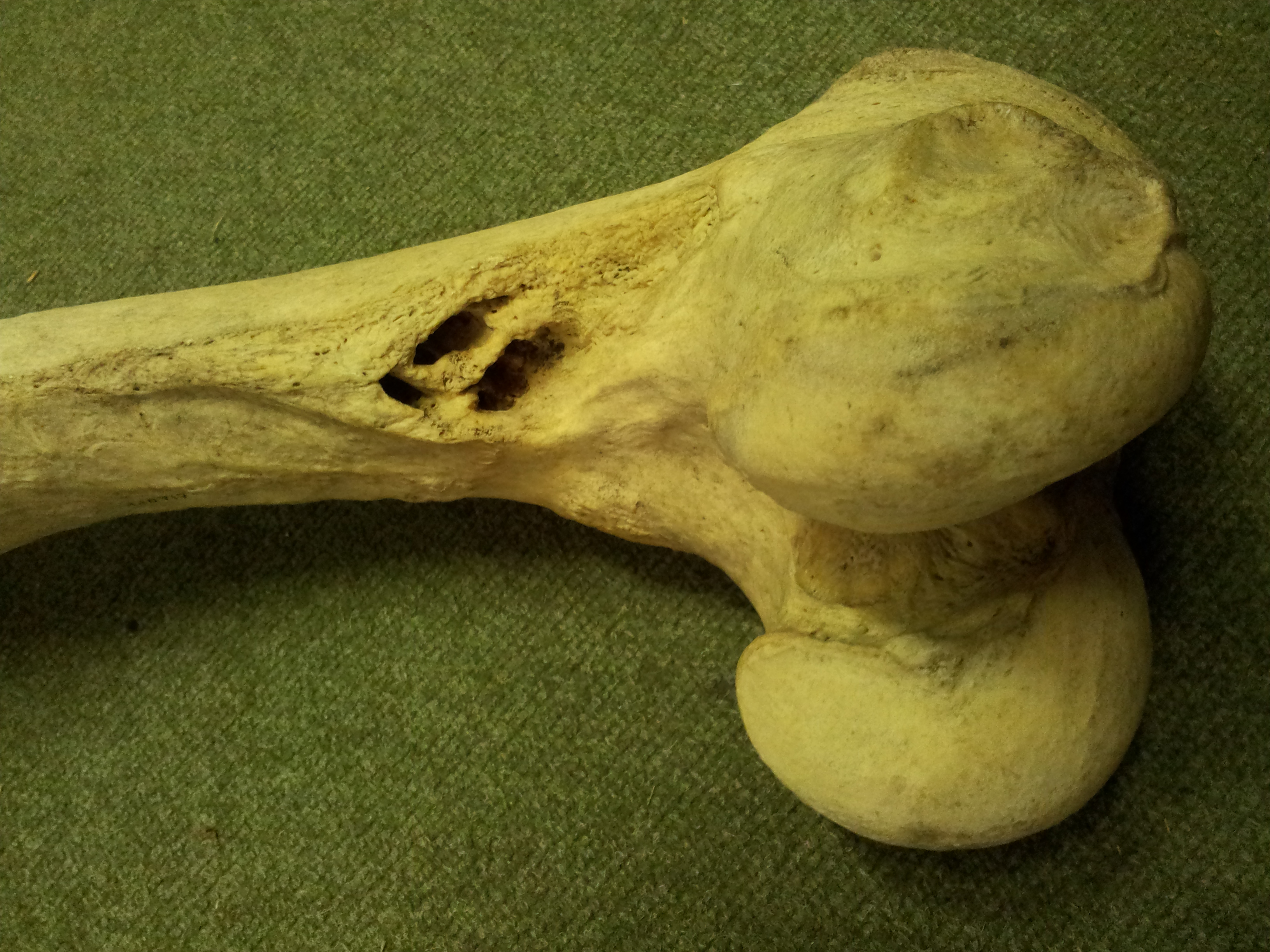
I’m not sure if this is a new tradition at this blog or not (probably not), but hey let’s give it a name: an Anatomy Vignette. Just something curious I notice during my research that deserves more than just a tweet. I borrowed some bones from the University of Cambridge Museum of Zoology (whom I love, because they have great exhibits and are very research-friendly) to CT scan for some projects. I noticed this:
And I thought “Ouch! That’s nasty, dude.” (the holes in the bone just above the knee joint– these should just be a roughened area where the adductor muscles and other leg muscles attach)
So I was interested to see the CT scan images to find out how these possibly osteomyelitic lesions continued into the bone. They’re really pervasive, continuing into the marrow cavity quite far up the femur, as this shows (good CT-viewing practice to match up what you are seeing in the photo above with this movie):
I would be surprised if this was not the reason this animal died (presumably being euthanased at a UK zoo). There would have been extensive infection and pain resulting from this bony disease. How did it originate? Who knows. Maybe the animal strained a muscle and bacteria got inside, or maybe there was a fall or other injury. Hard to tell.
Oh, and also note the lack of a true marrow cavity in hippos, which is true for all the long bones. The “cavity” is filled in with cancellous bone. Same with rhinos, elephants, and many other species… science doesn’t entirely know why but this feature surely does help support the body on land, and grants at least some extra negative buoyancy in water; at a cost of some extra weight to lug around, of course.
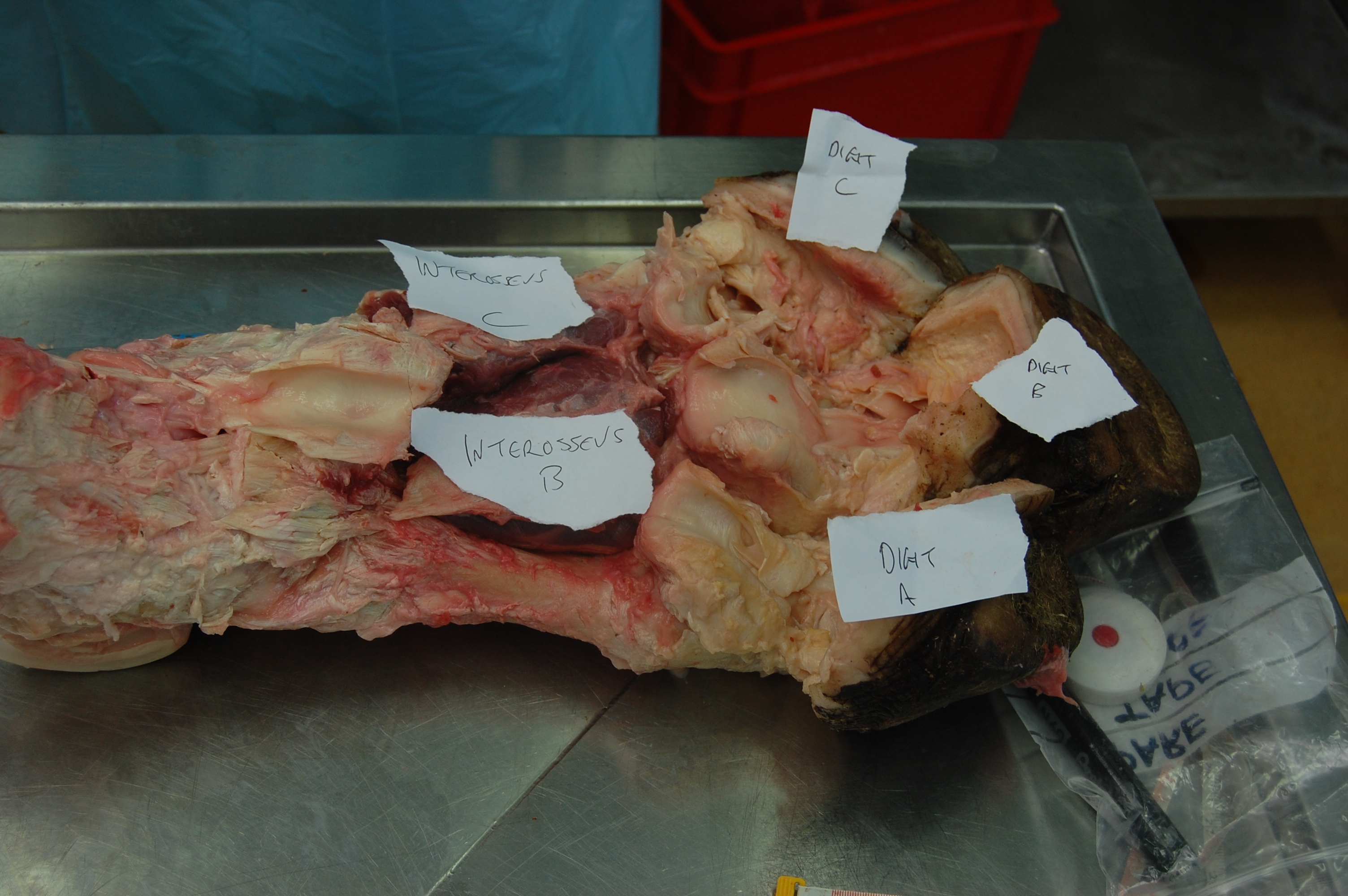
One for the weekend morning crowd here. The early bird gets the… cadaver?
At last I’ve managed to pore thru my photos and find something that works for a Mystery Dissection image, so without further adieu here it is! Answer will come tomorrow (Monday) night.
What is the largest structure evident (i.e. what is the picture mainly featuring) and from what group of organisms (be as specific as you can).
Remember, we have a scoreboard now, and rules for scoring. See here. Regular points for this round– Xmas is over, folks!
To recap, Mark Robinson is in the lead w/14pts, tied w/Filippo, but with Heinrich and RH close behind at 12 pts, followed by the 5-person Gang of Awesomeness at 7 pts.
Today I’m doing something a bit unusual for this blog, but which very comfortably fits within its theme. Enough talking about my papers and media appearances and such. Too much self-indulgence, I feel. I want to talk about someone else. And then I will get back to the usual business of this blog: sharing the joy of cool anatomy, with a Mystery Dissection/Image post that is long overdue. Yet first, I wish to share the joy of knowing a cool anatomist– and artist.
One of my great shames as a scientist is that I never cultivated some decent artistic skills that I had as a young boy. And now as an anatomist I feel that my work often suffers from a lack of artistic talent (e.g. the image below, which still makes me hang my head in shame). In addition to scientific know-how, anatomy, when done best, demands the eyes and the hands of an artist. I might have the eyes but I definitely lack the hands. I envy people that have both; Julia Molnar from my team is but one example. And for me, encountering them is always a special delight. What follows is my personal perspective on one of the shining stars in the field.
Right ischium (hip bone; pelvis/synsacrum) of an adult ostrich in side view, showing some muscle origins and stuff, with a 1cm scale bar. Cringe. My boring, amateurish, pixelly line drawing from a paper on pelvic evolution. I hate it and wish I’d done better.
Mieke Roth is a scientific illustrator from the Netherlands, with a Masters degree from the prestigious and hallowed halls of Wageningen University. Her homepage has the tagline “Complex processes beautifully revealed”. This is a wonderfully succinct and eloquent way to describe the magic that she is able to conjure with her skills in scientific illustration. Her “Ultimate Croc Anatomy” project will be the greatest weaving of that sorcery yet. That project is described and will be documented on this page, and has an Indiegogo crowdfunding page here. Mieke describes its goals best:
“I will meticulously dissect a Nile crocodile and document it. I will share the dissection in text, illustrations and video via my website. I will process the data I gathered and each time build a new part of the digital crocodile. From there I will adapt the model for illustrations, books, animations and apps.”
I first became a happy victim of the artistic spells that Mieke casts when I saw her blog entry “How to make an octopus,” which you absolutely must read if you have not already or else you’ll be firmly spanked and sent away from this blog with only lumps of coal in your freezer for Freezermas (what’s Freezermas? Find out soon, and in the meantime be nice– or else!). In her post, Mieke didn’t just look up a picture of an octopus somewhere and redraw it in an abstract, schematic, flat and deceptively simplified way. She went and did her own hands-on research by dissecting an octopus, and then described the steps in converting those observations into a brilliantly novel set of digital illustrations that really brought octopus anatomy to life.
Octopus image by Mieke Roth
Part of what first mesmerized me is that this whole investigative and creative process was lovingly documented on her blog. In doing this, Mieke played the roles of both scientist and artist, by displaying the mundane-but-wonderful labour she did to come up with her final, gorgeous results, and the passion, dedication, scholarship and originality that make her stand head and shoulders above so many gifted scientific or medical illustrators. This thrilled me at both visceral and intellectual levels. It literally gave me chills to witness how good the final product was. As I write this and look back on that blog again, months later, I still feel the magic.
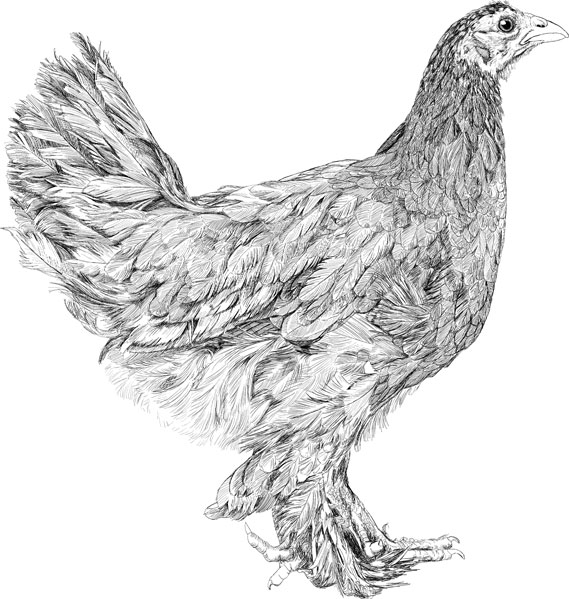
So then I started browsing around her homepage and became punch-drunk from repeated blows of amazement—again and again and again the quality and novelty and thoroughness leaped off the computer screen. Images of nature that I thought I knew well, such as the growth of a chick into a chicken(really great blog here documenting this with sketches), were conveyed in a way that made me see them as if for the first time, with joy and wonder. In the space of a day, I became a huge Mieke Roth fan.
Young chicken sketched by Mieke Roth
And now Mieke is taking it not just a notch, but a huge step, to spend a year documenting the anatomy of the Nile crocodile—how cool is that!?! As an expert in the postcranial anatomy of the Crocodylia, I can confidently state that the available scientific literature on the subject is patchy in coverage and often poor in quality by modern standards. There are big flashes of excellence here and there, such as Larry Witmer’s and Chris Brochu’s teams’ very thorough work on head and neck anatomy, or Colleen Farmer’s and Emma Schachner’s studies of lung morphology. But then I glance at some scholarly books (to avoid offending, I will not cite them here) that are supposed to be key references on the complete anatomy of Crocodylia and I frankly am left cold. While there is some superb work from the 1800s (Gadow, Fürbringer and others come immediately to mind), it is in the flat, often colourless style which the printing technology of that age imposed upon those great masters of anatomy. And while there is superb work by Romer, a tome on the Chinese alligator and a few others, again they tend to be limited to line drawings or spotty coverage of various anatomical systems. We need a visionary with both the scientific and artistic skill to make a subject that could seem dry or arcane become miraculous and accessible. I think you can guess whom I have in mind.
I can think of no one better suited to the ambitious goals and demands of the Ultimate Croc Anatomy project than Mieke Roth. She combines the attention to anatomical detail of a classical 19th century anatomist with the technical wizardry of a modern digital artist. She will have a supportive team of experts to ensure the content is exceptional and up-to-date. I’ll be one of them (and the crocs will come from my freezer), because of my enthusiasm for the project, and I’ve been helping to recruit others. So I urge you not just to join in her crowdfunding effort to carry out a very worthy and exciting project that the world can share, but also to share the joy I had in discovering her work by browsing her online collection of awesomeness. I predict that many of you will feel the power of her spell and become Mieke Roth fans, too, if you are not fortunate enough to be one yet.
A quick plug here for BBC Radio 4’s fourth episode of “Just So Science”, playing at 13:45 GMT today (this is the link). I was interviewed a few weeks ago for the show “How the Rhinoceros Got His Skin,” a la the classic Kipling tale. This series is revisiting Kipling’s tales in light of modern evolutionary science and evidence, whereas Kipling only had crude, Lamarckian or early Darwinian insight. Check out their earlier episodes on whales, leopards and armadillos– good stuff, and with real scientists. Richard Dawkins may appear again (EDIT: yep! Dawkins manifested) in this episode to provide some gravitas and evolution street cred, too.
And Freezersaurus gets a big plug! From the website: ” Rhinos and horses have much in common. John Hutchinson studies both, but just don’t ask to look inside his freezer.” 🙂 NOTE: I am not a vet (I am a biologist), and definitely not a horse specialist like others in our lab, but I do study horses a little, in a comparative context.
While the original Kipling story focuses on rhino skin, and the producers were interested because of my popular post here on rhino skin, we discussed other issues such as gait, fossil record, feet, and more. I owe thanks to rhino skin expert Dr Tobin Hieronymus for helping me bone up on the unusual skin of rhinos, which has a surprising amount in common with the tough hide of walruses, boars, some water deer, and a few other species. It’s not just normal thickened skin, as Tobin and others have shown. Anyway, I don’t want to give away what’s on the radio programme; afterwards I might embellish this post more with some rhino anatomy and mechanics facts.
Coincidentally, I’m receiving four white rhinoceros feet today from a zoo mortality. So it’s rhino-fest here!
I hope you like the show— please let me know what you think in the comments below! I really enjoyed listening to it, but I’d like to know what you thought.
White rhinoceros forelimb (left side), ready for dissection.
To kick off the New Year just right, our tetrapod team has a new paper in Nature, following up on last year’s Ichthyostega not-so-good-at-walking study (also see here). Yet this paper has a more anatomically descriptive — and also an “evo-devo” — twist to it. For brevity, I’ll let our press release tell the story, since I think it does a good job of it (like I always preach scientists should do, we worked with our PR company to write this together, so we’re happy with how the press release came out). In a nutshell, our study used some very fancy synchotron radiation techniques to image the 3D anatomy of the backbone in early land vertebrates. Our findings surprised even us, and ended up turning around palaeontology/comparative anatomy’s view of how the backbone evolved, giving us a new glimpse into our inner tetrapod.
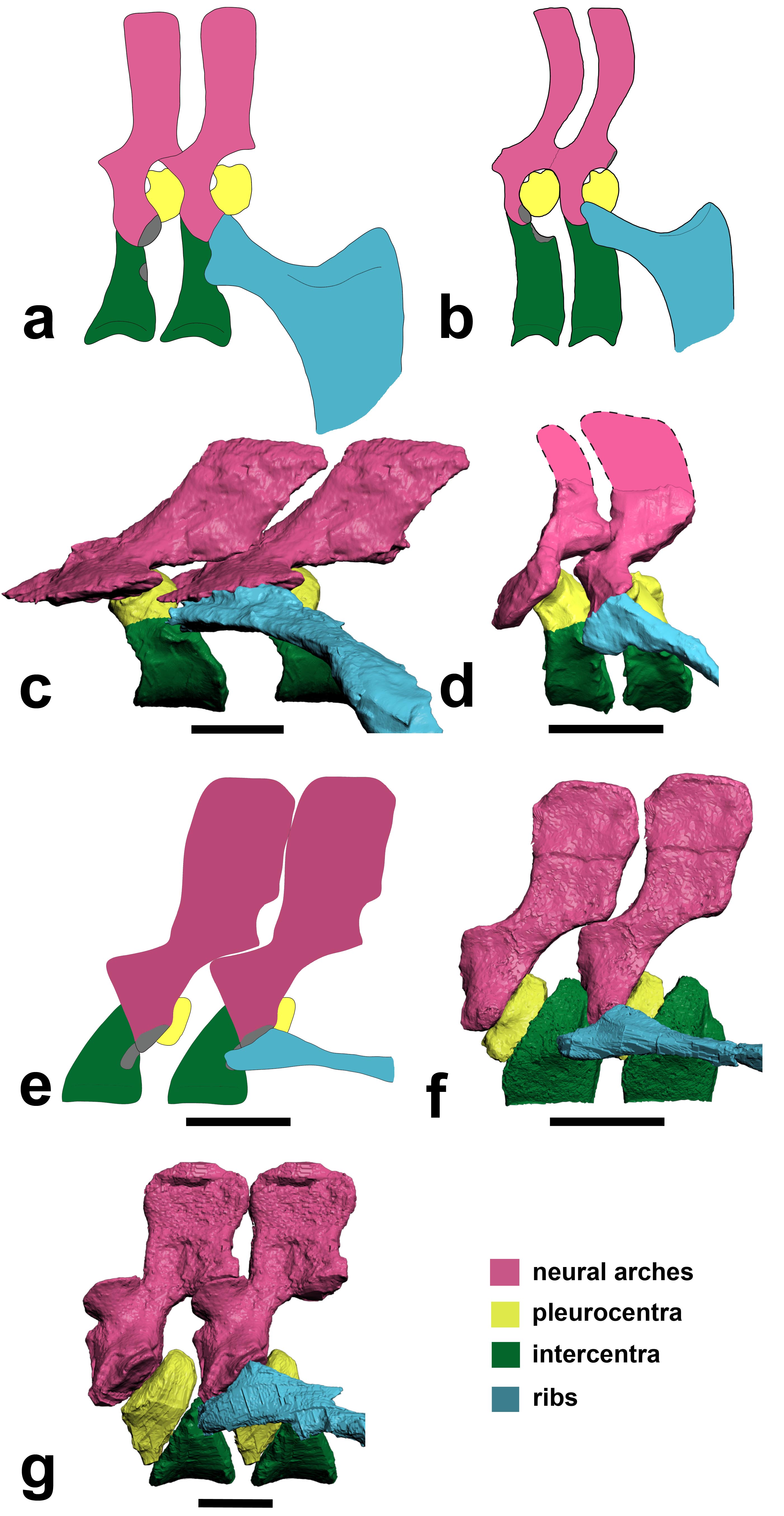
Stick around for the videos at the end, which are the first four supplementary movies from the paper and are rather pretty (there are two more, for imaging/segmenting afficionados, but they are not as pretty or interesting for most of this blog’s readership). The final figure (Figure 1 from our paper) gives some extra visual context.
The paper is:
Pierce, S.E., Ahlberg, P.E., Hutchinson, J.R., Molnar, J.L., Sanchez, S., Tafforeau, P., Clack, J.A. 2013. Vertebral architecture in the earliest stem tetrapods. Nature, published online [here].
I should note that I’m just 3rd author, so I deserve only modest credit. But I helped. Even though no freezers were involved, or harmed, in the process.
Above image: Julia Molnar‘s illustration of Ichthyostega showing anatomical changes of its spine from front to back, with neural arch/spine in pink, twin pleurocentra in yellow, and intercentrum in green. These four parts, three kinds of bones, made up the backbone of the first land vertebrates. These parts evolved in different ways in later animals, but formed one main bone in all living lineages of vertebrates.
RVC PRESS RELEASE:
Scientists reassemble the backbone of life using a particle accelerator
Research published today (Sunday 13 January 2013) in the journal Nature documents, for the first time, the intricate three-dimensional structure of the backbone in the earliest four-legged animals (tetrapods).
The backbone, also known as the spine or vertebral column, is a bony structure found in all tetrapods, along with other vertebrates such as fish. It is formed from many elements or vertebrae all connected in a row – from head to tail. Unlike the backbone of living tetrapods (e.g. humans), in which each vertebra is composed of only one bone, early tetrapods had vertebrae made up of multiple parts.
Lead author Dr Pierce says: “For more than 100 years, early tetrapods were thought to have vertebrae composed of three sets of bones – one bone in front, one on top, and a pair behind. But, by peering inside the fossils using synchrotron X-rays we have discovered that this traditional view literally got it back-to-front.”
For the analysis, the European Synchrotron Radiation Facility (ESRF) in France, where the three fossil fragments were scanned with X-rays, used a new protocol to reveal tiny details of the fossil bones buried deep inside the rock matrix.
Using this new technology, the team of scientists discovered that what was thought to be the first bone – known as the intercentrum – is actually the last in the series. And, although this might seem like a trivial oversight, this re-arrangement in vertebral structure has over-arching ramifications for the functional evolution of the tetrapod backbone.(see here for a now out-of-date image from Wikipedia)
Dr. Pierce explains: “By understanding how each of the bones fit together we can begin to explore the mobility of the spine and test how it may have transferred forces between the limbs during the early stages of land movement”.
But, the findings didn’t end there. One of the animals – known as Ichthyostega – was also found to have an assortment of hitherto unknown skeletal features including a string of bones extending down the middle of its chest.
Professor Clack says: “These chest bones turned out to be the earliest evolutionary attempt to produce a bony sternum. Such a structure would have strengthened the ribcage of Ichthyostega, permitting it to support its body weight on its chest while moving about on land.”
This unexpected discovery supports recent work done by the same authors that showed Ichthyostega probably moved by dragging itself across flat ground using synchronous ‘crutching’ motions of its front legs – much like that of a mudskipper or seal.
Dr Pierce adds: “The results of this study force us to re-write the textbook on backbone evolution in the earliest limbed animals.”
The next step, the researchers say, is to understand how the backbone aided locomotion in these early tetrapods using sophisticated biomechanical analysis.
These are rotating images of the anatomy, colour-coded, of the four species of early tetrapod that we examined for this study. Each shows the same basic pattern of having a “reverse rhachitomous” (pleurocentra in the front, intercentrum in the back; trying to think of a mullet joke…) anatomy. This is opposite the pattern that essentially all studies since famed evolutionary biologist/palaeontologist Edward Drinker Cope coined the term “rhachitomous” in 1878 have portrayed these and related animals as having. And this realization forces a re-examination of how the backbone structures first evolved in tetrapods and which parts (intercentra? pleurocentra? And where?) formed the spines of later animals.
For once, as authors we all felt that this finding really deserved the painfully hackneyed “rewrite the textbooks” label. It changes a lot of what we thought we knew about this classic evolutionary transition of anatomy. Check a vertebrate palaeontology/comparative anatomy textbook and you’ll likely find rhachitomous vertebrae and/or changes of pleurocentra vs. intercentra told in a way that we now are pretty sure is wrong.
You can also see the “sternebrae” (sternal elements; parts of the sternum that evolved independently in later land animals) in the first movie. This, to my knowledge, is by far the oldest such evidence. I know of ossified sternal plates in Early Permian mesosaurs like Stereosternum, but nothing earlier although perhaps in some synapsid I don’t know, or a basal diapsid of some kind? Chime in in the comments if you know of something I missed. Regardless, the sternebrae in Ichthyostega have nothing to do directly with those convergently evolved in lissamphibians, lepidosaurs, synapsids and archosaurs, although there may be some parallel developmental mechanisms involved and at least similar dermal tissues recruited into ossification patterns. Even so, these sternebrae are further evidence of how that taxon, at least, was beginning to make forays onto land, as they’d have helped it to support its belly on land and breathe.
The segmented PPC-SRµCT of Ichthyostegastensioi MGUH VP 6115 spinning in yaw and roll.
The segmented PPC-SRµCT of Ichthyostegaeigili MGUH VP 29017a spinning in yaw and roll.
The segmented PPC-SRµCT of Acanthostegagunnari MGUH f.n. 1227 spinning in yaw.
The segmented µCT of Pederpes finneyae GLAHMS 100815 spinning in yaw.
FIGURE:
Above: (a,b) How we used to think the vertebrae were composed in early tetrapods like Ichthyostega. (c) How we found that Ichthyostega‘s posterior thoracic vertebrae actually tend to look. (d) Ichthyostega‘s anterior lumbar vertebral morphology. (e) Acanthostega according to Coates’s important description. (f) Our revision of the anatomy of Acanthostega(anterior dorsal). (g) Our new interpretation of Pederpes‘s morphology, from a posterior dorsal. Focus on the yellow vs. green elements. In a,b and e they are in different positions (reversed) compared with our new versions in c,d,f,g.
To put the above figure and movies into broader context, check this Wikipedia image. We think the red/pink bones (pleurocentra) are in the wrong place relative to the blue ones (intercentrum); the ones currently there in this image actually belong to the vertebral unit behind that one, so the pleurocentra should be moved to the front (left end) of each unit. But also look down toward the bottom of the figure. Some of those vertebrae may need to have their blue/pink bits re-examined and interpreted, too. Is it turtles intercentra all the way down?
There you have it! Welcome to your new, revised, irradiated, reverse-rhachitomous inner tetrapod’s vertebrae. Propagation phase-contrast X-ray synchrotron microtomography FTW!!!!
Science media articles arising from this study–
I like to keep track of media stories covering our research, using this blog, so here are some of the stories about this paper. It’s funny… this was one of the most broadly important papers I’ve ever been on, but the coverage was relatively scant. It was too technical. We knew that would be a problem, and really had a hard time putting into words why the study was so surprising even to us! Most writers wanted the “how did the animals move?” angle, which was not what the study was about. I still feel that this angle was not even needed; the study (and again I take minimal credit for it) is exciting without it. To comparative anatomy and evo-devo specialists, anyway. Well, that’s science for you; sometimes it is just too hard to explain its value to the outside world, even when you feel its importance in your very spine… And the press coverage was not terrible by any means; no sour grapes from me. Regardless, we’re glad it has been well received by specialist researcher colleagues we’ve spoken to, and that matters a lot.
NERC’s Planet Earth (nice story from our funder)- “Scientists had fossil backbone backwards”
BBC online (the only story aside from NERC’s that did more than read the press release) “Tetrapod anatomy: Backbone back-to-front in early animals”
Discovery News online– “First Land Animals Shuffled Like Seals” (good, but is sort of mixing up our this study, our 2012 one and Ahlberg et al’s 2005 seal-analogue study; latter two were more about movement. As often happens, a lot of other media stories basically copied this one’s headline/angle.)
Discover 80beats– “Paleontologists Use 3-D Models to Rewrite Evolution” (also in “top stories”)
Popsci– “Particle Accelerator Reveals That First Land Animals Walked Like Seals”
Daily FMail (nice pics)- “Astonishing 3D images reveal the first four-legged land animals in amazing detail – and overturn a century of research” (wins longest headline award)
Red Orbit– “Study Reveals First Ever Images Of Early Tetrapod Backbone And How It Helped In Land Evolution”
Examiner.com– “X-ray study rewrites tetrapod backbone evolution (Photos)”
Business Standard– “Scientists recreate earliest quadraped’s backbone” (Proofread, editors! Quadruped.)
Geekosystem– “Early Land-Dwelling Animals Moved About Like Seals, Probably Didn’t Balance Balls on Their Noses” (scores some pts for humour)
…and the PR-copying, non-spellchecking fail of the week award goes to… Physorg! “Scientists reassemble the backbone of life with a particle acceleratorynchrotron [sic] X-rays”
Warming up the acceleratorynchrotron for our next study… 🙂
Good day, everyone. Maybe by the end of this post if you don’t agree that it is a good day, you will at least see why I think it is.
Ten years ago today, something Really Bad happened to my brain. I don’t need to go into details, but it is very fair to say that I almost died. And that was the second close call in my adult life; there was another, years earlier, with a different vital organ system. So I celebrate December 16th each year as “Not Dead Yet Day“. As this is this blog’s first NDYD, I figure you can all join in the celebration, for any reason you might have to celebrate life. It can be hard to love some aspects of life sometimes, especially in pretty depressing times like the 21st century can be (so far). This can especially feel true in light of recent events in Connecticut, or ongoing nightmares in Syria and many other lands, with vanishing innocents, vanishing wildlife and vanishing habitats, the inexorable heat death of the universe… shit I’d better stop now or I’ll lose it!
This day helps to remind me to stay focused, as much as I can, on what matters in my life, and what I can control in my life to make things better for the little bubble of the world that I exist in. Some things are far beyond even our hope, let alone our means, to control. And sometimes we get broadsided by Really Bad Shit. But in between any of that powerlessness or inauspicious shit, there can be joy from many sources– for me (like many others), it comes from family and friends, science and the natural world’s wonders, delicious food and amazing travel, and much more. It comes from experiencing reality with all its facets.
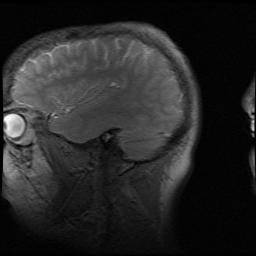
Here is my brain. You can’t see much. Feel free to make jokes about that, I’ve set myself up nicely with that last sentence!
These are MRI scan images from a routine checkup I had about 3 years ago. I suppose you can consider it a game of “Mystery MRI slices”, but one in which I give you the answer (my brain). You can see lots of cool anatomy here; if you know your anatomy feel free to mention what’s visible (or not) in the Comments, and make jokes– I will probably enjoy any of them. I like self-deprecatory humour. And happily, I checked out fine in that scan, and continue to be fine… relatively. I’m not the same person I was >10 years ago— in 2002 I got married (but missed my bachelor party because I was hospitalized for another problem), got an important paper (“Tyrannosaurus was not a fast runner”) published in Nature that changed my career (and arguably got me my job today), had this Really Bad thing happen, and plenty more. It was an eventful year.
At the time the Really Bad thing happened, I was feeling poorly but working very hard on final revisions/re-analysis of elephant gait data for a paper that ended up being published in Nature in 2003; so things ended up looking even better for my career. But I made a decision that day that, in a fortunate way, ended up having a greater impact than any mere publication. Rather than sit in my house with our cats and feel poorly, I made the choice to drive in to work and process more elephant video data. Just as I was parking my car on the Berkeley campus (illegally; I was feeling very poorly by that point) to go in to do the work… I woke up in an ambulance.
I was lucky. I was somewhere public where I was spotted having trouble, not alone in my house for >8 hours until my newlywed-wife came home to discover me. So I got help, and medical science saved my ass — and my brain, and thus other regions of my anatomy and my mortal existence. If I’d adopted the other choice, and stayed home alone, our cats probably would have witnessed something terrible and been unable to help, awesome as kitties can be.
I’ve never felt the same after that day. I’m certainly a case of “scarred but smarter.” I can say smarter mainly because my brain survived the trauma OK and I learned from the experience. I can say scarred because I still feel repercussions of all sorts from that Really Bad day. Although I’ve always had a dark sense of humour, strongly connected with my eccentric passions in science (e.g. this blog! Go figure.), I think it’s fair to say that my humour darkened. I’m not as bubbling with joy as I used to be. I used to almost always grin and exclaim “Excellent!” when someone asked me “how’s it going?”. I can still burble with frabjous joy, but not quite as often.
That day brought me closer in touch with the darker side of life, and the brighter side too. I think I’d been overlooking both. Closer in touch with reality, and with the serendipity and calamity that accompany it. There have been other, terrible events in my life since then, too, that have brought new existentialist focus to my mind, but that’s a part of most people’s middle age period (e.g. losing many loved ones). I’ve had a great career so far, too, thanks in part to good things that happened 10 years ago, and to good things that have happened since thanks to hard work and some good fortune. But that doesn’t mean life has been a nonstop joyride, or even easy.
So today I take some special time to think about what life is about, what is real and must be faced wide awake vs. what is self-deceitful slumber, and why life is still worth loving– which I do love, with all my brain. And every day I think about the big changes that 2002 wrought on my life, and how so many other seemingly important things that happen in my life don’t matter one fucking bit– hence I try to just have fun, be a good human and not worry so much.
Have the best day you can have, everyone. I’m off to have some fun family time, but wanted to share my brain’s thoughts with you today. Maybe you have a similar story to share, too, or maybe my brain’s thoughts inspire some in your own brain. It’s wonderful how that glistening anatomy can do such things, and it’s wonderful how resilient that anatomy is, much as we need to be… because we are one and the same, our brains and our selves that dwell inside them, and the love of life that they can conjure.
If this post bummed you out, just focus on these contented cats.
I have a lot to be thankful for as a scientist, including a great, steady set of blog readers interested in my freezer and its sundry tenants. And now and then I get a fun surprise, like Redditors stumbling across my posts and ramping up my blog views by a factor of 10-20 fold. So this weekend I did (and am still doing at this moment) an “Ask Me Anything” (AMA) on Reddit, by suggestion, and I just crossed 1000 Twitter followers. So I figure I should give some thanks.
And I will give those thanks in a way that I can only do on this blog. With kickass pictures of incredible animal anatomy! Much as I started this blog with giraffes, I will return to them now. And I will let the pictures, with brief captions, tell the tale. These photos are from a dissection our team did quite a few years ago, on an adult giraffe that died suddenly in a local zoo. I forget who snapped these photos– my thanks to them anyway, as I didn’t take them but it was someone from our team.
Stomach-Churning Rating: a 7/10 or even 8/10, depending on your fortitude. Blood, a freshly dead animal, guts, brains, and more. So before we go further, while you brace yourself if need be, a pic to liven things up. Here I am with my cat (taken a few years ago, too), wishing you Happy Holidays — and much fortitude.
Away we go!
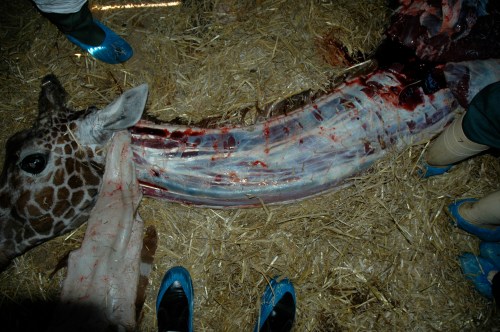
Left side of the neck. Purplish-blue vessel toward the bottom/eft is the jugular vein, shown next. Nuchal ligament, shown further below, is toward the top.
The jugular vein, opened to show the valves (little pockets), which prevent blood from flowing back down the neck.
Cross-section of trachea (windpipe). A narrow tube should give less dead space to move in/out with each breath, so it makes sense for such a huge, long-necked animal to have such a thin trachea.
The nuchal ligament, which runs along the spine and helps hold up that long neck.
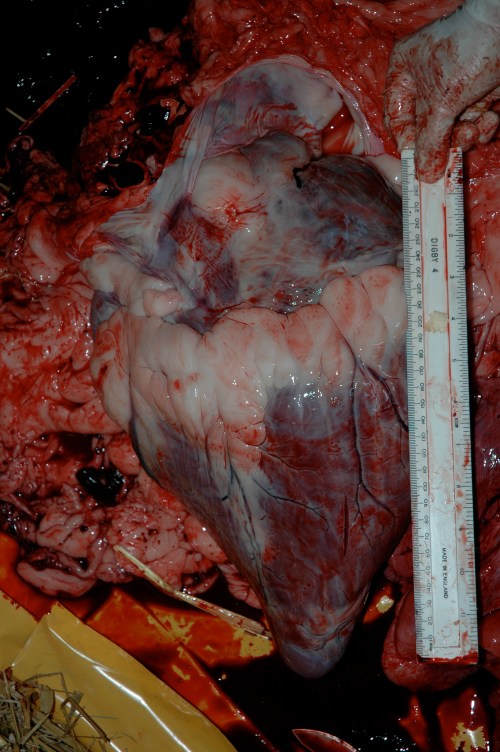
The big heart, needed to pump blood up that long neck to the head. Compare with the elephant and rhino hearts posted here before.
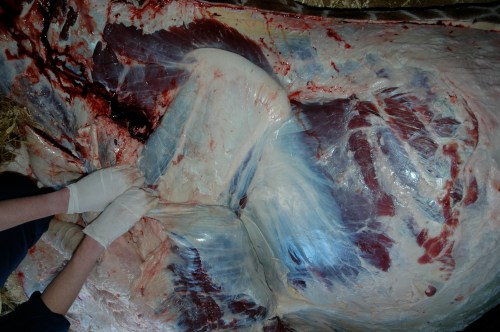
Left shoulder and ribcage, muscles of the triceps peeled back. Shoulder blade (scapula) visible. The neck extends up to the left corner.
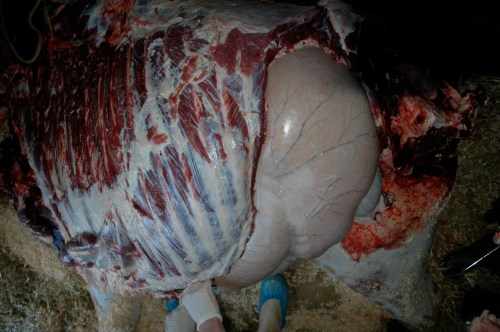
Left side of chest, rumen (fermenting tank) showing through behind ribcage. Forelimb has been entirely removed here.
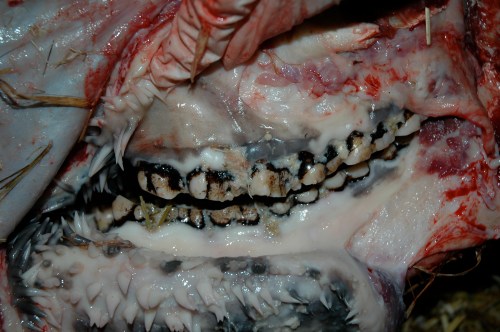
The left cheek’s teeth (molars)– and check out the spines on the inside of the cheek! They are keratinous growths to aid in chewing, food movement, digestion, protection against thorns, etc. These extend into the stomach, too! These amazed me the first time I saw them, in an okapi (giraffe cousin).
The brain, in bottom view. Olfactory nerves leading to the nostrils near the top (whitish), and optic chiasm for the eyes (“X” shape behind the olfactory nerves) are visible, then the medulla oblongata, smallish cerebellum and the spinal cord. For a human brain diagrammed and labelled in similar view, see here.
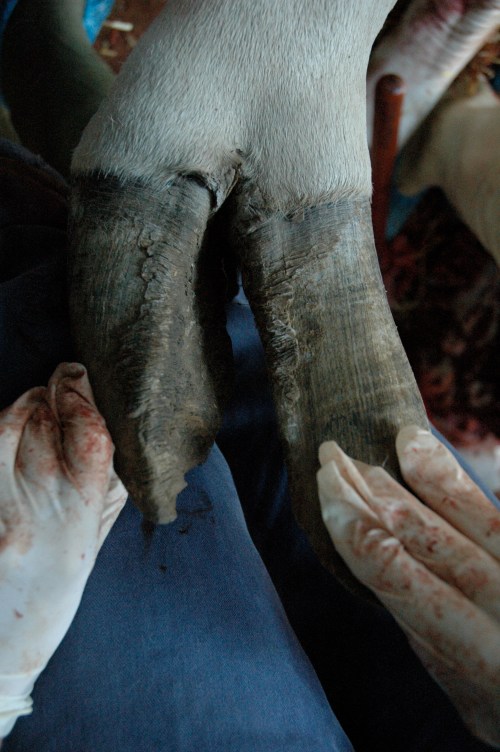
Like rhinos, elephants and many other large mammals, giraffes (especially in captivity) are vulnerable to foot/hoof pathologies, such as this very skewed/divergent pair of nails on the right front foot. This can lead to them walking very abnormally, getting infections or arthritis and other problems, so it is very serious.
The tapetum lucidum; reflective coating of the eye that can aid in night vision and protect the eye a bit. Gorgeous!
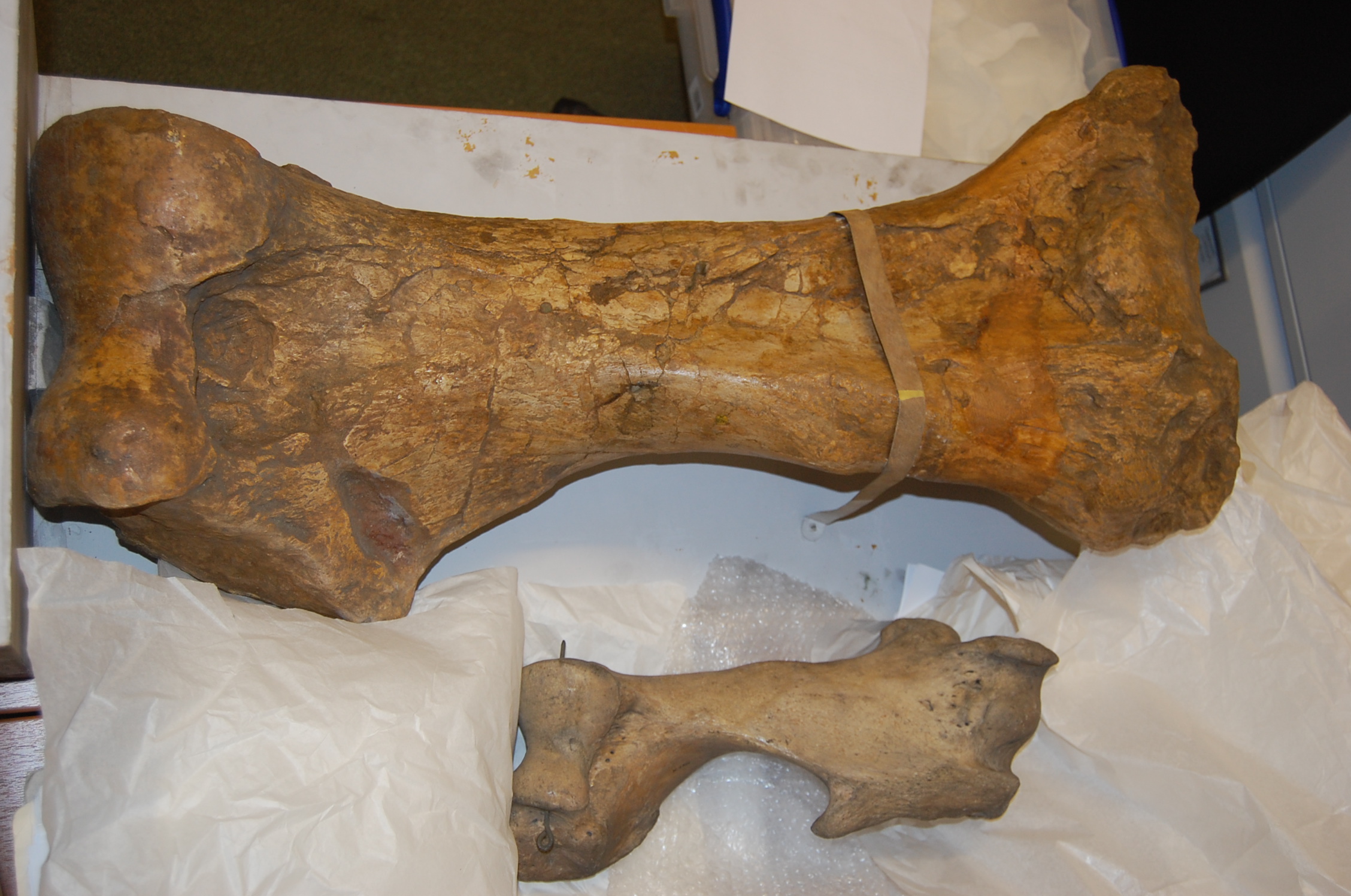
A vignette from research I’m engaged in with a couple of different projects follows. Below is a photo I took of two humeri (upper arm bones; humerus is singular).
One is from a Black Rhinoceros; Diceros bicornis (modern; specimen #H.6481 from the University Museum of Zoology, Cambridge), which was collected in 1873 in Bogos, Abyssinia by zoologist ?Edward? Gerrard.
The other, larger one is from a giant long-necked and (presumably) hornless rhinocerotoid; Paraceratherium [AKA Indricotherium, Baluchitherium] (extinct of course; specimen #NHMUK PV M 12251 from The Natural History Museum, London); which was collected in 1911 in the Siwalik Hills of India by palaeontologist Forster Cooper. My photo is shown with kind permission of the Natural History Museum, London.
For an idea of scale, the smaller one is 39 cm (just over a foot) long, so about the same length as your humerus, give or take a bit. It comes from an animal that probably weighed around one tonne (1000 kg; 2200 lbs) or so. Look back at the picture, and pause to reflect on the scale. This is one of the largest living land animals right here, and despite that size it is quite an athlete (watch the classic John Wayne chasing-animals-around-Africa film Hatari! if you want elegant proof, or browse Youtube videos of boisterous rhinos).
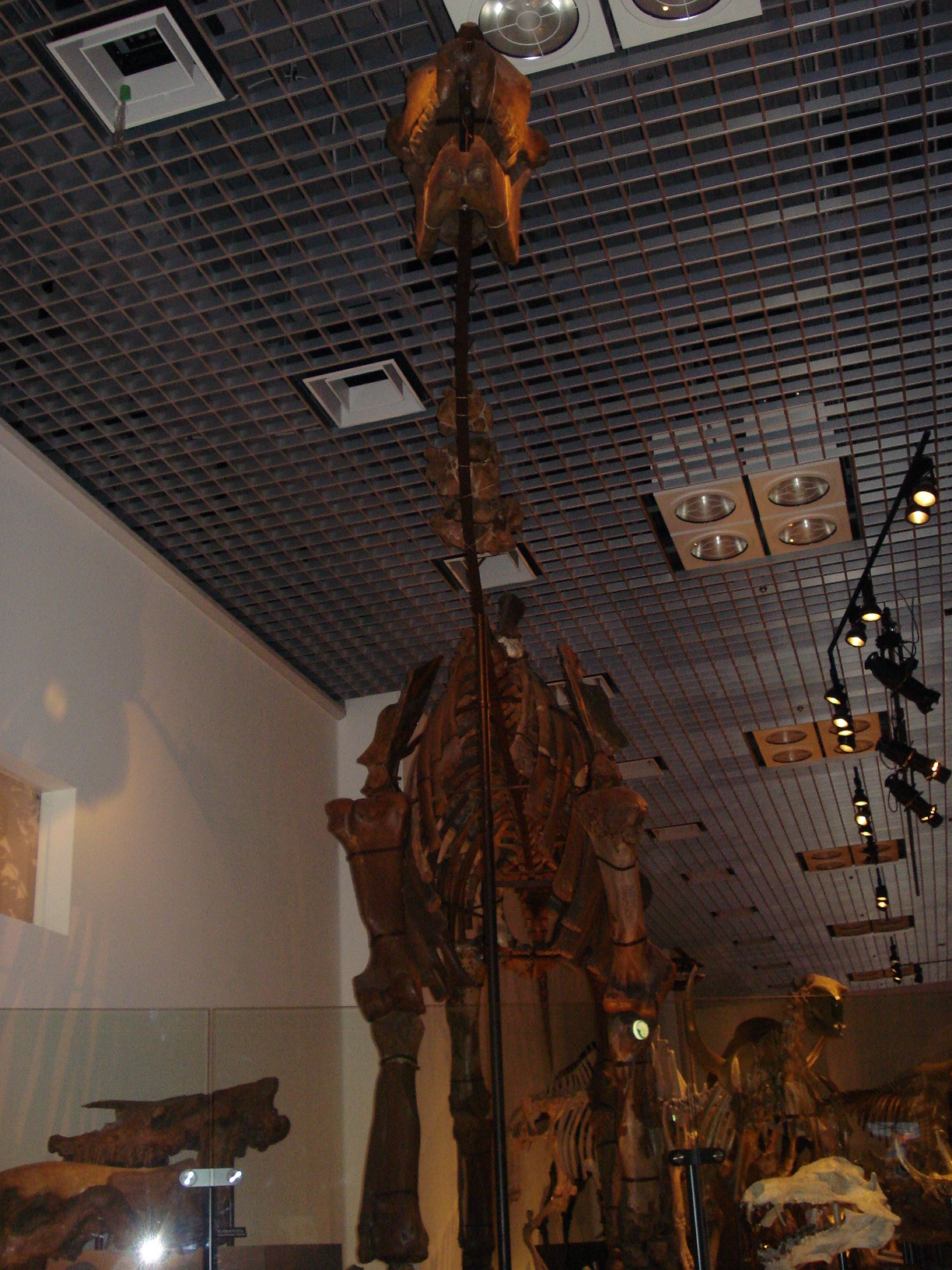
But any living rhino pales in comparison to the giant Oligocene form, whose humerus is twice the length (~80 cm; almost as long as your entire leg, probably) and quite a bit more robust. The best estimates of mass for such an animal are up to 15-20 tonnes, on a par with the largest mammoths and other elephant relatives. That’s like a ten-rhino rhino!Sure, they all pale somewhat in scale against the largest sauropods (or whales, which cheat by living in water). Yet for my money (warning: subjective value judgement ahead!) a rhinoceros is cooler than any sauropod at the same size, and sauropods are extinct so we have less left to study. (I’m being deliberately provocative for my sauropod researcher friends, but in a loving way)
The scale, and often cramped conditions, make it hard getting a good photo of a Paraceratherium skeleton or reconstruction, but here’s one I took at Tokyo’s Museum of Nature and Science.
Now, of course if you know me, you know I am thinking about how such giant land animals moved. Authors such as Gregory Paul and Per Christiansen have made arguments based on real data, both qualitative anatomy and quantitative bone dimension measurements, that even giant rhinos like Paraceratherium could trot and gallop much like living rhinos do, despite their giant size. They have inferred from the limb joint structure that these giant rhinos were more crouched, were less columnar (vertical-limbed) than living elephants are (although I’ve shown with my team that this characterization of elephants is quite misleading; they get quite un-columnar, rather crouched, as they attain faster speeds). If Paul and Christiansen were correct, it would be remarkable. I can’t definitively show either way, just yet. But I want to see how well this argument holds up with other data and methods, so I’ve been planning to test this idea for a long time. We’ll see how it goes.
Anyway, that was my brief tale of two scales. On one hand we have living “giants” in the form of the five currently remaining species of rhinoceroses, which are quite extraordinary in many ways, albeit in big trouble. On the other hand we have amazing, mysterious uber-giants like Paraceratherium, two or more times the size in linear dimensions and an order of magnitude greater in weight. Both are certainly giants by any measure of size in land animals.
But was the bigger rhino living in a rather different world, even more dominated by gravity than its smaller relative is today? (No, gravity was no different! It was only 30 or so million years ago; relatively recent!) Or did they live in relatively similar worlds of just being “bloody huge and devastatingly powerful, thank you very much”? I find that question really exciting and wondrous to ponder. What do you think?
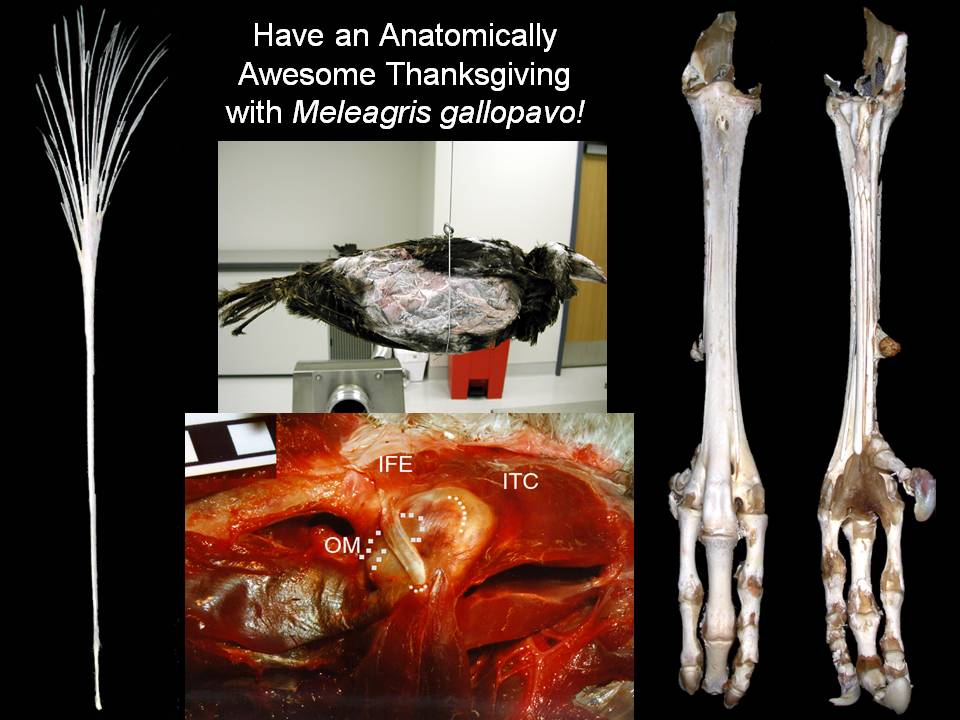
Hey, Americans and others happening to be gobbling down Meleagris gallopavo today– don’t forget to practice your anatomy! Such a great opportunity. Dig in to that carcass and horrify/amaze your family and friends! This pic might help you get started (info below if you want it), and is my WIJF blog wish of happiness to you all, today.
Stomach-Churning Rating: 6 out of 10; a small picture of some fresh turkey leg muscles, but not that bad really.
Click to embiggen.
Wondering what’s shown here?
On the left: an ossified (turned into bone!) tendon, probably part of the M. flexor perforans et perforatus group (a wickedly complex set of muscles that go from the knee region to the toes, and act mainly to flex the knee, extend the ankle and (plantar)flex the toes; i.e curl the toes up). What’s particularly cool is that, towards the top, you can see the divisions where the pennate (angled) fibers of the short, meaty muscle belly sat. If you are eating a turkey drumstick, you will be picking some of these out of the meat, although many turkeys seem to have fewer bony tendons due to human breeding and young age at slaughter.
In the middle, top: a crude experiment where we hung a frozen turkey’s body in a few different orientations to determine its centre of mass, important for biomechanical calculations. Mad science, but simple science.
In the middle, bottom: the right hip joint of a turkey in lateral (side) view, showing a few of the key muscles of the thigh. The ITC is M. (abbreviated Latin for Musculus) iliotrochantericus caudalis. Practice saying that (ill-ee-oh-tro-kan-tare-ick-us caw-dahl-iss) to impress your friends. It sits in a depression in the ilium (top pelvic bone), in front of the hip joint. The ITC is also important for helping birds to support their weight, as Steve Gatesy and I discussed in our 2000 Paleobiology paper. The ITC leaves a lovely crescent-shaped scar on the top of the femur (thigh bone). Show off your culinary skills by noting to your dinner party that this muscle is the best bit of the bird, AKA the “oyster”. (A little tip is here for how to find it; in a chicken but the anatomy is almost the same in a turkey)
The OM is the obturatorius medialis (obb-turr-ahh-tor-ee-us mee-dee-ahl-iss), an antagonist to the ITC, used to swing the leg. It is mostly hidden inside the pelvis so you just see its tendon (dotted line), and especially in turkeys (seriously, they have very nicely visible muscle attachments on their leg bones, for any bird!), a little knobby bit of bone that helps guide the tendon to keep it in its little groove on the femur. Unless you’re very industrious and break open the body cavity to excavate into the pelvis, you won’t be eating this muscle.
The IFE; M. iliofemoralis externus (ill-ee-oh-fem-oh-rahl-iss ex-ter-nuss); arching over the ITC and OM tendons, is a vestigial muscle, often lost in birds, and having little major function but helping a bit to draw the leg away from the body (abduction). Even though it is a puny muscle, it still has a nice little pit for its insertion on the femur. Turkeys are just cool that way. But it’s not much in the way of eating.
And now you know three of the ~40 main muscles of the avian leg, well done!
I love these muscles not only because I did a lot of my PhD (and later) research on them, but also because they leave great scars on bird and other dinosaurian bones that allow us to reconstruct how muscles evolved. I better stop here or I’ll be writing for days… don’t wind me up further! 🙂
On the right: the foot of a turkey in front and back views. Lots of ossified tendons are visible if you squint. Why do birds only have ossified tendons below their knee joints, and why only some muscles in some birds, and not so commonly in most other species of land animals? This is one of those cool mysteries that remain for people doing evolutionary or biomechanics research to sort out.
Hope you enjoyed a quick anatomy tour with our pal Meleagris!
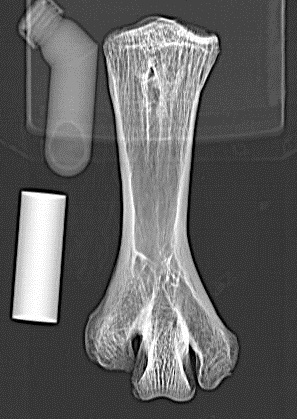
(What is it and what from? Answers must be in limerick form to count. Pilot scans explained in this post.)
This post is dedicated in memory of the late, great Professor Farish Jenkins, Jr; one of the best anatomists and functional morphologists ever. Excellent retrospectives here and here and here.
Aaaaaand here is the current scoreboard, as promised last time; starting from this post onwards–
RULES: 5 pts for correct, spot-on and FIRST right answer, 4 pts for very close or second, 3 pts for partly right or third in line with right answer, 2 pts for a good try, 1 pt consolation prize for just trying, or for a good joke!
If you post as “anonymous” name then it all goes into the same tomb of the unknown anatomist.
If you change your answer, you lose ~1 pt. Answers posted via Twitter, Facebook, email or whatever do not count! No appeals. I am a frigid dictator. 🙂












 What's In John's Freezer?