Feeds:
Posts
Comments

I’m gearing up for a major post with lots of striking pictures from The Freezers, but to tide you over, here’s a simple movie from one of my CT scans of a Hellbender salamander (Cryptobranchus alleganiensis; with a supportive rod down its GI tract; this was a museum specimen that apparently needed the rod to keep its body straight). We’ve scanned loads of salamanders and other cool critters for our NERC-funded project on the evolution of terrestrial locomotion in the earliest tetrapods (more about that coming up in a future post, as we have some Big News from that study!); this is just one of them.

The huge gaps between limb joints indicate extensive articular cartilage (typical of many aquatic animals, especially some amphibians) and would make a sauropod jealous. The relatively homogenous vertebral column, without much differentiation from head to tail, is also striking, contrasting even with that observed in animals with vaguely similar locomotor styles such as lizards; not to mention mammals, which take that regionalization to an extreme. Also, like most (all?) salamanders, this one has almost no ribs — this is a secondary reduction during their evolution; early fossil tetrapods had nice big ribs. But those ribs aren’t useless (they play a role in moving and breathing), and at least one caudate (member of the broader salamander group) has evolved a very cool use for them!

Well, it’s time for the Grand Reveal of what the picture in the previous post is (reproduced below). The guesses ranged from bird to wallaby/kangaroo to the stuff of nightmares. And indeed Nick Gardner got it right first, it is a wallaby. Specifically, it is a Bennett’s Wallaby (Macropus rufogriseus rufogriseus), which is the Tasmanian island form related to the Red-necked Wallaby, and an animal that has gone feral (along with mara and other cool critters) in Whipsnade Zoo near the RVC. You can tell it is a wallaby and not a bird, because there is an “Achilles tendon” attaching to a calcaneal tuber (“heel bone”) on the back side of the limb (shown with asterisk below) that birds lack, and if you look closely the toes are hairy, lack bird-like claws, and a few other details like the profile of the musculature are very different; more mammalian than avian. The stump of the muscular tail (cut off) is also a clue. Although the avian similarity in the case of wallabies is still striking, which is one reason I chose this image. Well done, Nick!
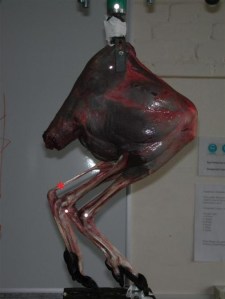
I found this picture in my archives and remembered when it was taken back in ~2005- some lab members received some frozen wallaby legs and thawed them out to use in experiments. They tried to compress the legs in an Instron machine (mechanical testing system; partly visible at the top of the pic) to see what the passive, springlike properties of the legs are like in a wallaby, vs. the properties they could measure in a living animal. (The shiny white reflective areas in the pic are for tracking joint motions) And I thought it was a freaky cool pic, so I shared it.

I also posted that pic because my team has done some in vivo analysis of the leg properties in such animals (previous news story here; paper in preparation), and because we use this technique of loading cadaveric legs in such machines quite routinely. We did this for elephant feet to study how the “sixth toe” of elephants works, and we’re analyzing data (as I write) for how elephant feet and rhino feet deform or move when loaded similarly. This method has a long history; we didn’t invent it; perhaps most famously used for studying horse limb mechanics [pdf example], which have a lot of passive properties (almost everything below the elbow/knee is non-muscular). Many animals’ limbs are tendinous/elastic toward their distal end (toes), so the limbs tend to become less actively controlled by the nervous system and become more of a mechanical control system (sometimes involving a non-neural “preflex“) in that region; although it’s all a matter of relative degree of passive:active control in different situations, species, and limbs.

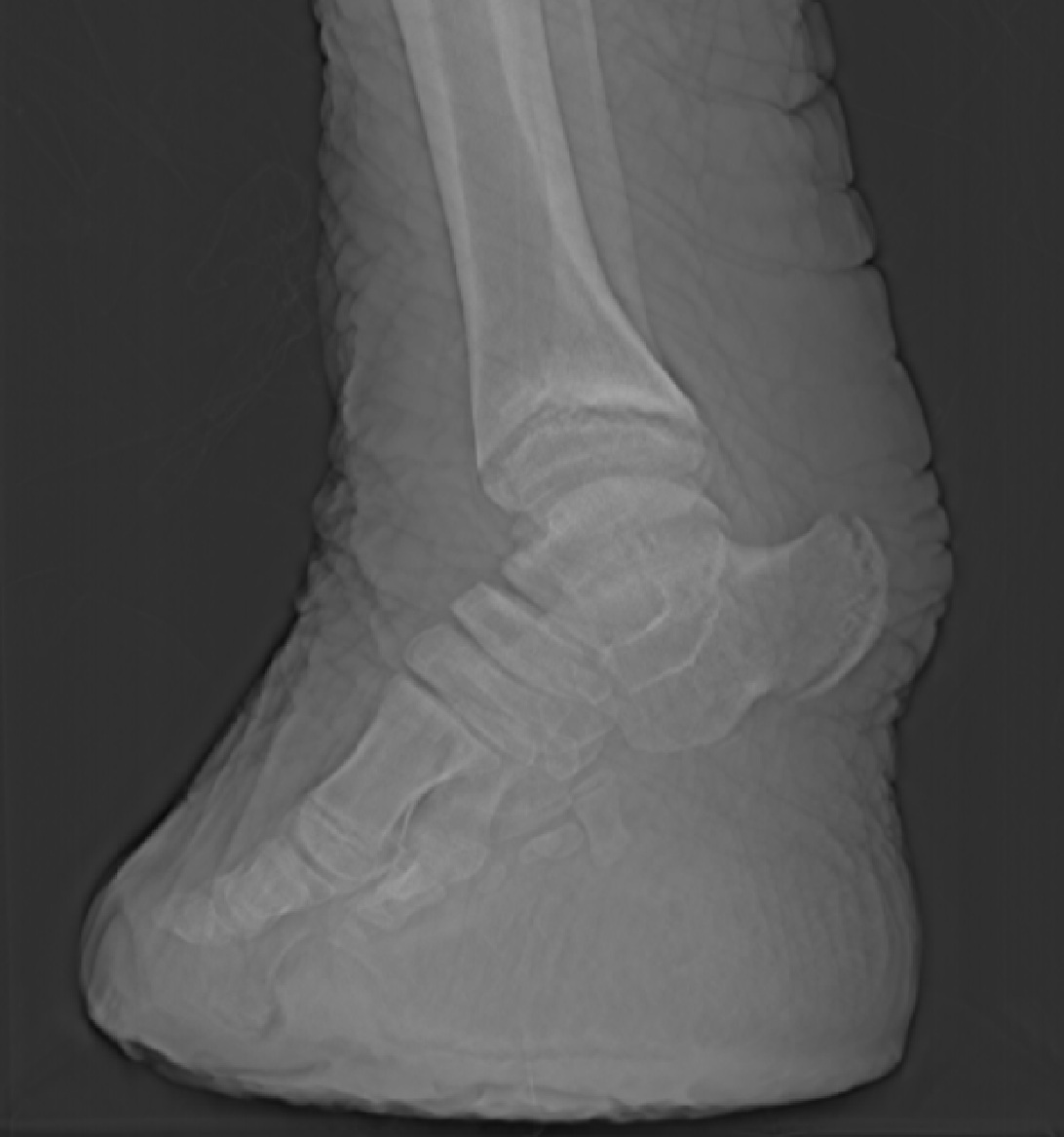
The picture below shows an x-ray of an elephant’s whole hind foot, in which you should be able to see the bones (brighter white) of the foot surrounded by a lot of soft tissue, mostly more passive kinds like fat, skin, fascial sheets, ligaments and tendon.

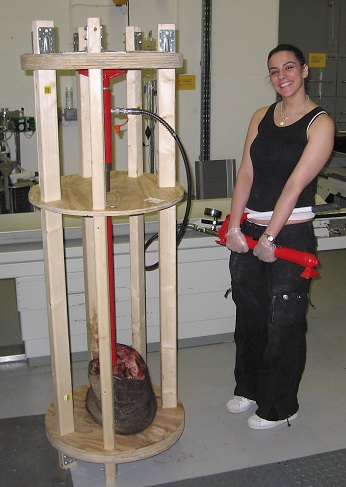
Here (further below) is a preliminary image from our elephant foot studies in progress, intended to reveal the passive properties/motions of the feet so we can figure out how those properties are combined with more active control, and how actively elephants control their feet vs. other, possibly more ‘passive-footed’ animals like horses. This is interesting from anatomical and evolutionary perspectives, and for helping with foot health problems that are serious concerns for such animals– more about that later. The arrow in the picture below shows where a lot of the motion is: at the knuckle (metatarsophalangeal) joints of the toes; the rest of the foot tends to rotate around these mobile joints. We can’t peer inside living elephant feet to see if they actually do this, but we can compare the external motions, pressure patterns, and other data from living and dead elephant feet to see how they match up, which is what we’re doing now — and we’re doing the same thing with rhinos, which have cool 3-toed, more “hoof-like” feet, as opposed to the 5-toed, fatter feet of elephants. To get this image, we’ve had to put the foot inside a custom-made device using a car jack to apply a constant load, and a wooden framework to hold the specimen still, and then run it through a CT machine in unloaded and then loaded states to see how the bones move. Here is what the crazy apparatus looks like, with enthusiastic undergrad for scale:

This, below, is a right hind foot (pes) of an Asian elephant, shown from the inside of the foot (toes are numbered 1-4 from the big toe/hallux toward the outside of the foot; 5th toe is not visible). The yellow image is the relaxed, unloaded foot; the green is after applying a large load equivalent to the animal standing on one foot (or running quickly). Notice how the third metatarsal (the long bone that the arrowhead is touching) for the unloaded state is in front of that for the loaded state, whereas yellow and green images of the bones toward the tip of the toes are overlapping more, indicating they did not move much/at all. That tells us that the motion is occuring at the joint indicated (“knuckle”), which makes sense anatomically, because that joint looks like it has a lot of mobility.

Image

On a serious note, in case you aren’t aware of it, there is a huge crisis afoot with the world’s rhino populations, because of demonstrably false claims about the health benefits of rhino horn (e.g. curing cancer) leading to a surge in its value worldwide, and thereby a massive upswing in poaching- as well as theft of museum specimens(!?). It may just be a matter of time before zoos’ and safari parks’ rhinos outside of Africa/Asia get hit, too. If sustained, this poaching could wipe out multiple rhino species in a matter of years; it is that severe and seems to already be worse this year than it was last year- and that was a Very Bad Year for rhinos.

However, a lot of people are uniting against the cruel greed and gross ignorance that has fueled the decline of rhinos, and public support seems to be growing. You can contribute, too; one example is this cause, or this one, to name but two. I’ve tried to make this my #1 cause, both on personal/ethical and scientific grounds (e.g. our work on rhino foot mechanics, health and care, to be detailed here later), and have been educating myself about it.

Anatomist extraordinaire Professor Larry Witmer of Ohio University has been contributing scientifically to helping rhinos, in an unexpected (but very sensible) way. This is a perfect example of how important basic science is; if we didn’t know rhino horn/nose anatomy we’d be less able to treat problems when they arise, and such problems can come from unexpected directions. His team’s contributions in the understanding of rhino anatomy are helping in one horrible case (see video below), in which three rhinos had their horns slashed off (along with part of the top of their skulls!) and two have survived so far. The vets in South Africa are trying to treat these two mutilated animals, and Larry’s group has been providing anatomical advice along with superb pictures on their Facebook page, which I want to publicize here because it is such GREAT freezer-based anatomical science and stunning imagery, and a seriously urgent cause. Please take a look. And while you’re at it, check out the Kariega Game Reserve’s Facebook page with more info on the plight of poor Themba and Thandi.

Edit: also check out this great story on our research, by Ann and Steve Toon, rhino conservationists/photographers/journalists.

hypnotosov comments that “a band named \\\Maytag uses refrigerator sounds as the basis for ambient black metal” and I could not resist delving deeper into this revelation; nor could many others, it seems.

Indeed, the “music” that resulted from their efforts is suitably majestic for this blog. CoverFeast your ears on this gem that is awesomely entitled “The Saga of the Frostbitten Lands of Frigidaire”:

And if that’s not enough aural assault for you, they are on Myspace; rejoice! I’m more of a “Frost Hammer” metalhead man myself, but I can appreciate a song like “I’m On a Fridge.”

In other news that is cold off the presses, here is an explanation of the phenomenon of freezer burn. And a Burning Man event held in the frigid wastes of Alberta, called Freezer Burn. Well I didn’t know of these things, anyway! I am learning as I go. No Siberian sage am I. Amazing what you can learn when you google random phrases. Just stay away from subjects like freeze-dried pets if you know what’s good for your sanity. Or don’t. Some sojourns down the rabbit hole are not meant to be taken.

To fit with the randomness and WTF-ness that infests this post, ponder this picture. I’ll discuss it in the next post.

Image

In case you missed the story about this paper released just before Xmas, here are some links to stories about “From flat foot to fat foot: Structure, ontogeny, function and evolution of elephant “sixth toes,” in Science, 2011:

1. The paper (free download from my publications list; nice policy, Science!)

2. Our website about the paper (more imagery goodness!)

3. Ed Yong’s first (Nature News) and second (more detailed blog) article

4. BBC News’s story

5. Reuters TV‘s excellent video

6. Science Now/Wired’s story

7. Daily Mail‘s story (not a daily fail, in this case)

Clarification: it’s not a real sixth toe in elephants; it’s a false, toe-like structure (“predigit”) made from other tissue. That confusion seeped into some media stories. But this whole story ties into the thorny question of what a digit (finger/toe) is and how we can tell (e.g., notions of homology). Regardless, the elephant predigits are present in all four feet, and are super duper cool!

Most importantly for this blog, that research relied, and still relies, on our fabulous freezers to keep the elephant “toes” in snuggly cold conditions until we wanted to study them.

The research is continuing- I’ll post more about that later. We’ve been doing lots more histology to explore the complex ways that these predigits are formed, and also studying how they function (ex vivo) in more 3D detail than before (with new comparisons to rhino feet). Also, a new paper of ours will come out in J Experimental Biology very soon. It elaborates on how whole elephant feet function, across ontogeny, using in vivo pressure patterns.

Too many CT scans, too little freezer action I say! Feast your eyes on these babies, then–

Freezer #1029, AKA “The Freezer”, AKA “Freezasaurus rex”. Abandon warmth, all ye who enter here:

Image

Don’t be shy now, Freezasaurus, show us your rear, ahh nice! You work out, dontcha?Image

And The Multitude of Maytag Minions (on the left); AKA Chesty McFrosty and The Fulsome Frigidaires:

Image

That’s a quick glimpse of our cast of chilly characters. We shall delve into them shortly and see what glistening, hoary grandeur they conceal!

Birds and crocodiles are part of the spectacularly diverse group of animals called the Archosauria, or archosaurs if you’re on casual terms with them. Other (extinct) archosaurs include the dinosaurs (non-avian), pterosaurs, and sundry wondrous other beasts like aetosaurs and phytosaurs. Archosaurs have, and presumably their common ancestor had, many specialized features of their anatomy that are related to metabolism and locomotion. That’s a big reason why, as a scientist, I love them.

Yet the bird lineage evolved its own extreme specializations, whereas in some (but not all!) ways crocodilians stayed closer to the ancestral state. Here is a great example of one of the major categories of differences between living crocs and birds: the proportions of the respiratory system, from freezer specimens I’ve CT scanned with my former PhD student Vivian Allen, which were part of a paper we published in Anatomical Record back in 2009. We scanned the thawed specimens with and without the lungs inflated (croc results not shown for inflated state). This was easy; we just stuck a syringe into the windpipe and then tied it off once we had pressurized the lungs. [I’m now working with Colleen Farmer and Emma Schachner on using these specimens to learn more about the surprisingly “bird-like” features of croc lungs despite the smaller total volume of the airways; more about that another day… we can do MUCH better than these images!]

Here, the airways are coloured blue/purple and the flesh has been made transparent yellow, while the skeleton is orange. The relatively massive size of the airways is evident in birds, especially the air sacs (side pockets of the lungs/other air passages), whether they are relaxed or inflated. The lungs (purple) aren’t that differently sized in the two animals.

Australian Freshwater crocodile from CT scan:

Junglefowl (“ancestral wild chicken”) from CT scan; relaxed airways:

Junglefowl from CT scan; inflated airways:

(note that the light blue region is the expanded air sacs; the lung in purple hardly changes because it is fairly rigid in birds)

Croc-cicle

Breaking up the giraffe monotony with my next subject (too long postponed in my research): how awesome crocodile anatomy (and locomotion) is! Just a teaser, using a CT scan of one of my favourite freezer specimens: the enigmatic Crocodylus moreletii. The frozen specimen itself was quite rotten so I won’t put a pic of that up right now (you’re welcome!) but the skeletal anatomy shows up great when all that decay is made transparent– and when the bones are turned a pleasing purple.

The specimen came from La Ferme Aux Crocodiles in France, which very kindly let us drive down there and come back with a vanload of >20 awesome crocs, which now occupy the left side of The Freezer.

Edit: check out the great blog post by Darren Naish on Tetrapod Zoology, about a crocodile dissection and crocodylomorph phylogeny- hopefully the start of a long series on these wonderful critters!

William Pérez from the Veterinary Anatomy Facebook page sent me a link to this stunning image of a giraffe hindlimb dissection– wowza!

Scanner's eye view of giraffe leg

This is why we get scan artifacts from giant specimens. It fits, but only just. The x-ray beams are getting scattered from being too close to the x-ray detectors (ring around the specimen), creating noise in the images. The red lines on the specimen are from a laser, used to align it properly within the gantry of the scanner. The femoral head (hip joint) is visible as the pale white thingy, down on the bottom right.