A quick report on an exciting event for my team, from this week: We got a box! A big one! With 10 frozen crocodiles.
Stomach-Churning Rating: 5 out of 10. Just 1 picture with some blood.
These come from a breeding centre in southern France, and died of natural causes. Here is a little, icy box of five Crocodylus moreletii, a species that has featured here before:
And five young Nile crocodiles (remember WCROC?), one of which seems to have had an uncomfortable encounter with a larger relative:
At the Structure and Motion Laboratory, we’re not boring scientists who robotically focus only on writing grants and publishing papers, much as senior management might want us to pretend. We’re human. We like fun. And we like Halloween. And brainssss! What follows is some good, jolly, Halloweenerly, spooky, sciencey fun that we came up with yesterday (in between writing grants and papers, ahem).
First, our surreal B-movie extravaganza: It Came From the Biomechanics Laboratory. See if you can piece together the plot:
(subtitle: Open John’s freezer… if you dare!!!)
And in case you want more of the ritual sacrifice of the pumpkin at beginning, here are two versions in glorious slo-mo, from our AOS high-speed digital video cameras:
and
Finally, an outtake from the film, in which Gary, the RHex robot from Andrew Spence’s Spencelab, takes his gory vengeance on a hapless cameraman, and then turns on his masters!
A short(ish) post, but to me an important one. As I’ve mentioned here before, and still mean to write a detailed post on, I’m on a 1-year Royal Society Leverhulme Trust senior research fellowship (pause to breathe… long phrase there!) to study the mechanics and evolution of the kneecap (patella) in birds. Knees are very cool, and the patella is one of the coolest parts of the knee. My fellowship is aimed at returning to my roots, i.e. my PhD research on theropod dinosaur hindlimb evolution (anatomical and functional), to focus in great detail on just the patella (this, not this).
The patella is a mysterious structure: a sesamoid bone like I’ve argued elephant predigits are, and probably the best known sesamoid, but still quite enigmatic– especially in non-humans and most particularly in non-mammals. Why did it evolve three different times, at least? What mechanical/developmental environment encourages it to form? Why don’t some species have them? Does the presence of a patella tell us anything about posture, gait, or anything else? Why did no giant dinosaurs evolve patellae?
Anyway, I now have a related PhD studentship that I need a great EU/UK-based student to apply for, and I’m casting a wide net. It’s a very, very freezer-based PhD: imagine cutting up the knees of the frozen zoo of critters that I’ve shown on this blog already, to your heart’s content! And studying fossils, and doing histology (cool imaging techniques with RVC faculty Michael Doube and Andy Pitsillides, along with bone uber-guru Alan Boyde), and conducting experiments with real animals, and computer modelling both experimental and fossil data… this PhD has it all.
Here are the details. If you know anyone in the EU/UK looking for a good PhD that seems to fit the bill very well, send them my way please!
We now return you to your regularly scheduled frozen organisms… and there is a fun post coming tomorrow!
The knee of an emu from my freezer, showing the many muscles and other tissues that connect to or surround the patella. It’s complicated, and that makes for fun science!
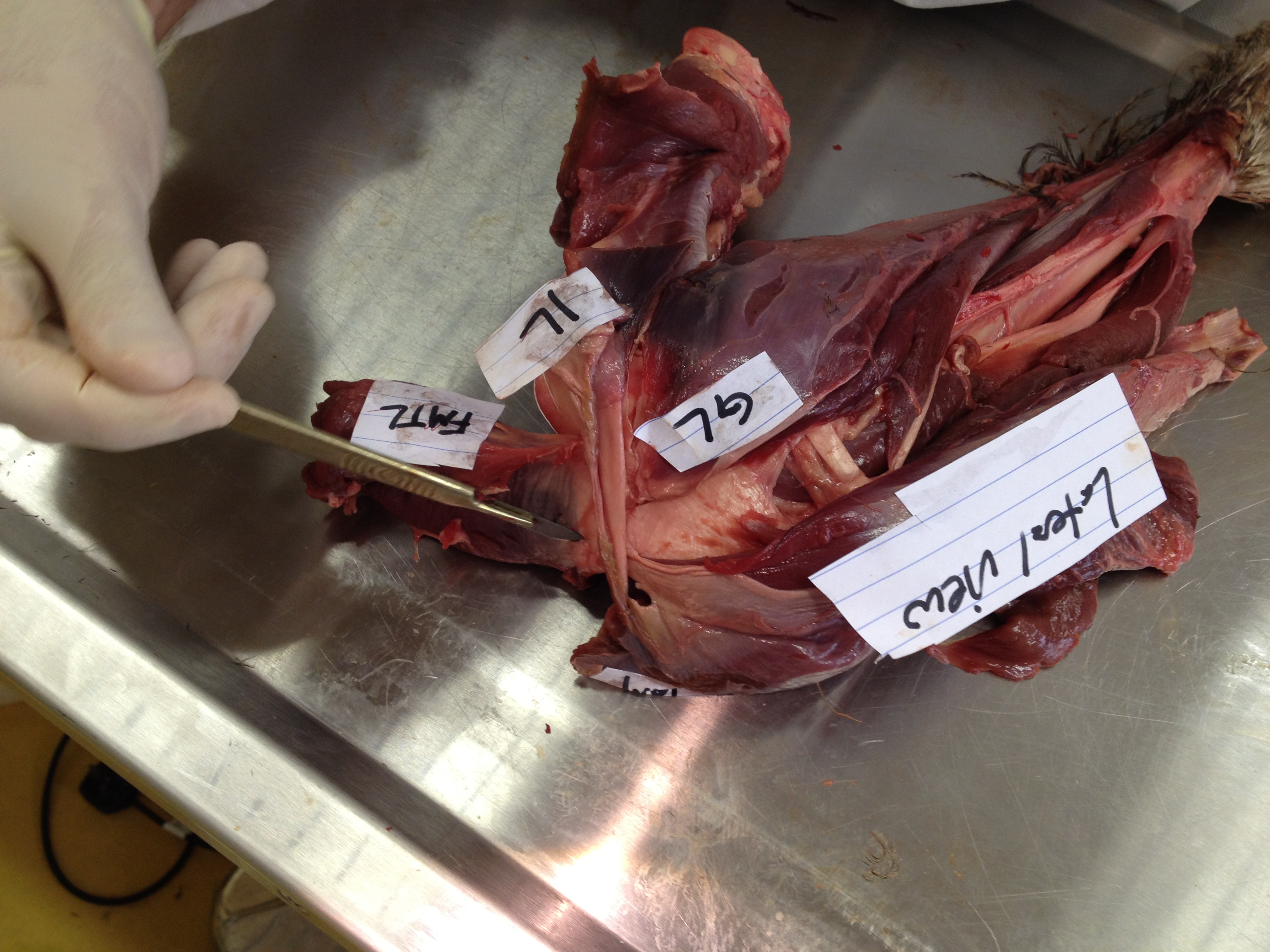
A quick and easy Mystery Dissection post for you today– these objects are left over from a dissection we did awhile ago. What are they, and (for extra points) from what species (be as precise as possible)?
Speed round. Let’s see how many correct answers we can get in the next 24 hours!
Stomach-Churning Factor: 1. They won’t bite.
Difficulty: small image, oblique angle, object on the left side of the image is in the way (and not related to this post).
This will lead into a full-length blog post, hopefully to come sometime late this week, after Halloween. And there should be a Halloween bonus post this year!
I stumbled across some old pics, which I thought I’d lost, from the filming/preparations of 4 episodes of Inside Nature’s Giants (Jan-Feb 2009) at the RVC. They form a nice accompaniment to my previous post reflecting on my experience with the show, and the timing is great because I’m about to head to Raleigh, NC to talk about this research at the Society for Vertebrate Paleontology conference.
Stomach-Churning Rating: 4 at first (just a dead animal; and a rather clean one at that), then about halfway through the dissections start and it edges up to a 7 or so.
These pictures are sadly some of the few I have of the whole, intact body of a gorgeous adult Nile crocodile (Crocodylus niloticus) that the Windfall Films team managed to get to the RVC from La Ferme Aux Crocodiles in Pierrelatte, France. (I have scores of pics of the dissected limbs, shown further below) As the title indicates, it was a nice big croc. And as you’d expect, CT scanning and then dissecting it was no tiny feat, and makes a fun story. Story time, then, after an introductory pic!
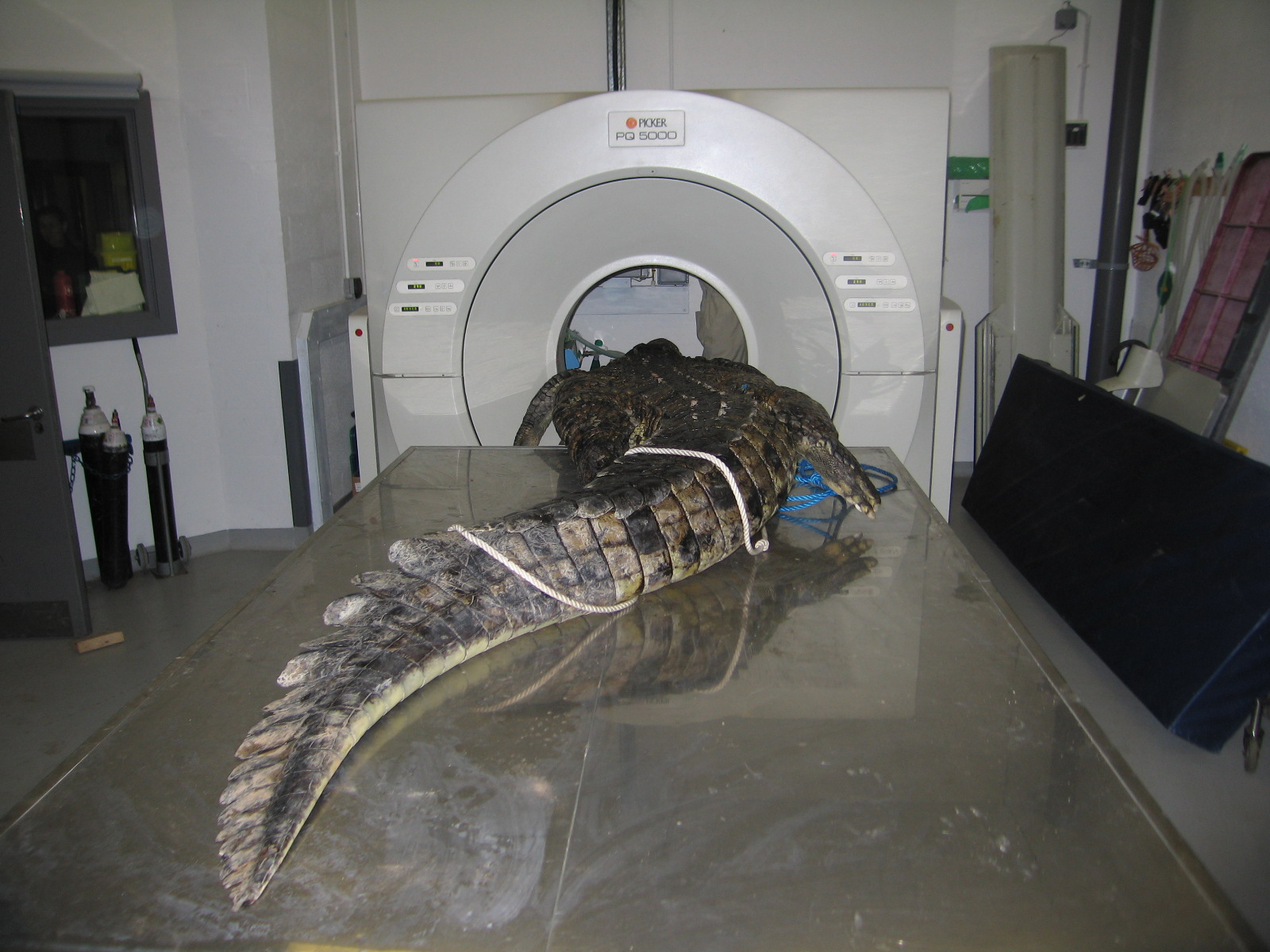
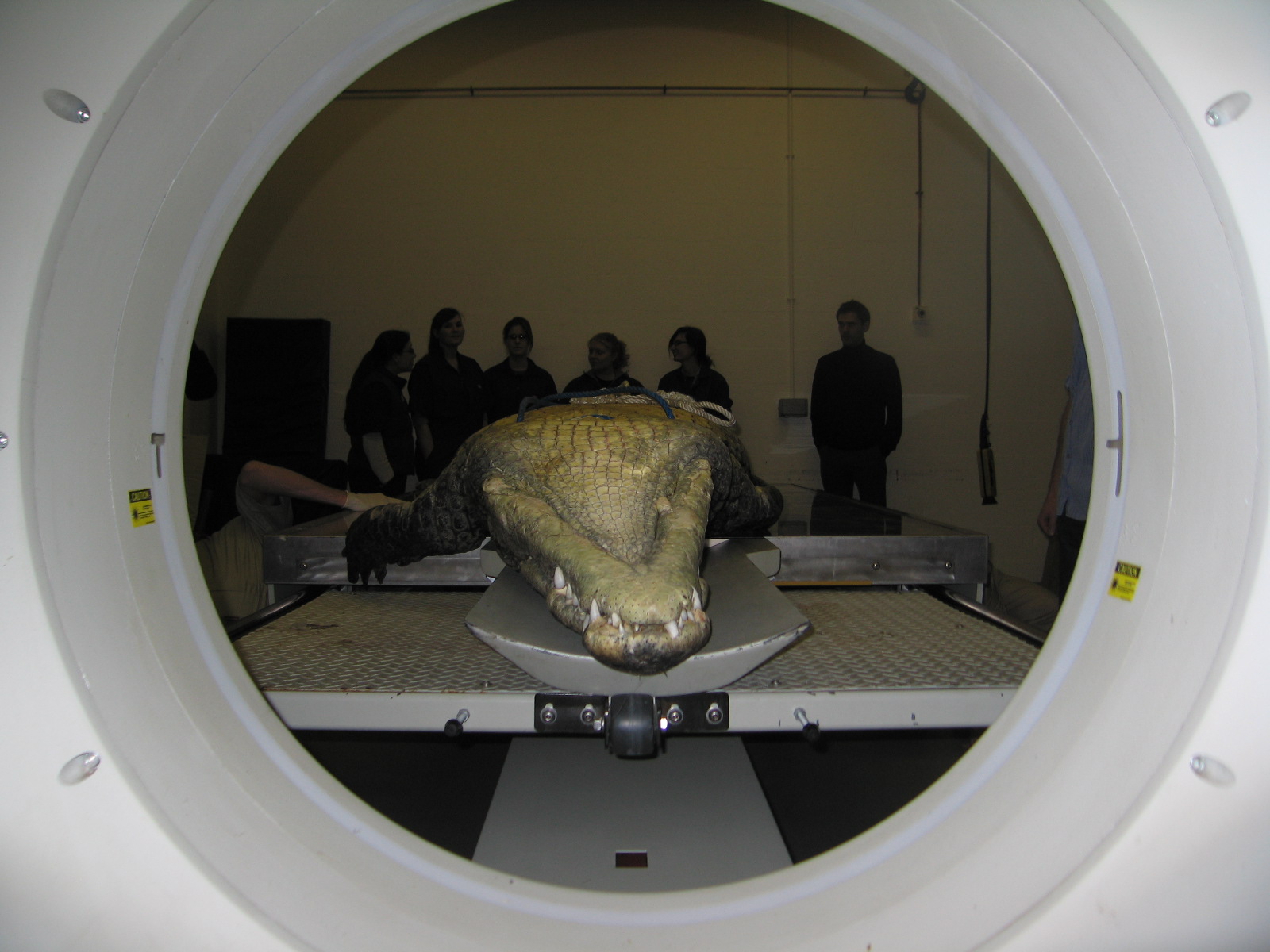
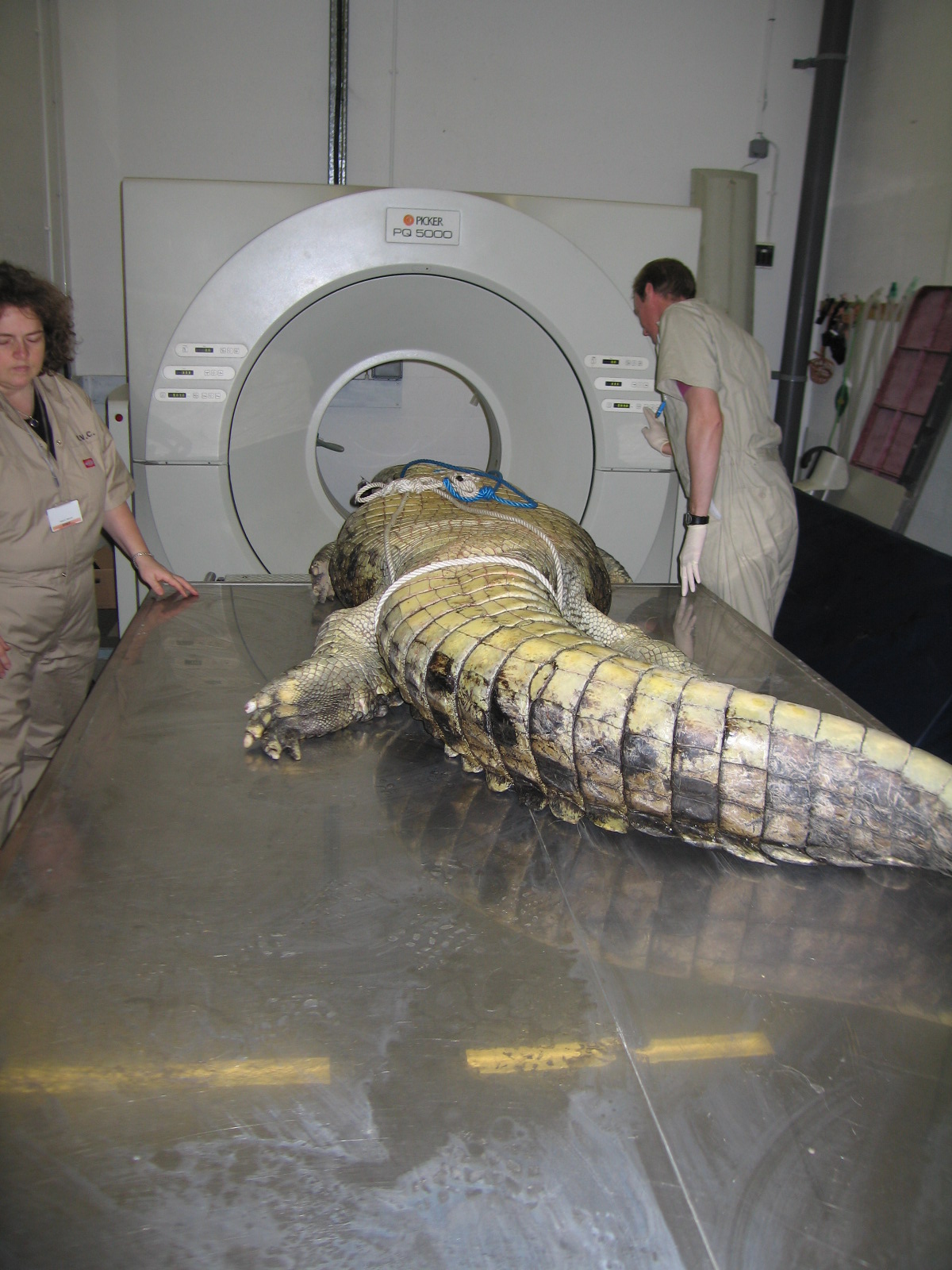
Dr Samuel Martin, vet from La Ferme Aux Crocodiles, brought the crocodile (and some smaller specimens) over to our Hawkshead campus in late January 2009, and we quickly moved to run the specimen through our CT scanner to preserve some details of its anatomy (example shown at the end of this post) and for potential usage in the show. As the photos below illustrate, this was hard work for several people.
And then, as we were finishing the last CT scans of the specimen, our ageing medical scanner stopped working. And could not be resuscitated. R.I.P., Picker PQ5000 (buy one or two here!). The crocodile, “WCROC” as my team came to designate it, had claimed its final victim. It took about a year for us to get a new one, and that year sucked. It made me appreciate how lucky we are to have a CT scanner just across the parking lot from my office!
Anyway, the day of filming I was hoping to make it in to watch my colleague and friend Dr Greg Erickson help lead the dissection team, but a wicked blizzard blew up, and as I was starting the 31 mile drive south from my home to the RVC I realized, from the queue of cars that seemed to be 31 miles long (and train lines shut down), that this was going to be a snow day. So I turned around and came home. Another victory for WCROC!
The filming proceeded despite heavy snow delaying many of the key players’ arrivals. I got filmed a day or two later for a little section of the show on the limbs and locomotion of crocodiles but sadly this got cut from the main ING show (but did air in the National Geographic version “Raw Anatomy“, in the USA at least).
The limbs had been left largely intact, although some of the dissectors who didn’t know croc anatomy very well had slashed through parts of the pelvis and, in eagerness to reach key parts to demonstrate in the show, some major muscles got shredded. This is no big surprise; crocodiles have a lot of bones all over the place: in their skin (scutes; bony armour), in their bellies (the belly ribs called gastralia), and almost everywhere else, so some brute force is required to get to the gooey bits. Apparently there had been 6 or so people dissecting at once and things got a little carried away. The curse of WCROC continues?
Oh well; that’s just how documentaries go sometimes, especially with a pioneering show like this and the intensely compressed timescales of filming (time is ££!). There can be pulses of chaos. And the show turned out GREAT! (alternative link if latter does not work outside UK)
Let’s have more photos tell the story of the scanning, which also shows off this beautiful animal’s external anatomy:
Anyway, things turned out fine overall for our research. A week or so later (maybe longer; I forget if the specimen was frozen and thawed out for us) we came in to start dissections. We were really excited to measure the limb muscles of such a big crocodile, for comparison to a growth series (babies to adults) of alligators that my former PhD student (now postdoc; Dr.) Vivian Allen had dissected back in 2008. Here he is with a masked co-dissector, displaying their joy for the task at hand:
And let’s not leave out the exhuberance of visiting research fellow Dr. Shin-Ichi Fujiwara! He wanted to inspect the forelimbs for his ongoing studies of limb posture, joint cartilages and locomotor mechanics.
The remaining images show progressive stages of dissection of WCROC, starting from the pectoral (fore-) limbs with a view of the belly (and the giant jaw-closing muscles visible on the left side of image):
Isolated right forelimb, with coracoid (part of shoulder girdle) sticking through:
Assorted forelimb/upper arm (brachial) muscles:
And the triceps (elbow-straightening) muscles; not that big in such a big animal:
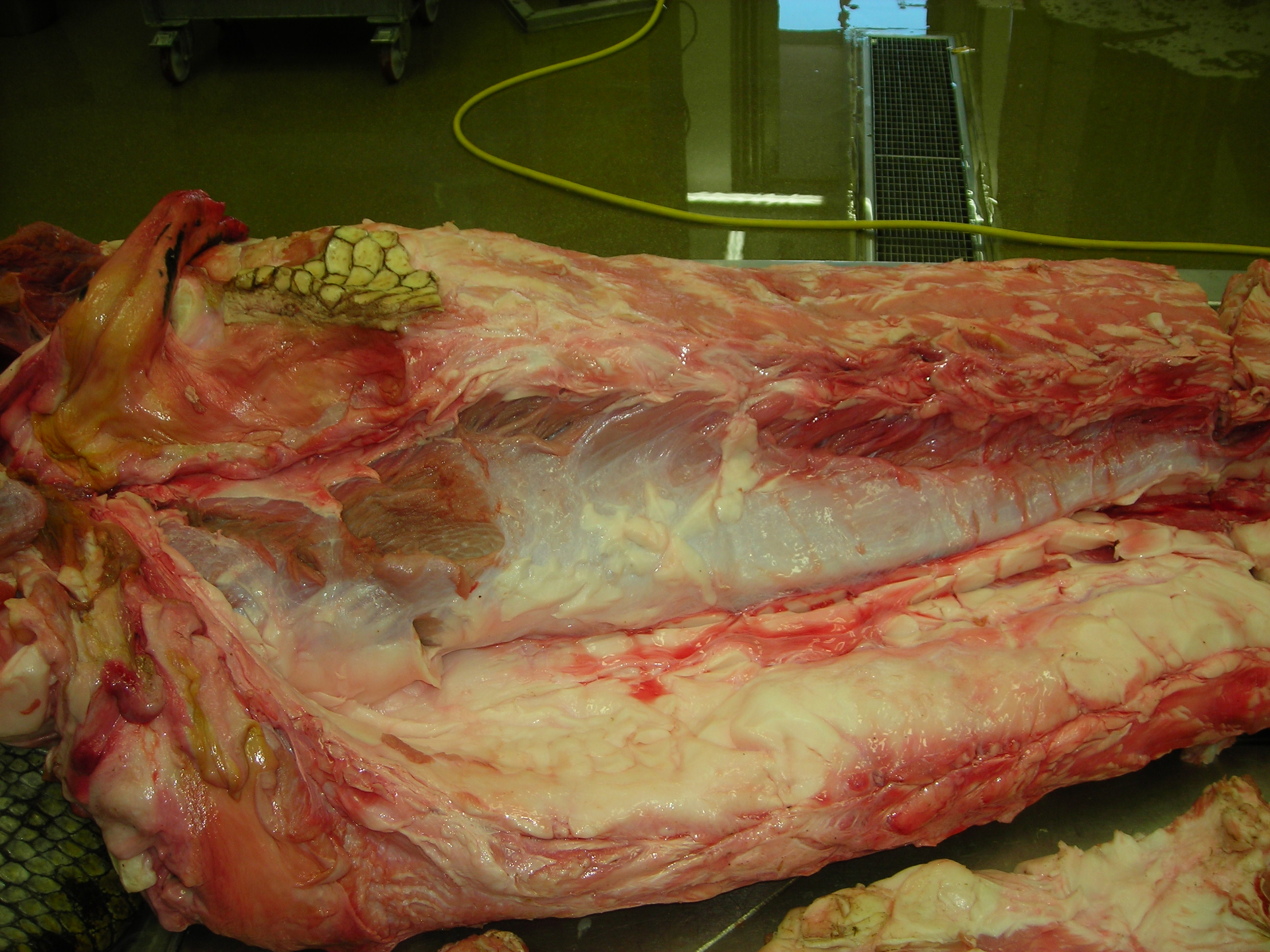
…and on to the pelvic limbs and the huge tail:
With a closer look at the HUGE thigh muscle, the famed M. caudofemoralis longus:
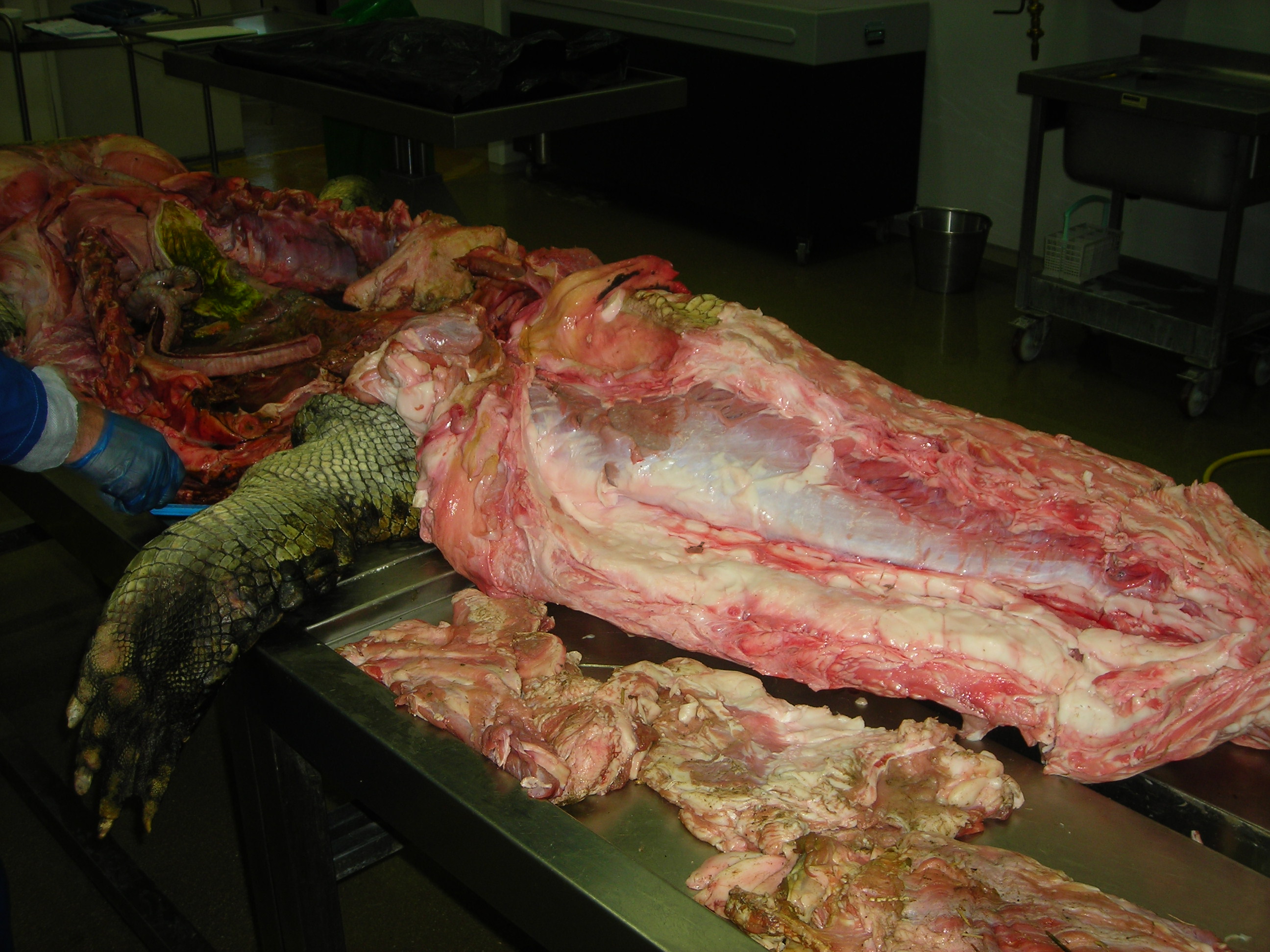
And then an isolated right hindlimb:
Thigh muscles, with which I have a peculiar fascination that stems from my PhD research:
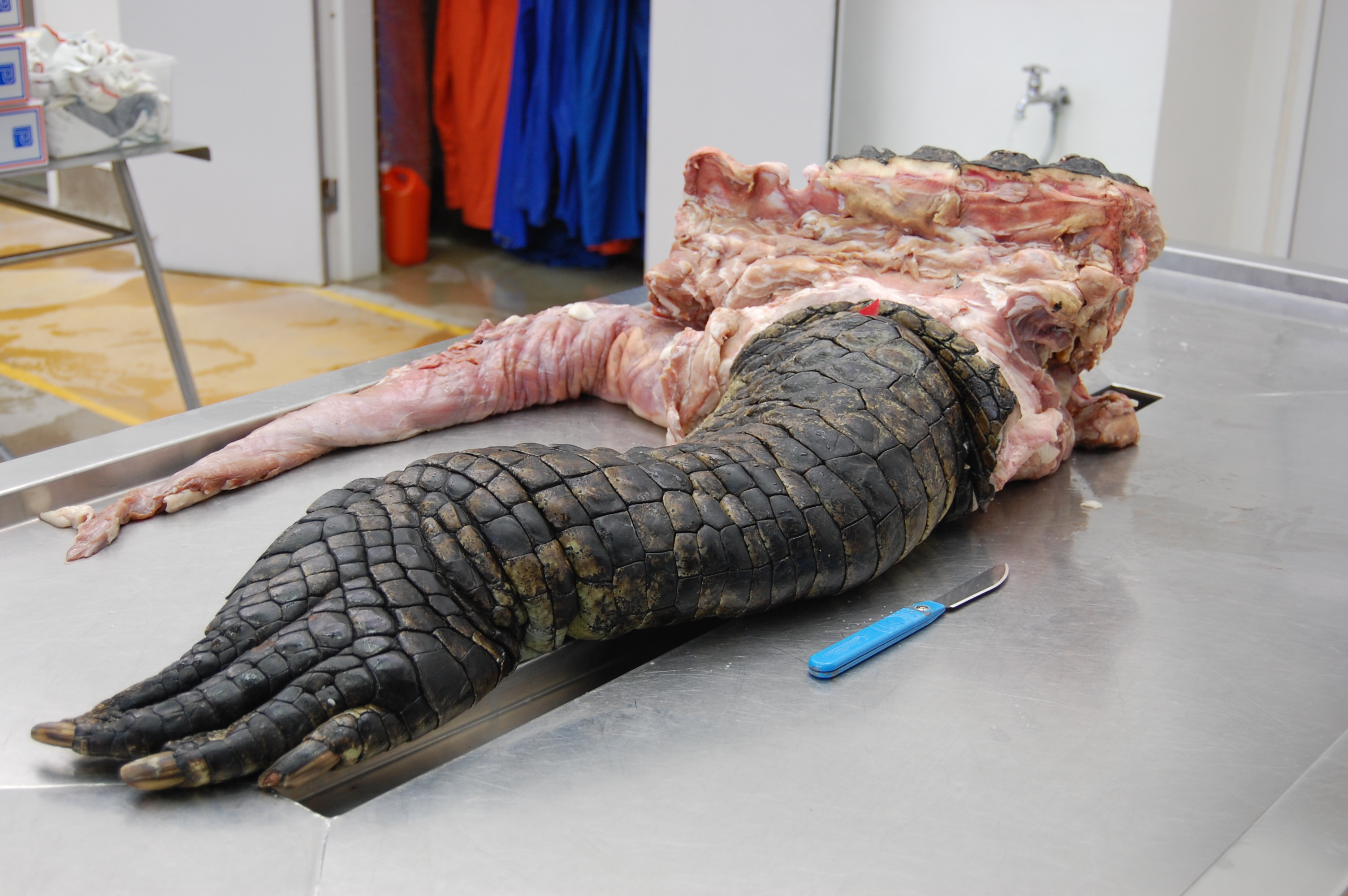
And last, the great, paddle-like hind foot!
What a great experience that was! We have fond memories of WCROC, a great documentary from Windfall Films, some nice data– and a lovely skeleton. Perhaps the curse of WCROC is not so bad. Nothing can go wrong now!
Soon Mieke Roth, scientific illustrator from the Netherlands, is coming here to do a similar dissection on more Nile crocodiles at the RVC. As with the octopus she wrote about in September, she will make a 3D model, but with much more detail and with an emphasis on accuracy and accessibility. The end products will be really cool; think of the visible body, 3d models that can be used in teaching, animations, a book and lots more but also a “how did she do that?” blog. To finance this project (that probably will take a year or more) she will use crowd funding. In several weeks there will be more info on how to participate in her fantastic endeavour. For now, see her video with the initial pitch for “Nile Crocodile 2.0“!
Hi folks, as my birthday present to you, and big thanks for racking up 70,000 blog views in 7 months (and my 50th post!), here is a new installment of Mystery CT Slice!
This time with a pilot (or scout) scan of an odd object. A pilot/scout scan is a quick, low exposure scan used to plan a series of CT slices, which shows a a larger area that is then narrowed down to focus just on the object of interest and a bit of buffer room for those slices. It generally isn’t used for much else, but sometimes can make a neat picture. As you can see here, the pilot scan area was excessively massive relative to the object. The two odd objects below the primary object of interest are scanning phantoms, used to calibrate density from Hounsfield units to actual real-world density (one is water at 1 g/cm3; the other is “cortical bone” at 1.69 g/cm3). Ignore them.
But what is this object and from what taxon? Be as specific as you can, but pinning it down to genus/species level will be bloody hard!
Stomach Churning Rating: 1/10; it doesn’t get much tamer than a pilot scan.
Difficulty Level: small image, hazy, not a lot of diagnostic traits visible, 1 main element.
In case you haven’t heard, Saturday, September 22nd, 2012 (today, at this writing) is World Rhino Day! The main websites include here and here. Ivan Kwan has also posted a fantastic blog entry “Rhinos are not prehistoric survivors” for WRD2012- check it out! And if you haven’t seen the WitmerLab’s AWESOME Visible Interactive Rhino site, you really really need to (in fact, quit reading this and go there first; it is soooooo good!).
I’ve written about the global rhino crisis before, and about rhino foot pathologies. The title of today’s post may be “cute”, or at least goofy, but the real situation is as grim as the images I’ll share. I won’t repeat the explanation, but all five living species of rhinoceroses are in serious trouble. There’s a good chance that most or all of them will go extinct quite soon– see the previous links for more information on this. Javan and Sumatran rhinos are dangling the most precariously over the precipice of extinction. My goal in this post is to share the beautiful, complex and exotic anatomy of rhinoceros anatomy and movement, and the joy of contributing new scientific information about poorly understood species.
Stomach-Churning Rating: 7/10— dissections, and there are a couple of pics where the specimens are not so fresh, and there’s big skin, and a huge heart.
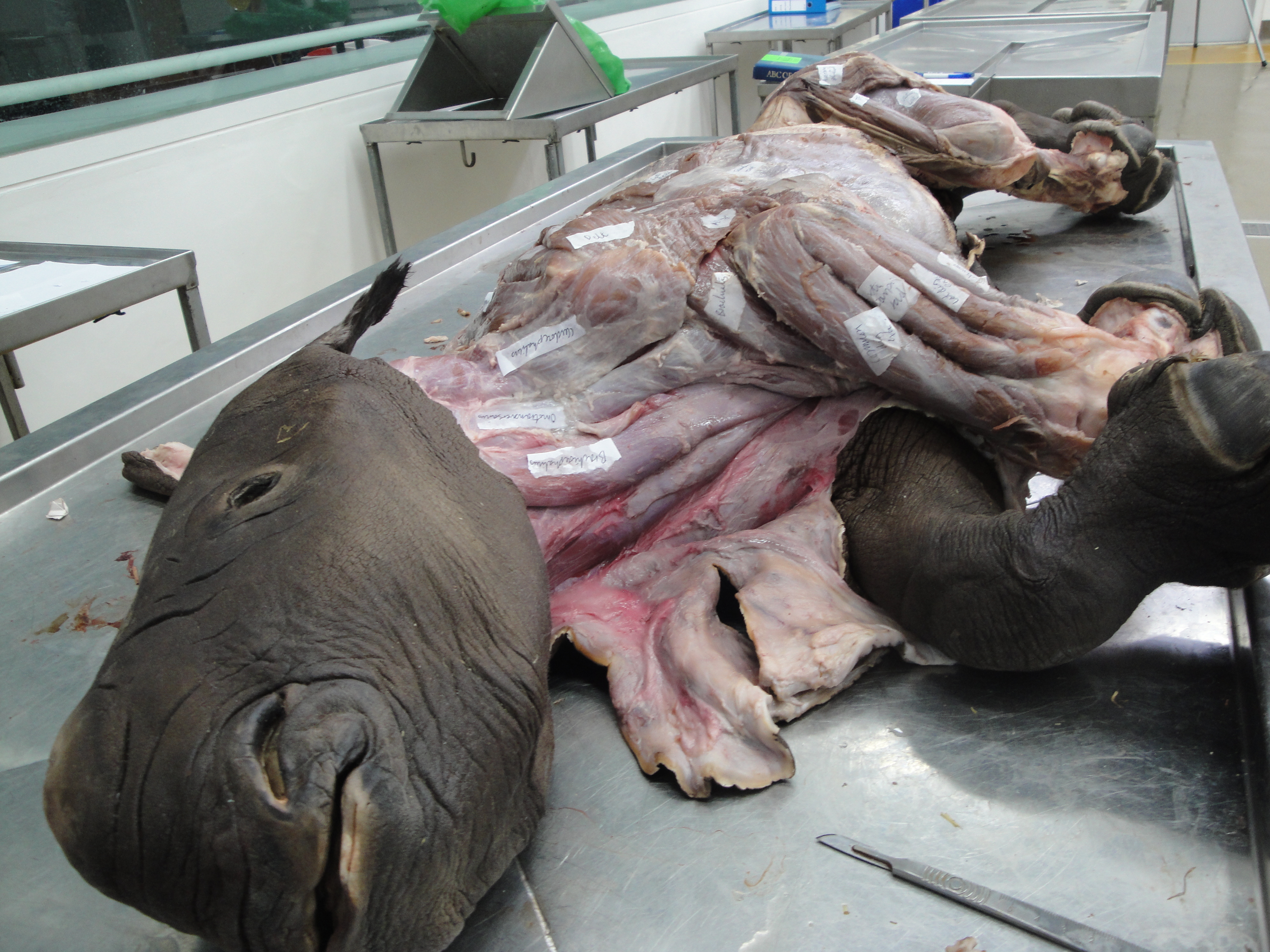
Baby white rhinoceros. Will frozen specimens like this be all we have of rhinos someday?
The purpose of today’s rhino post is to share a bit more; especially images; of the work my team has done on rhinoceros gait and limb anatomy; all of it unpublished but hopefully coming soon. We’ve steadily been collecting data since ~2005. Because my previous post went through some of this, I’ll keep it brief and image-focused.
First, a video of one of our amusing encounters with a white rhinoceros, at Woburn Safari Park. In this study, we wanted to measure, for the first time really, the gaits (footfall patterns) that a white rhinoceros uses at different speeds, and how often it uses those different gaits. We attached a GPS unit on a horse surcingle around the rhino’s torso, which measured the animal’s speed once a second. We then observed 5 individuals (1 at a time over various days), following them in my station wagon (estate car) across the safari park. We filmed them with a conventional camcorder to document their gaits, and concentrated on the two periods of the day that they’d normally be active: when released from their overnight barn, and when coming in for the night back to that barn. They got rather excited and frisky some of those times. The GPS belt then kept recording speeds for the rest of the day; unsurprisingly, the rhinos generally did not do much. I have to thank Nick Whiting, rhino handler, for his help making this research happen. I’ve been meaning for too long to finish the final paper… soon, I hope! Enjoy this tense scene of a rhino investigating my car (driven by me and with an undergraduate student filming) then having a nice canter/gallop across the field (accompanied by my jubilant narration).
Like our foot pressure research, we aim that this work provides baseline data useful to caretakers of rhinos; for example, to test if a particular animal is lame. This follows what we’ve successfully done with elephant gaits and feet, translating basic research into more clinical application. But my major scientific interest is in understanding more about what makes any rhinoceros, even a 2-tonne White rhino, so much more athletic than any elephant (even a baby or 2-tonne small adult Asian elephant). As the video shows, they can use a variety of gaits including cantering and galloping, and trotting at slower running speeds. No elephant ever does that, and no one knows precisely why. The leg bones are more robust, but the muscles aren’t that dramatically larger in rhinos.
An Indian rhinoceros forelimb- note the characteristic knobbly hide, unlike the smoother, more elephant-like hide of a White rhinoceros.
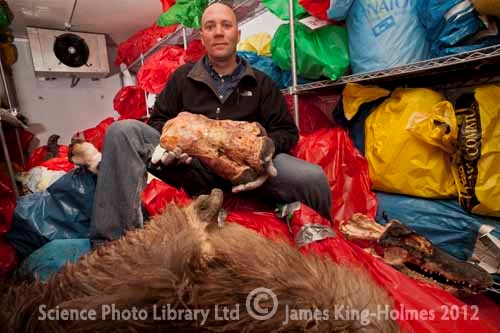
Similarly, the anatomical work we do with rhinos is intended to not only be useful science for comparative biologists like me, showing how rhino limbs work and how they differ from those of other animals, but also to aid clinicians in comparing normal vs. pathological anatomy. For conveying that anatomical work, I’m lucky to have been granted permission to use a professional photographer’s pictures of some of my freezers’ rhino specimens– big thanks to James King-Holmes and the Science Photo Library. The watermarked images below belong to them. I ask that you do not use them elsewhere, honouring their license to me for personal usage on this website (and I will only use them here). I’m in all the images, which makes me feel weird putting them up here, but it’s about the rhinos (and freezers), not me. First: the infamous “rhino foot freezer”, featuring some of its denizens:
…and inside we go (and I begin to get frosty and numb-fingered from holding a foot; my smile soon fades):
Taking a rest with the skinned white rhinoceros foot:
And now warming up at the “digital freezer”, our CT scanner, and preparing to scan another rhinoceros foot, which segues nicely out of this image sequence:
Now over to some 3D anatomy– segmented reconstructions of rhinoceros fore (top) and hind (bottom) feet, from CT scans; if you’ve frequented this blog you know the drill. Here, the longest bones are the metacarpals/metatarsals and the upper bones are the carpals/tarsals, then the bones near the botttom are the phalanges, which connect to the hooves (visible in the bottom image):
I’ll wrap up with a series of images of basic limb muscle anatomy from dissections we’ve done of baby and adult Indian and White rhinoceroses. First, here’s what a rhino looks like underneath the skin:
But ahh that skin, that fabled “pachyderm” skin! A rhino’s greatest defense is also a real chore to get through in a dissection. Here, we enlist the help of a crane and hook, hurrying to get down to the muscles of this forelimb before rotting takes over too much (as with other big animals, this is a tough race against time even in chilly England!):
Here is a closer look at that amazing armoured skin; sometimes 10cm or so thick:
Back to the forelimb muscles– stocky and well-defined for this athletic animal:
(late addition) Here are the massive shoulder muscles, such as the serratus and latissimus dorsi (this is a left limb in side view; head is toward the left):
And now a close look at the forearm muscles:
And then over to the hindlimb, here from an adult Indian rhino, whose thigh bone (femur) shows the characteristic giant “third trochanter” (toward the bottom centre of the image), which is an expanded bony attachment for the giant “gluteobiceps” muscle complex that retracts the femur for the power stroke in locomotion. Also, this specimen showed fascinating anatomy that I’d never seen before: the third trochanter has a thin bar of bone that extends up (toward the bottom left in the image) to fuse with the greater trochanter, opposite the head of the femur (upper left corner):
Damn my photography skills, cutting off the edge of that image and instead giving a view of my boots! Anyway, another interesting feature of that femur: the medial (inner) condyle of the femur (knee joint surface) has a pink stripe of worn cartilage. This is indicative of at least a moderate stage of arthritis, shown here (look for the pinkness amidst the shiny, healthy white cartilage on the upper right side). It is an exemplar of serious welfare problems that some captive, and probably some wild as well, rhinos face:
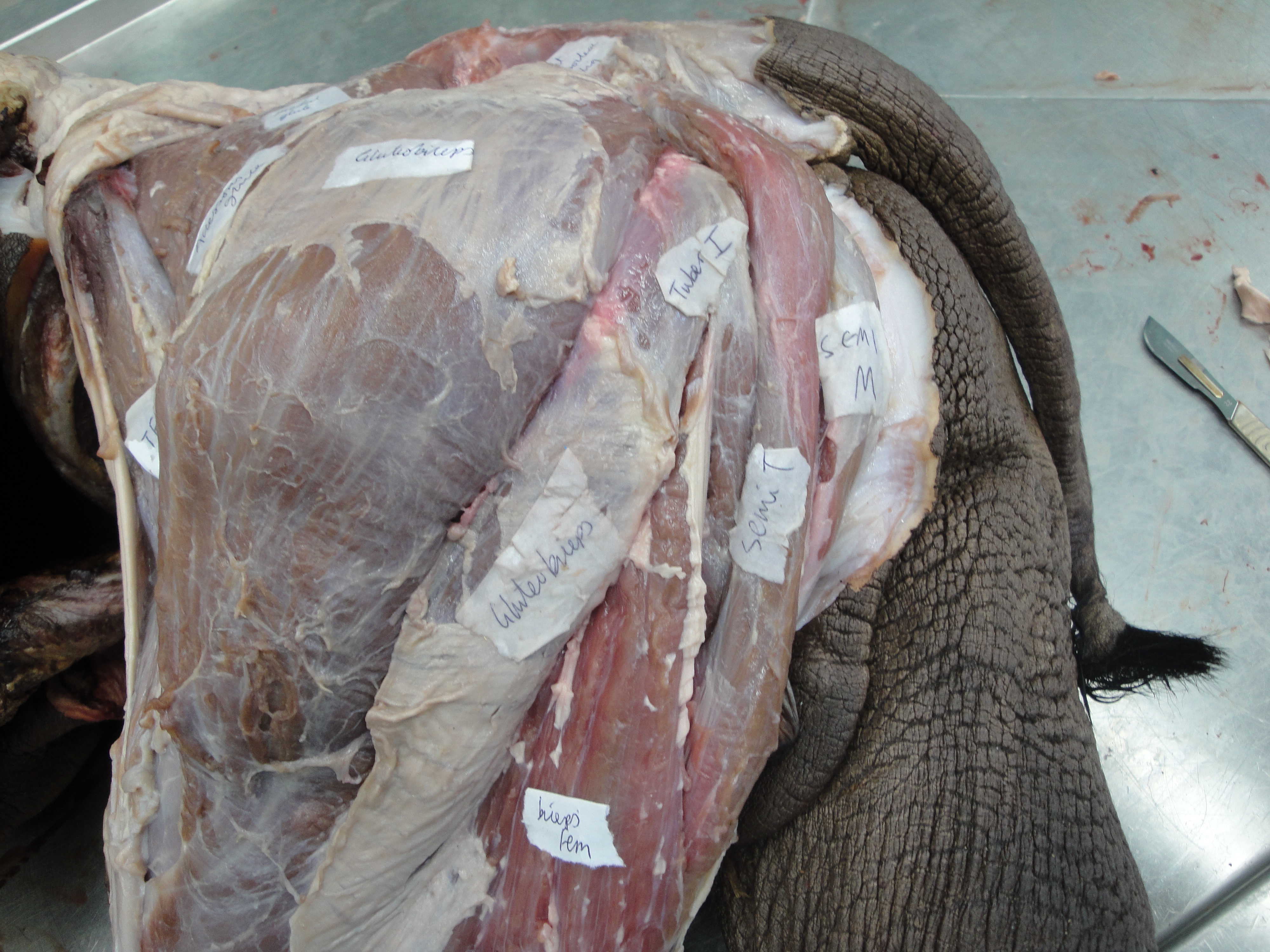
(late addition) Back up the limb, this baby White rhino shows the massive thigh muscles, especially that “gluteobiceps” that attaches to the third trochanter, noted above, and also showing the hamstrings:
Moving down the limb, we encounter the glorious three-toed perissodactyl foot of rhinos, and the robust hooves/nails, which are reasonably healthy in this animal– unlike others I’ve seen:
And the sole of that foot, showing a fairly healthy pad, below. Toward the rear (away from the nails), it culminates in a modest-sized fat pad, or digital cushion, akin to that in elephants but far less well developed and lacking the false “sixth toe” (predigit) (see also CT scan movie of the hindfoot above):
Here’s a view inside that marvelous foot, showing the HUGE digital flexor tendons. These help support the toes against gravity and, in theory, can act to curl them up– although in a rhino’s foot, as in an elephant’s, the toes are more like a single functional hoof, with reduced independence compared to a carnivore or primate:
And that ends our tour of rhinoceros limb anatomy and function. Help spread the word of how precious and threated rhinos are; educate yourself and others! And if you overhear someone talking about using rhino horn for medicine, try to politely educate them on the utter fallacy of this tradition. It is this cruel, greedy, ignorant practice that needs to die; not rhinos. I don’t enjoy receiving dead rhinos, on a personal level, even though the science excites me. I’d rather have many more alive and living good, healthy lives. And my team is trying to do what we can to help others on the “front lines” of rhino conservation make that happen.
For example, Will Fowlds, vet and co-owner of Amakhala Game Reserve, South Africa, recently sent us some images of a white rhino that had been caught in a poacher’s foot snare some years ago. The poor rhino still was having problems healing– we inspected x-ray images and external photos and helped to make an initial diagnosis of osteomyelitis, a nasty infectious, inflammatory foot bone/joint disease. We are following this case to hope that the rhino recovers and contribute help where we can, but the tough job belongs to the keepers/vets on the ground, not to mention the rhinos…
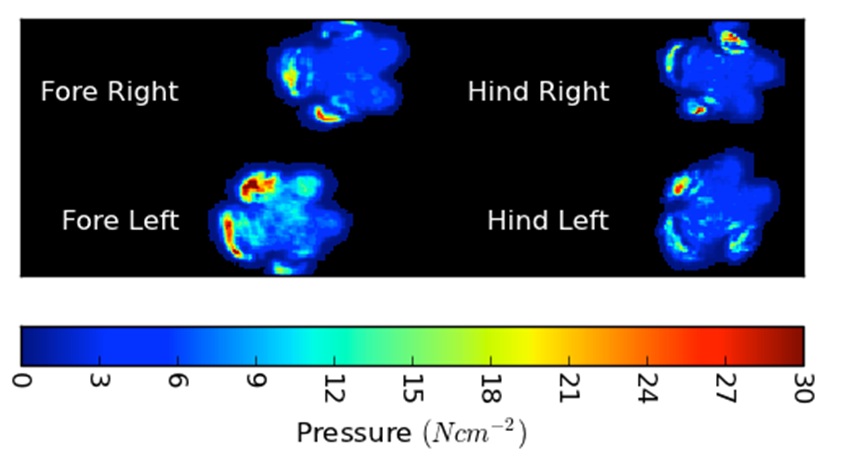
Furthermore, we’ve done foot pressure research covered here, and here is an example of the data we’ve collected (image credit: Dr Olga Panagiotopoulou), showing high pressures on the toes and low pressures on the foot pads:
Big thanks to people on my team that have helped with this and related research: Dr Olga Panagiotopoulou (and Dr Todd Pataky at Shinshu University, Japan), Dr Renate Weller in the VCS Dept at the RVC, Liz Ferrer at Berkeley, and former undergraduate student researchers Sophie Regnault, Richard Harvey, Hinnah Rehman, Richard Sheehan, Kate Jones, Bryony Armson and Suzannah Williams.
A White rhino’s heart, with more images below, all courtesy of William Perez’s Veterinary Anatomy Facebook pages. A mass of around 10kg (22 lbs weight) is not unusual! (Compare with even larger elephant heart)
It’s puzzle time again! For a change, and to make this installment easier but fun and different, I’ll use a movie, of a 3D skeleton segmented from 480 CT slices, rather than just 1 CT slice. Let ‘er rip, folks!
Difficulty: not to scale, and dentition/jaws obscured.
Stomach-Churning Rating: 1/10; c’mon, it’s a CT scan!
(The following post has a Stomach-Churning Rating of 3/10; the dried fish may not get you, but the bad jokes could. A respite before I slap some freezer-spawned Grand Guignolishness on you in future posts.)
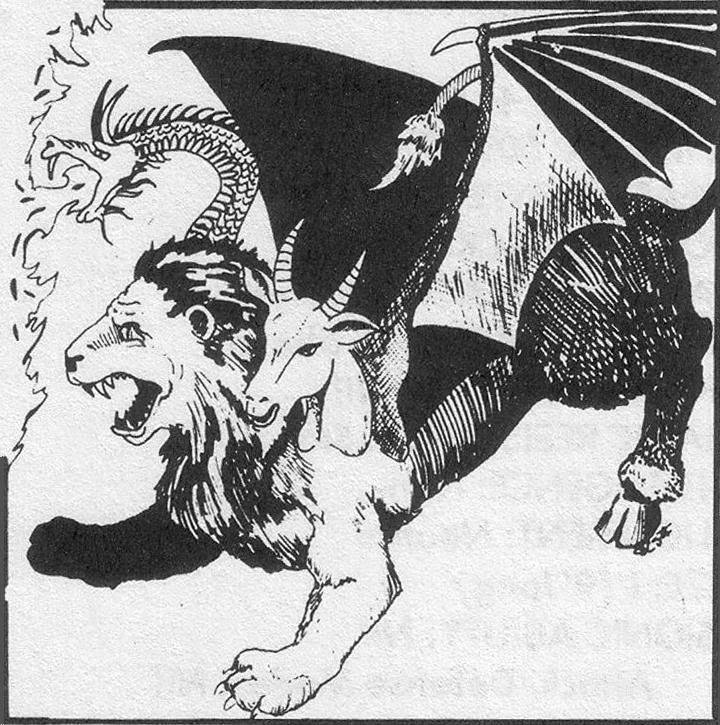
Continuing this crazy summer’s theme of anatomy exhibits in museums, here’s a different twist: using cadavers, or mockups of animal bodies, to create chimeras — fusions of the bodies of multiple species to create new, fanciful organisms. This post was inspired, and will be illustrated, by my visit to Salzburg, Austria’s Haus der Natur, which is well worth a visit for its eclectic cornucopia of exhibits. I’ve also read that the Field Museum’s Mythic Creatures is worth a peek. The post is particularly timely as true chimeras are more and more a thing of scientific reality these days (unsettling testimonial here), although lion-(dragon/snake)-goat hybrids are not coming anytime soon–we can all hope. Enjoy the links! I’ve added a lot of external links to more content if you want to further explore this post’s subjects.
Anyway, my favourite Salzburg escape (from Mozart overdoses that are an all too real- and lethal- threat) was the “Fabel und Mythos” exhibit in the “Mensch und Natur” section of Haus der Natur, which is about just what it sounds like: how natural history and mythology/fantasy intersect. That theme is a passion of mine, as a sci fi/B-movie monster/horror/fantasy film and book fan and as a scientist. It is a big part of why I became a scientist (especially evolutionary biologist/anatomist/palaeontologist) — the junctures of art and science, imagination and reason, fantasy and reality, fascinate me, and if teamed up with the grotesque, monstrous, whimsical and nightmarish, I’m helpless to resist, much as I suspect many of this blog’s readers are. So sit back and enjoy.
Chimeras (in the broader sense of mixed-up animals) have a long history of cultural significance, from Greek myth (and an atrocious recent film featuring The Worthington) even to the godfather of taxonomy, Carl von Linne, and his Animalia Paradoxa. The chimeras (and basilisks, cockatrices, etc.) have featured prominently in the art of the past as well as of the present. People today remain fascinated by the role chimeras and other anatomical tomfooleries have played in hucksterism and hoaxes, as evidenced by many online exhibits such as the Museum of Hoaxes, 15 Craziest Biological Hoaxes, April Fool’s hoaxes, kickass artwork, lamest hoaxes, posts by The Bloggess, sightings of real (i.e. freakish) unicorns in real life, and taxidermy-gone-berserk sites like here and here and here and this cautionary tale; this also overlaps with cryptozoology and WTF-is-that internet fetishes. And let’s not forget the man-bear-pig. No, we shan’t forget that… Nor shall palaeontologists soon forget some famous chimeras in our field, particularly the infamous Piltdown man and Archaeoraptor. These hoaxes incidentally, ended up being not just a temporary embarrassment for science, but also an exemplar of how science is a self-correcting process, so frauds inevitably get unmasked– and in some cases (e.g. Archaeoraptor consisting of two very important legitimate fossils!), science makes new discoveries and advances in that process of corrective peer review.
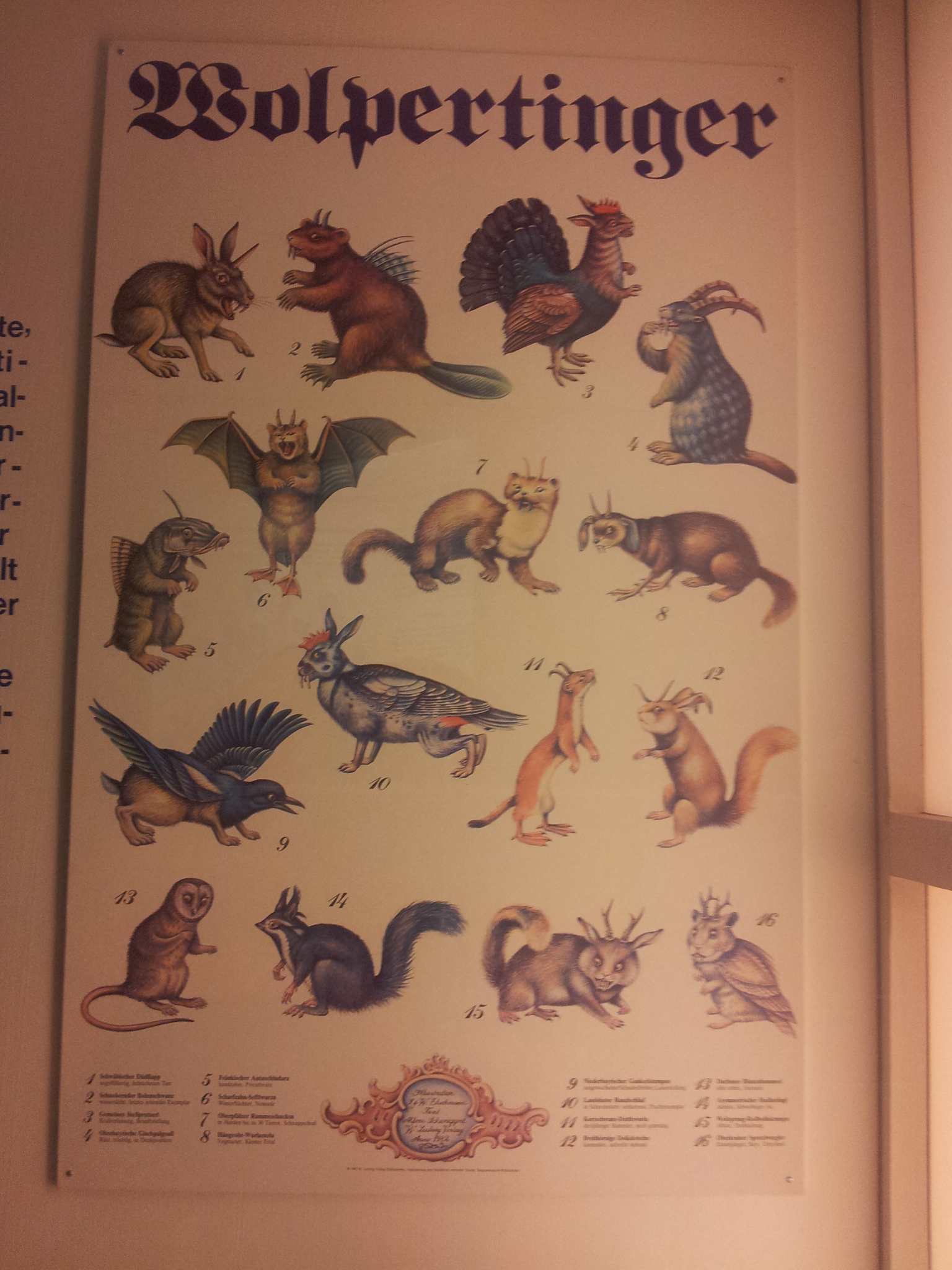
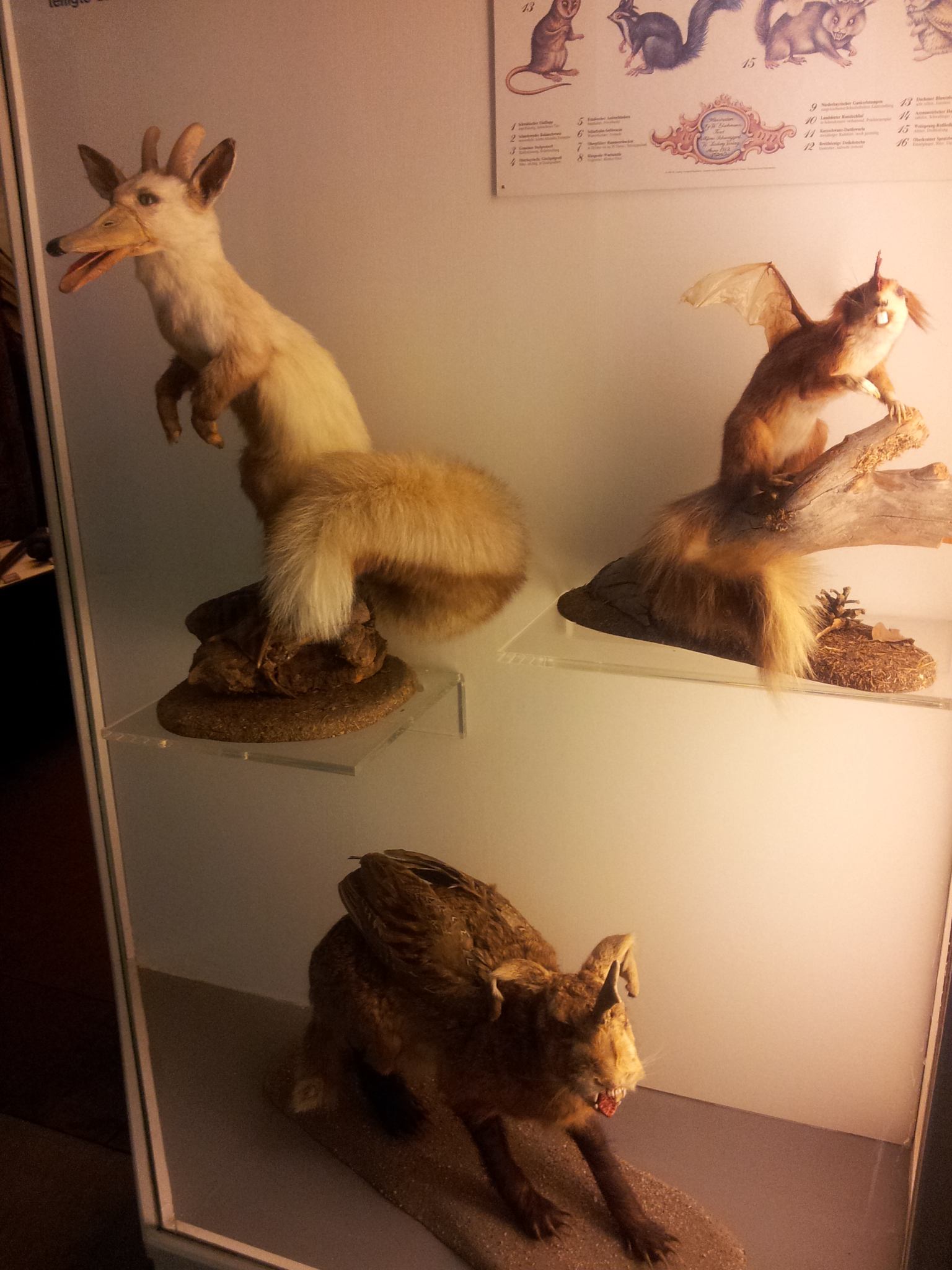
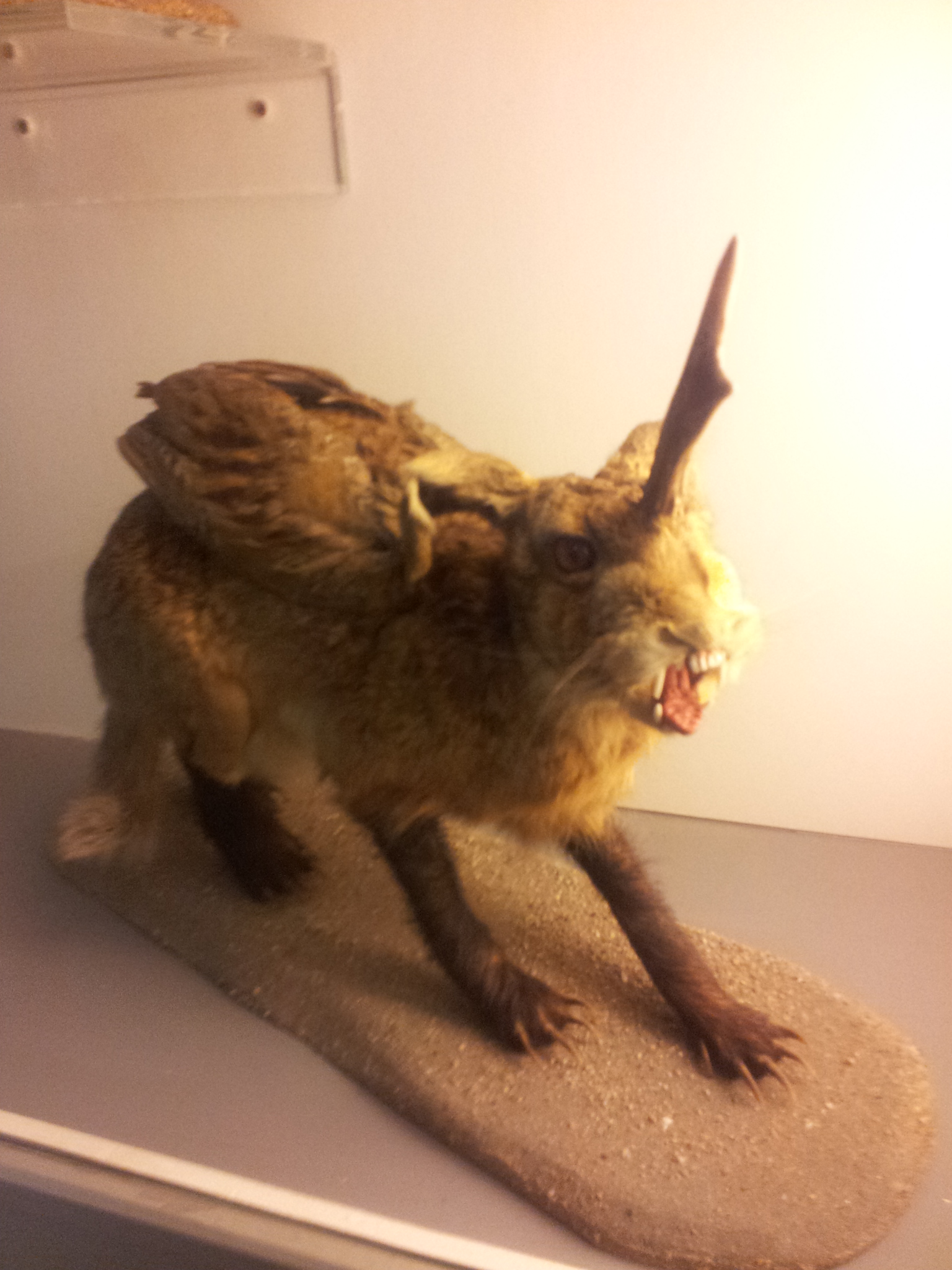
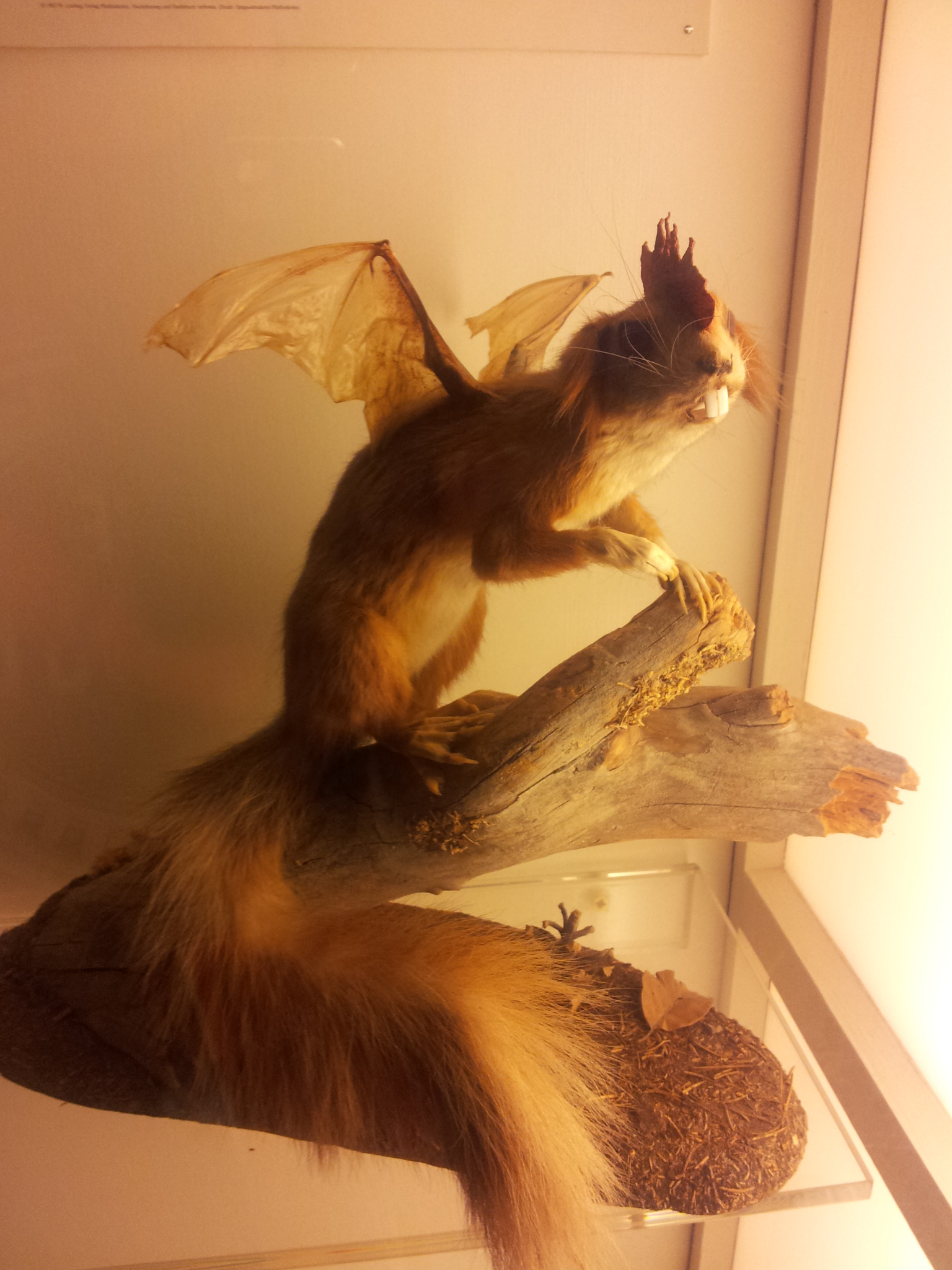
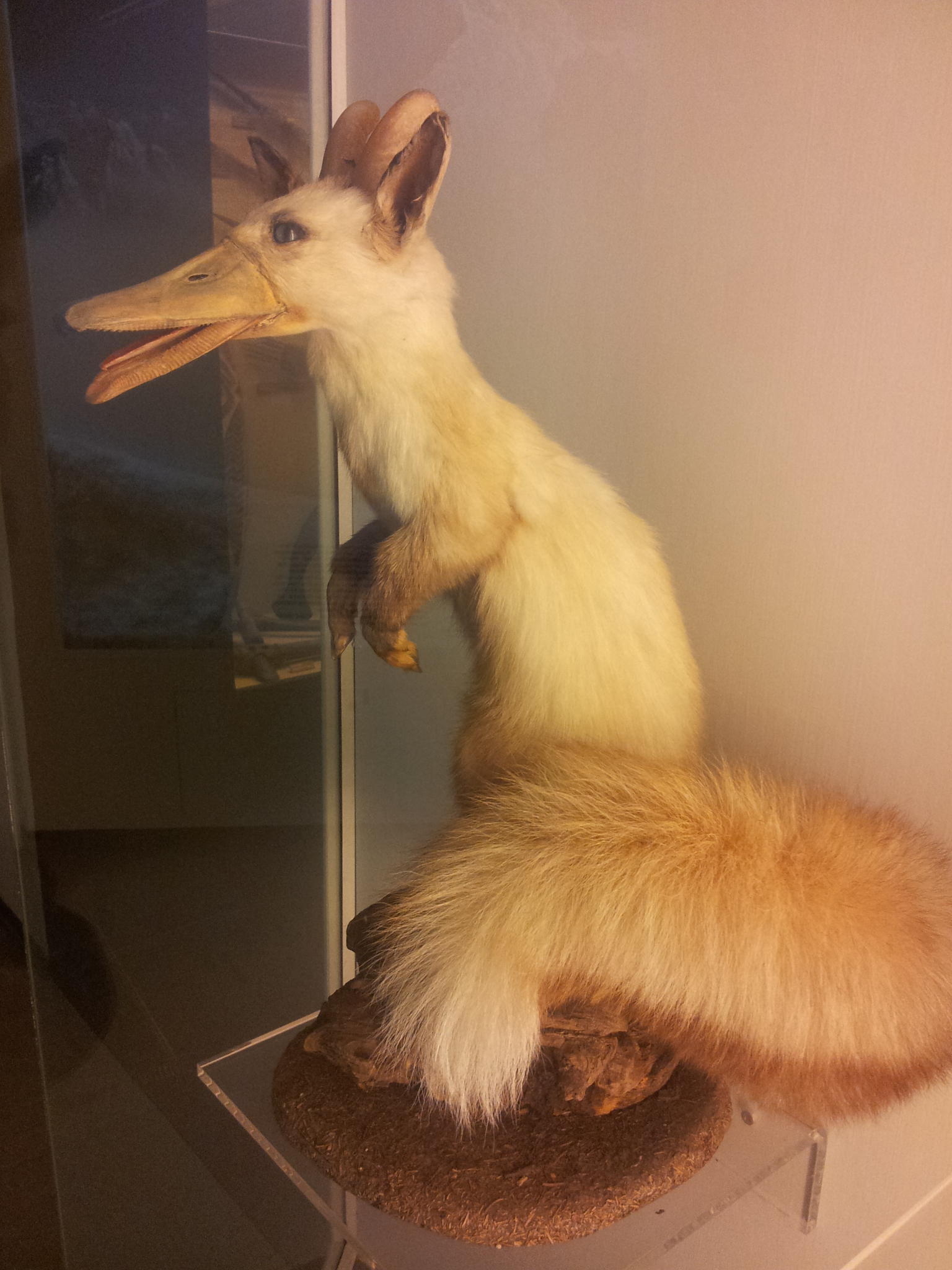
First up in this blog post: the Bavarian Wolpertingers (leaking into native Austrian culture as the Raurackl; AKA Rasselbock, Dilldapp, Skvader and other names; and leaking into video games too)! The wolpertinger is a small and not-so-scary chimera, but often with fairy powers, and is very much akin to that folkloristic mainstay of Americana, the jackrabbit-pronghorn lovechild called the Jackalope. In contrast, however, the jackalope mainly has powers of being a lame souvenir, although fable has it they are prone to ventriloquism, pugnaciousness and whiskey– a fearsome combination (don’t try this at home). This panel from the museum illustrates the diversity and anatomical disparity of Wolpertingers:
And the museum did a great job making some physical chimeras using the wonders of taxidermy… aww, do you want one of your own now?
With closeups below–e.g. the jackalope from hell:
A flight of fancy?
Some quizzical quackery:
Echt toll, meine Freunde! A bit more about wolpertingers and their kin is here. Pokemonologists, take notes. People laughing at the alternative name for wolpertingers, “poontingers,” behave…
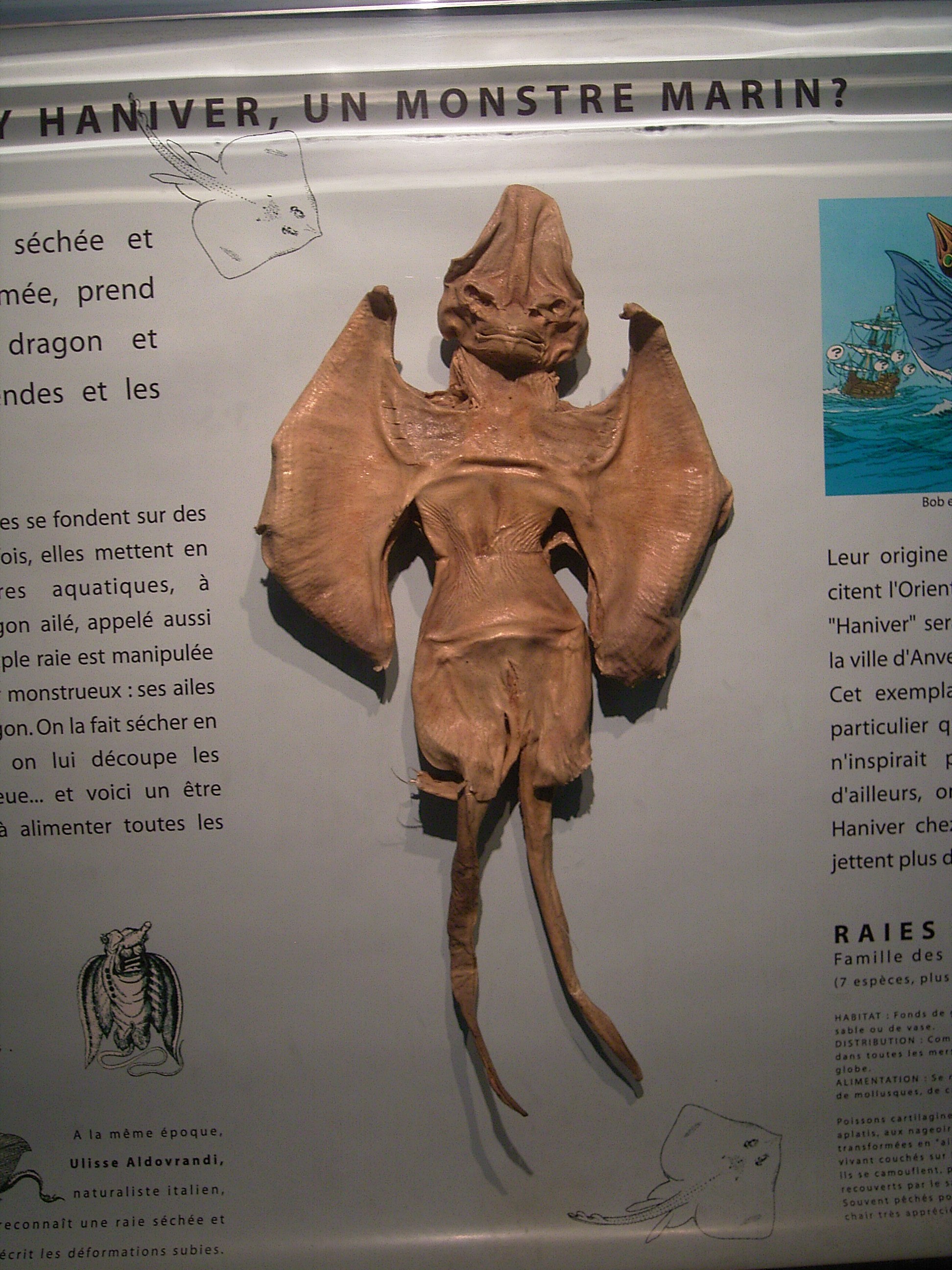
One can hardly discuss chimeras and fake animals/taxidermy hoaxes without getting into mermaids (no, I won’t discuss THAT recent TV debacle) and then into Jenny Hanivers; “devil fish”, seabishops or sea fairies. The hanivers go back to at least the 16th century, even being used by sailors to prove they’d had an exotic adventure after their voyages, or sold to supplement their meager salaries. There is plenty written on this phenomenon and how numerous people were skate punk’d (AHEM) by a simple dried fish. But then, skates (not to be confused with an altogether different, but related, kind of chimera) do look odd, and many people don’t know their anatomy or are just credulous, prone to self-deception and confirmation bias.
Stuart Pond was so kind as to send pics of a J.H. that he has in his shed (spinoff potential: What’s in Stu’s Shed???) for me to share— thanks again man! Note the apparent “legs” (probably organs used in mating’; claspers; but sometimes just snipped bits of the tail, which is also evident here):
Obviously the typical Jenny Haniver is a skate that has been messed with a bit to emphasize the humanoid features, but then there’s a sucker born every minute, and PT Barnum famously took advantage of that rhythmic nativity in the 1842 hoax he called the Fiji (Feejee) mermaid, which was a monkey’s head/torso with fish body and papier maché coating. Below, a wolpertinger-like “horn” is visible; this is the remnants of a nasal process of the chondrocranium of the ray; the flanges to either side of it are parts of the front of the head that have been cut apart to make the haniver’s head look more humanoid:
With a “face” only a mermother- or chondrichthyologist- could love– note that the “eyes” are actually nasal openings:
And thanks to Sven Sachs for some extra photos of a Jenny Haniver at the Zoological Museum Liege in Belgium– thanks Sven!:
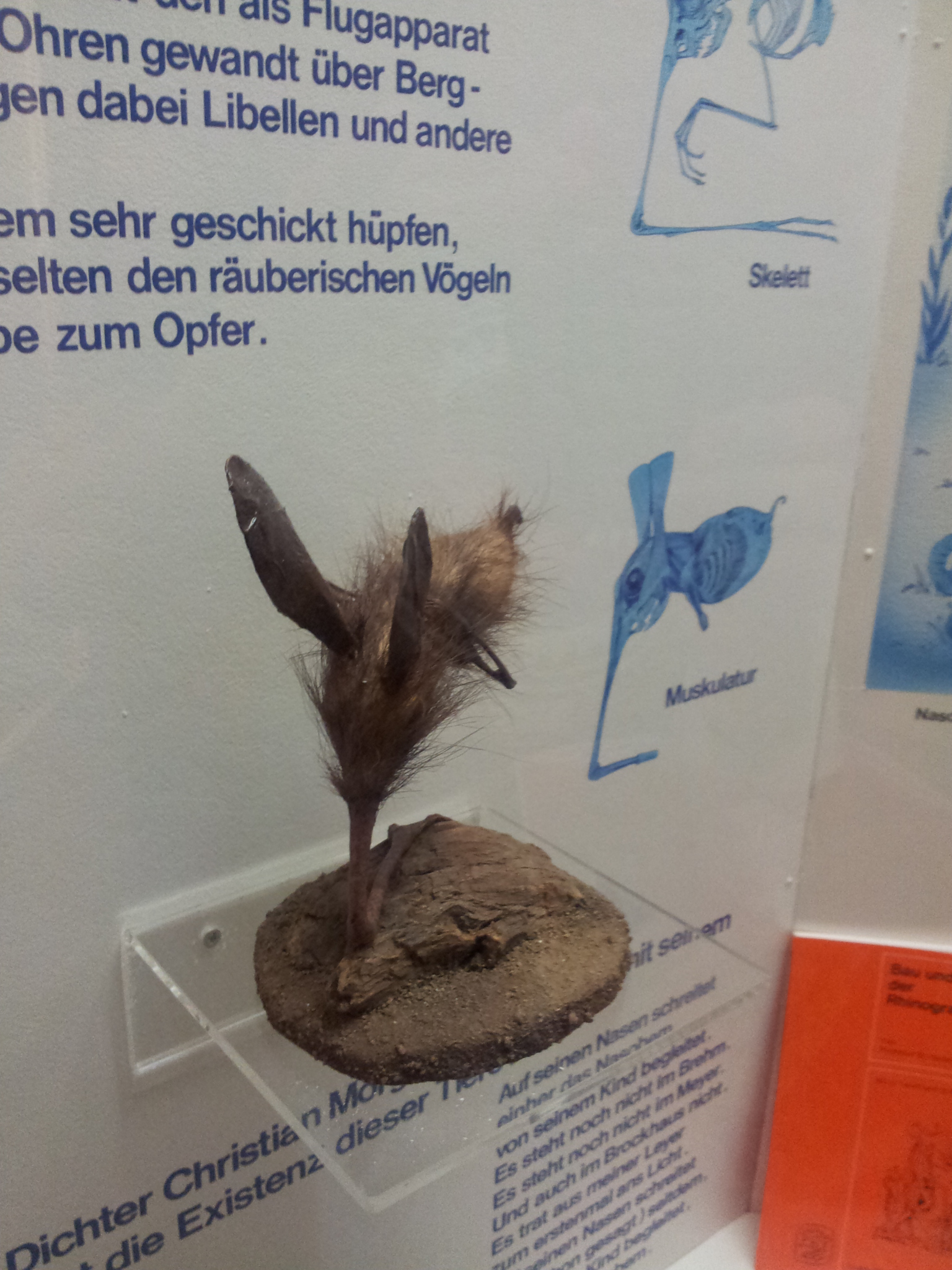
But, in the world of academic science, there is perhaps no greater you-fools-I-invented-a-fanciful-critter hoax/joke than the Rhinogradentia (snouters, or rhinogrades), rumoured in 1905 but first described in Gerolf Steiner/Harald Stümpke’s (latter= pseudonym; AKA Karl D.S. Geeste, Hararuto Shutyunpuke) wonderfully over-the-top, tongue-in-cheekish 1957 faux-scientific monographic book Bau und Leben der Rhinogradentia.Darren Naish‘s blog Tetrapod Zoology (along with others, in 4 parts) has done far better justice to the snouters than I could ever hope to, and others have contributed to the legend. But at least I can share some pics of the first reconstructed (or were they, hmm…?) rhinogrades I’ve ever seen in physical form (again from the Haus der Natur):
Here are the closeups; first Orchidiopsis rapax:
And next Otopteryx volitans:
Last but not beast, an infamous nasobeme, Nasobema lyricum!
























 What's In John's Freezer?