Like other birds, ostriches are fluffy. Too fluffy for some anatomists– so fluffy, it’s hard imagining or estimating what they look like beneath all the feathers. A few years ago, we received an ostrich from a UK farmer. The male bird had been killed by a kick to the neck from another rival, and at the time was supposedly “Britain’s largest ostrich.” As the feathers were valuable to him, the farmer delivered the animal to us whole but plucked. I wanted to dissect it mainly to refresh my memory on ostrich anatomy while developing a biomechanical model of their limbs (see below). Taphonomy expert Jason Moore then buried it for his studies of how bodies decompose.
[Side note: ostriches and other ratites (flightless birds, members of the palaeognath group, whose evolution remains fascinatingly complex) are often brought up as uniquely dinosaur-like. That’s rather misleading; all birds are living dinosaurs, so all birds are descended from an ancestor that was equally ‘dinosaur-like’. What we see of them today is a snapshot that is biased by their recent evolutionary history. During their apparently multiple losses of flight, ratite birds increased in body size and “re-evolved” (or simply enhanced) some traits that were more marked in extinct dinosaurs than in the most recent common ancestor of living birds. Some of those more ‘primitive’ traits may be due to flightlessness, some due to large size, some due to their extreme running specializations; science hasn’t sorted all that out just yet. But the point is, ostriches and other ratites are far from the ancestral form that all birds sprung from, which was probably more like a small, flying tinamou-like animal. Their similarities are due to convergent evolution. And they’re still quite different from something like an “ostrich-mimic” dinosaur- which is a sad misnomer because it’s more that ostriches mimicked (in a naughty teleological sense) ostrich-mimic dinosaurs like Struthiomimus than the other way around; the ornithomimosaurs did it first (Huzzah!). Ratites have just gone back, in some ways but not others (e.g. no long tail or large arms) to a superficially more primitive body form. There have been some wacky ideas to the contrary before, such as the idea that ratites evolved entirely separately from other living birds from different dinosaur stock, but they’re so discredited now by multiple lines of evidence that I won’t glorify them by spending time discussing each. This tangent has gone on too long and must die.]
Anyway, back to the plucked ostrich in question. My first look at it really stunned me. It was a powerful example of just how ‘dinosaurian’ most of the anatomy of living birds is, for reasons noted above. I’d never seen a naked ostrich and now I’ll never look at them the same again. Maybe you won’t, either…
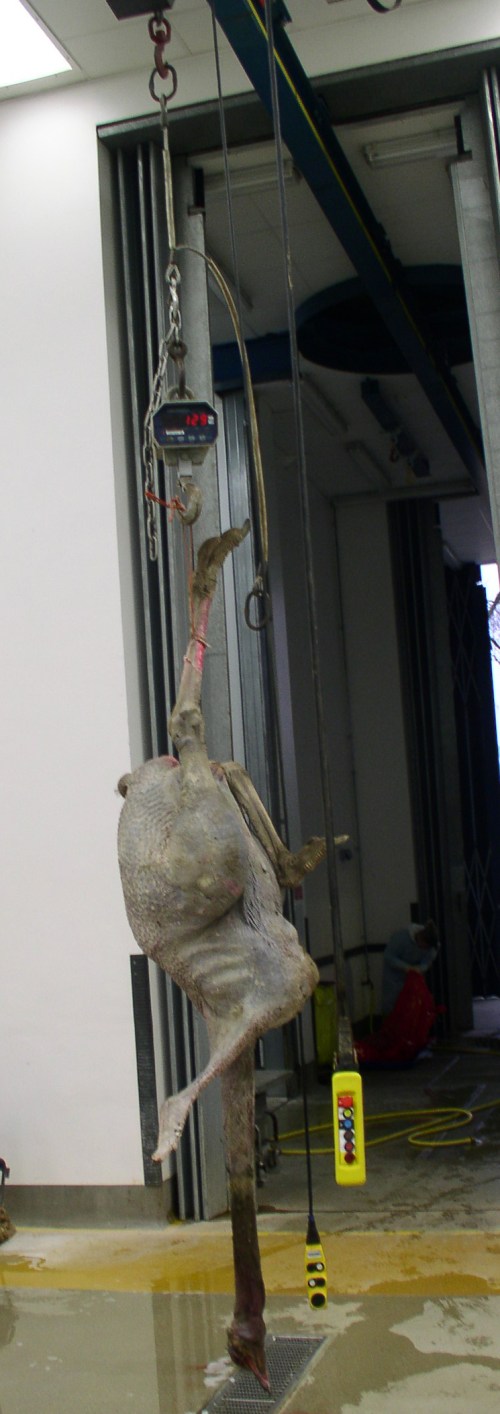
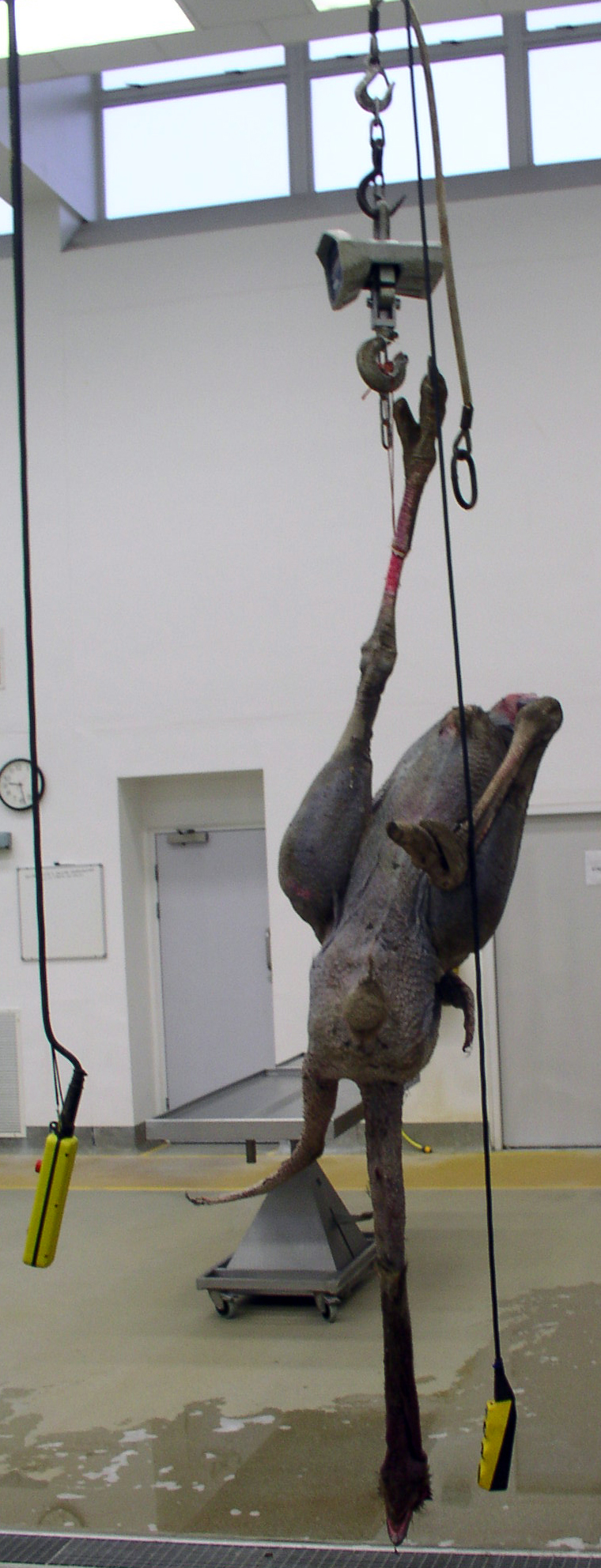
First, some images of the animal once it was brought into our dissection room (which you might recognize from the great Inside Nature’s Giants documentary).

The device near the top of the screen is a digital scale; we were weighing the bird before we cut in…
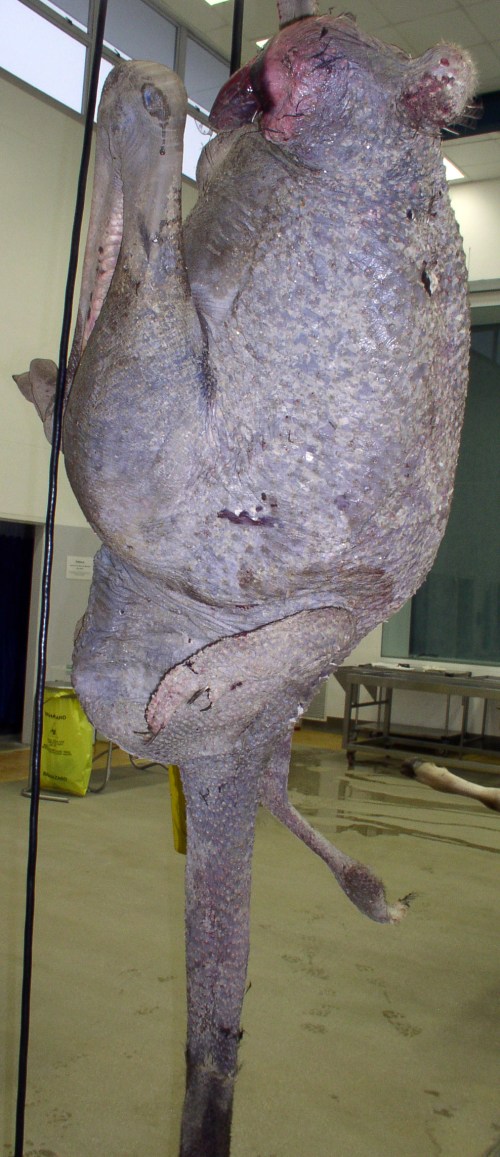
Close-up view of the hugely muscular legs (each leg is around 25% of the animal’s body weight, and mostly muscle; about 50% more bulky than our legs), and the arms (shown more below).

129 kg weight sans feathers; not bad! That’s about 284 pounds for those folks still mired in the medieval Imperial system of units. 🙂

The swollen, bloody region just below the head (on the left above) is where the mortal blow struck. Ouch!
I love the hands of ratite birds. Yes, those are little claws attached to the three vestigial fingers (thumb/first finger at top, long middle finger, and tiny third finger bound to it). Darren Naish covered some of this in a previous post, and let’s not forget SV-POW’s excellent series of “things to make and do” involving various critters including ostriches.
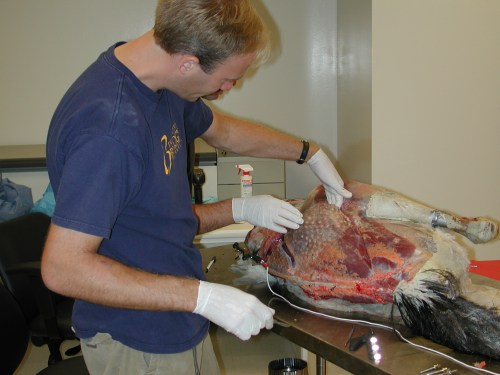
Ostriches and I go way back. Here I am from my less bald immature postdoctoral days at Stanford University in 2002, dissecting a smaller (female, 65kg) ostrich for some biomechanical modelling (still mostly unpublished; aaargh!).
And yes, I had a third hand back then; later lost during a tragic dissection incident involving a battleaxe and a bottle of tequila. I don’t want to talk about that.
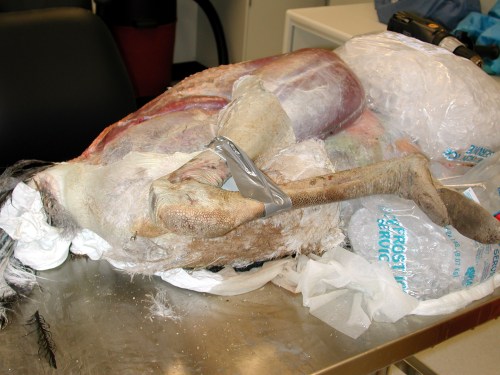
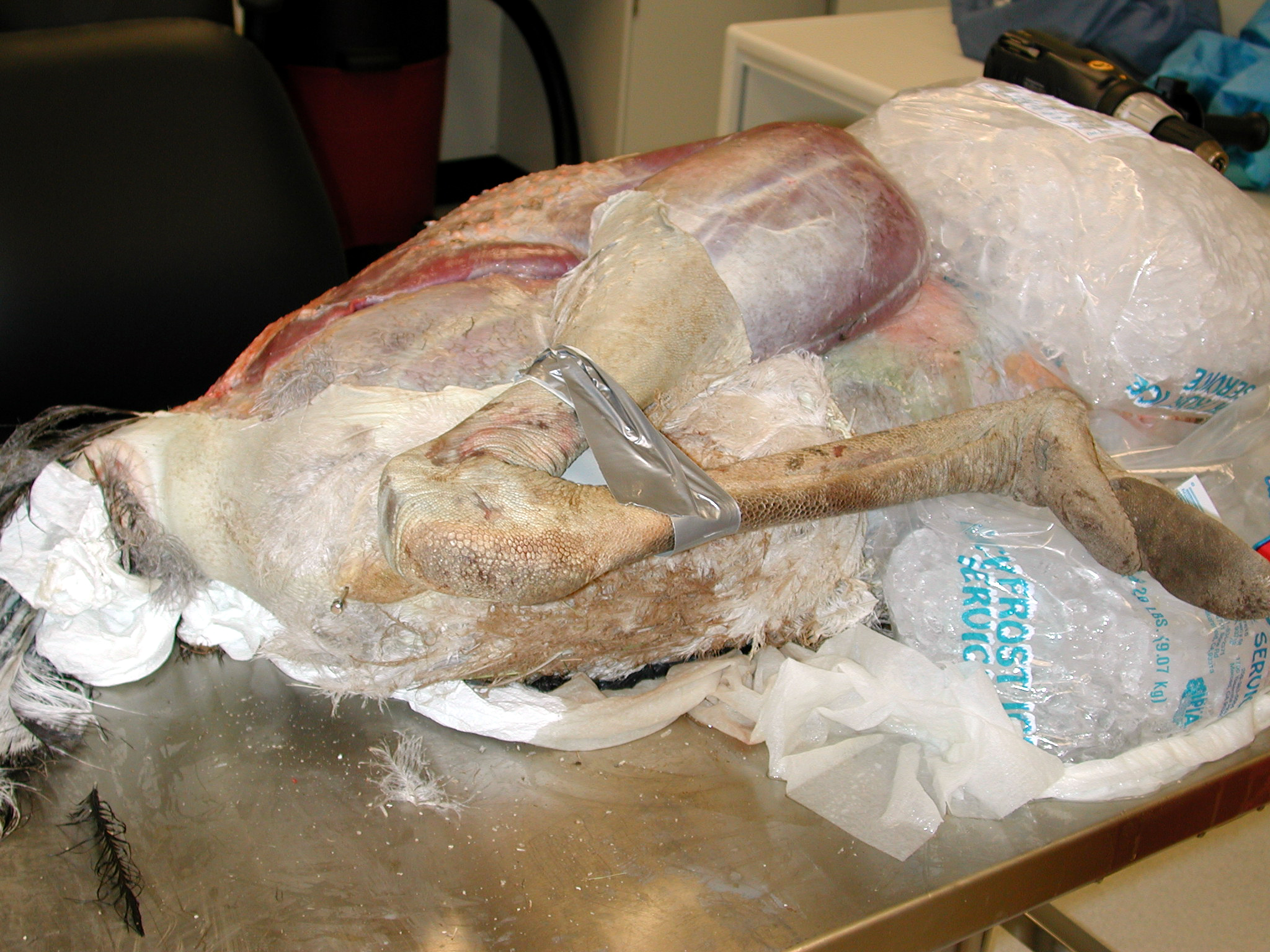
Ostrich packed for transport. Just barely fit in the trunk of my little 1993 Toyota Tercel (R.I.P.)!

Once we complete dissections. we put everything together in some fancy biomechanical computer models (a subject of a future post), resulting in a nice, 3D, poseable, anatomically-realistic model of the entire limb musculature, shown above. This is a right hindlimb in side view, with the individual muscle paths abstracted as red lines. More about this when it is finally published…
This is just a teaser showing off some of the cool external anatomy of ostriches-in-the-buff, and what we’ve done with the anatomical data we’ve gathered. I’ll do a post later showing what’s inside, which is also pretty amazing. Hope you enjoyed it!
Read Full Post »






 What's In John's Freezer?