Hi folks, as my birthday present to you, and big thanks for racking up 70,000 blog views in 7 months (and my 50th post!), here is a new installment of Mystery CT Slice!
This time with a pilot (or scout) scan of an odd object. A pilot/scout scan is a quick, low exposure scan used to plan a series of CT slices, which shows a a larger area that is then narrowed down to focus just on the object of interest and a bit of buffer room for those slices. It generally isn’t used for much else, but sometimes can make a neat picture. As you can see here, the pilot scan area was excessively massive relative to the object. The two odd objects below the primary object of interest are scanning phantoms, used to calibrate density from Hounsfield units to actual real-world density (one is water at 1 g/cm3; the other is “cortical bone” at 1.69 g/cm3). Ignore them.
But what is this object and from what taxon? Be as specific as you can, but pinning it down to genus/species level will be bloody hard!
Stomach Churning Rating: 1/10; it doesn’t get much tamer than a pilot scan.
Difficulty Level: small image, hazy, not a lot of diagnostic traits visible, 1 main element.
In case you haven’t heard, Saturday, September 22nd, 2012 (today, at this writing) is World Rhino Day! The main websites include here and here. Ivan Kwan has also posted a fantastic blog entry “Rhinos are not prehistoric survivors” for WRD2012- check it out! And if you haven’t seen the WitmerLab’s AWESOME Visible Interactive Rhino site, you really really need to (in fact, quit reading this and go there first; it is soooooo good!).
I’ve written about the global rhino crisis before, and about rhino foot pathologies. The title of today’s post may be “cute”, or at least goofy, but the real situation is as grim as the images I’ll share. I won’t repeat the explanation, but all five living species of rhinoceroses are in serious trouble. There’s a good chance that most or all of them will go extinct quite soon– see the previous links for more information on this. Javan and Sumatran rhinos are dangling the most precariously over the precipice of extinction. My goal in this post is to share the beautiful, complex and exotic anatomy of rhinoceros anatomy and movement, and the joy of contributing new scientific information about poorly understood species.
Stomach-Churning Rating: 7/10— dissections, and there are a couple of pics where the specimens are not so fresh, and there’s big skin, and a huge heart.
Baby white rhinoceros. Will frozen specimens like this be all we have of rhinos someday?
The purpose of today’s rhino post is to share a bit more; especially images; of the work my team has done on rhinoceros gait and limb anatomy; all of it unpublished but hopefully coming soon. We’ve steadily been collecting data since ~2005. Because my previous post went through some of this, I’ll keep it brief and image-focused.
First, a video of one of our amusing encounters with a white rhinoceros, at Woburn Safari Park. In this study, we wanted to measure, for the first time really, the gaits (footfall patterns) that a white rhinoceros uses at different speeds, and how often it uses those different gaits. We attached a GPS unit on a horse surcingle around the rhino’s torso, which measured the animal’s speed once a second. We then observed 5 individuals (1 at a time over various days), following them in my station wagon (estate car) across the safari park. We filmed them with a conventional camcorder to document their gaits, and concentrated on the two periods of the day that they’d normally be active: when released from their overnight barn, and when coming in for the night back to that barn. They got rather excited and frisky some of those times. The GPS belt then kept recording speeds for the rest of the day; unsurprisingly, the rhinos generally did not do much. I have to thank Nick Whiting, rhino handler, for his help making this research happen. I’ve been meaning for too long to finish the final paper… soon, I hope! Enjoy this tense scene of a rhino investigating my car (driven by me and with an undergraduate student filming) then having a nice canter/gallop across the field (accompanied by my jubilant narration).
Like our foot pressure research, we aim that this work provides baseline data useful to caretakers of rhinos; for example, to test if a particular animal is lame. This follows what we’ve successfully done with elephant gaits and feet, translating basic research into more clinical application. But my major scientific interest is in understanding more about what makes any rhinoceros, even a 2-tonne White rhino, so much more athletic than any elephant (even a baby or 2-tonne small adult Asian elephant). As the video shows, they can use a variety of gaits including cantering and galloping, and trotting at slower running speeds. No elephant ever does that, and no one knows precisely why. The leg bones are more robust, but the muscles aren’t that dramatically larger in rhinos.
An Indian rhinoceros forelimb- note the characteristic knobbly hide, unlike the smoother, more elephant-like hide of a White rhinoceros.
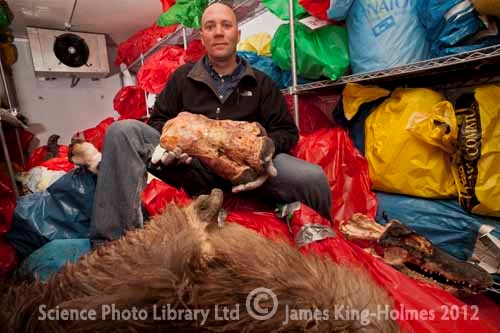
Similarly, the anatomical work we do with rhinos is intended to not only be useful science for comparative biologists like me, showing how rhino limbs work and how they differ from those of other animals, but also to aid clinicians in comparing normal vs. pathological anatomy. For conveying that anatomical work, I’m lucky to have been granted permission to use a professional photographer’s pictures of some of my freezers’ rhino specimens– big thanks to James King-Holmes and the Science Photo Library. The watermarked images below belong to them. I ask that you do not use them elsewhere, honouring their license to me for personal usage on this website (and I will only use them here). I’m in all the images, which makes me feel weird putting them up here, but it’s about the rhinos (and freezers), not me. First: the infamous “rhino foot freezer”, featuring some of its denizens:
…and inside we go (and I begin to get frosty and numb-fingered from holding a foot; my smile soon fades):
Taking a rest with the skinned white rhinoceros foot:
And now warming up at the “digital freezer”, our CT scanner, and preparing to scan another rhinoceros foot, which segues nicely out of this image sequence:
Now over to some 3D anatomy– segmented reconstructions of rhinoceros fore (top) and hind (bottom) feet, from CT scans; if you’ve frequented this blog you know the drill. Here, the longest bones are the metacarpals/metatarsals and the upper bones are the carpals/tarsals, then the bones near the botttom are the phalanges, which connect to the hooves (visible in the bottom image):
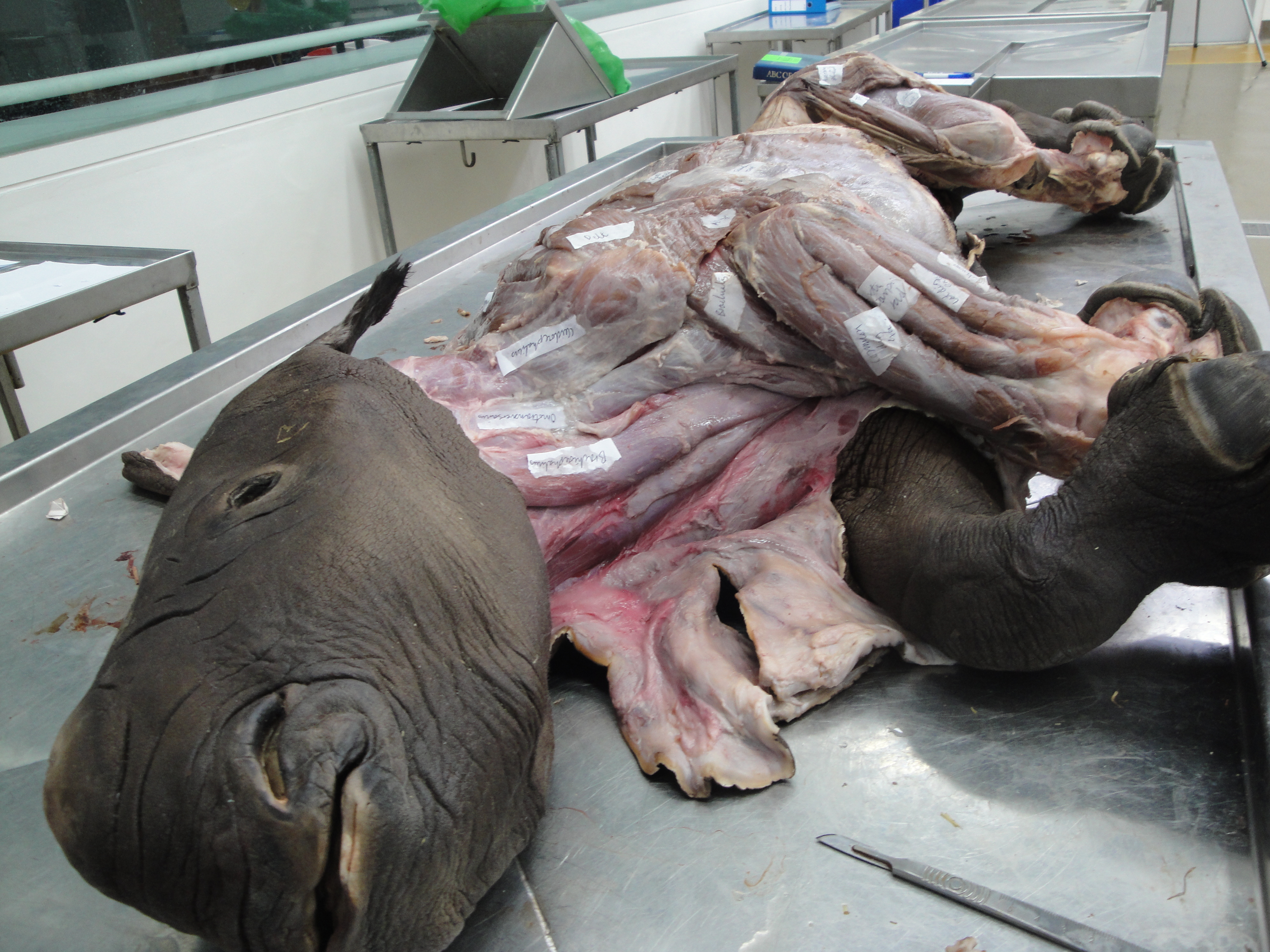
I’ll wrap up with a series of images of basic limb muscle anatomy from dissections we’ve done of baby and adult Indian and White rhinoceroses. First, here’s what a rhino looks like underneath the skin:
But ahh that skin, that fabled “pachyderm” skin! A rhino’s greatest defense is also a real chore to get through in a dissection. Here, we enlist the help of a crane and hook, hurrying to get down to the muscles of this forelimb before rotting takes over too much (as with other big animals, this is a tough race against time even in chilly England!):
Here is a closer look at that amazing armoured skin; sometimes 10cm or so thick:
Back to the forelimb muscles– stocky and well-defined for this athletic animal:
(late addition) Here are the massive shoulder muscles, such as the serratus and latissimus dorsi (this is a left limb in side view; head is toward the left):
And now a close look at the forearm muscles:
And then over to the hindlimb, here from an adult Indian rhino, whose thigh bone (femur) shows the characteristic giant “third trochanter” (toward the bottom centre of the image), which is an expanded bony attachment for the giant “gluteobiceps” muscle complex that retracts the femur for the power stroke in locomotion. Also, this specimen showed fascinating anatomy that I’d never seen before: the third trochanter has a thin bar of bone that extends up (toward the bottom left in the image) to fuse with the greater trochanter, opposite the head of the femur (upper left corner):
Damn my photography skills, cutting off the edge of that image and instead giving a view of my boots! Anyway, another interesting feature of that femur: the medial (inner) condyle of the femur (knee joint surface) has a pink stripe of worn cartilage. This is indicative of at least a moderate stage of arthritis, shown here (look for the pinkness amidst the shiny, healthy white cartilage on the upper right side). It is an exemplar of serious welfare problems that some captive, and probably some wild as well, rhinos face:
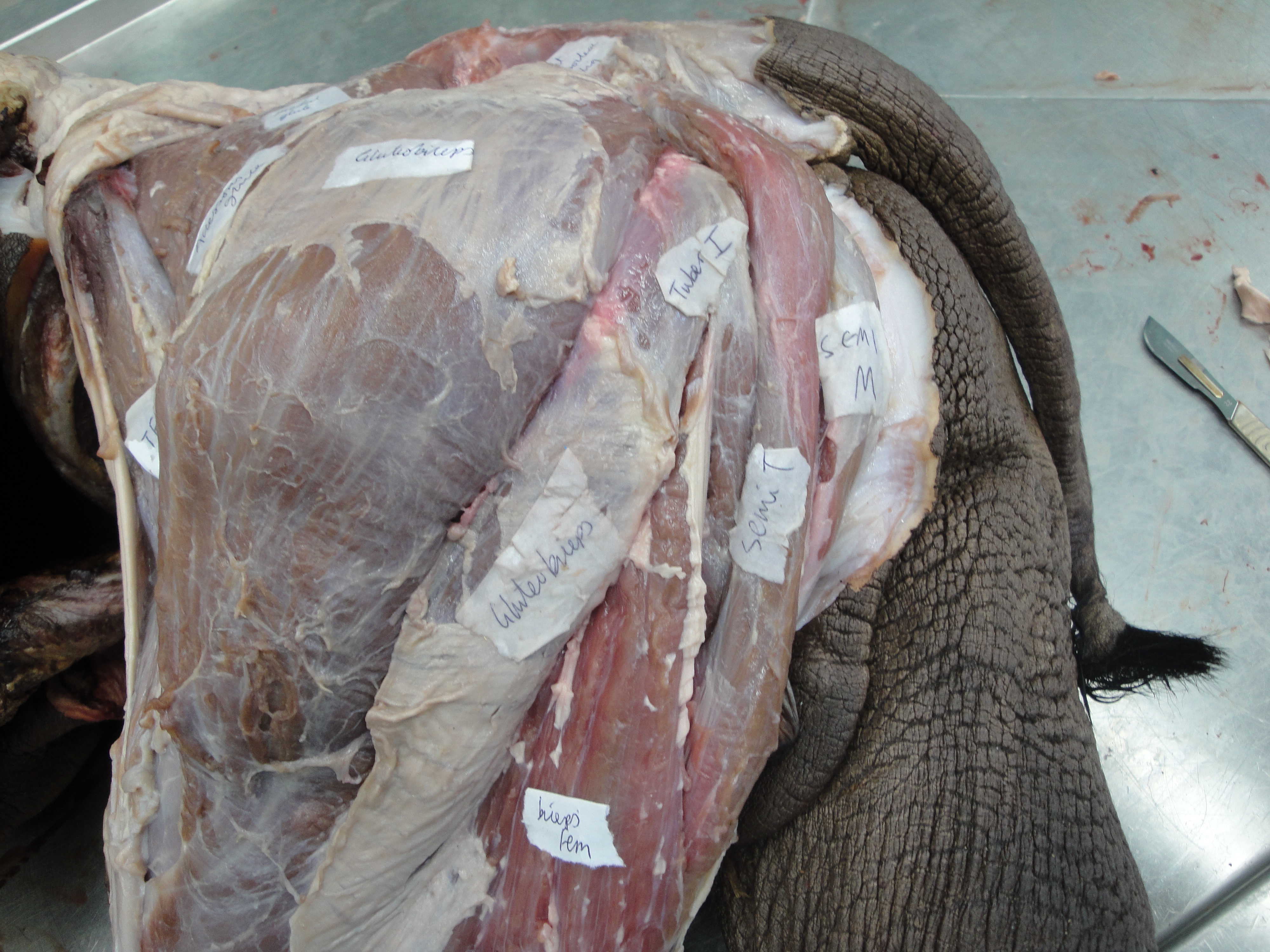
(late addition) Back up the limb, this baby White rhino shows the massive thigh muscles, especially that “gluteobiceps” that attaches to the third trochanter, noted above, and also showing the hamstrings:
Moving down the limb, we encounter the glorious three-toed perissodactyl foot of rhinos, and the robust hooves/nails, which are reasonably healthy in this animal– unlike others I’ve seen:
And the sole of that foot, showing a fairly healthy pad, below. Toward the rear (away from the nails), it culminates in a modest-sized fat pad, or digital cushion, akin to that in elephants but far less well developed and lacking the false “sixth toe” (predigit) (see also CT scan movie of the hindfoot above):
Here’s a view inside that marvelous foot, showing the HUGE digital flexor tendons. These help support the toes against gravity and, in theory, can act to curl them up– although in a rhino’s foot, as in an elephant’s, the toes are more like a single functional hoof, with reduced independence compared to a carnivore or primate:
And that ends our tour of rhinoceros limb anatomy and function. Help spread the word of how precious and threated rhinos are; educate yourself and others! And if you overhear someone talking about using rhino horn for medicine, try to politely educate them on the utter fallacy of this tradition. It is this cruel, greedy, ignorant practice that needs to die; not rhinos. I don’t enjoy receiving dead rhinos, on a personal level, even though the science excites me. I’d rather have many more alive and living good, healthy lives. And my team is trying to do what we can to help others on the “front lines” of rhino conservation make that happen.
For example, Will Fowlds, vet and co-owner of Amakhala Game Reserve, South Africa, recently sent us some images of a white rhino that had been caught in a poacher’s foot snare some years ago. The poor rhino still was having problems healing– we inspected x-ray images and external photos and helped to make an initial diagnosis of osteomyelitis, a nasty infectious, inflammatory foot bone/joint disease. We are following this case to hope that the rhino recovers and contribute help where we can, but the tough job belongs to the keepers/vets on the ground, not to mention the rhinos…
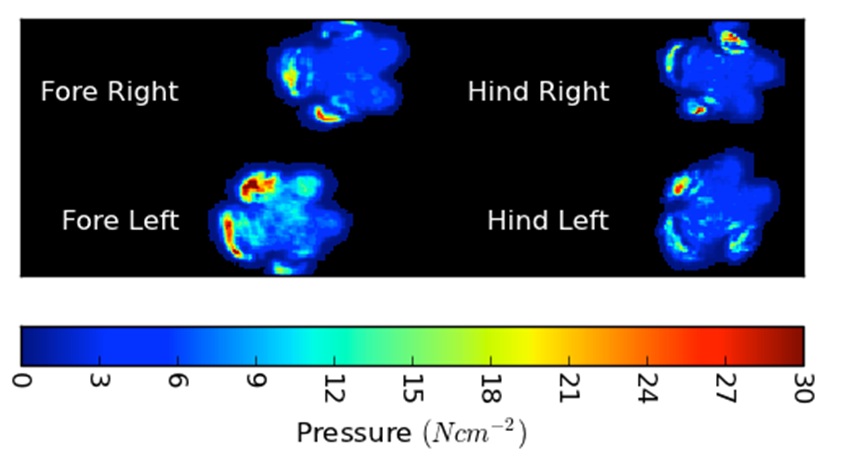
Furthermore, we’ve done foot pressure research covered here, and here is an example of the data we’ve collected (image credit: Dr Olga Panagiotopoulou), showing high pressures on the toes and low pressures on the foot pads:
Big thanks to people on my team that have helped with this and related research: Dr Olga Panagiotopoulou (and Dr Todd Pataky at Shinshu University, Japan), Dr Renate Weller in the VCS Dept at the RVC, Liz Ferrer at Berkeley, and former undergraduate student researchers Sophie Regnault, Richard Harvey, Hinnah Rehman, Richard Sheehan, Kate Jones, Bryony Armson and Suzannah Williams.
A White rhino’s heart, with more images below, all courtesy of William Perez’s Veterinary Anatomy Facebook pages. A mass of around 10kg (22 lbs weight) is not unusual! (Compare with even larger elephant heart)
It’s puzzle time again! For a change, and to make this installment easier but fun and different, I’ll use a movie, of a 3D skeleton segmented from 480 CT slices, rather than just 1 CT slice. Let ‘er rip, folks!
Difficulty: not to scale, and dentition/jaws obscured.
Stomach-Churning Rating: 1/10; c’mon, it’s a CT scan!
(The following post has a Stomach-Churning Rating of 3/10; the dried fish may not get you, but the bad jokes could. A respite before I slap some freezer-spawned Grand Guignolishness on you in future posts.)
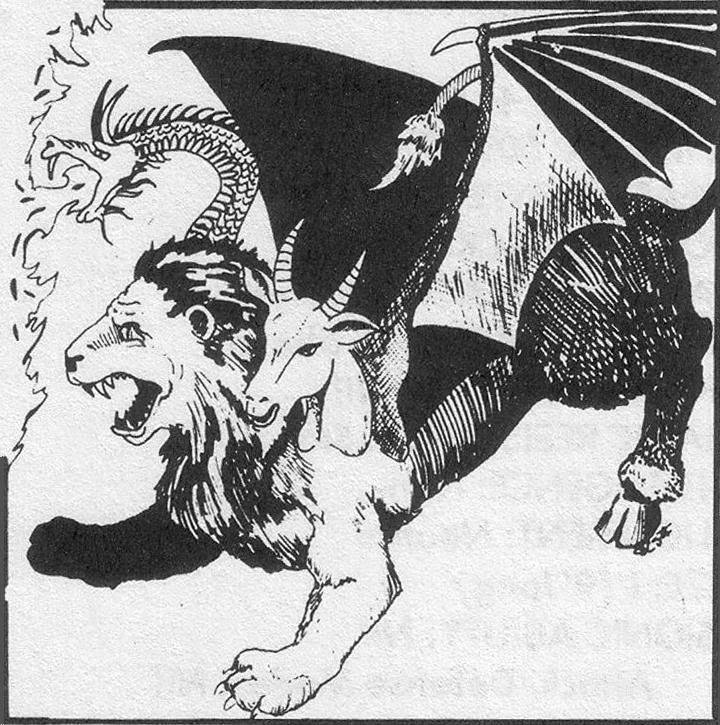
Continuing this crazy summer’s theme of anatomy exhibits in museums, here’s a different twist: using cadavers, or mockups of animal bodies, to create chimeras — fusions of the bodies of multiple species to create new, fanciful organisms. This post was inspired, and will be illustrated, by my visit to Salzburg, Austria’s Haus der Natur, which is well worth a visit for its eclectic cornucopia of exhibits. I’ve also read that the Field Museum’s Mythic Creatures is worth a peek. The post is particularly timely as true chimeras are more and more a thing of scientific reality these days (unsettling testimonial here), although lion-(dragon/snake)-goat hybrids are not coming anytime soon–we can all hope. Enjoy the links! I’ve added a lot of external links to more content if you want to further explore this post’s subjects.
Anyway, my favourite Salzburg escape (from Mozart overdoses that are an all too real- and lethal- threat) was the “Fabel und Mythos” exhibit in the “Mensch und Natur” section of Haus der Natur, which is about just what it sounds like: how natural history and mythology/fantasy intersect. That theme is a passion of mine, as a sci fi/B-movie monster/horror/fantasy film and book fan and as a scientist. It is a big part of why I became a scientist (especially evolutionary biologist/anatomist/palaeontologist) — the junctures of art and science, imagination and reason, fantasy and reality, fascinate me, and if teamed up with the grotesque, monstrous, whimsical and nightmarish, I’m helpless to resist, much as I suspect many of this blog’s readers are. So sit back and enjoy.
Chimeras (in the broader sense of mixed-up animals) have a long history of cultural significance, from Greek myth (and an atrocious recent film featuring The Worthington) even to the godfather of taxonomy, Carl von Linne, and his Animalia Paradoxa. The chimeras (and basilisks, cockatrices, etc.) have featured prominently in the art of the past as well as of the present. People today remain fascinated by the role chimeras and other anatomical tomfooleries have played in hucksterism and hoaxes, as evidenced by many online exhibits such as the Museum of Hoaxes, 15 Craziest Biological Hoaxes, April Fool’s hoaxes, kickass artwork, lamest hoaxes, posts by The Bloggess, sightings of real (i.e. freakish) unicorns in real life, and taxidermy-gone-berserk sites like here and here and here and this cautionary tale; this also overlaps with cryptozoology and WTF-is-that internet fetishes. And let’s not forget the man-bear-pig. No, we shan’t forget that… Nor shall palaeontologists soon forget some famous chimeras in our field, particularly the infamous Piltdown man and Archaeoraptor. These hoaxes incidentally, ended up being not just a temporary embarrassment for science, but also an exemplar of how science is a self-correcting process, so frauds inevitably get unmasked– and in some cases (e.g. Archaeoraptor consisting of two very important legitimate fossils!), science makes new discoveries and advances in that process of corrective peer review.
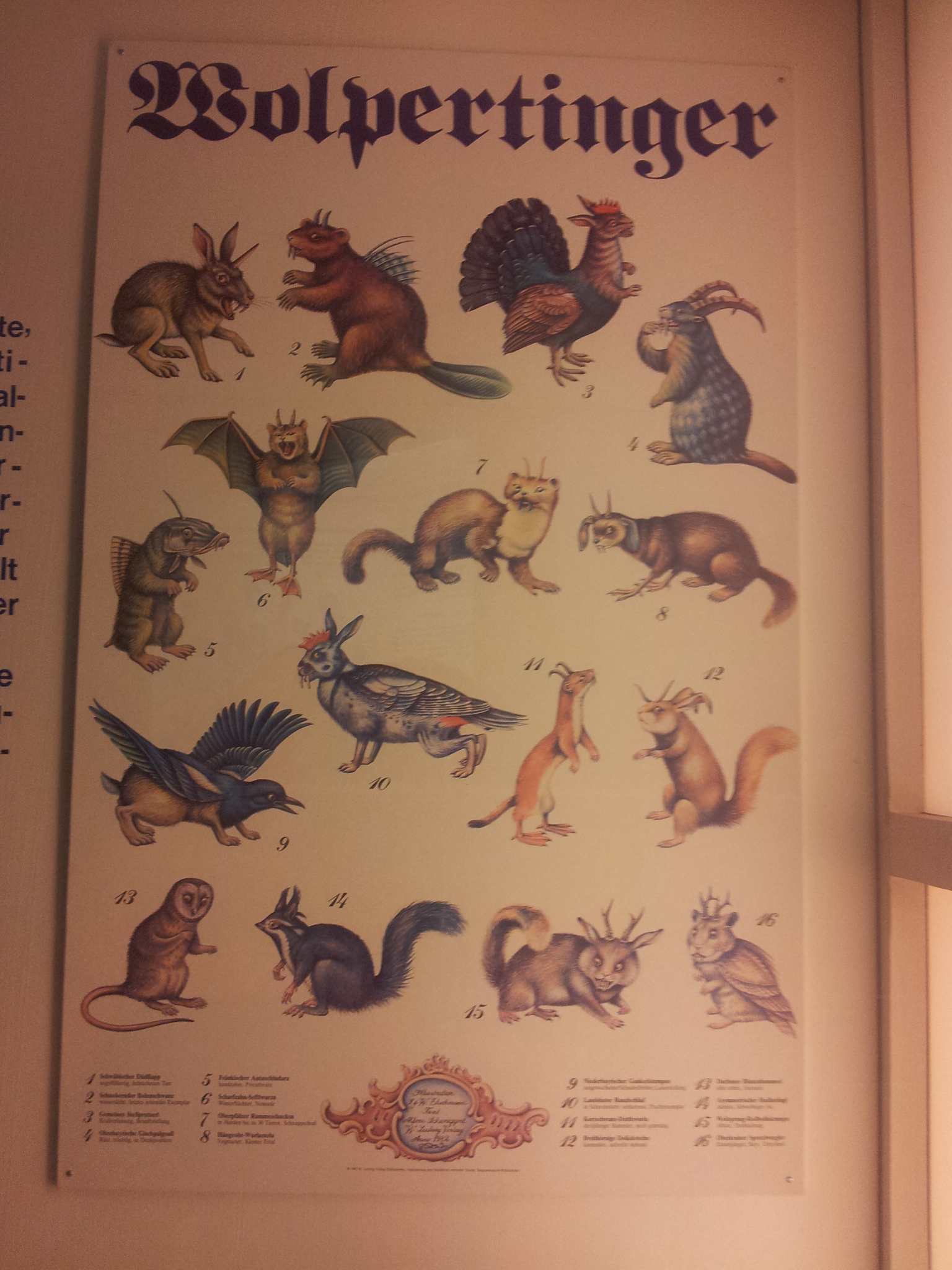
First up in this blog post: the Bavarian Wolpertingers (leaking into native Austrian culture as the Raurackl; AKA Rasselbock, Dilldapp, Skvader and other names; and leaking into video games too)! The wolpertinger is a small and not-so-scary chimera, but often with fairy powers, and is very much akin to that folkloristic mainstay of Americana, the jackrabbit-pronghorn lovechild called the Jackalope. In contrast, however, the jackalope mainly has powers of being a lame souvenir, although fable has it they are prone to ventriloquism, pugnaciousness and whiskey– a fearsome combination (don’t try this at home). This panel from the museum illustrates the diversity and anatomical disparity of Wolpertingers:
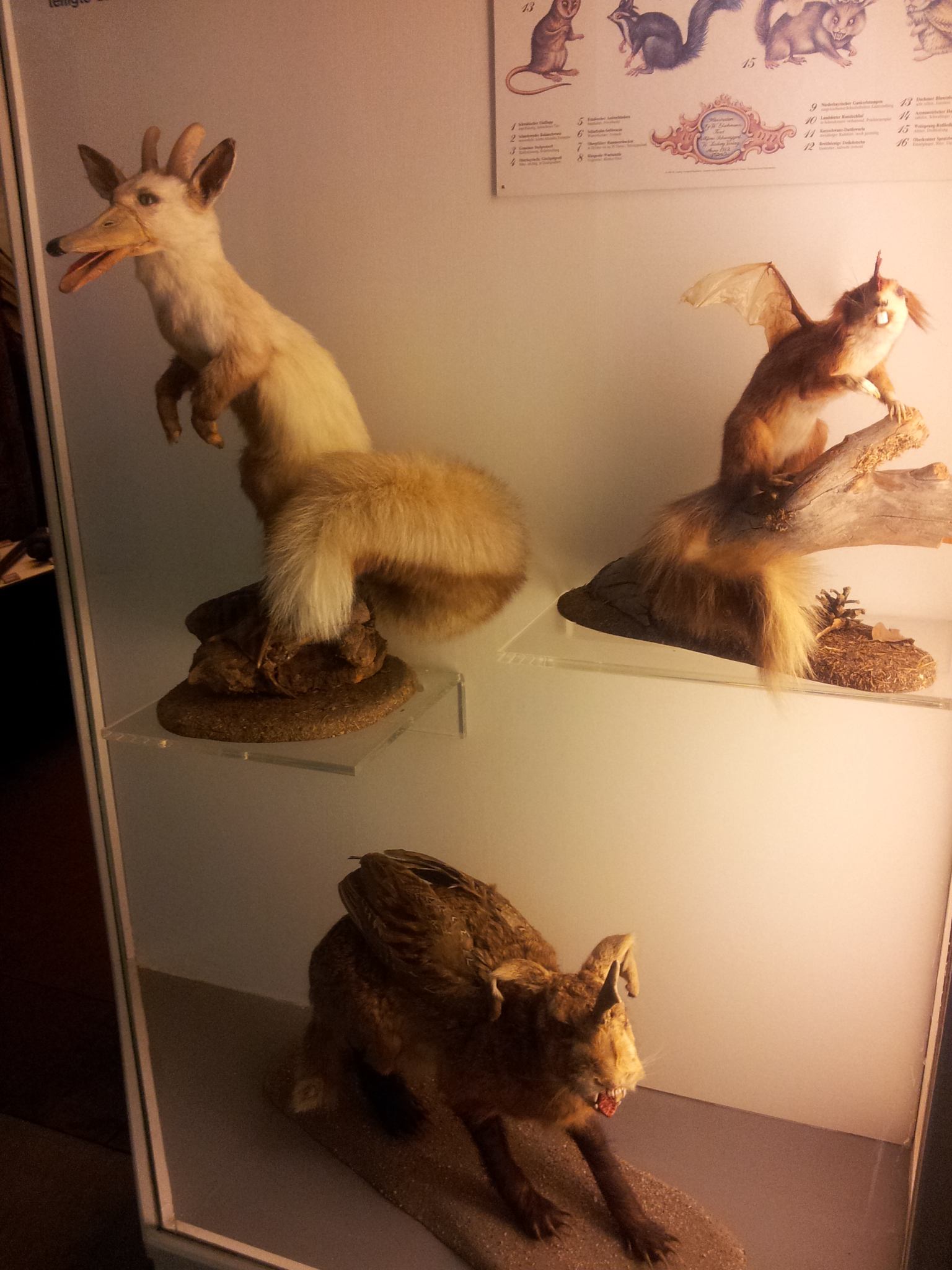
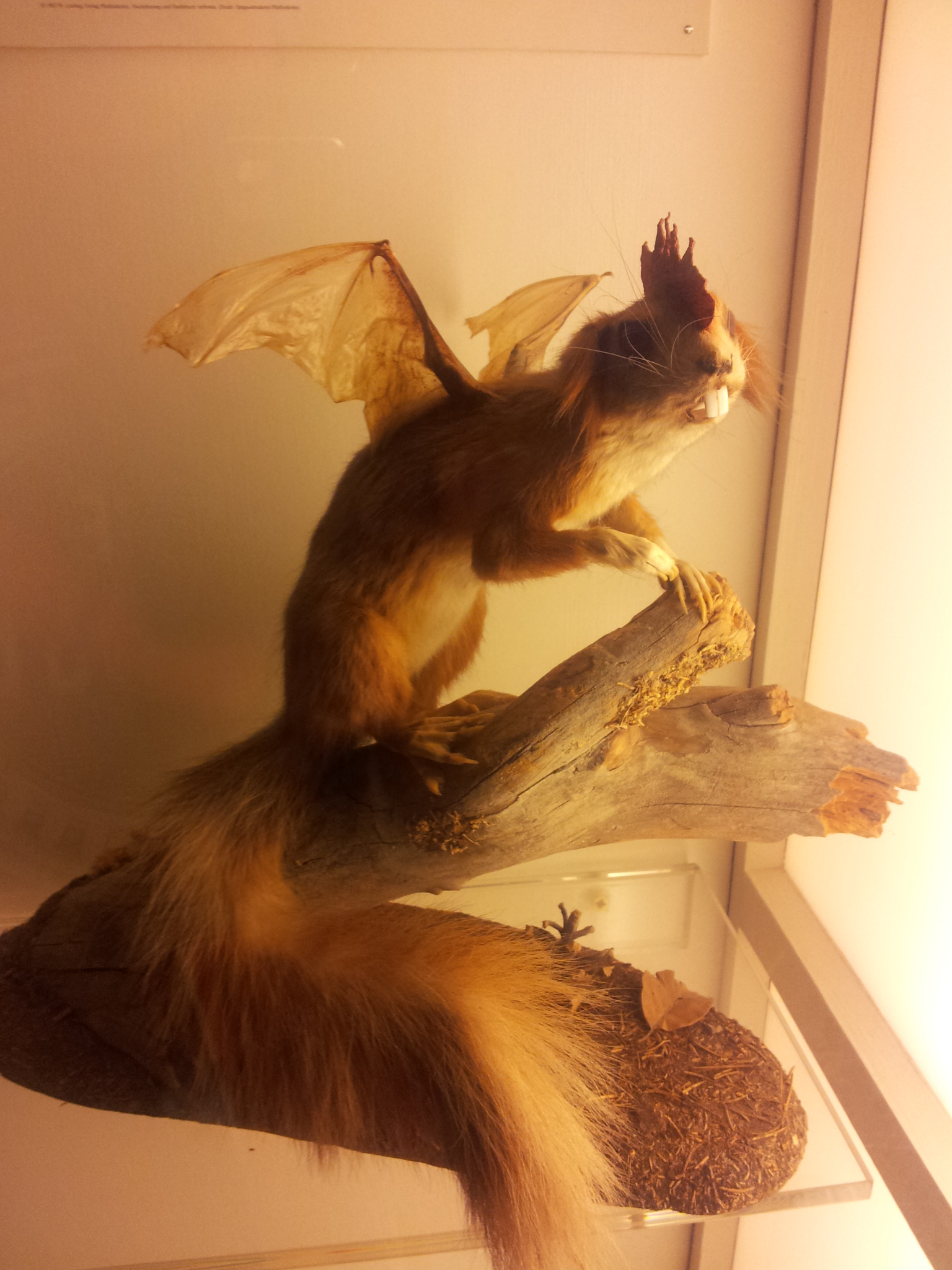
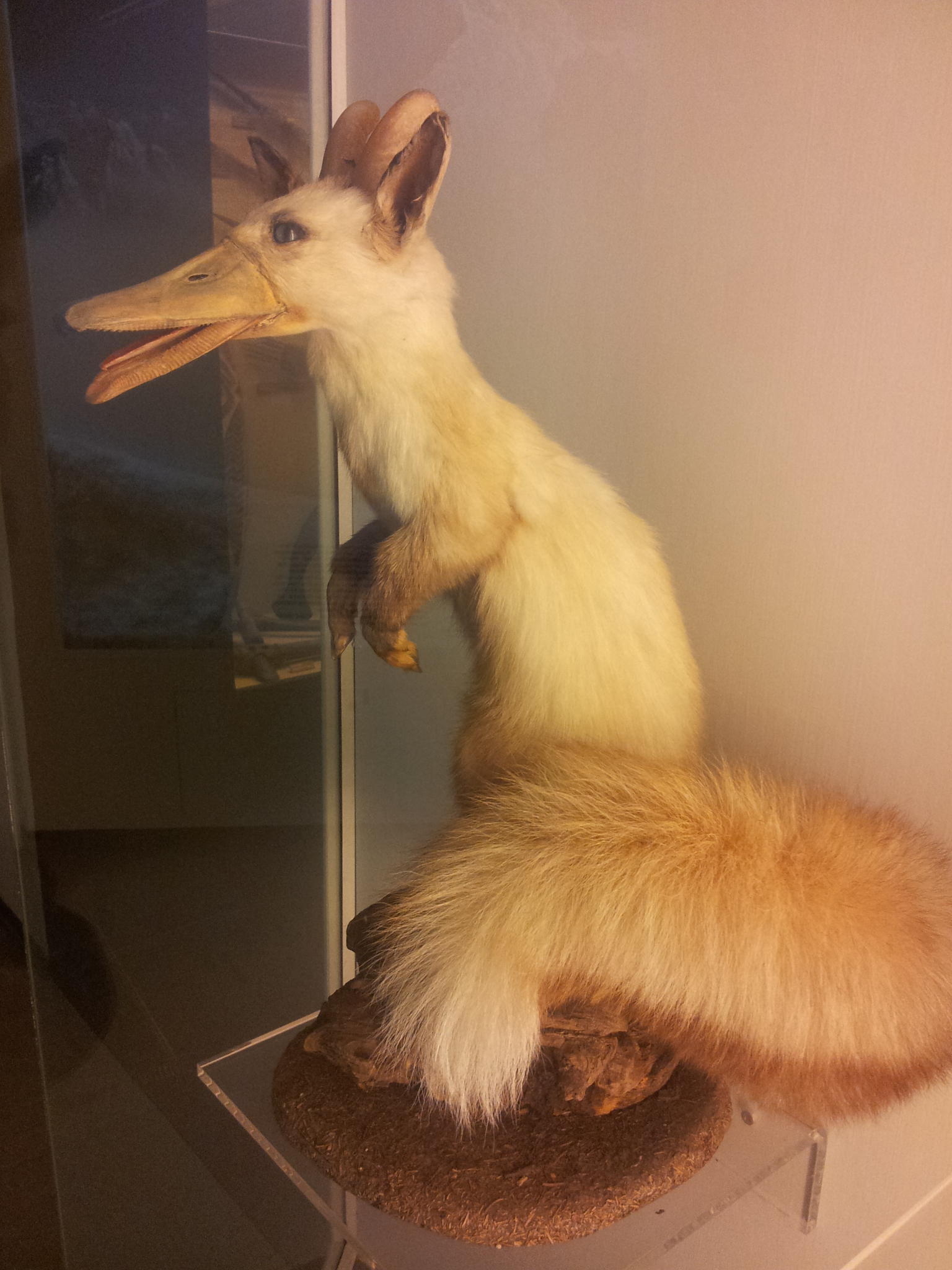
And the museum did a great job making some physical chimeras using the wonders of taxidermy… aww, do you want one of your own now?
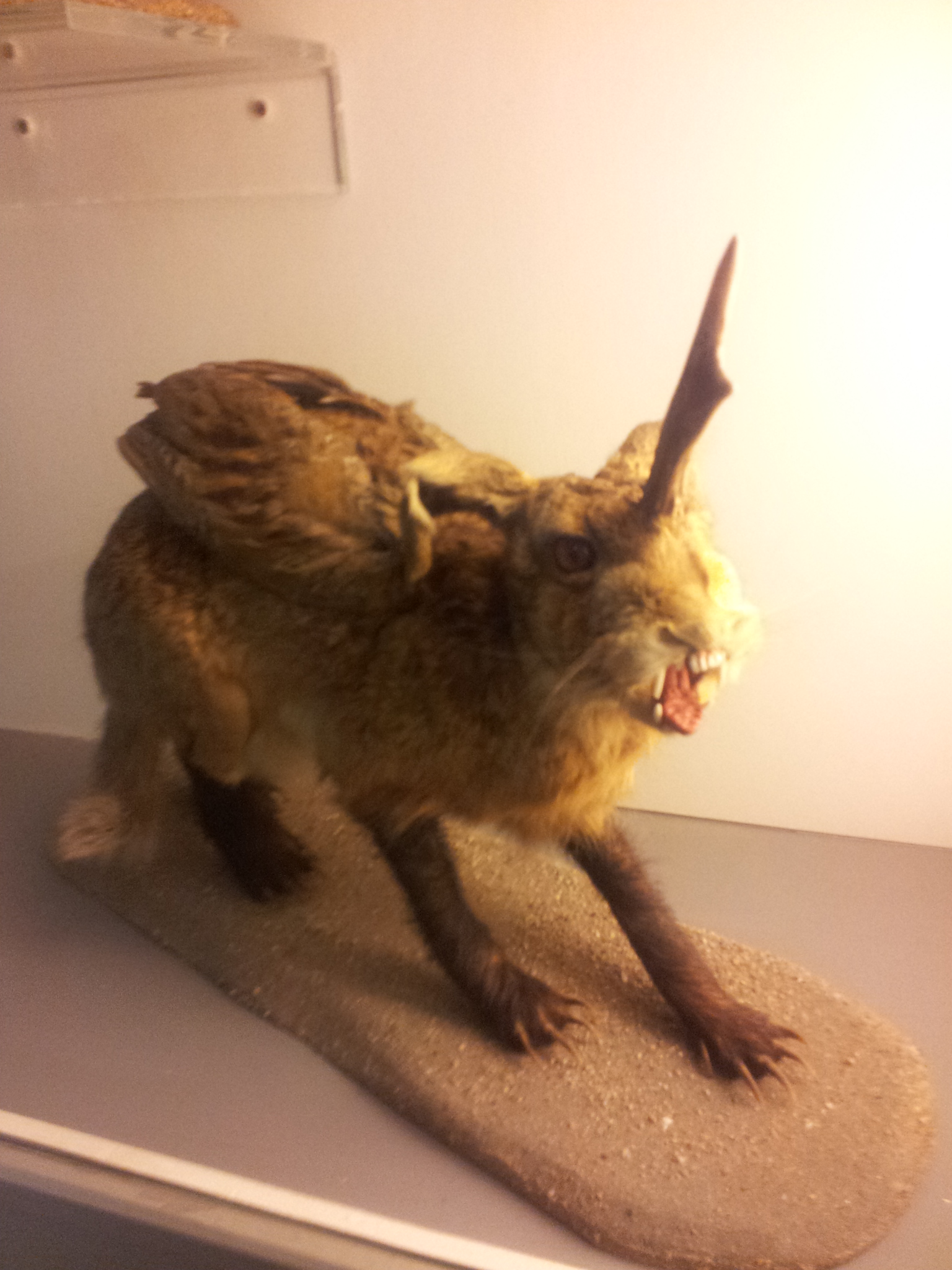
With closeups below–e.g. the jackalope from hell:
A flight of fancy?
Some quizzical quackery:
Echt toll, meine Freunde! A bit more about wolpertingers and their kin is here. Pokemonologists, take notes. People laughing at the alternative name for wolpertingers, “poontingers,” behave…
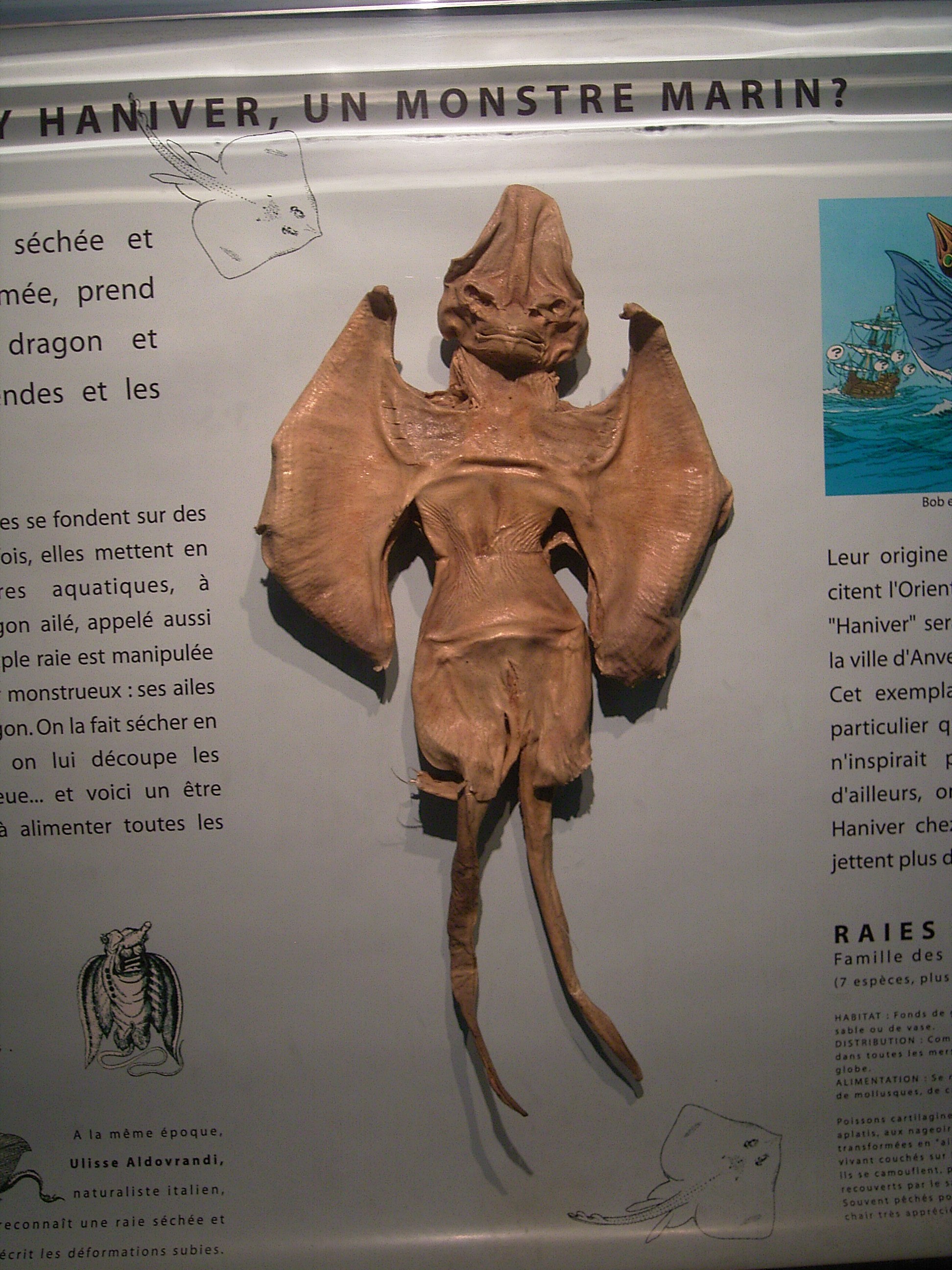
One can hardly discuss chimeras and fake animals/taxidermy hoaxes without getting into mermaids (no, I won’t discuss THAT recent TV debacle) and then into Jenny Hanivers; “devil fish”, seabishops or sea fairies. The hanivers go back to at least the 16th century, even being used by sailors to prove they’d had an exotic adventure after their voyages, or sold to supplement their meager salaries. There is plenty written on this phenomenon and how numerous people were skate punk’d (AHEM) by a simple dried fish. But then, skates (not to be confused with an altogether different, but related, kind of chimera) do look odd, and many people don’t know their anatomy or are just credulous, prone to self-deception and confirmation bias.
Stuart Pond was so kind as to send pics of a J.H. that he has in his shed (spinoff potential: What’s in Stu’s Shed???) for me to share— thanks again man! Note the apparent “legs” (probably organs used in mating’; claspers; but sometimes just snipped bits of the tail, which is also evident here):
Obviously the typical Jenny Haniver is a skate that has been messed with a bit to emphasize the humanoid features, but then there’s a sucker born every minute, and PT Barnum famously took advantage of that rhythmic nativity in the 1842 hoax he called the Fiji (Feejee) mermaid, which was a monkey’s head/torso with fish body and papier maché coating. Below, a wolpertinger-like “horn” is visible; this is the remnants of a nasal process of the chondrocranium of the ray; the flanges to either side of it are parts of the front of the head that have been cut apart to make the haniver’s head look more humanoid:
With a “face” only a mermother- or chondrichthyologist- could love– note that the “eyes” are actually nasal openings:
And thanks to Sven Sachs for some extra photos of a Jenny Haniver at the Zoological Museum Liege in Belgium– thanks Sven!:
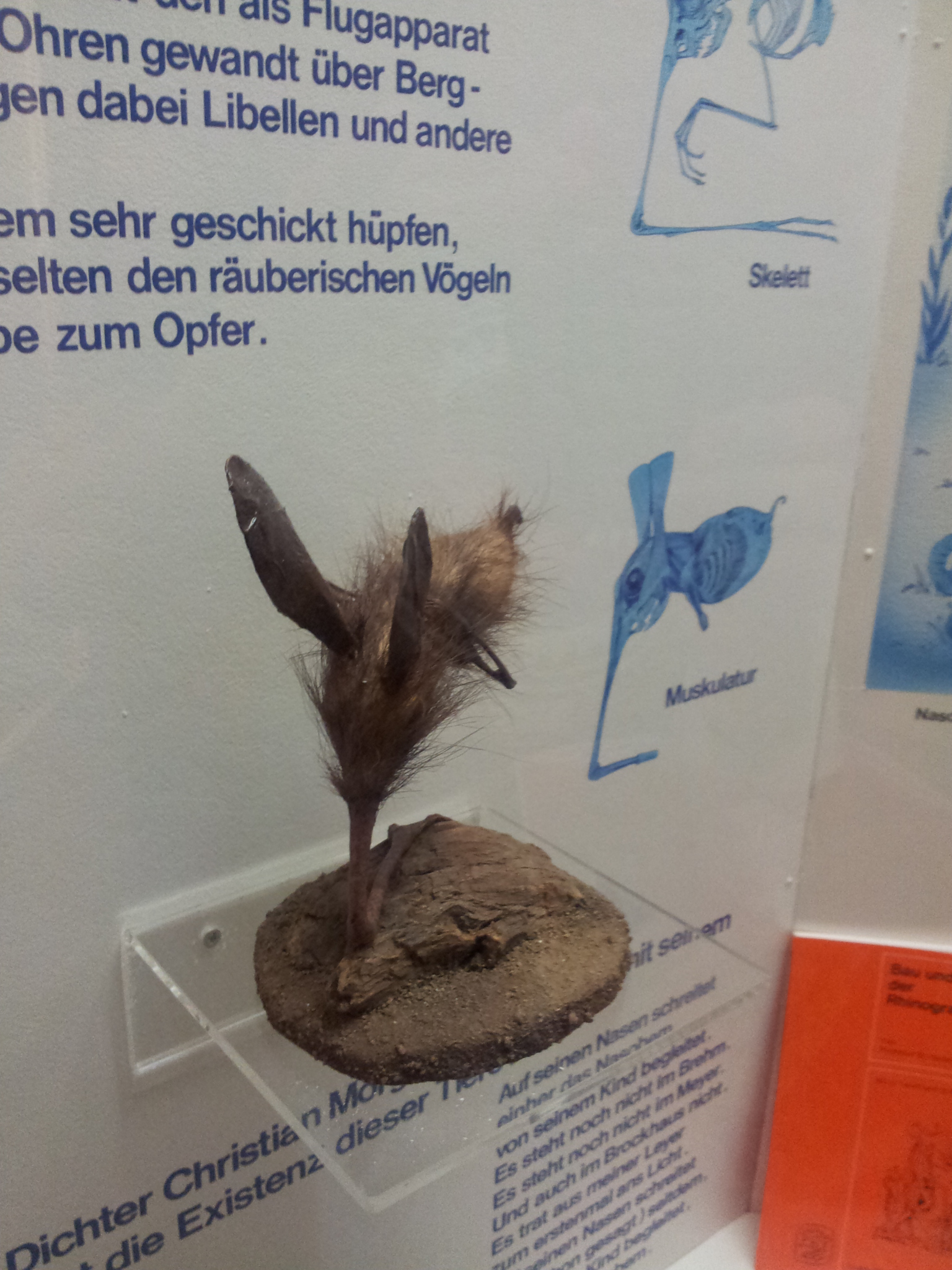
But, in the world of academic science, there is perhaps no greater you-fools-I-invented-a-fanciful-critter hoax/joke than the Rhinogradentia (snouters, or rhinogrades), rumoured in 1905 but first described in Gerolf Steiner/Harald Stümpke’s (latter= pseudonym; AKA Karl D.S. Geeste, Hararuto Shutyunpuke) wonderfully over-the-top, tongue-in-cheekish 1957 faux-scientific monographic book Bau und Leben der Rhinogradentia.Darren Naish‘s blog Tetrapod Zoology (along with others, in 4 parts) has done far better justice to the snouters than I could ever hope to, and others have contributed to the legend. But at least I can share some pics of the first reconstructed (or were they, hmm…?) rhinogrades I’ve ever seen in physical form (again from the Haus der Natur):
Here are the closeups; first Orchidiopsis rapax:
And next Otopteryx volitans:
Last but not beast, an infamous nasobeme, Nasobema lyricum!
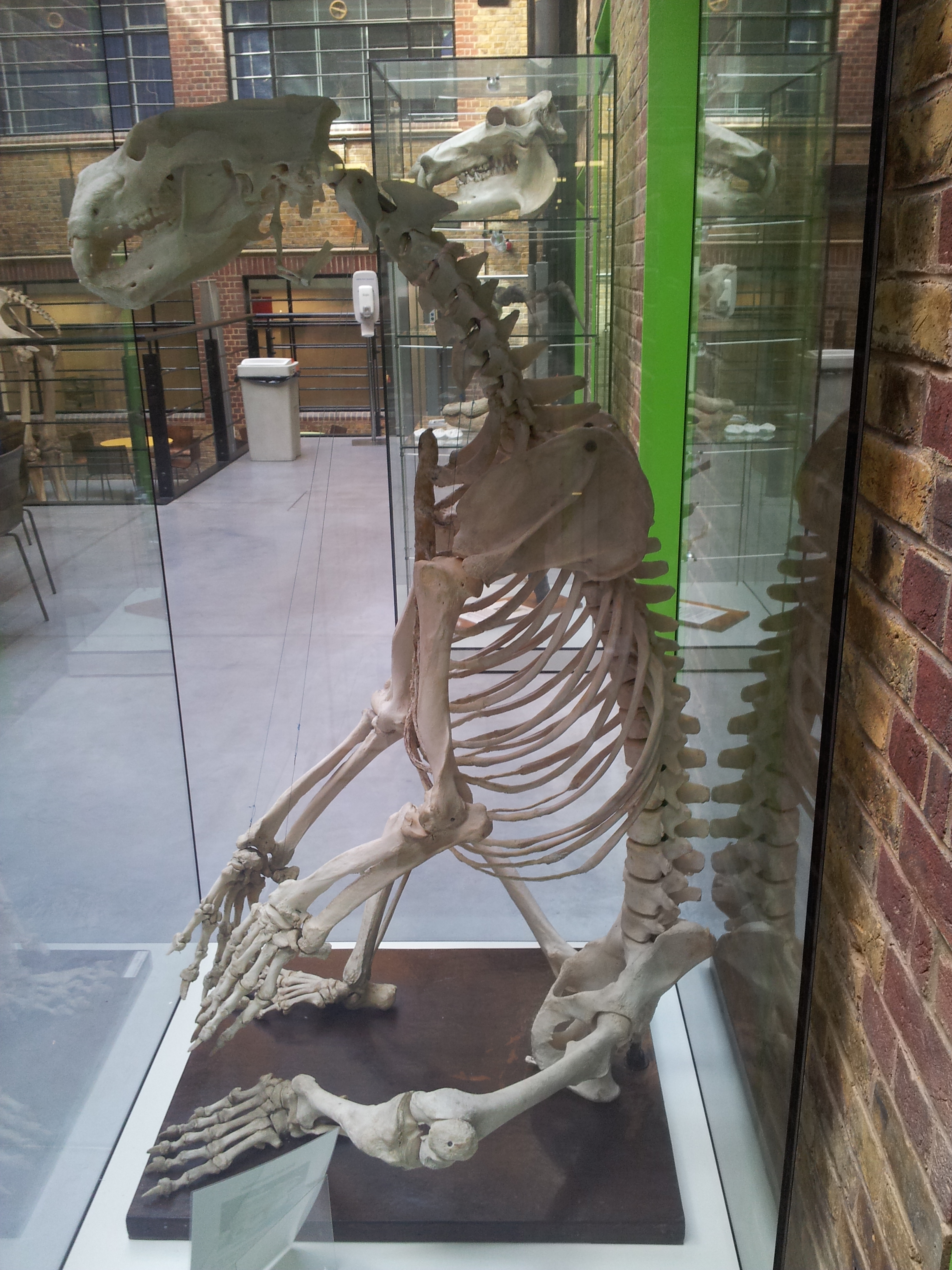
Then, also out in our cafe area you’ll find some nice smaller specimens in addition to our elephant. Such as:
A decent mount of a three-toed sloth is above; and below I’ll share several skulls including a second hippo (male? quite different morphology from the other one I showed):
And another charismatic megafauna, a ?black? rhinoceros (shown previously as a mounted skeleton in our old hall):
And a small gharial (Gavialis) skull:
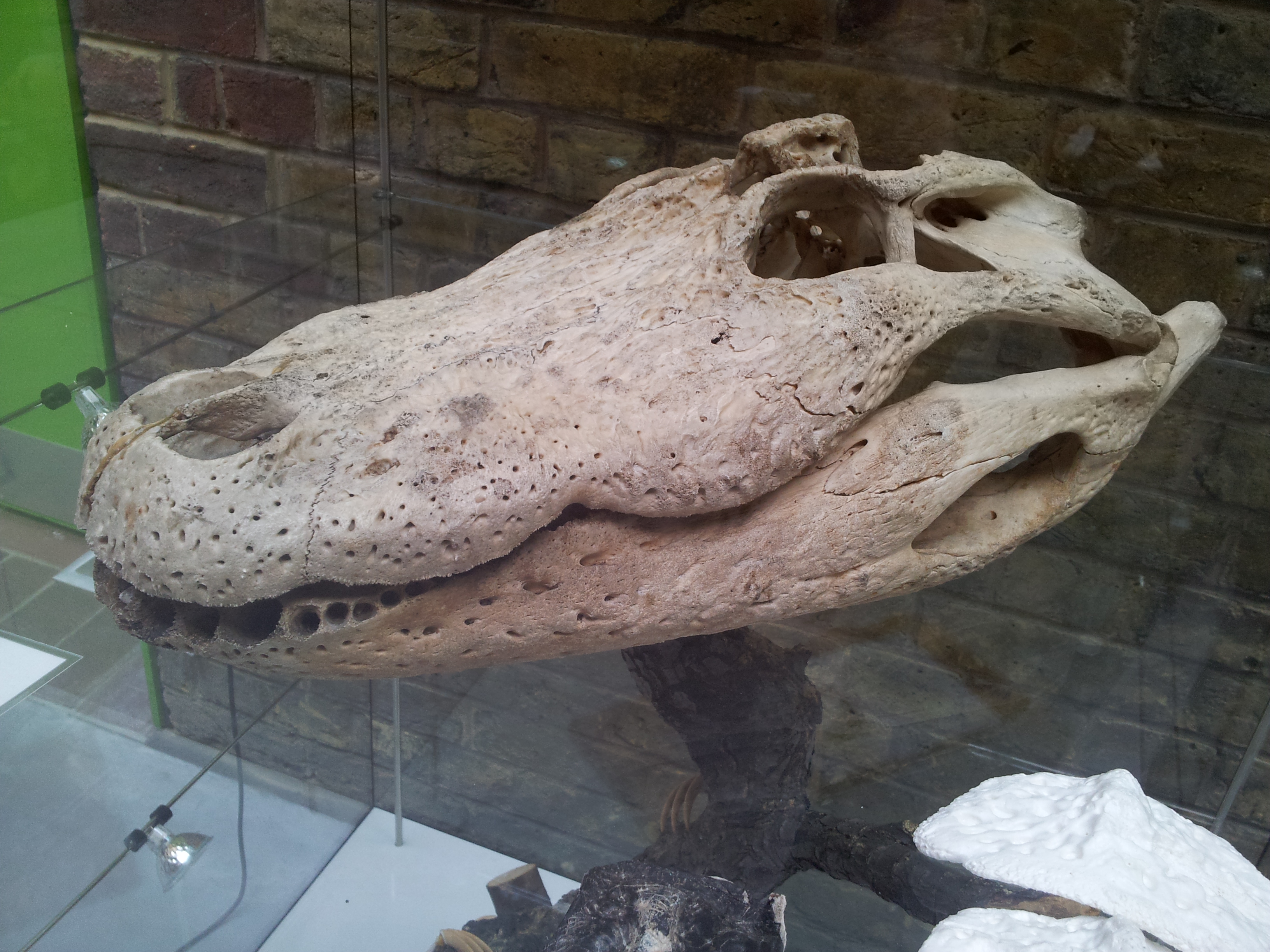
Which can be nicely juxtaposed with a more robust Caiman (or our earlier Alligator):
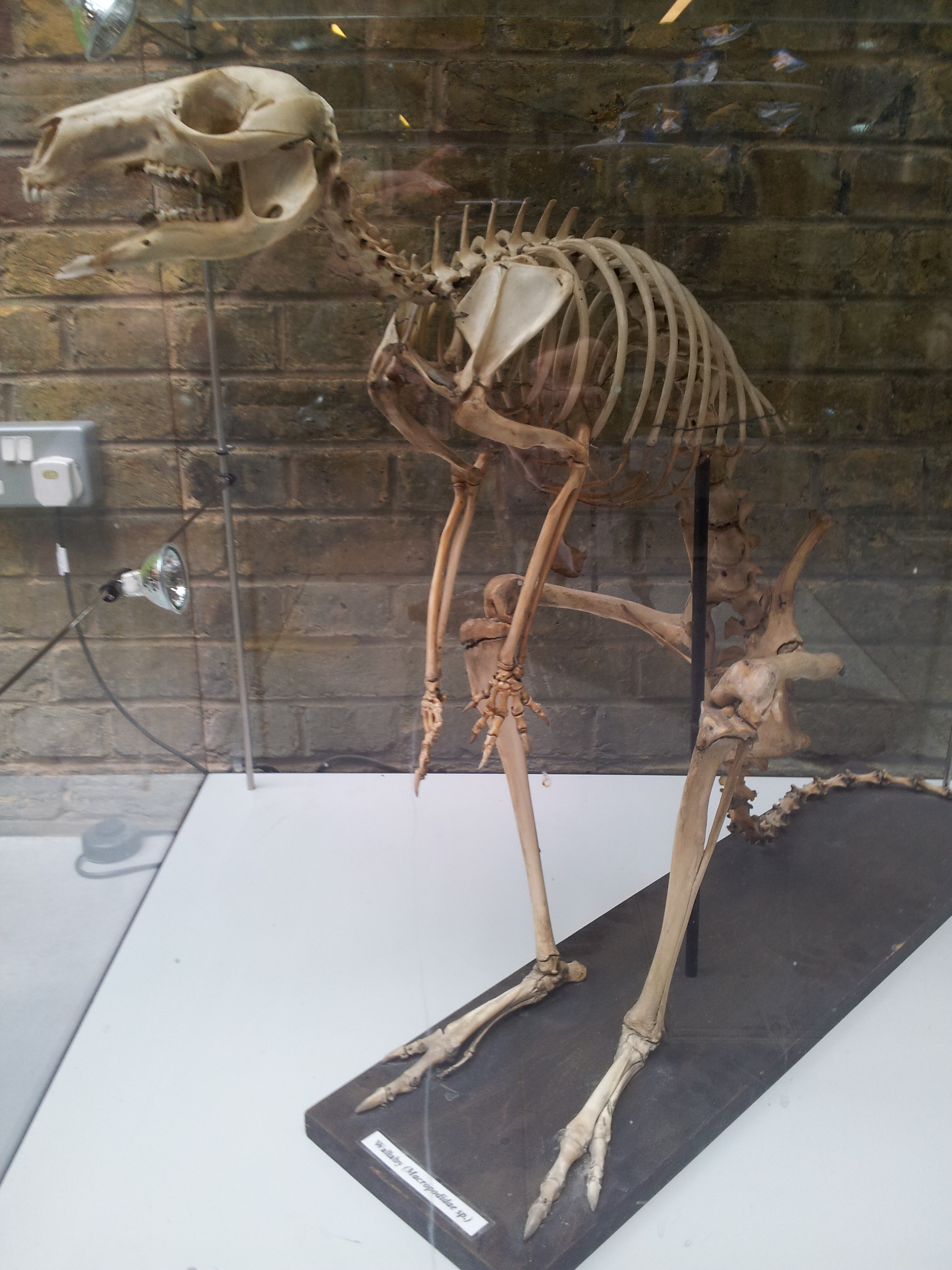
And then a small wallaby:
Let’s go back inside. I have a few more friends for you to meet. Such as our chimp next to a Lucy skeleton (both casts), briefly glimpsed in my first post:
And a really, really gnarly-faced bulldog! Shudder.
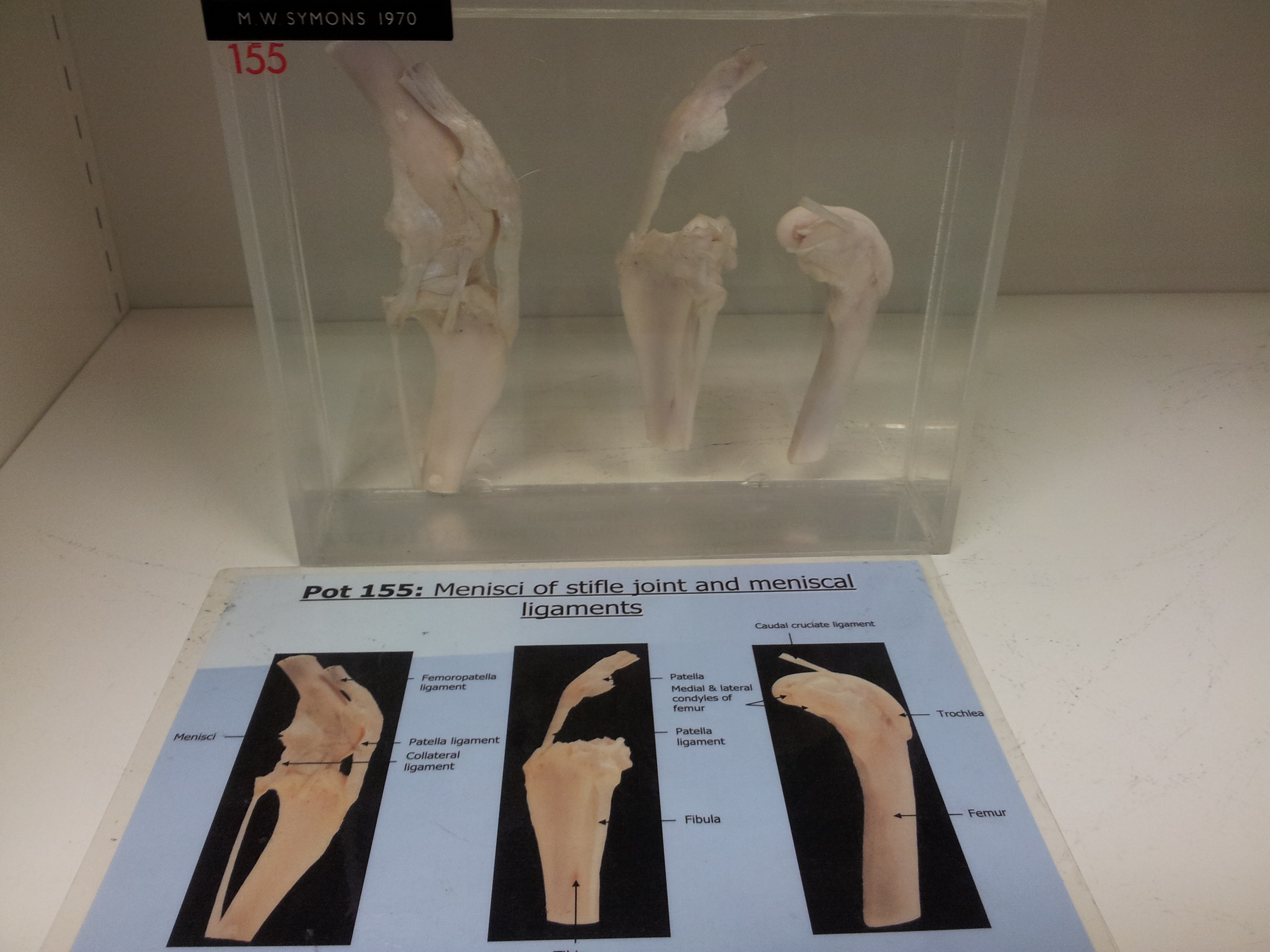
During my brief perusal of the exhibits the other day, I realized I had never shared our nice knee joint dissection in my post on those specimens, nor had I included it in my knotations about knee joints. This is particularly egregious as I am now doing a year-long fellowship/sabbatical to study knee joints, in particular the patella (kneecap) of birds. Here, a dog, with helpful labels of the anatomy around the stifle:
And that’s all folks! I’m preparing a particularly wacky post for later, which will include lots of whimsical anatomy, so stay tuned and keep coooooooool!
The Olympics are over! Hooray for everybody! Here I’m taking a different spin on the blog’s Mystery Dissection series: a mysterious method– what is going on here and why? I know someone will get this, but experts might want to hold back and let non-specialists have their moment in the sun first…
Stomach-churning rating: 6/10. (but probably too late!) Be glad this image does not include an olfactory component.
The scene is from ~2005 and took place in our old lab- note the filthy floor. It rarely got much cleaner than that. Before we moved in, this was an abattoir at some point. We used to have experiments going on in this hangar-like area of our small office building, right next to our office rooms. The smell and noise was… unpleasant. Luckily, now we have a separate office building (renovated from this old structure) and a wholly new, giant gait laboratory full of science toys.
Well, here we are at the end of our virtual tour of the RVC’s little-anatomy-museum-that-could. Soon we will return to our regularly scheduled programme of dismembered cadavers and frozen body segments. I know you’ve missed them.
This post has a Stomach-Churning Rating (SCR) of 2/10, unless either penis bones or the backs of knees really gross you out (then maybe 4/10 at worst, although there is a link hidden in the text that might really freak you out).
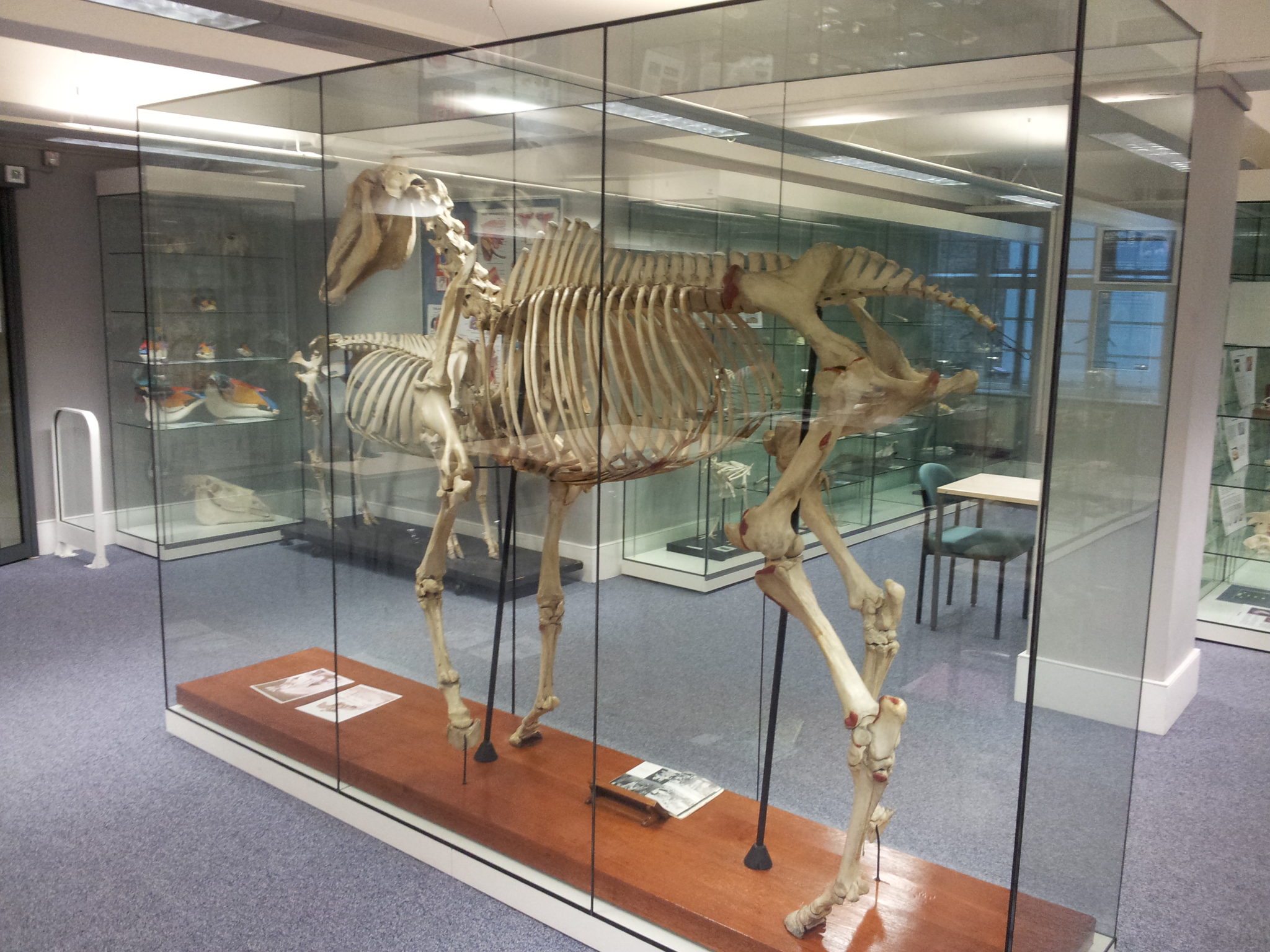
OK, here we go. You might remember this chap, the famed racehorse Foxhunter:
And the museum features sundry other domestic-type species and their close kin, such as this sheep (a Soay Ram):
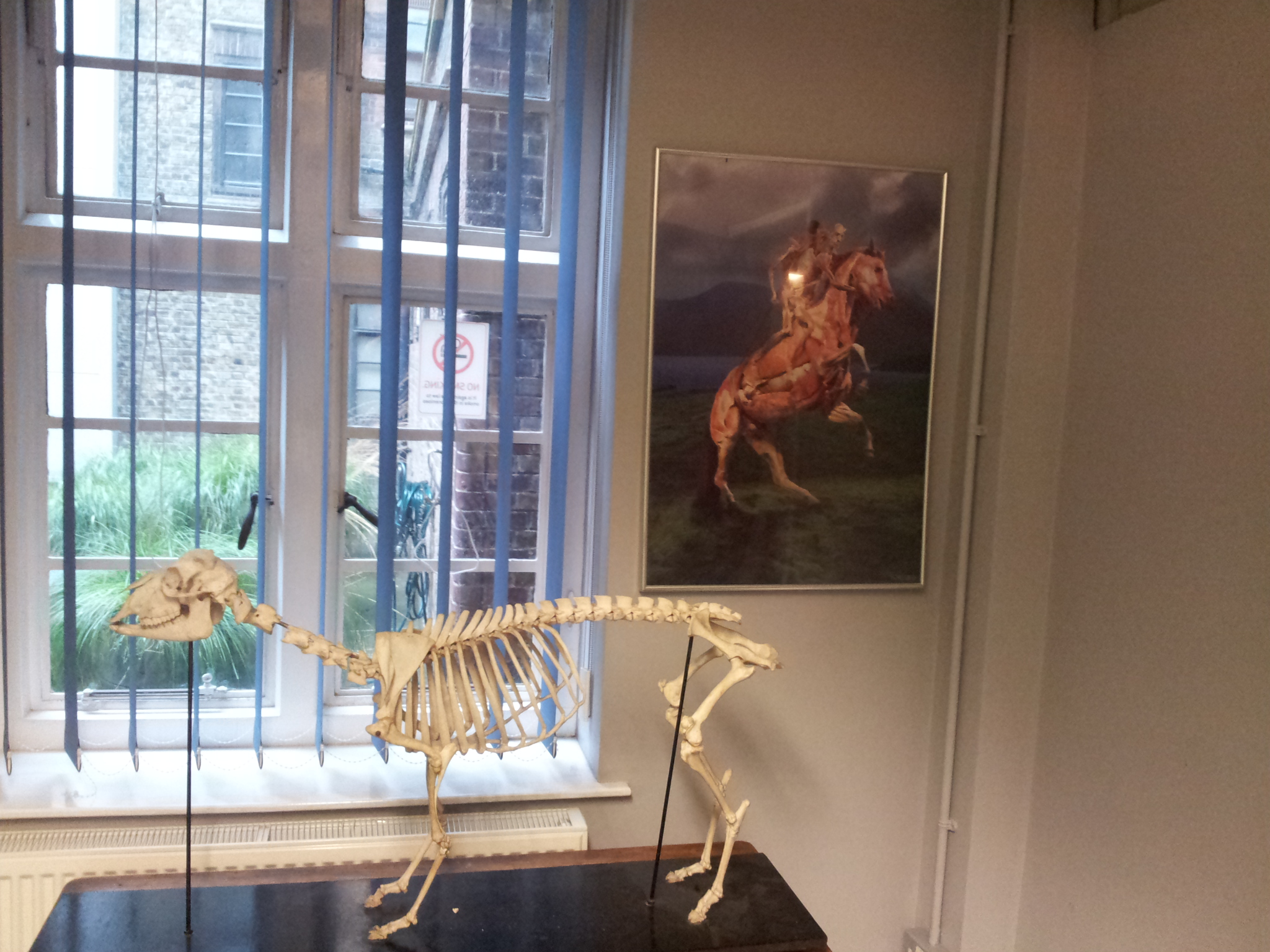
And this skeleton that is probably also a sheep, unless it is a tricky goat (notice framed photo of Bodyworlds exhibit on wall):
As well as his barnyard buddy, a quite robust pig:
But I want to focus more here on the surprises that the museum’s collection of skeletons has to offer, like this tiger poised below the pig:
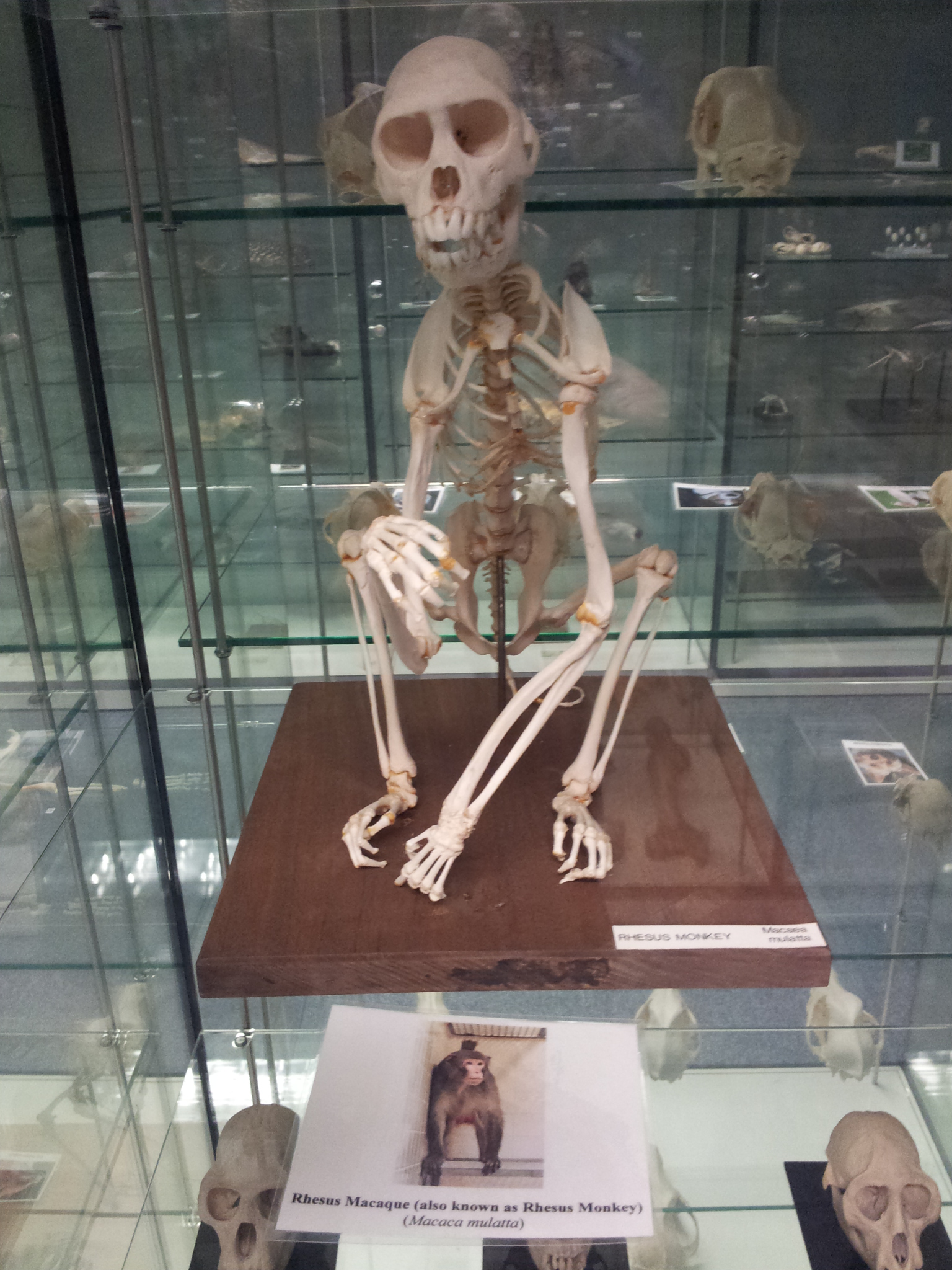
And a rhesus monkey (our primate skeletal collection is not shabby at all!):
And a whole shelf of ossified dog (and other carnivore) penises, oh joy! (os baculum; the “penis bone” of various Primata, Rodentia, Insectivora, Carnivora and Chiroptera– the infamous mnemonic P.R.I.C.C. of comparative anatomy):
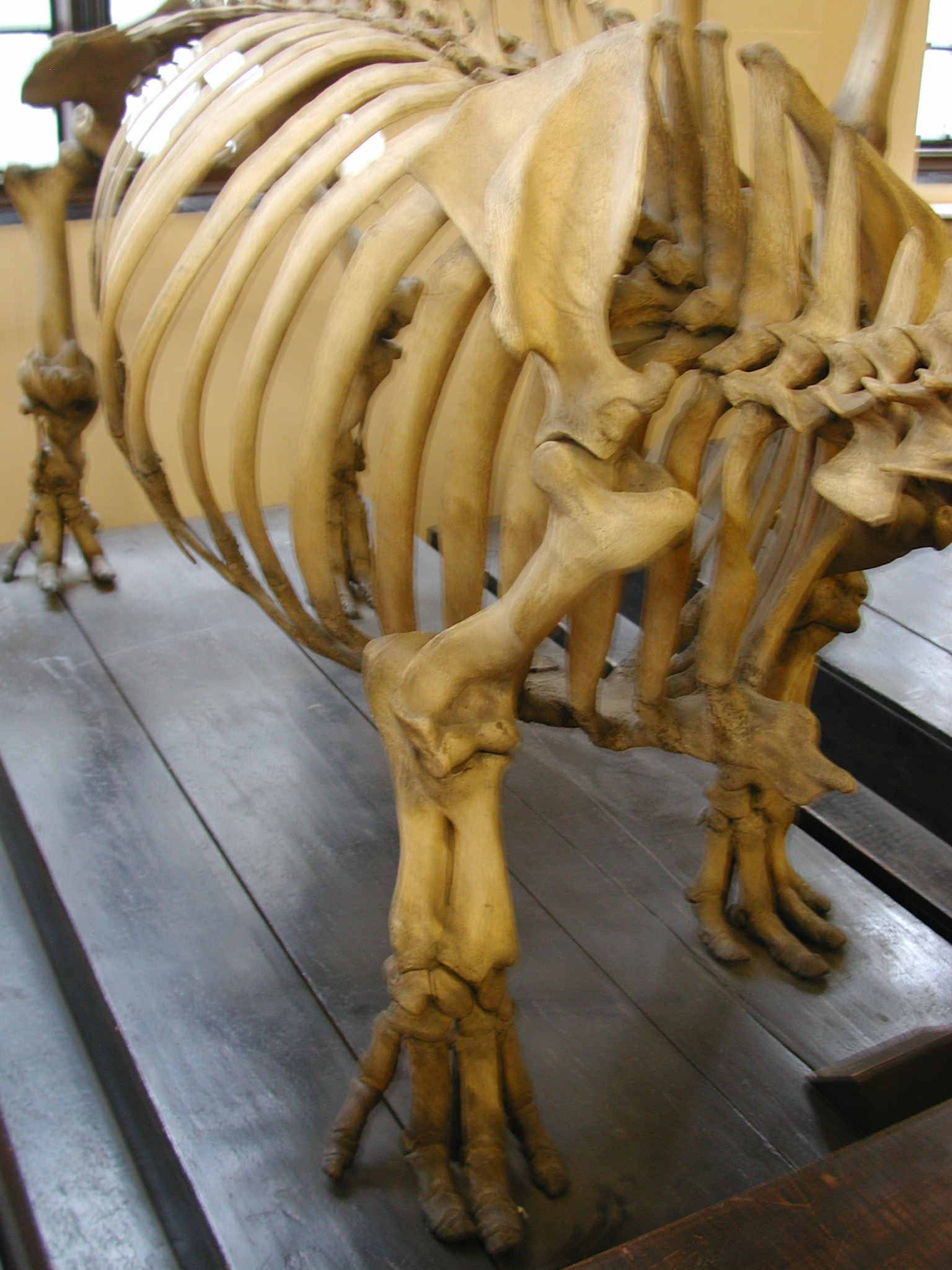
As I mentioned way back in my first post, what really sold me on the museum when I first viewed it back in 2003 was the megafauna! Here’s a photo I dug up of how the rhino used to appear in the museum’s old settings:
And the hippo was close by:
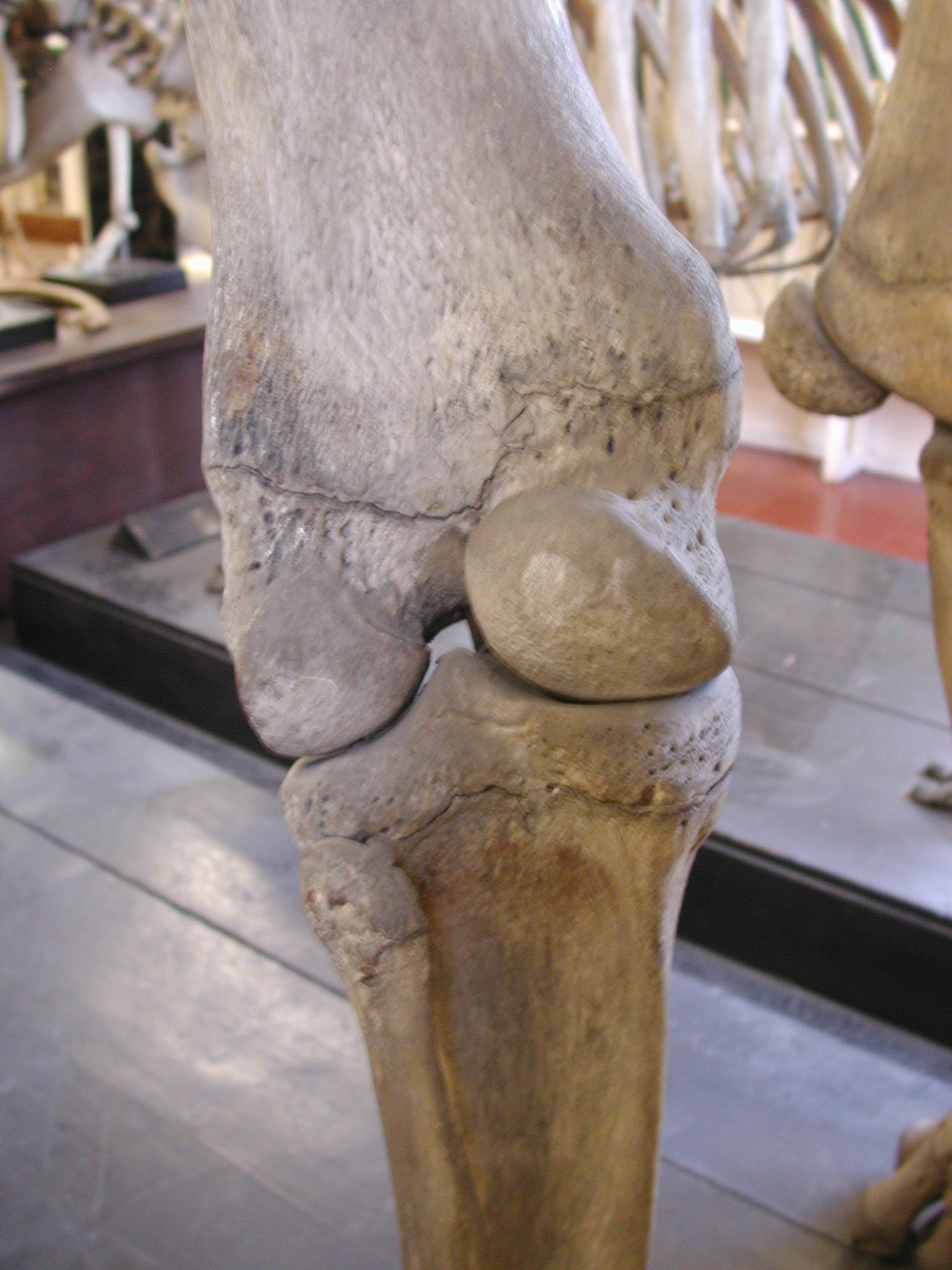
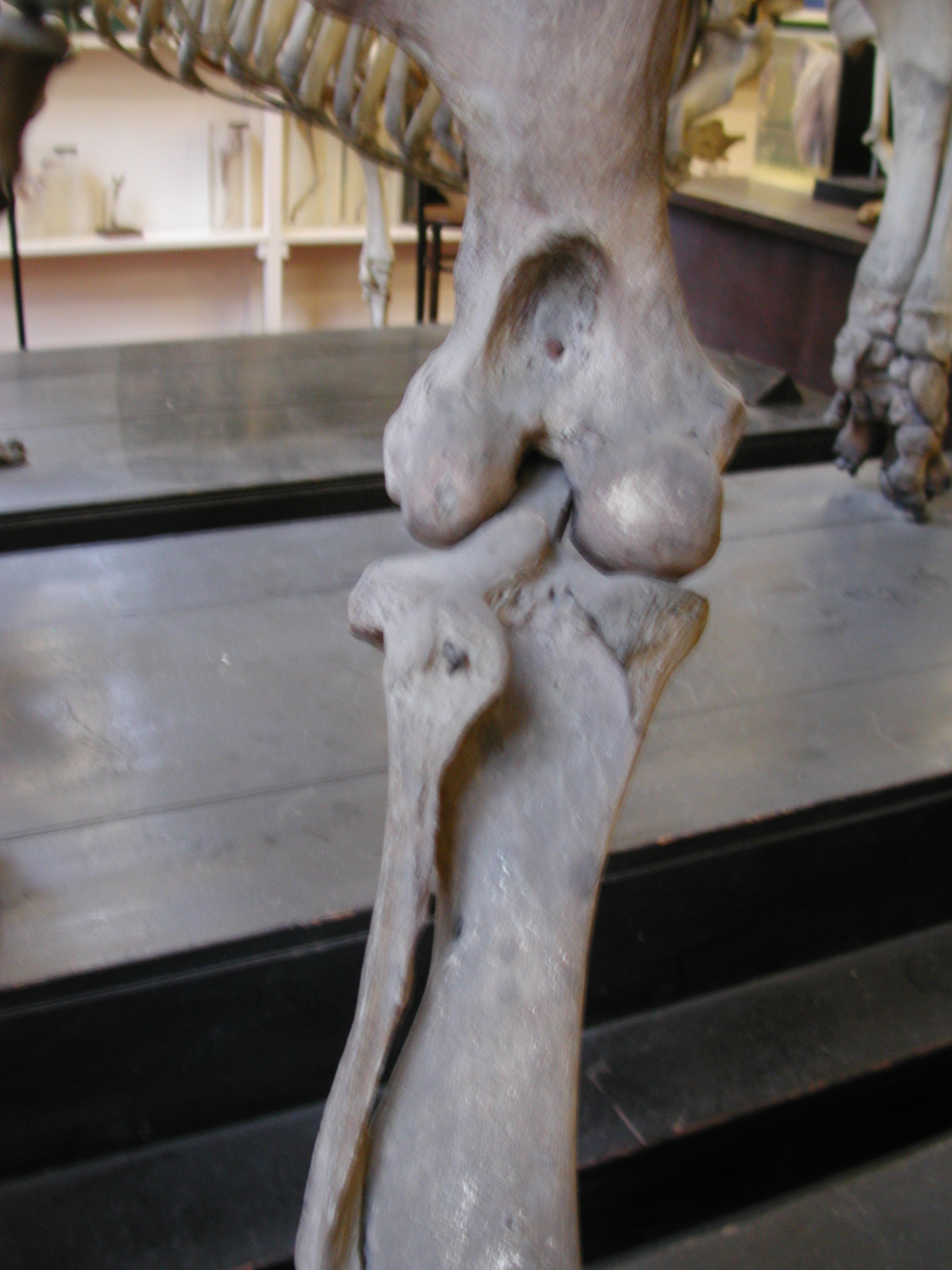
My off-with-their heads bias rears its ugly cranial appendage here, but I’ve already shown you its skull, so rest easy craniophiles; you had your day of glory. It’s time to kneel before Zod, or in this case kneel before my collection of animal knee photos! I hate to remind you of the trauma, but I did promise this with the mystery emu knee dissection, so suppress your PTSD [knee TSD?] and come along quietly now… Let an elephant knee soothe your tortured soul (from here on, all knees are left knees, in caudal/rear view):
I’m going to continue on without providing longwinded interpretations. I’ll leave you to draw your own, and just enjoy the diversity of knee anatomy, with some surprises toward the end. Descending in the size scale from multi-tonnes to semi-tonnes, first, a rhino:
And then our hippo:
The RVC does not have a mounted giraffe skeleton but I can show you the knee from our dissections, now nice and tidy (note the absence of a fibula, reduced to a small tarsal (ankle) bone in many artiodactyls– but not pigs or hippos as you can see above; what consequences this change has for knee joint mechanics is entirely unknown! However, the fibula has such a small/nonexistent connection to the femur/knee joint in many large mammals that the consequences may be negligible; who knows.):
Now, a horse of course:
One reason I find knees so fascinating scientifically is that they are mechanically so complex (and often over-simplified as simple hinges) and yet so fragile (knee injuries are common in many species; poorly adapted humans in particular! To wit…). But I also love knees because they feature prominently in discussions of form and function in extinct animals; in particular, dinosaurs. Let’s not forget Scrotum humanum, either…
Consider a few representative dinosaur images (mostly from the AMNH; not RVC!) here, starting with my old pal Tyrannosaurus (sorry, dislocated knee in this mount; ouch!):
Now, a ceratopsian (probably Triceratops??), I think; photo-labelling fail! Could easily be some sort of hadrosaur or something, though:
For what its worth, sans massive cartilages, a sauropod knee to round out the holy trinity of Dinosauria:
Consider here how the fibula plays a greater role in the dinosaurian knee joint (as in birds, too, to some degree), compared with the mammals above. But also consider the whopping amount of soft tissues missing here, as made evident in the emu post. Daunting indeed.
We kneed to know more about knees before we can knavigate their aknatomy and make knew iknfereknces about their fukntiokn! And so I’m coming back full circle to my earlier anatomical studies this year to look more closely at knees in a variety of species; more about that later.
And that’s the end. I hope you liked the kneet photos and knurture the kneed to come back for my knext post, which will kontain more knormal spellikng.
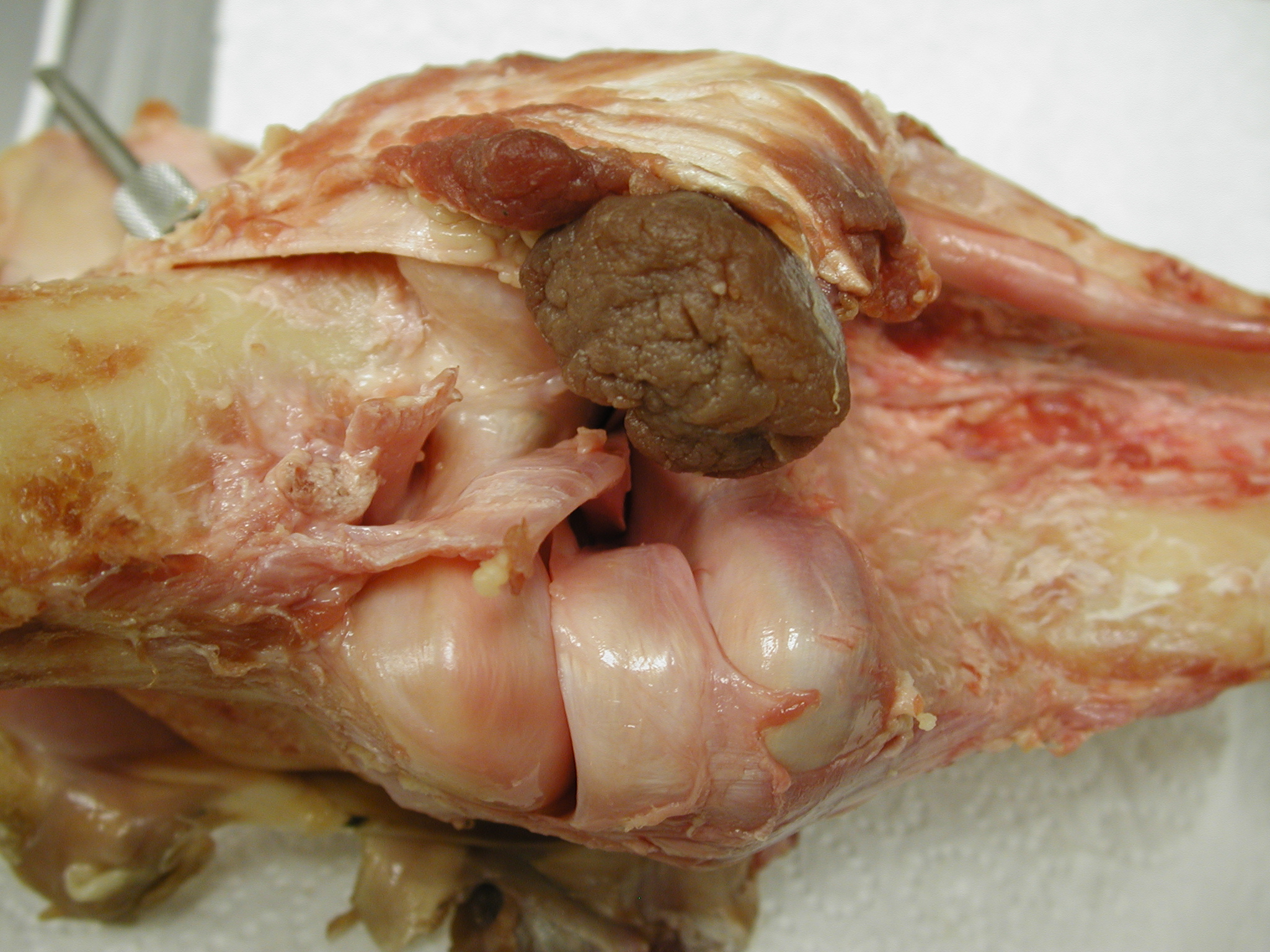
You know the drill- tell me what you can about this rather messy dissected specimen from The Freezers. What are the structures shown? Identification to genus/species level is probably not possible, but try to pin down the group of organisms it is from as tightly as you can:
Edit: This post had a Stomach-Churning Rating of 5/10. So you were probably safe anyway; if not, share your tale of revulsion in the Comments. 🙂
Edit edit: The specimen is revealing more here; this may or may not help:
And so we return to the series of posts on non-frozen, but still anatomically awesome, specimens from the RVC’s Anatomy Museum. Refer to posts on dissections, skulls and the introduction if you missed the last three.
Today is for the birds. Feel free to cry fowl if you feel this post is a poultry sum of images. Oh I could go on with lame puns, but I am merciful…
We’ll start with what is presumably not a Norwegian Blue; presumably neither resting and certainly bereft of beautiful plumage, but nonetheless a remarkable bird and great fodder for a wide range of silly jokes:
Which provides us with a segue into our series of nicely mounted skeletons of domestic poultry, first with the super-sized American variety termed Meleagris:
Which is a reminder of the non-defunct poultry that the RVC maintains, including a sporadic series of chickens that our lab hosts for our research (blog to come soon!), first shown in the fluffy 2 week old stage:
And what a difference 2 weeks makes!
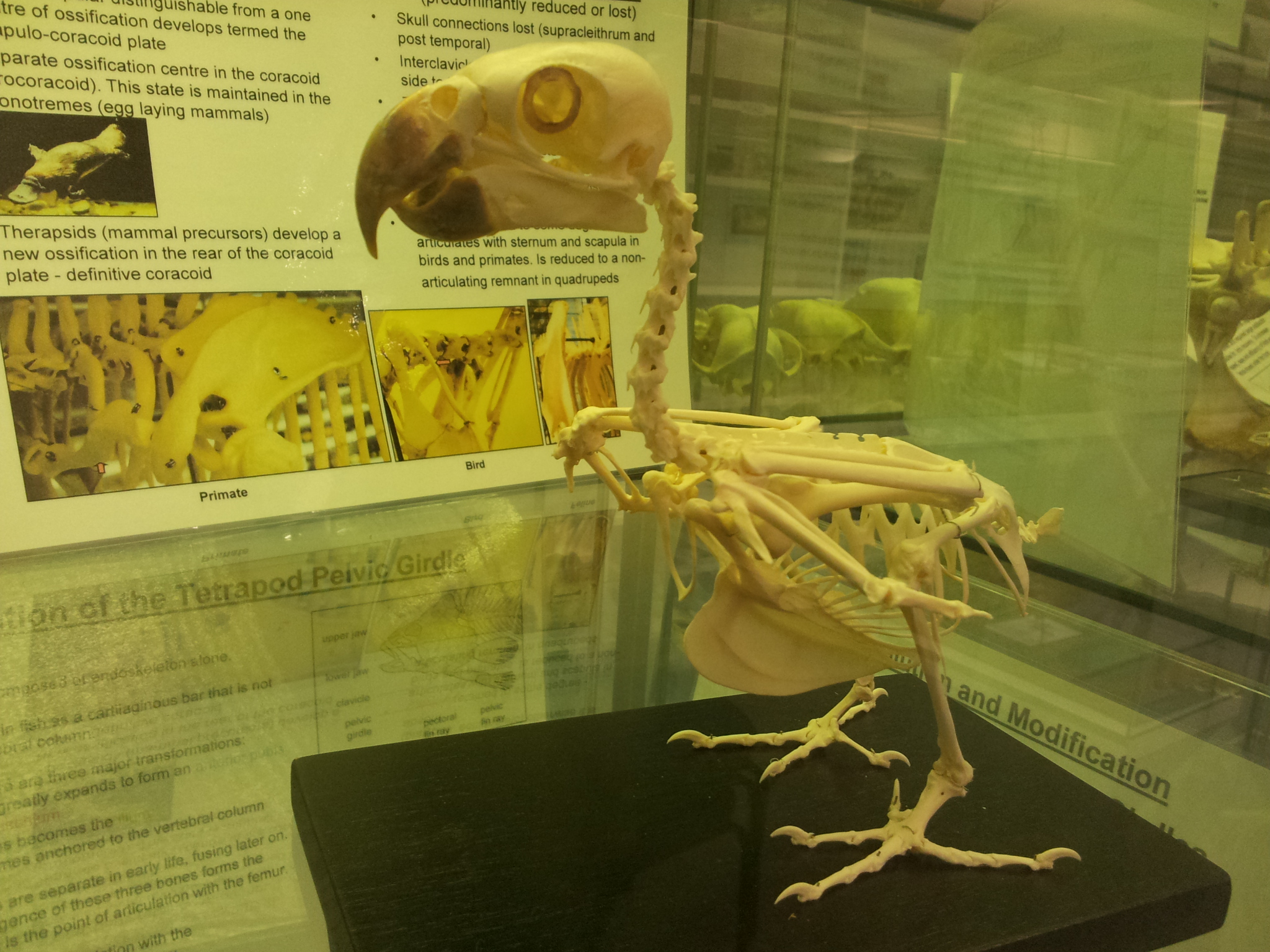
But back to the museum. Perhaps in sympathy for the plight of broiler chickens, a local raptor hangs, wings akimbo, to display various external features:
Plodding along, and missing the cranial end of the skeleton in this photo (in John’s typical photography/research style; d’oh!) is a nice big Maribou stork:
Nearby there is an ostrich pelvis for a similar comparison as in the latter post. And not far from that is a nice view of an ostrich foot, along with other birds’ feet in a display on perching/pedal adaptations:
These ratite displays remind me of our emu flock that we are maintaining (not at the museum!), which is 13 strong at the moment and very cute at ~8 weeks of age (intriguingly, a similar ~3kg body mass to a 6-week old broiler chicken! But much leggier.):
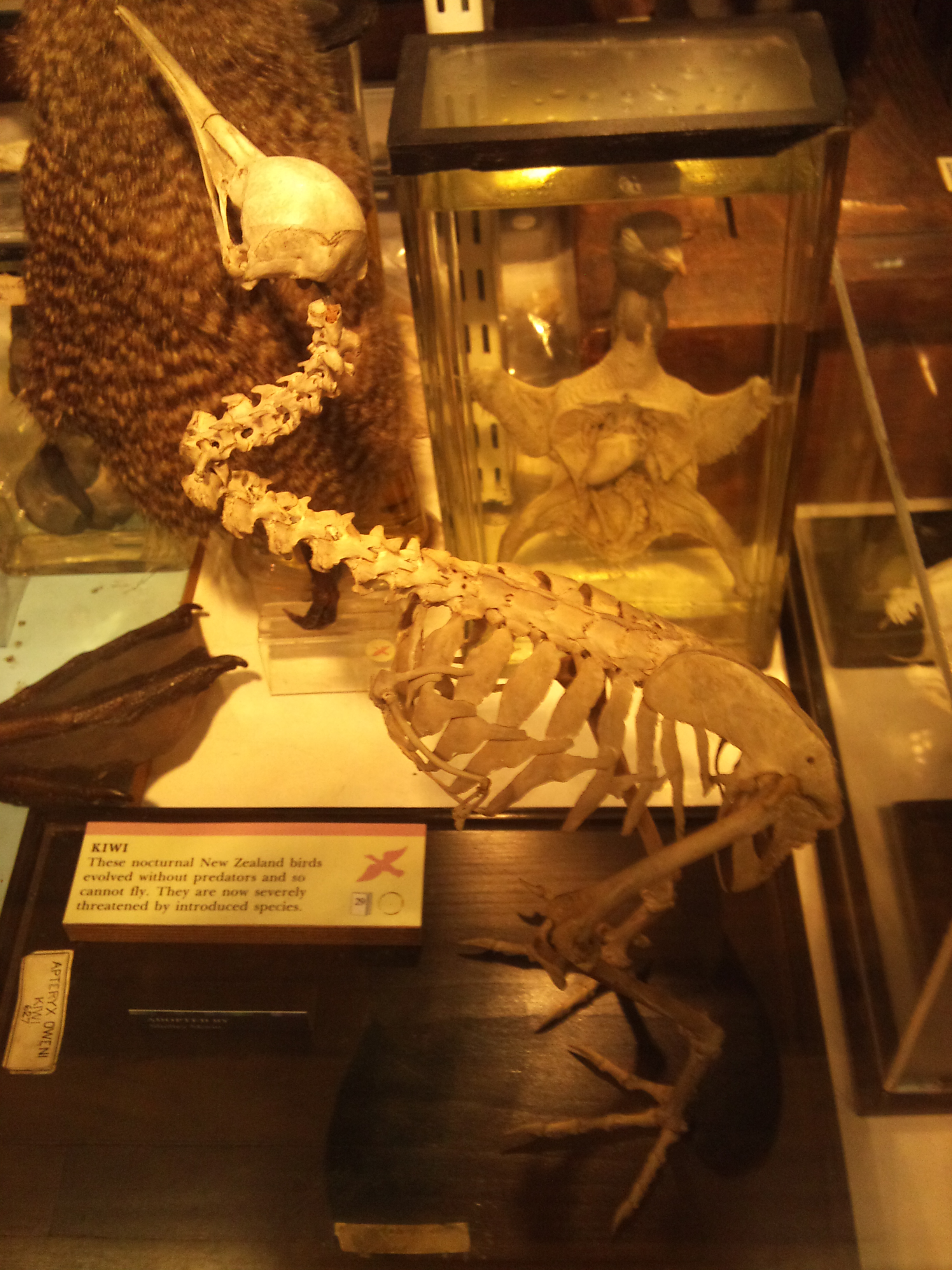
If you happen to visit the Anatomy Museum to peruse plastinated poultry or oggle other oddities, save time for a stroll to the nearby Grant Museum of Zoology; one of London’s greatest natural history treasures (edit- see recent TetZoo blog post on this) — and one that is drenched in history. Great flightless bird exhibits, too, such as this kiwi:
Or a stunning assortment of dodo bones:
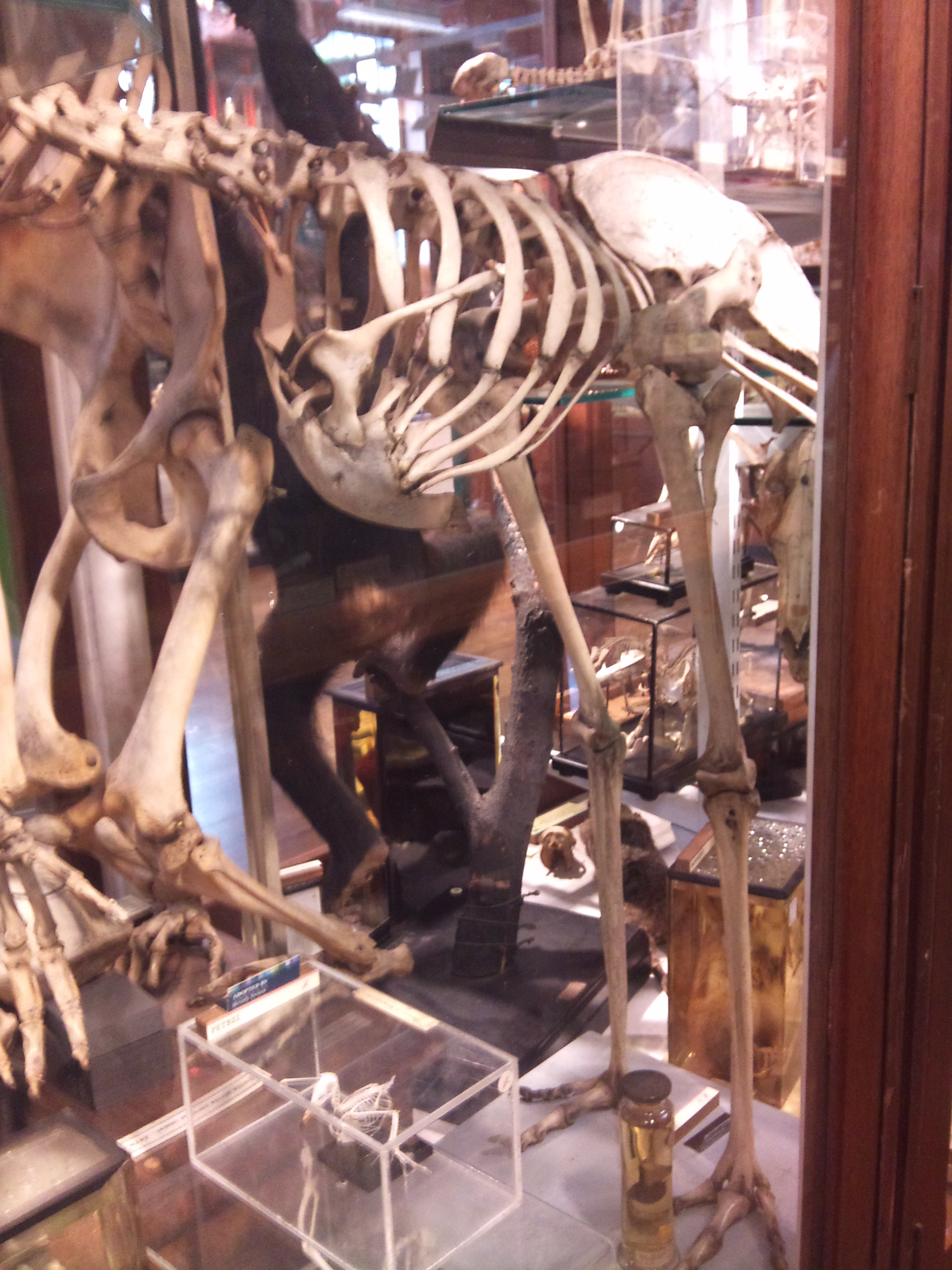
Or, coming full circle, an emu (or so I think… naughty John’s headless-photo bias at play again!).
And the emu will escort you to the exit. Thanks for visiting! We’re nearing the end of this series, so I hope you have enjoyed it.
































 What's In John's Freezer?