Feeds:
Posts
Comments

Archive for August, 2014

A short post that guest-tweeting at the  Biotweeps account on Twitter got me thinking about– featuring a poll.

Imagine this: two scientists (colleagues, if you’re a scientist) are arguing thusly. Say it’s an argument about a classic paper in which much of the data subjected to detailed statistical analyses are quantitative guesses, not hard measurements. This could be in any field of science.

Scientist 1: “Conclusions are what matter most in science. If the data are guesses, but still roughly right, we shouldn’t worry much. The conclusions will still be sound regardless. That’s the high priority, because science advances by ideas gleaned from conclusions, inspiring other scientists.”

Scientist 2: “Data are what matter most in science. If the data are guesses, or flawed in some other way, this is a big problem and scientists must fix it. That’s the high priority, because science advances by data that lead to conclusions, or to more science.”

Who’s right? Have your say in this anonymous poll (please vote first before viewing results!):

link: http://poll.fm/4xf5e

[Wordpress is not showing the poll on all browsers so you may have to click the link]

And if you have more to say and don’t mind being non-anonymous, say more in the Comments- can you convince others of your answer? Or figure out what you think by ruminating in the comments?

I’m genuinely curious what people think. I have my own opinion, which has changed a lot over the past year. And I think it is a very important question scientists should think about, and discuss. I’m not just interested in scientists’ views though; anyone science-interested should join in.

Read Full Post »

[This is the original, unedited text of my shorter, tighter (and I think actually better) News & Views piece for Nature, on the paper described below)

Ambitious experimental and morphological studies of a modern fish show how a flexible phenotype may have helped early “fishapods” to make the long transition from finned aquatic animals into tetrapods able to walk on land.

Stomach-Churning Rating: 1/10. Cute fish. Good science. Happy stomachs!

Photo by Antoine Morin, showing Polypterus on land.

Photo by Antoine Morin, showing Polypterus on land.

Napoleon Bonaparte’s military excursions into Egypt in 1798-1799 led a young French naturalist, Ètienne Geoffroy Saint-Hilaire, to cross paths with a strange fish that had paired lungs and could “walk” across land on its stubby, lobelike fins. In 1802, he dubbed this fish “Polyptère bichir”1, today known as the Nile bichir, Polypterus bichir La Cepède 1803. The bichir’s mélange of primitive and advanced traits helped to catapult Geoffroy into scholarly conflict with the reigning naturalist Georges Cuvier back in France and to establish Ètienne as a leading anatomist, embryologist and early evolutionary researcher of repute even today2. Now, on their own excursion under the very “evo-devo” flag that the discoverer of Polypterus helped raise, Canadian scientists Standen et al.3 suggest how the remarkable plasticity of the skeleton of Polypterus (the smaller west African relative of P. bichir, P. senegalus or “Cuvier’s bichir”) reveals a key part of the mechanism that might have facilitated the gradual transition from water to land and thus from “fishapods” to tetrapods (four-limbed vertebrates).

In a bold experiment, the authors raised 149 young bichirs on land and in water for eight months, then studied how they moved on land vs. in water, and also how the ultimate shape of the skeletal elements of the paired front fin bases differed between the land- and water-raised bichirs. Standen et al.3 discovered that both the form and function of the fins’ foundations transformed to better satisfy the constraints of moving on land. Land-acclimated bichirs took faster steps on land, their fins slipped across the substrate less, they held their fins closer to their body, their noses stayed more aloft and their tails undulated less, with less variable motions overall—behaviours that the authors had predicted should appear to enhance walking abilities on land. In turn, the bones of the neck and shoulder region altered their shape to produce a more mobile fin base with greater independence of fin from neck motion, along with improved bracing of the ventral “collarbone” region. These environmentally-induced traits should have fostered the locomotor changes observed in “terrestrialized” fish and aided the animals in resisting gravity, and they represent a common biological phenomenon termed developmental plasticity4,5. Interestingly, the land-reared fish could still swim about as well as the wholly aquatic cohort, so there was not a clear trade-off between being a good swimmer and a good walker, which is surprising.

Considered alone, the developmental plasticity of bichir form and function shows how impressive these amphibious fish are. But Standen et al.’s study3  ventured further, to apply the lessons learned from bichir ontogeny to a phylogenetic context and macroevolutionary question. The phenotypic plasticity during bichir development, they infer, could have been harnessed during the evolutionary transformation of fins for swimming into limbs for walking, in the “fishapod” ancestors of tetrapods. Indeed, bichirs are close to the base of the family tree of fishes6, and other living relatives of tetrapods have reduced or lost their fins (lungfishes) or adapted to strange deep-sea swimming lifestyles, never walking on land (coelacanths). Thus perhaps bichirs and the “fishapod” lineage share what Geoffroy would have called “unity of type”, today termed homology, of their developmental plasticity in response to a land environment. Surveying the fossil record of early “fishapods” and tetrapods, Standen et al.3 found that the macroevolutionary changes of neck and shoulder anatomy in these gradually more land-adapted animals parallel those they observed in terrestrialized Polypterus, providing ancillary support for their hypothesis.

A further test of the application of Polypterus’s plasticity to fossil tetrapods is naturally difficult. However, the “fishapod” lineage has some exceptional examples of fossil preservation. With sufficient sample sizes (e.g. fossil beds that reveal growth series, such as the Late Devonian Miguasha site in Canada7) and palaeoenvironmental gradients in fish or tetrapods, one could imagine performing a rigorous indirect test. Even small samples could be helpful– for example, the early tetrapod Ichthyostega exhibits some developmental changes in its forelimb suggesting that it became more terrestrial as it grew, whereas the related Acanthostega does not evidence such changes8— this hints at some developmental plasticity in the former animal.

During the Devonian period (~360-420 million years ago), were the “fishapod” ancestors of tetrapods floundering about on land now and then, gradually shifting from anatomy and behaviours that were more developmentally plastic (as in bichirs) to ones that were more canalized into the terrestrialized forms and functions that more land-adapted tetrapods retained? An attractive possibility is that the developmental plasticity could have led to fixation (reduction of plasticity), an evolutionary phenomenon called genetic assimilation, which another intellectual descendant of Geoffroy, Conrad Hal Waddington, promoted from the 1950s onwards9, a concept that now enjoys numerous cases of empirical support10 that this one may eventually join.

The nature of the genetic and developmental mechanism that bichirs use to achieve the observed developmental plasticity is still unclear. If it has a high enough degree of heritability, then it could be selected for in cross-generational experiments with bichirs. With sufficient time and luck raising these unusual fish, the hypothesis that their plastic response to a terrestrial environment can become genetically assimilated could be directly tested. This study could thus become an epic exemplar of how genetic assimilation can contribute not only to microevolutionary change but also to major macroevolutionary events, as was presciently suggested in a seminal review of developmental plasticity4.

This genetic assimilation is the Polypterus study’s reasonable speculation, and one that Geoffroy likely would have applauded, all the more for involving his beloved bichirs. Much as Napoleon’s landfall in Egypt was not a lasting success, bichirs never left wholly terrestrial descendants despite their malleable locomotor system. But the same type of plastic developmental mechanism that bichirs use today to make tentative, floppy incursions of the terrestrial realm might have been harnessed by our own “fishapod” forebears, leaving a far more revolutionary dynasty upon the Earth.


References

  1.  Geoffroy, E. (1802). Histoire naturelle et description anatomique d’un nouveau genre de poisson du Nil, nommé polyptère. Annales du Muséum d’Histoire Naturelle 1:57-68.
  2. Le Guyader, H., & Grene, M. (2004) Geoffroy Saint-Hilaire: A Visionary Naturalist. Univ. Chicago Press.
  3. Standen, E. M., Du, T. Y., & Larsson, H. C. E. (2014). Developmental plasticity and the origin of tetrapods. Nature, published online.
  4. West-Eberhard, M. J. (1989). Phenotypic plasticity and the origins of diversity. Annual Review of Ecology and Systematics 20:249-278.
  5. Pigliucci, M., Murren, C. J., & Schlichting, C. D. (2006). Phenotypic plasticity and evolution by genetic assimilation. Journal of Experimental Biology 209(12):2362-2367.
  6. Near, T. J., Dornburg, A., Tokita, M., Suzuki, D., Brandley, M. C., & Friedman, M. (2014). Boom and bust: ancient and recent diversification in bichirs (Polypteridae: Actinopterygii), a relictual lineage of ray‐finned fishes. Evolution 68:1014-1026.
  7. Cloutier, R. (2013). Great Canadian Lagerstätten 4. The Devonian Miguasha Biota (Québec): UNESCO World Heritage Site and a Time Capsule in the Early History of Vertebrates.Geoscience Canada40:149-163.
  8. Callier, V., Clack, J. A., & Ahlberg, P. E. (2009). Contrasting developmental trajectories in the earliest known tetrapod forelimbs.Science324:364-367.
  9. Waddington, C. H. (1953). Genetic assimilation of an acquired character. Evolution 7:118-126.
  10. Crispo, E. (2007). The Baldwin effect and genetic assimilation: revisiting two mechanisms of evolutionary change mediated by phenotypic plasticity. Evolution 61:2469-2479.

Read Full Post »

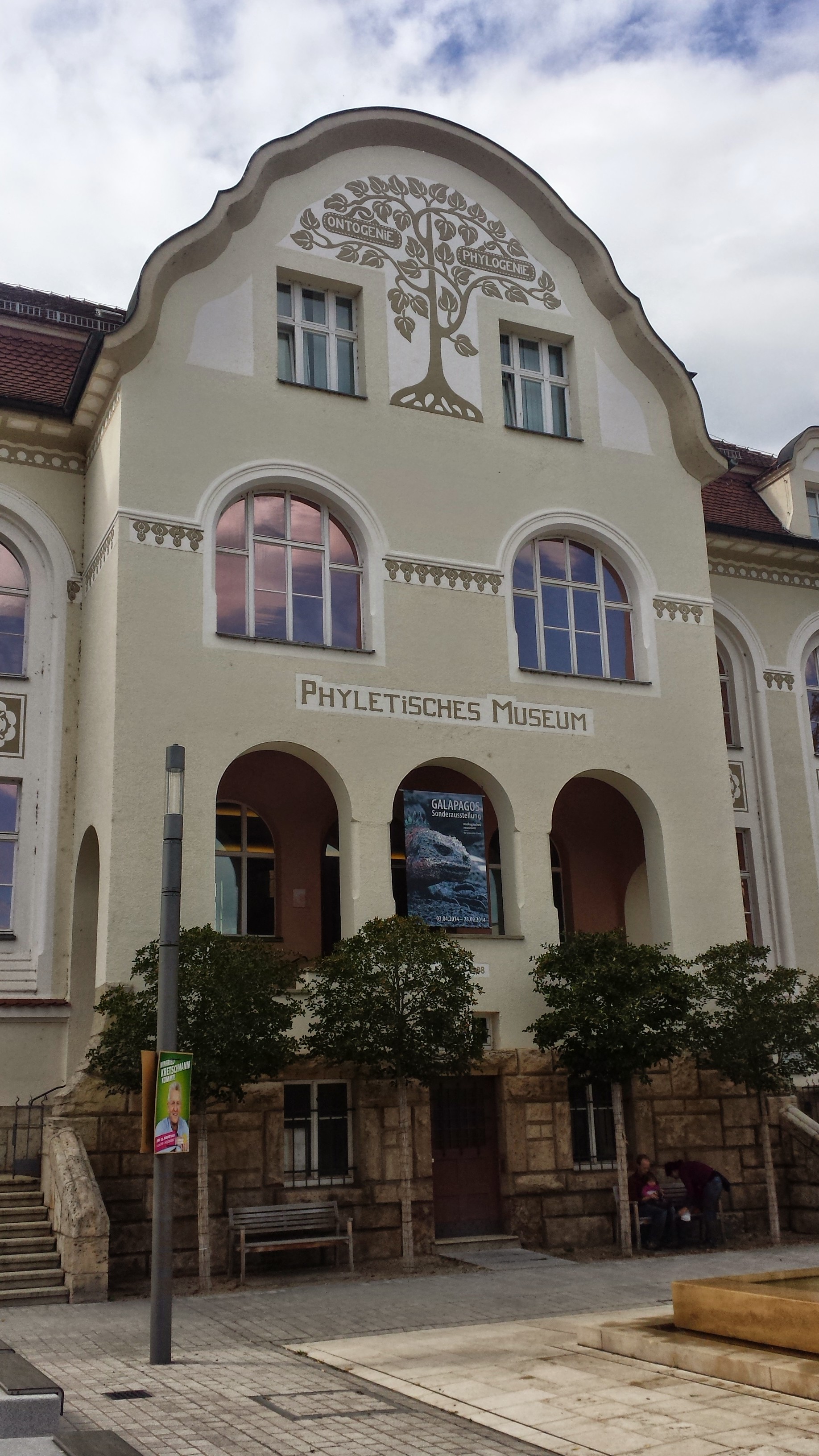
Construction of the Phyletisches Museum in Jena, Germany began on Goethe’s birthday on August 28, 1907. The Art Nouveau-styled museum was devised by the great evolutionary biologist, embryologist and artist/howthefuckdoyousummarizehowcoolhewas Ernst Haeckel, who by that time had earned fame in many areas of research (and art), including coining the terms ontogeny (the pattern of development of an organism during its lifetime) and phylogeny (the pattern of evolution of lineages of organisms through time) which feature prominently in the building’s design and exhibits (notice them intertwined in the tree motif below, on the front of the museum). Ontogeny and phylogeny, and the flamboyant artistic sensibility that Haeckel’s work exuded, persist as themes in the museum exhibits themselves. Haeckel also came up with other popular words such as Darwinism and ecology, stem cell, and so on… yeah the dude kept busy.

Cavorting frogs from Haeckel's masterpiece Kunstformen der Natur (1904).

Cavorting frogs from Haeckel’s masterpiece Kunstformen der Natur (1904).

I first visited the Phyletisches Museum about 10 years ago, then again this August. Here are the sights from my latest visit: a whirlwind ~20 minute tour of the museum before we had to drive off to far-flung Wetzlar. All images are click-tastic for embiggenness.

Stomach-Churning Rating: 3/10 for some preserved specimens. And art nouveau.

Willkommen!

Willkommen!

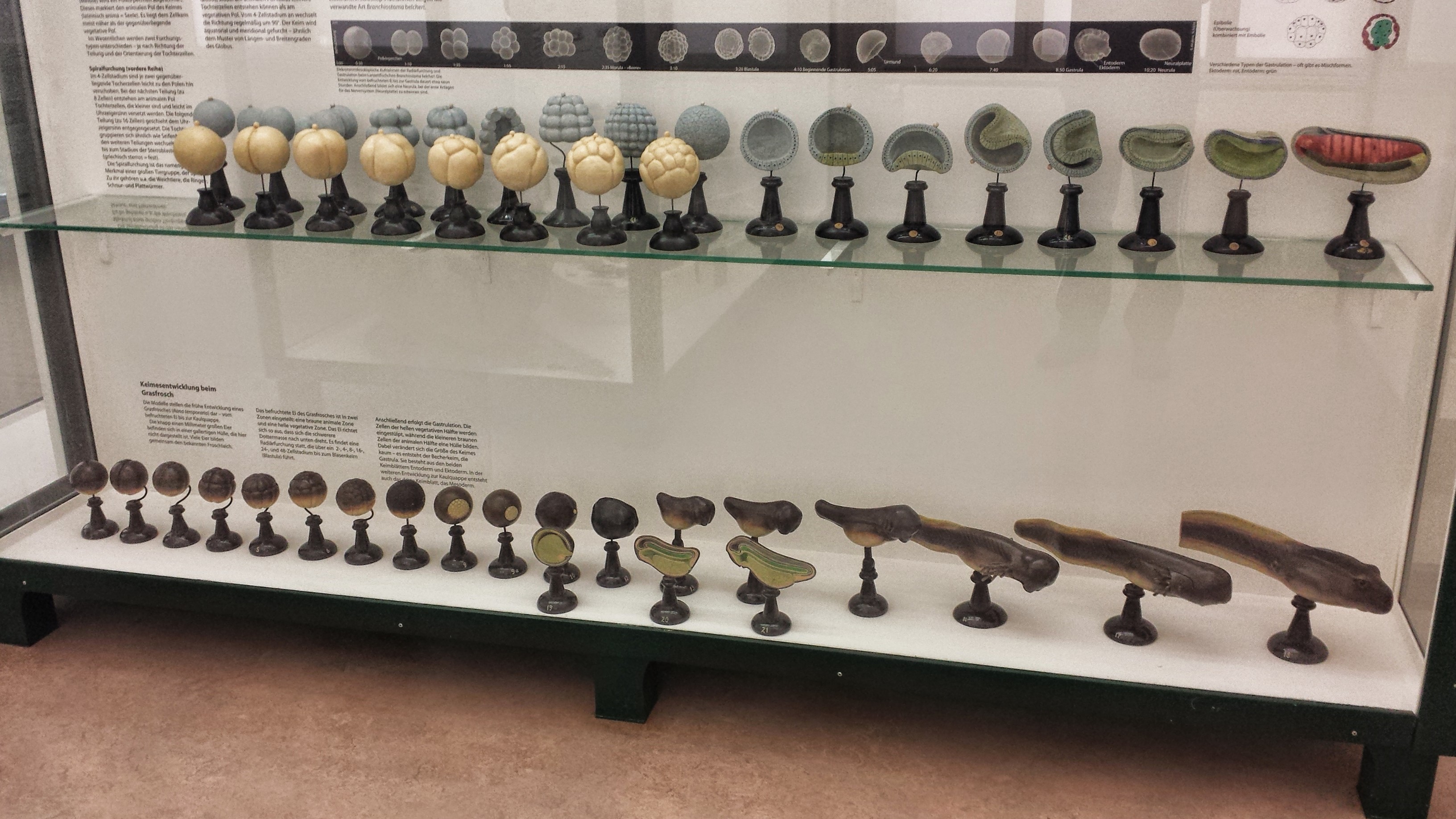
Frog ontogeny, illustrated with gorgeous handmade ?resin? models.

Frog ontogeny, illustrated with gorgeous handmade ?resin? models.

Fish phylogeny, illustrated with lovely artistry.

Phylogeny of Deuterostomia (various wormy things, echinoderms, fish and us), illustrated with lovely artistry.

Phylogeny of fish and tetrapods.

Phylogeny of fish and tetrapods.

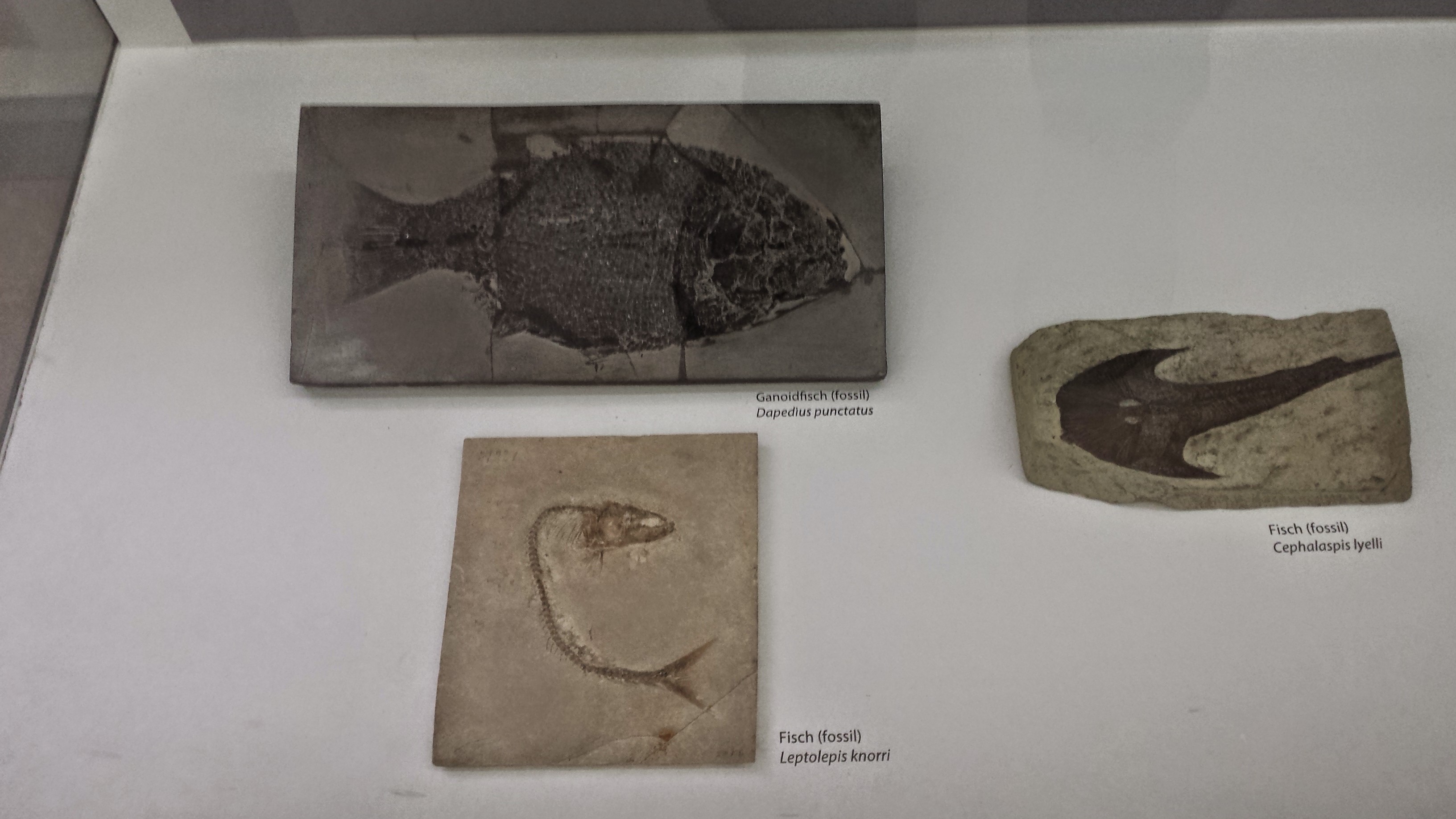
Slice of fossil fish diversity.

Slice of fossil fish diversity.

Plenty of chondryichthyan jaws and bodies.

Plenty of chondrichthyan jaws/chondrocrania, teeth and bodies.

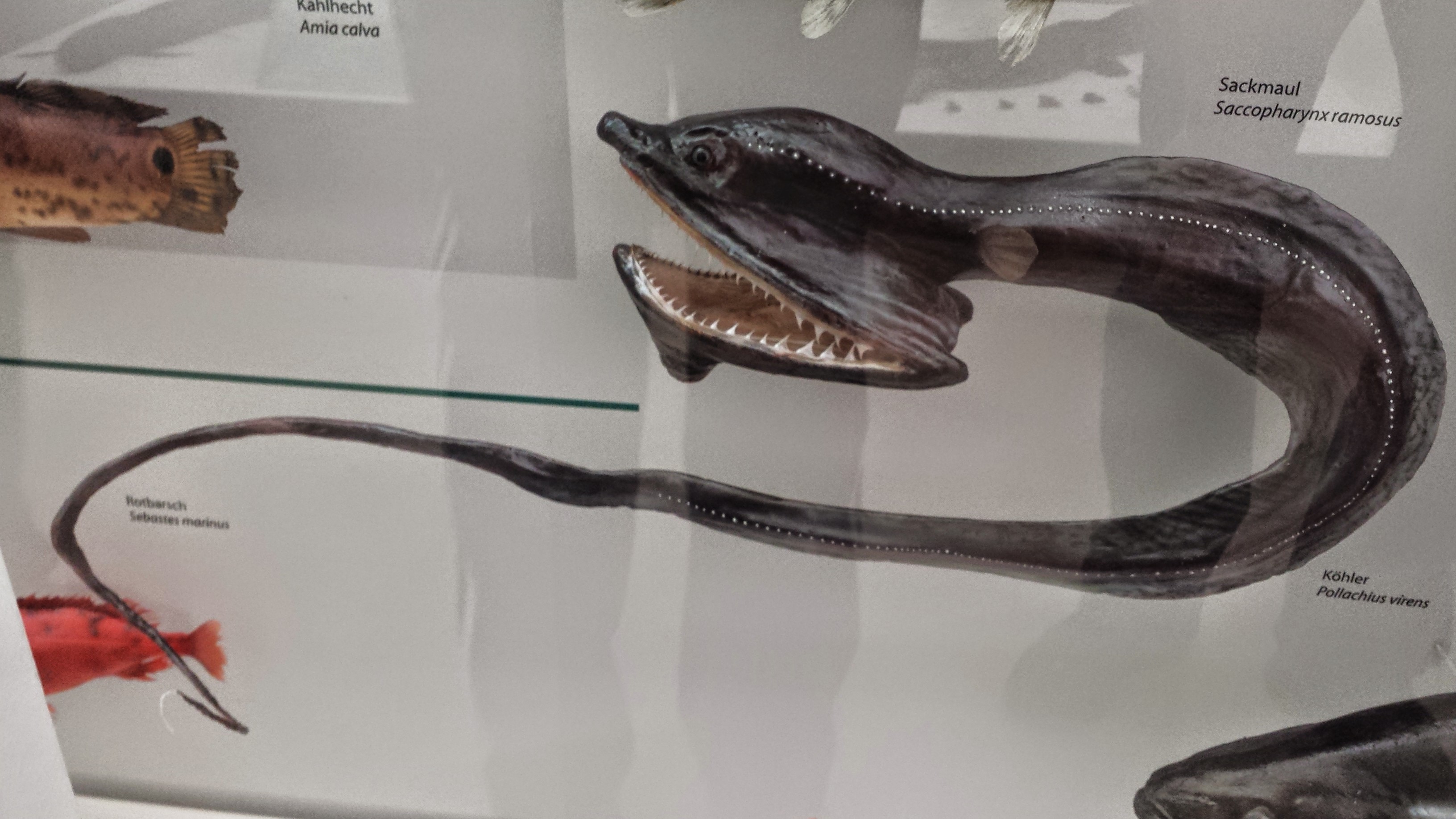
Awesome model of a Gulper eel (Saccopharyngiformes).

Awesome model of a Gulper Eel — or, evocatively, “Sackmaul” auf Deutsch (Saccopharyngiformes).

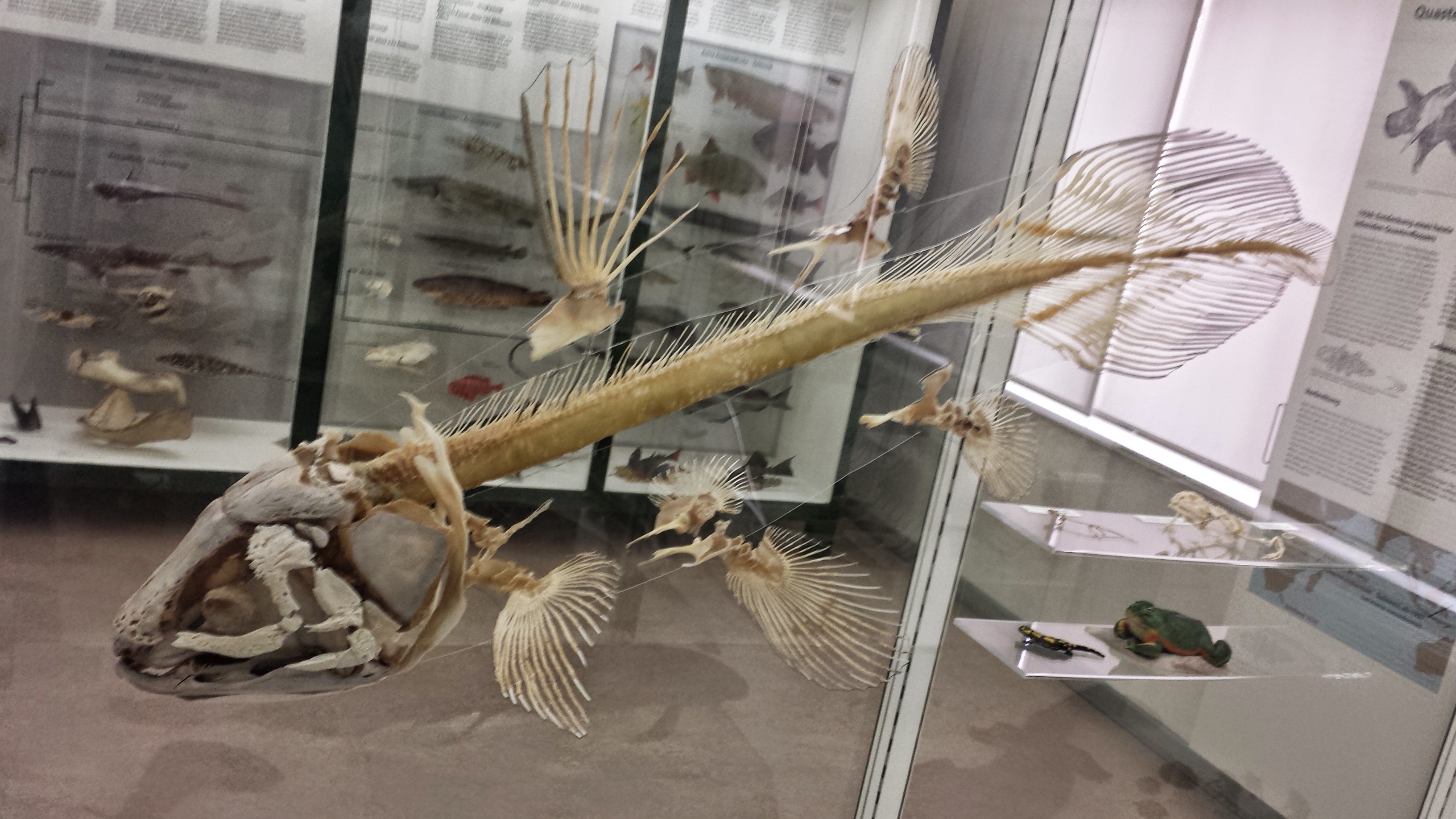
Lobe-finned fishes (Sarcopterygii)- great assortment.

Lobe-finned fishes (Sarcopterygii)- great assortment including a fossil coelacanth.

Lungfish body/model and skeleton.

Lungfish body and skeleton.

Coelacanth!

Coelacanth!

Coelacanth staredown!

Coelacanth staredown!

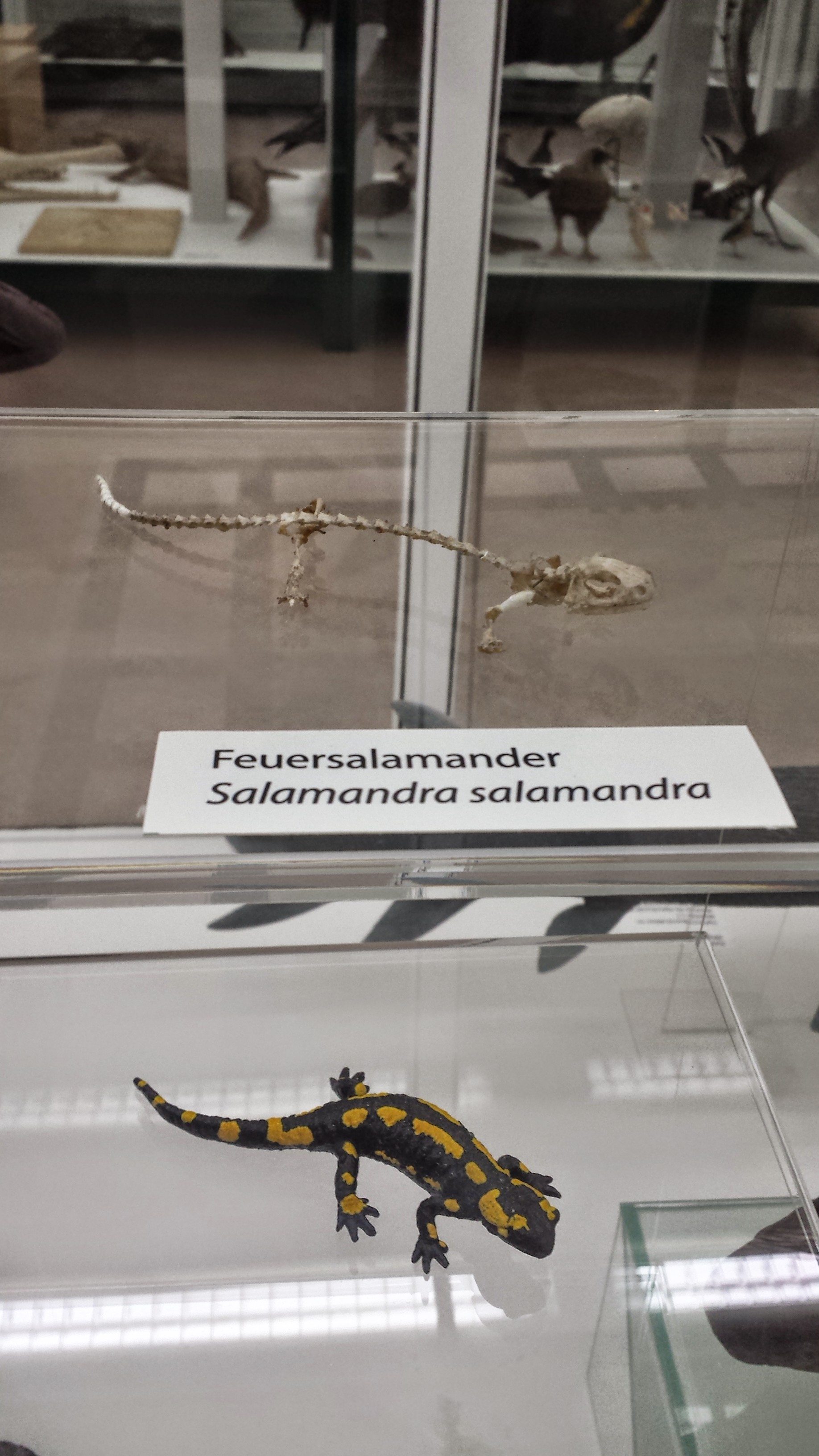
Fire salamander! We love em, and the museum had several on display- given that we were studying them with x-rays, seeing the skeleton and body together here in this nice display was a pleasant surprise.

On into tetrapods– a Fire Salamander (Salamandra salamandra)! We love ’em, and the museum had several on display- given that we were studying them with x-rays, seeing the skeleton and body together here in this nice display was a pleasant surprise.

A tortoise shell and skeleton, with a goofball inspecting it.

A tortoise shell and skeleton, with a goofball inspecting it.

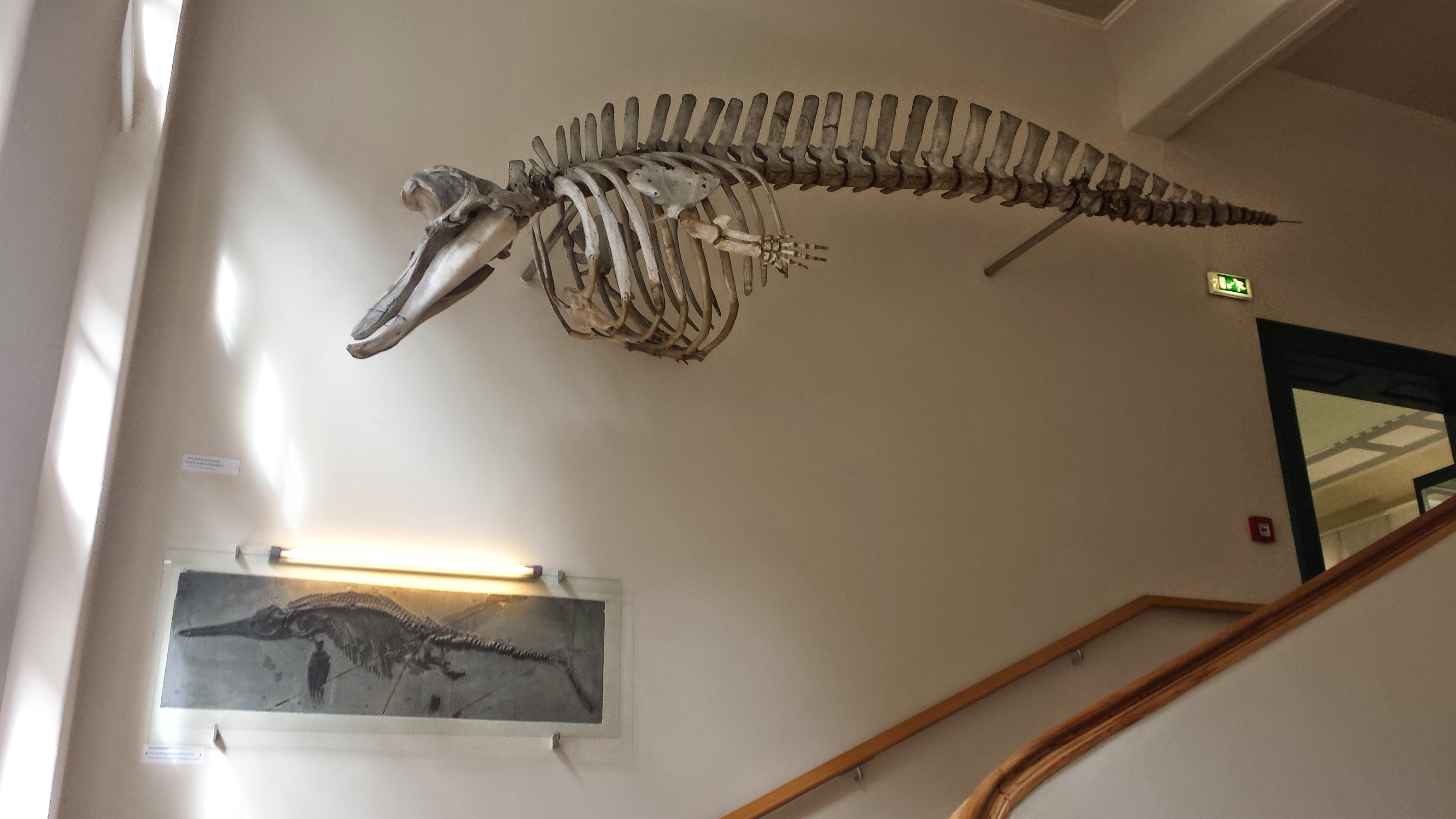
In a subtle nod to recurrent themes in evolution, the streamlined bodies of an ichthyosaur and cetacean shown in the main stairwell of the museum, illustrating convergent evolution to swimming locomotor adaptations.

In a subtle nod to recurrent themes in evolution, the streamlined bodies of an ichthyosaur and cetacean shown in the main stairwell of the museum, illustrating convergent evolution to swimming adaptations.

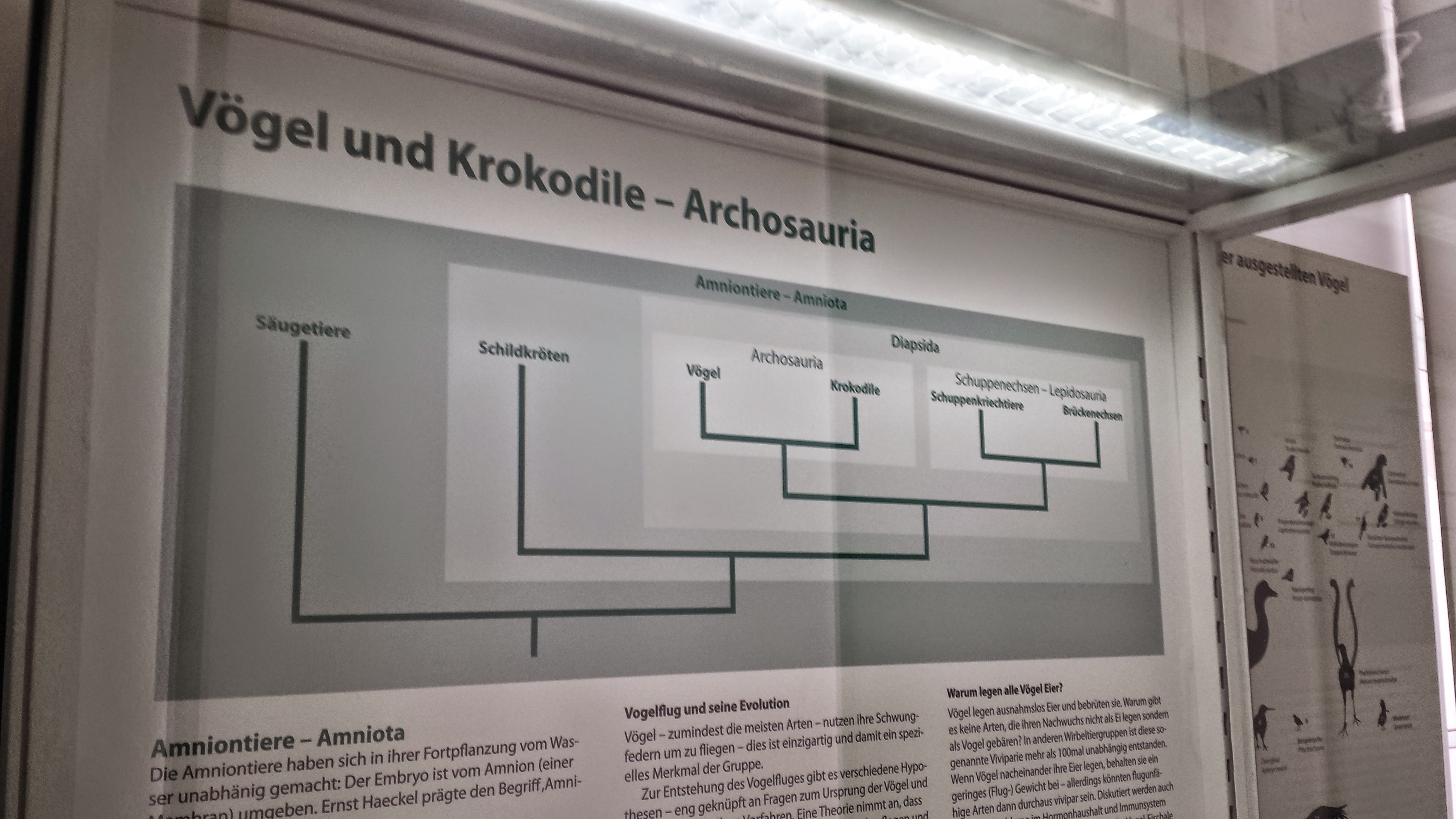
Phylogeny of reptiles, including archosaurs (crocs+birds).

Phylogeny of reptiles, including archosaurs (crocs+birds).

Gnarly model of an Archaeopteryx looks over a cast of the Berlin specimen, and a fellow archosaur (crocodile).

Gnarly model of an Archaeopteryx looks over a cast of the Berlin specimen, and a fellow archosaur (crocodile). The only extinct dinosaur on exhibit!

Kiwi considers the differences in modern bird palates: palaeognathous like it and fellow ratites/tinamous (left), and neognathous like most living birds.

Kiwi considers the differences in modern bird palates: palaeognathous like it and fellow ratites/tinamous (left), and neognathous like most living birds.

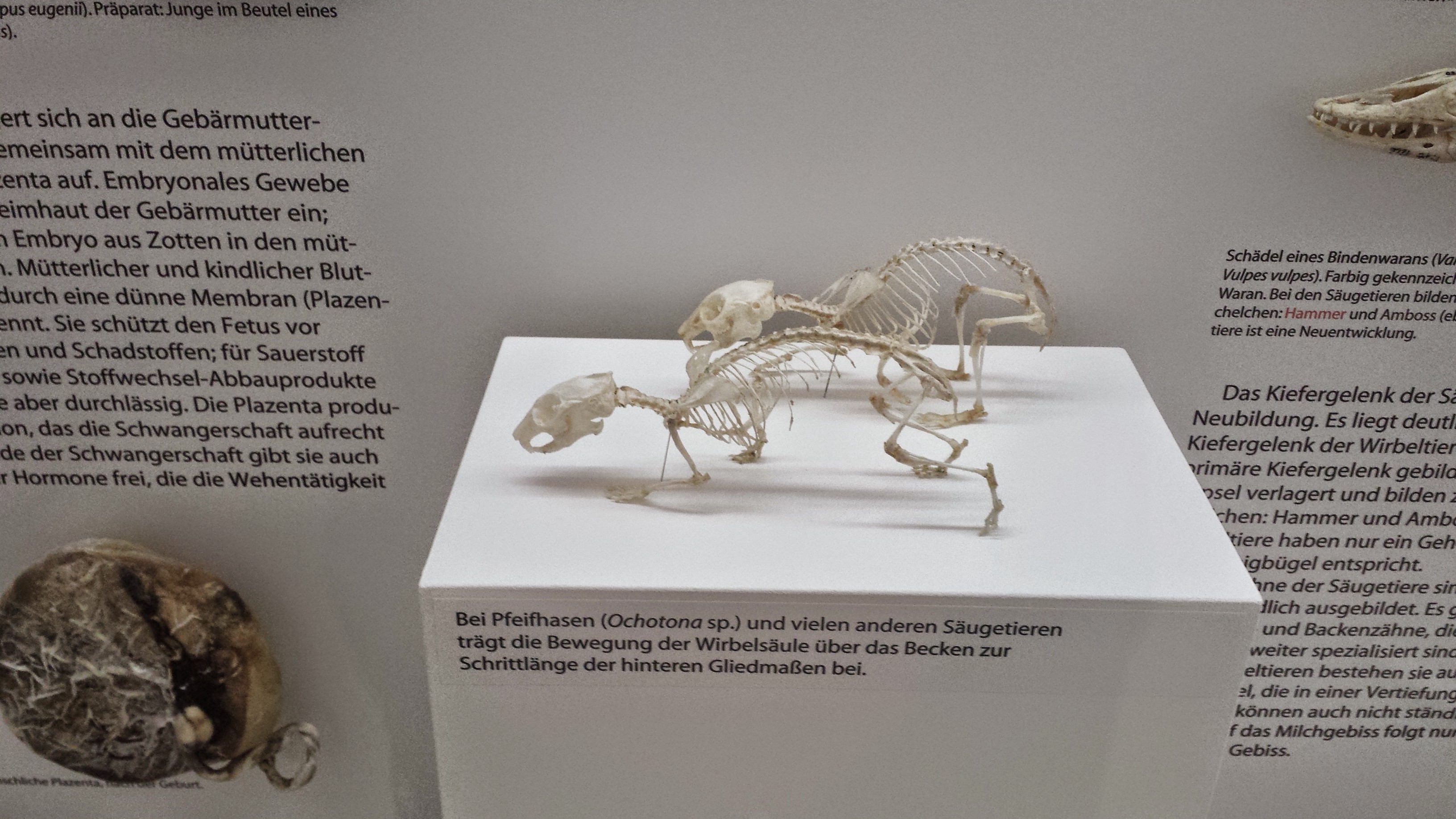
Echidna skeleton. I can't get enough of these!

Echidna skeleton. I can’t get enough of these!

Skulls of dugong (above) and manatee (below).

Skulls of dugong (above) and manatee (below), Sirenia (seacows) closely related to elephants.

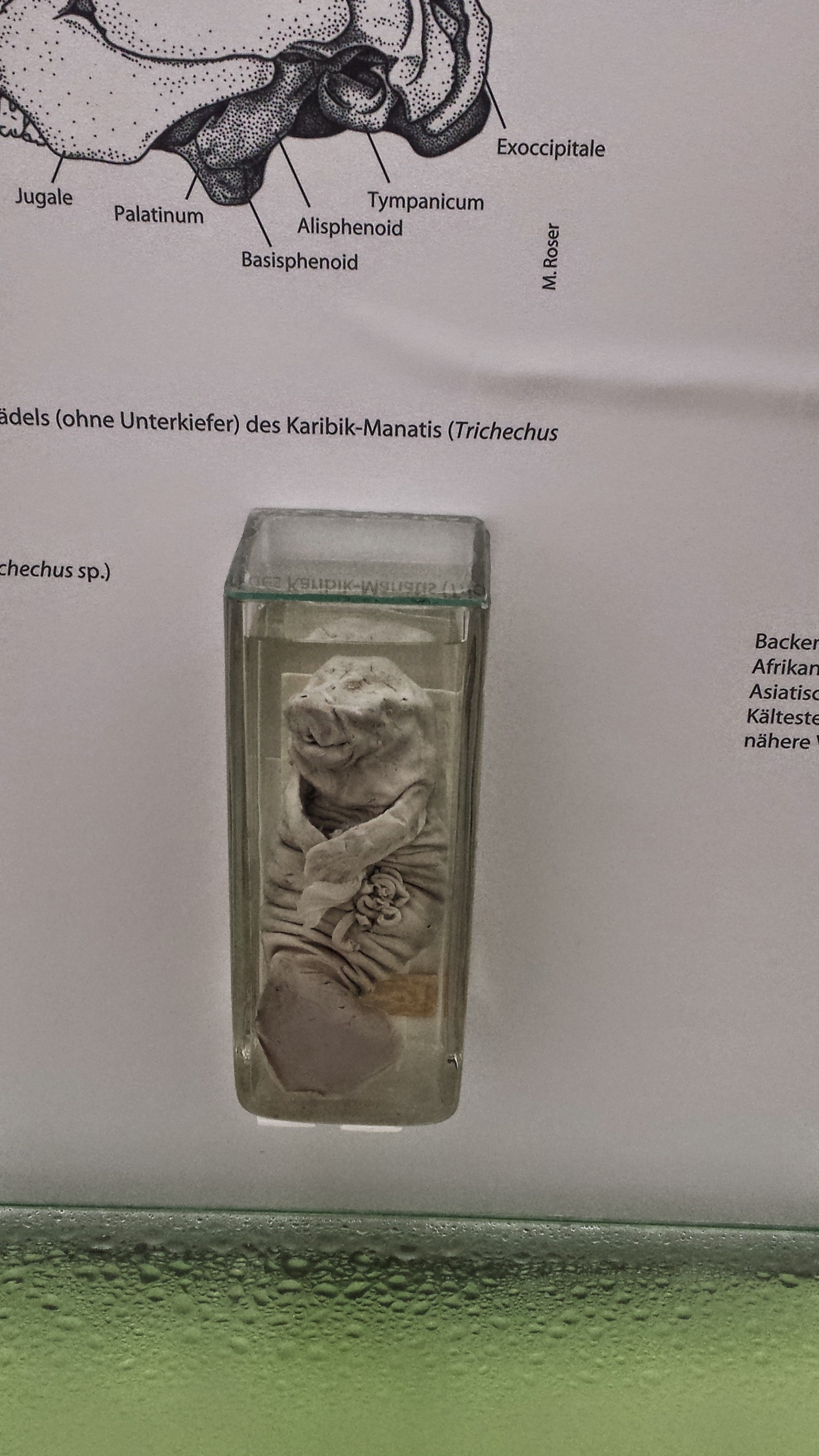
Fetal manatee. Awww.

Fetal manatee. Awww.

Adult Caribbean manatee, showing thoracic dissection.

Adult Caribbean manatee, showing thoracic dissection.

Hyraxes, which Prof. Martin Fischer, longtime curator of the Phyletisches Museum, has studied for many years.  Rodent-like elephant relatives.

Hyraxes, which Prof. Martin Fischer, longtime curator of the Phyletisches Museum, has studied for many years. Rodent-like elephant cousins.

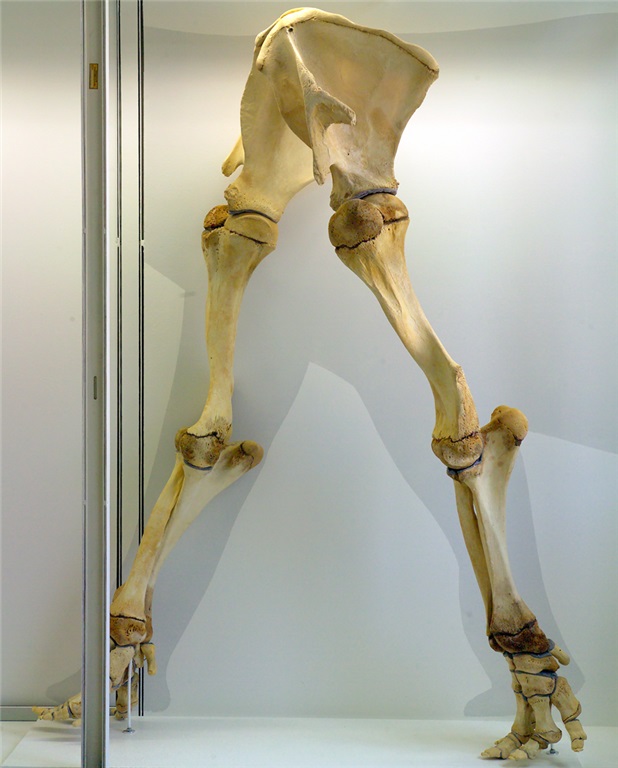
Old exhibit at the Phyletisches Museum, now gone: Forelimbs of an elephant posed in the same postures actually measured in African elephants, for the instant of foot touchdown (left pic) and liftoff (right pic). Involving data that we published in 2008!

Old exhibit at the Phyletisches Museum, now gone: Forelimbs of an elephant posed in the same postures actually measured in African elephants, for the instant of foot touchdown (left pic) and liftoff (right pic). Involving data that we published in 2008!

Gorilla see, gorilla do. Notice "bent hip, bent knee" vs. "upright modern human" hindlimb postures in the two non-skeletal hominids.

Eek, primates! Gorilla see, gorilla do. Notice the primitive “bent hip, bent knee” vs. the advanced “upright modern human” hindlimb postures in the two non-skeletal hominids.

Phylogeny of select mammals, including the hippo-whale clade.

Phylogeny of artiodactyl (even-toed) mammals, including the hippo-whale clade.

Hand (manus) of the early stem-whale Ambulocetus.

Hand (manus) of the early stem-whale Ambulocetus.

Carved shoulderblade (scapula) of a bowhead whale (Balaena mysticetus), which apparently Goethe owned. Quite a relic!

Carved shoulderblade (scapula) of a bowhead whale (Balaena mysticetus), which apparently Goethe owned (click to emwhalen and read the fine print). Quite a relic!

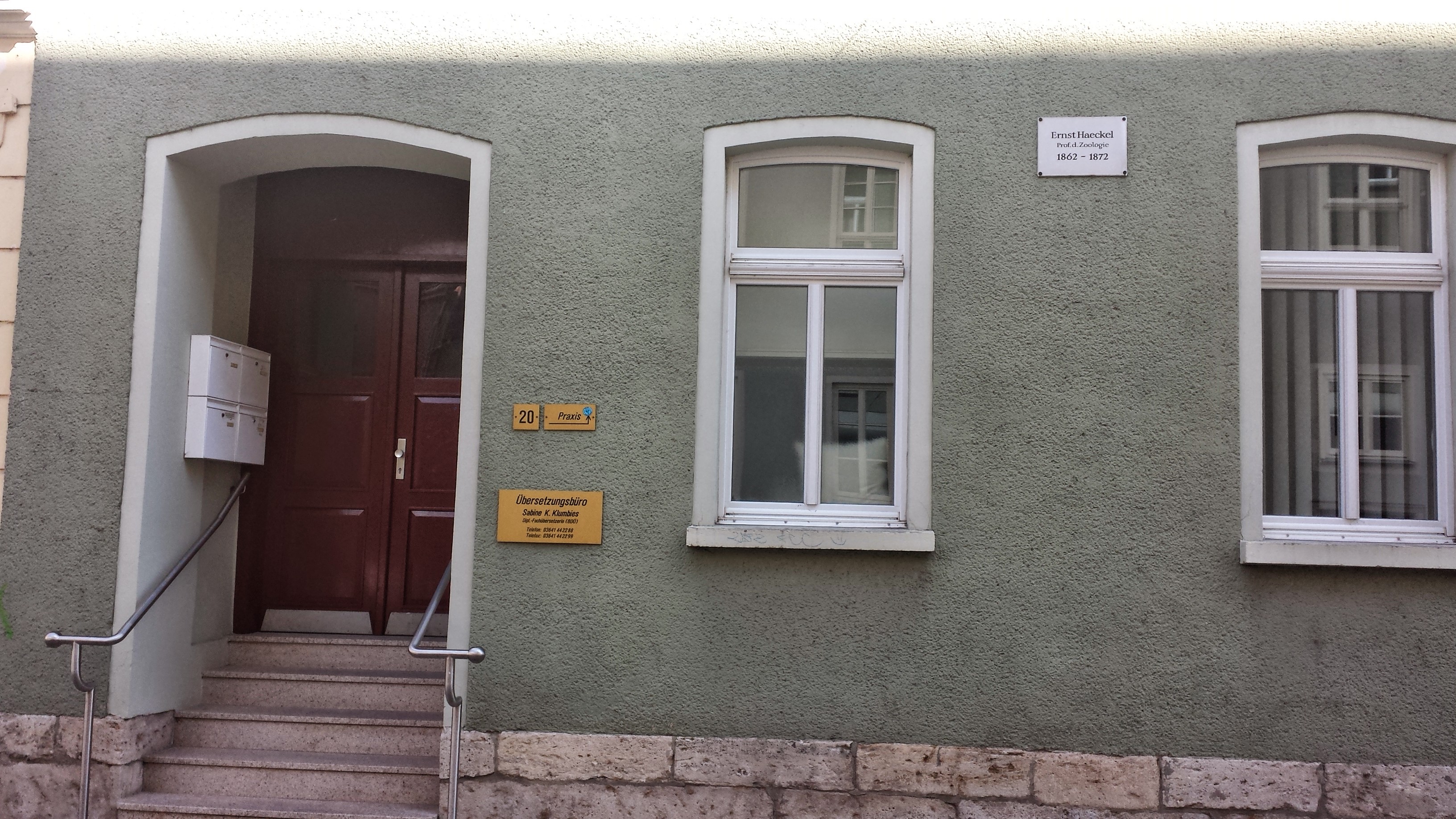
One of Haeckel's residences. There is also a well-preserved house of his that one can visit, but I didn't make it there.

One of Haeckel’s residences, across the street from the museum. There is also a well-preserved house of his that one can visit, but I didn’t make it there. I heard it’s pretty cool.

Jena is tucked away in a valley in former East Germany, with no local airport for easy access- but get to Leipzig and take a 1.25 hour train ride and you’re there. Worth a trip! This is where not just ontogeny and phylogeny were “born”, but also morphology as a modern, rigorous discipline. Huge respect is due to Jena, and to Haeckel, whose quotable quotes and influential research still resonate today, in science as well as in art.

Read Full Post »

Even nine years later, I still keep thinking back to a day, early in my career as an academic faculty member based in England, that traumatized me. Today I’m going to share my story of that day. I feel ready to share it.

Stomach-Churning Rating: hmm that’s a tough call, but I’ll say 1/10 because it’s just photos of live crocs and such.

This day was part of a research trip that lasted a couple of weeks, and it was in Florida, not England, and little of that trip went well at first. It transpired almost exactly 9 years ago today; around 20 August 2005. I took two 2nd/3rd year undergraduate students and our lab technician with me to Florida, meeting up with Dr. Kent Vliet, an experienced crocodile specialist, to study the biomechanics of crocodile locomotion, a subject I’ve been slowwwwwwly working on since my PhD days (see recent related blog post here). We were funded by an internal grant from my university that was supposed to be seed money to get data to lay groundwork for a future large UK research grant.

Cuban crocodile adult relaxing in a nearby enclosure. Pound-for-pound, a scary croc, but these acted like puppies with their trainers.

Cuban crocodile adult relaxing in a nearby enclosure. Pound-for-pound, a scary croc, but these acted like puppies with their trainers.

I’m interested in why only some crocodylian species, of some sizes and age classes, will do certain kinds of gaits, especially mammal-like gaits such as bounding and galloping. This strongly hints at some kind of size-related biomechanical mechanism that dissuades or prevents larger crocs from getting all jiggy with it. And at large size, with few potential predators to worry about and a largely aquatic ambush predator’s ecology, why would they need to? Crocodiles should undergo major biomechanical changes in tune with their ecological shifts as they grow up. I want to know how the anatomy of crocodiles relates to these changes, and what mechanism underlies their reduction of athletic abilities like bounding. That’s the scientific motivation for working with animals that can detach limbs from your body. (The crocodiles we worked with initially on this trip were small (about 1 meter long) and not very dangerous, but they still would have done some damage if they’d chosen to bite us, and I’ve worked with a few really nasty crocs before.)

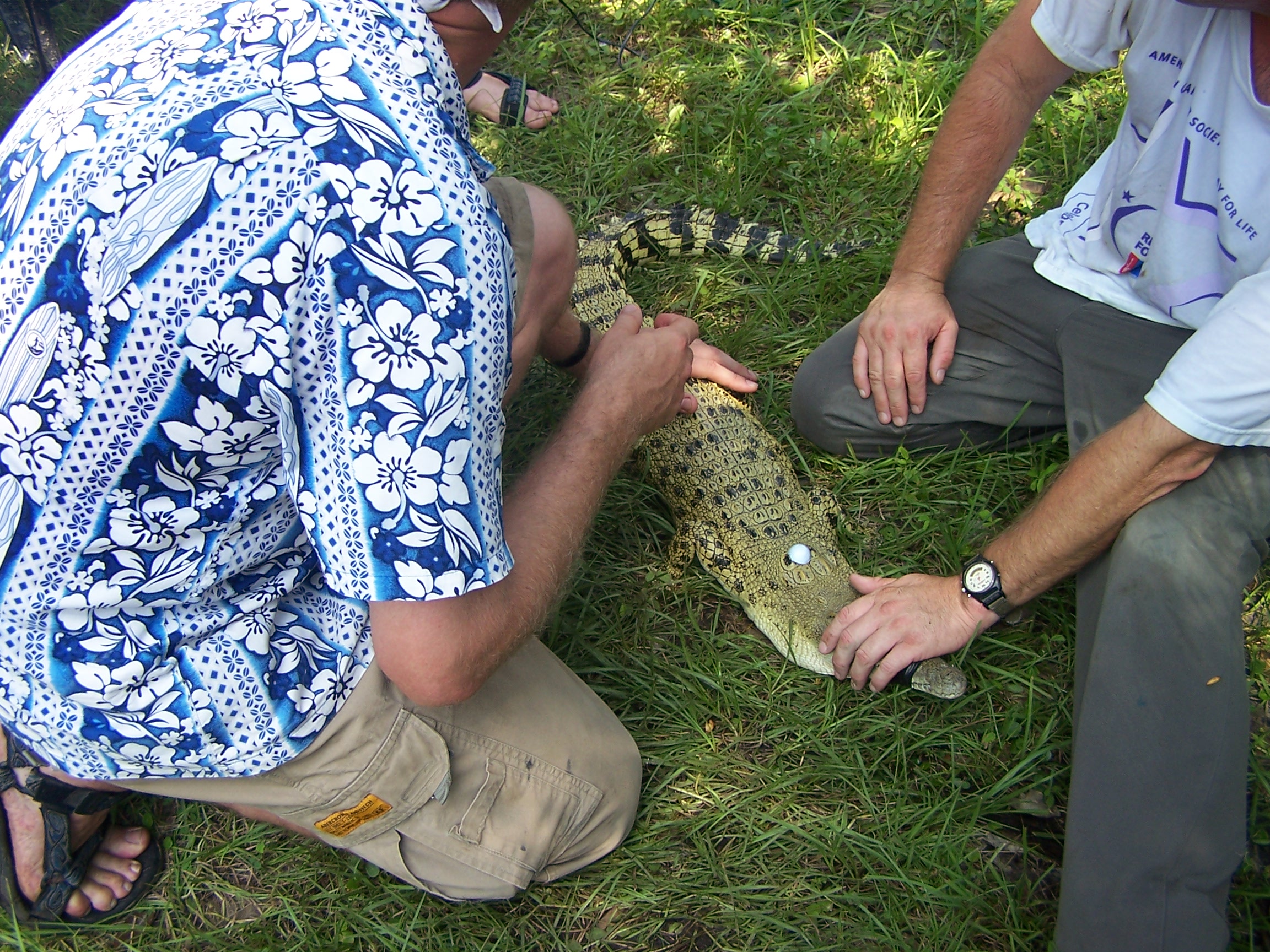
Me putting motion capture markers onto an uncooperative young Siamese crocodile.

Me putting motion capture markers onto an uncooperative young Siamese crocodile.

We worked at Gatorland (near Orlando) with some wonderfully trained crocodiles that would even sit in your lap or under your chair, and listened to vocal commands. The cuteness didn’t wear off, but our patience soon did. First, the force platform we’d borrowed (from mentor Rodger Kram’s lab; a ~$10,000 piece of useful gear) and its digital data acquisition system wouldn’t work to let us collect our data. That was very frustrating and even a very helpful local LabView software representative couldn’t solve all our problems. But at least we were able to start trying to collect data after four painstaking days of debugging while curious crocodiles and busy animal handlers waited around for us to get our act together. The stress level of our group was already mounting, and we had limited time plus plenty of real-life bugs (the bitey, itchy kind; including fire ants) and relentless heat to motivate us to get the research done.

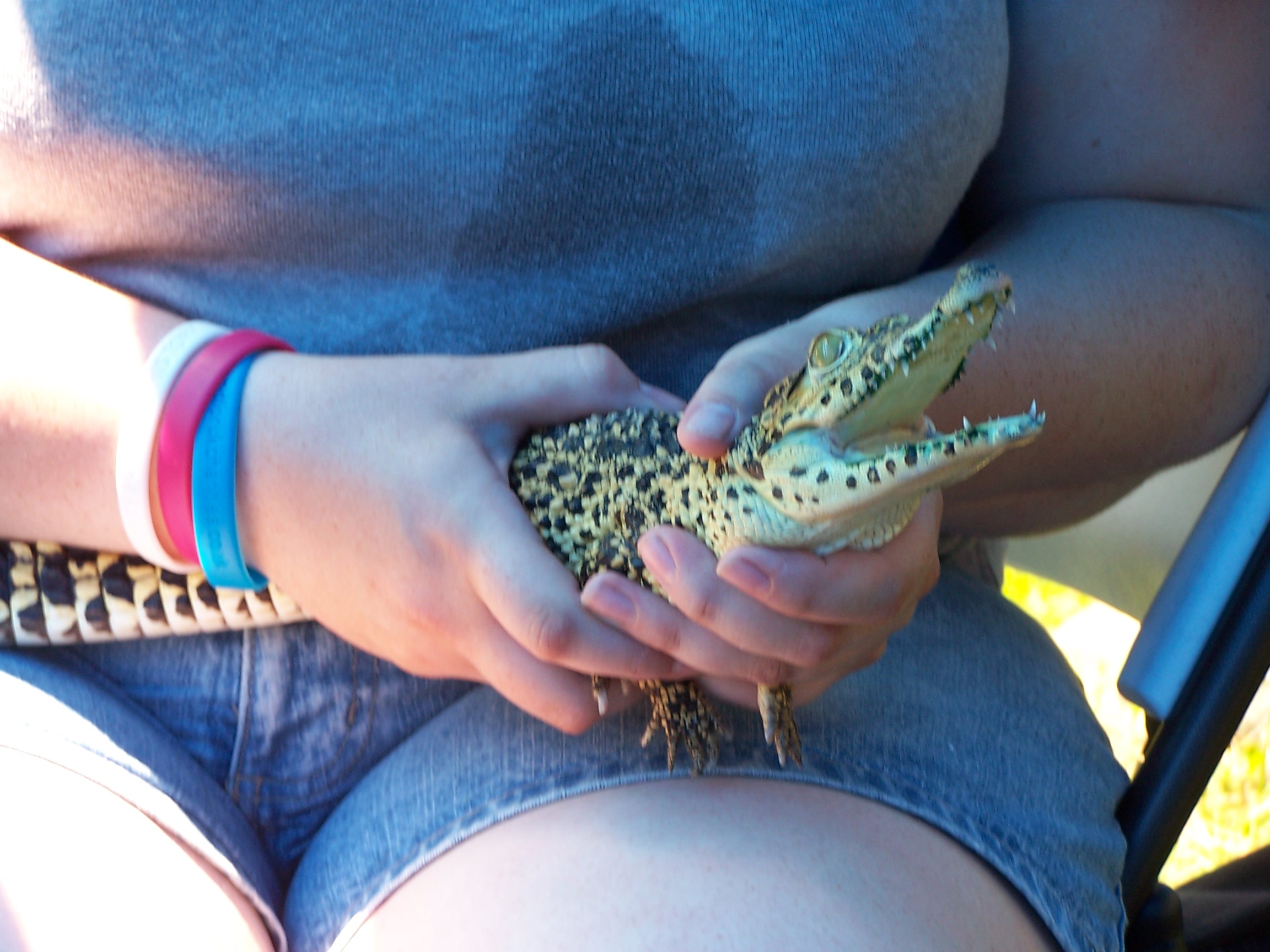
Adorable baby Cuban crocodile.

Adorable baby Cuban crocodile.

Then the wonderfully trained crocodiles, as crocodiles will sometimes do, decided that they did not feel like doing more than a slow belly crawl over our force platform, at best. This was not a big surprise and so we patiently tried coaxing them for a couple of sweltering August days. We were working in their caged paddock, which contained a sloping grassy area, a small wooden roofed area, and then at the bottom of the slope was the crocodiles’ pond, where they sat and chilled out when they weren’t being called upon to strut their stuff for science. We didn’t get anything very useful from them, and then the weather forecast started looking ugly.

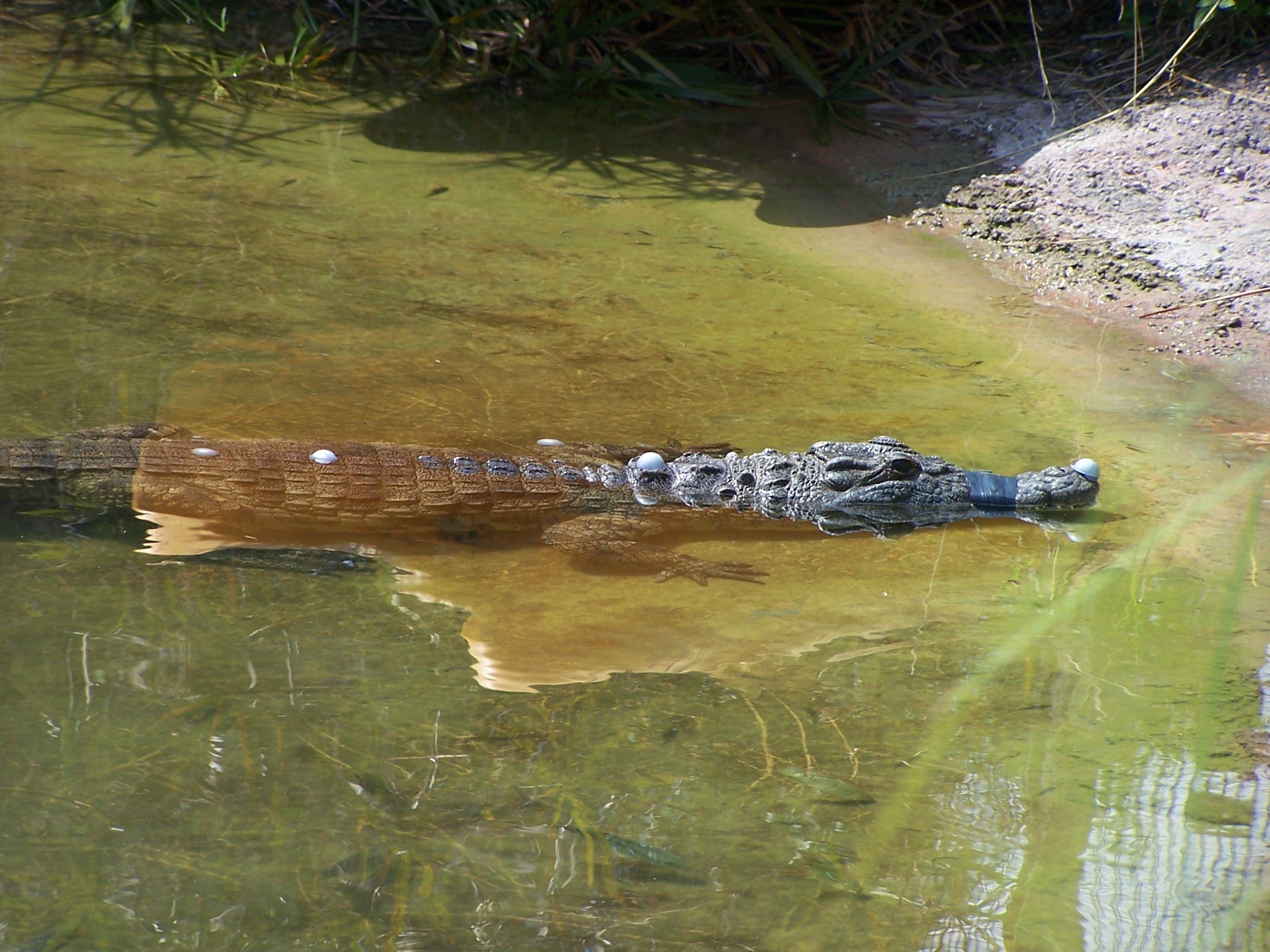
Hybrid Siamese crocodile in its pond in our enclosure, waiting to be studied.

Hybrid Siamese crocodile in its pond in our enclosure, waiting to be studied.

We’d been watching reports of a tropical storm developing off the southeastern coast of Florida, and crossing our fingers that it would miss us. But it didn’t.

When the storm hit, we were hoping to weather the edge of the storm while we packed up, because we decided we’d done our best but our time had run out and we should move to our next site, the Alligator Farm and Zoological Park in St Augustine, where I’d worked a lot before with other Crocodylia. But the storm caught us off guard, too soon, and too violently.

To give some context to the situation, for the previous several days the local croc handlers had told us stories of how lightning routinely struck this area during storms, and was particularly prone to hitting the fences on the park perimeter, which we were close to. There was a blasted old tree nearby that vultures hung out in, and they related how that blasting had been done by lightning. One trainer had been hit twice by (luckily glancing) blows from lightning hitting the fences and such.

Ominous onlooker.

Ominous onlooker.

The storm came with pounding rain and a lot of lightning, much of it clearly striking nearby- with almost no delay between flashes and thunder, and visible sky-to-ground bolts. We debated taking our forceplate out of the ground near the crocodile pond, because sensitive electrical equipment and rain don’t go well together, but this would take precious time. The forceplate was covered with a tarp to keep the rain off. I decided that, in the interest of safety, we needed to all seek shelter and let the forceplate be.

I’ll never forget the memory of leaving that crocodile enclosure and seeing a terrible sight. The crocodile pond had swiftly flooded and engulfed our forceplate. This flooding also released all the (small) crocodiles which were now happily wandering their enclosure where we’d been sitting and working before.
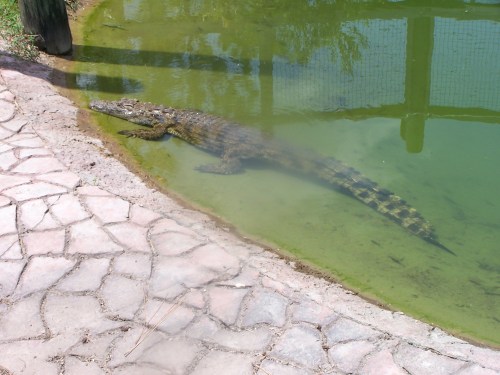
Another subject awaits science.

Another subject awaits science.

At that point I figured there was no going back. Lightning + deepening floodwater + electrical equipment + crocodiles = not good, so I wagered my team’s safety against our loaned equipment’s, favouring the former.

We sprinted for cars and keepers’ huts, and got split up in the rain and commotion. As the rain calmed down, I ventured out to find the rest of the team. It turned out that amidst the havoc, our intrepid lab technician had marshalled people to go fetch the forceplate out from the flooded paddock, storm notwithstanding. We quickly set to drying it out, and during some tense time over the next day we did several rounds of testing its electronics to see if it would still work. Nope, it was dead. And we still had over a week of time left to do research, but without our most useful device. (A forceplate tells you how hard animals are pushing against the ground, and with other data such as those from our motion analysis cameras, how their limbs and joints function to support them)

We went on to St Augustine and got some decent data using just our cameras, for a wide variety of crocodiles, so the trip wasn’t a total loss. I got trapped by remnants of the storm while in Washington, DC and had to sleep on chairs in Dulles Airport overnight, but I got home, totally wrecked and frazzled from the experience.

That poorly-timed storm was part of a series of powerful storms that would produce Hurricane Katrina several days later, after we’d all left Florida. So we had it relatively easy.

I’m still shaken by the experience- as a tall person who grew up in an area with a lot of dangerous storms, I was already uneasy about lightning, feeling like I had a target on my back. But running from the lightning in that storm, after all the warnings we’d had about its bad history in this area, and how shockingly close the lightning was, leaves me almost phobic about lightning strikes. I’m in awe of lightning and enjoy thunderstorms, which I’ve seen few of since I left Wisconsin in 1995, but I now hate getting caught out in them.
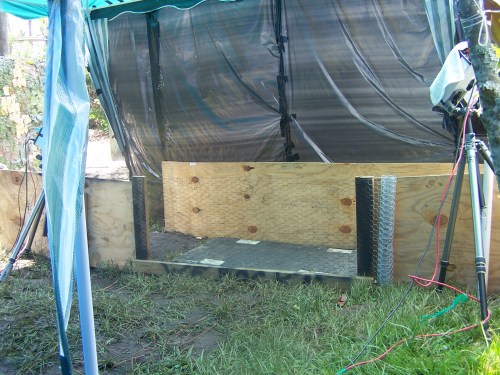
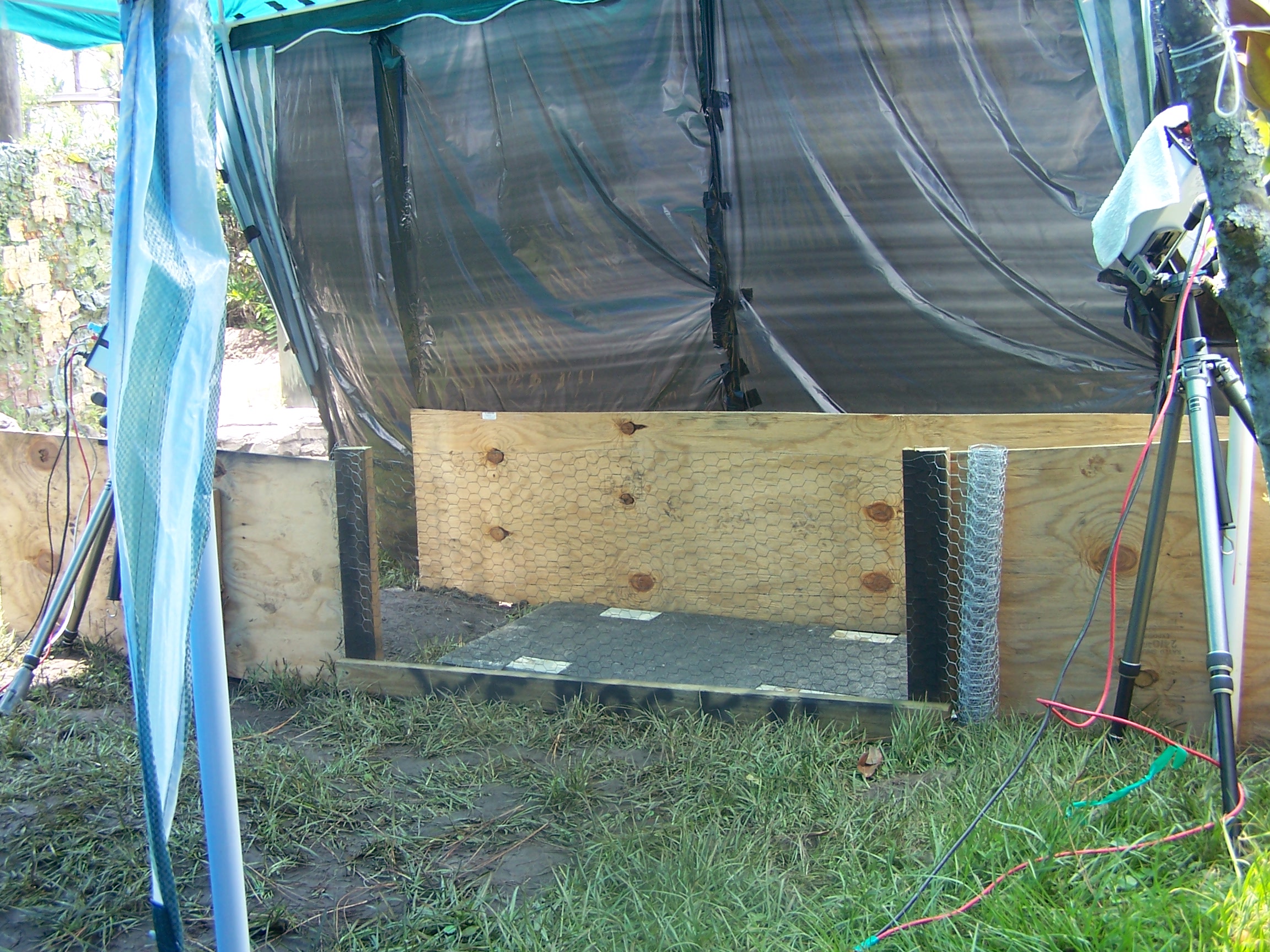
The ill-fated forceplate and experimental area.

The ill-fated forceplate and experimental area.

Moreover, the damage to the forceplate- which we managed to pay to repair and return to my colleague, and the failure of the Gatorland experiments, truly mortified me. I felt horrible and still feel ashamed. I don’t think I could have handled the situation much differently. It was just a shitty situation. That, and I wanted to show our undergrads a good time with research, yet what they ended up seeing was a debacle. I still have the emails I sent back to my research dean to describe what happened in the event, and they bring back the pain and stress now that I re-read them. But then… there’s a special stupid part to this story.

I tried to lighten the mood one night shortly after the storm by taking the team out to dinner, having a few drinks and then getting up to sing karaoke in front of the restaurant. I sang one of my favourite J Geil’s Band tunes– I have a nostalgic weakness for them- the song “Centerfold“. I not only didn’t sing it well (my heart was not in it and my body was shattered), and tried lamely to get the crowd involved (I think no one clapped or sang along), but also in retrospect it was a bad choice of song to be singing with two female undergrads there– I hadn’t thought about the song’s meanings when I chose to sing it, I just enjoyed it as a fun, goofy song that brought me back to innocent days of my youth in the early 1980’s. But it is not an innocent song.

So ironically, today what I feel the most embarrassed about, thinking about that whole trip and the failed experiment, is that karaoke performance. It was incredibly graceless and ill-timed and I don’t think anyone enjoyed it. I needed to unwind; the stress was crushing me; but oh… it was so damn awkward. I think I wanted to show to the team “I’m OK, I can still sing joyfully and have a good time even though we had a disastrous experiment and maybe nearly got electrified or bitten by submerged crocodiles or what-not, so you can relax too; we can move on and enjoy the rest of the trip” but in reality I proved to myself, at least, that I was not OK. And I’m still not OK about that experience. It still makes me cringe. Haunted, it took me many years to feel comfortable singing karaoke again.

It should have been a fun trip. I love working with crocodiles, but Florida is a treacherous place for field work (and many other things). I can’t say I grew stronger from this experience. There is no silver lining. It sucked, and I continually revisit it in my memory trying to find a lesson beyond “choose better times and better songs to sing karaoke with” or “stay away from floods, electricity and deadly beasts.”

So that wins, out of several good options, as the worst day(s) of my career that I can recall. I’ve had worse days in my life, but for uncomfortable science escapades this edges out some other contenders. Whenever I leave the lab to do research, I think of this experience and hope that I don’t see anything worse. It could have been much worse field work.

(Epilogue: the grants we’ve tried to fund for this crocodile gait project all got shot down, so it has lingered and we’ve done research on it gradually since, when we find time and students… And one of the students on this trip went on to do well in research and is finishing a PhD in the Structure & Motion Lab now, so we didn’t entirely scare them off science!)

Read Full Post »