Feeds:
Posts
Comments

Archive for April, 2014

It’s World Penguin Day! Watch your back though… these penguins aren’t as nice as they seem. But they need us to be nice to them!

Hahaha?Whether you watch a classic GIF like the one above, or a kid-friendly TV/film documentary, you might get the impression that penguins lead carefree, or at least silly or slapstick, lives– happy feet and all that. It works for Hollywood: a Charlie Chaplin comedy relief role to play.  And that’s the vision of penguins I grew up with: they were living cartoons to me.

But what’s the reality? Plenty of documentaries, most notably to my mind the recent Attenborough’s “Frozen Earth” episodes or “March of the Penguins” film, have dealt with the darker side to these two-toned, tuxedo-toting antipodeans. And anyone who has experienced penguins in the wild has probably seen those not-so-light facets of penguinity firsthand. On realiizing just how compulsively horny young “hooligan cock” male penguins were, Natural History Museum ornithologist Douglas Russell wrote: ““just the frozen head of the penguin, with self-adhesive white O’s for eye rings, propped upright on wire with a large rock for a body, was sufficient stimulus for males to copulate and deposit sperm on the rock.”

Stomach-Churning Rating: 5/10; some tears may be shed over cute baby penguins and you might choke if you’re a rhea trying to swallow one, but the anatomy shown is mostly skeletal or dessicated. No penguin juices. Except those just mentioned above.

I’m quick to admit, I didn’t know much about penguins until recently. I couldn’t name many species or say much about their behaviour, anatomy or evolutionary history. When I was a graduate student at Berkeley, I was enthused by a now-classic, elegantly simple study (published in 2000) that fellow PhD student Tim Griffin and biomechanist Dr. Rodger Kram conducted on penguin waddling. They found that the waddling gait of penguins isn’t mechanically disadvantageous, as it appears, but rather is a way that they conserve energy while walking. It’s the short legs, instead, that make their gait metabolically expensive, because shorter legs mean that more frequent, costly steps need to be taken, incurring high costs due to rapid firing of leg muscles to support the body. My vicarious enjoyment of Griffin’s & Kram’s research began my scientific introduction to penguins. Fast forward to 2014: I get a crash course in penguinology.

Punta Tombo (4)

Mostly-fledged Magellanic penguin

That’s what this post is about, and how it brought me in touch with The Existentialist Penguin— the haggard, storm-tossed, predator-harried, starved and bullied wanderer of wastelands.

My personal introduction to penguins over the past year has been initiated by a collaboration with PhD student James Proffitt and long-time colleague Dr. Julia Clarke, both at the University of Texas in Austin. They kindly invited me to collaborate on applying modern biomechanics to the surprisingly excellent fossil record of penguins (Sphenisciformes), among other extant water birds. Before diving into it all, I happened to go to Argentina.
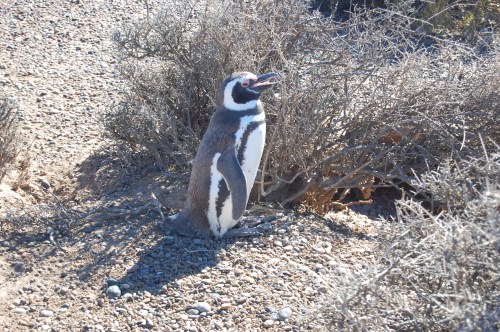
Punta Tombo (2)

Penguin tries to keep cool in the shade, opening its mouth to shed heat in the autumn sun.

Just before I travelled to Patagonia on unrelated business (to study sauropodomorph dinosaurs!), I did a little googling and came across Punta Tombo reserve, near the city of Trelew that I was visiting (more about that in a future post!). It’s where some 1+ million Magellanic penguins (Spheniscus magellanicus) gather every southern summer to breed and fledge before making a long ~5 month swim up to Brazil. I asked my host, Dr. Alejandro Otero, if we might take a day off to visit this spot, where guanacos, rheas and other wildlife were also said to be common, and he basically said “Hell yes!” as he’d never been there. My Flickr photostream gives a big set of my favourite photos from that trip, but here are some others below, to show some of my experiences. We rented a car and took a lovely 90-minute drive south across the Patagonian plains, observing wildlife like tinamous (yes! So exciting for me) as we went. You could get within 1.5m of the penguins according to park rules, and the penguins were very permissive of that!

This jaunty chap was staying put in his burrow while people walked by. We came closer and he kept rotating his head around, staring at us. I first took it as cute juvenile behaviour, but on later observations of penguins realized it was a threat- "My beak is sharp! Stay back, bro, or I'll glock ya!"

This jaunty chap was staying put in his burrow while people walked by. We came closer and he kept rotating his head around, staring at us. I first took it as cute juvenile behaviour, but on later observations of penguins realized it was a threat- “My beak is sharp! Stay back, bro, or I’ll glock ya!”

The video below shows a penguin encounter that left me with no doubts that these animals don’t mess around. The smaller penguin escaped, losing its cool burrow and some of its tough hide, too. Indeed, penguins can be remarkable assholes to each other.

With battles like this erupting all around us, where the penguins struggled to find shade in the desert-like inland parts of the park, often hundreds of meters away from the cool ocean, it came as no surprise to find casualties. The juveniles (and some remaining adults; most having left by now while the ~1 year-old juveniles fledge) not only battled, but also fasted, and roasted in the heat as they shed their insulatory fluff for waterproofed streamlining. This poor little flat Spheniscus had been trodden a bit past streamlined:Punta Tombo (3)

Near the end of our visit, just after I saw an informative sign about the lesser rhea or “choique” (Pterocnemia/Rhea pennata), we managed to get very close to a rhea and follow it for a while, as penguins stood around in apparent disinterest. I’ll never forget that meeting: two flightless birds, yet adapted to such different lifestyles and habitats. The penguins were in the rhea’s domain; a hot, wind-blown, scree-scoured scrubland on the edge of the fertile ocean.rhea-penguin

The choique soon found a dry old hatchling penguin carcass, no meatier than the surrounding thickets, and tried to swallow it. The loss of teeth by its distant ornithurine ancestors proved to be a bad move, because it struggled to get the jerky-like mass through its beak:

That Punta Tombo visit was an experience I’ll never forget. I returned to the UK, abuzz with excitement about penguins. I “got” them now, I felt, at least in a very unscientific, anthropomorphic way. It took the face-to-beak experience to drive that home, more than any emotive film treatment could. Whether enduring Antarctic wintery blasts or unforgivingly hot and dry, burrow-speckled coastal badlands, penguins are buggers with true grit. Survivors, as their >60 million year fossil record attests to. On my return, I delved through my photos of museum specimens to get a better appreciation for penguin anatomy, preparing to also get familiar with that fossil record; all as part of that ongoing work with Proffitt and Clarke. Here’s some of that anatomy:
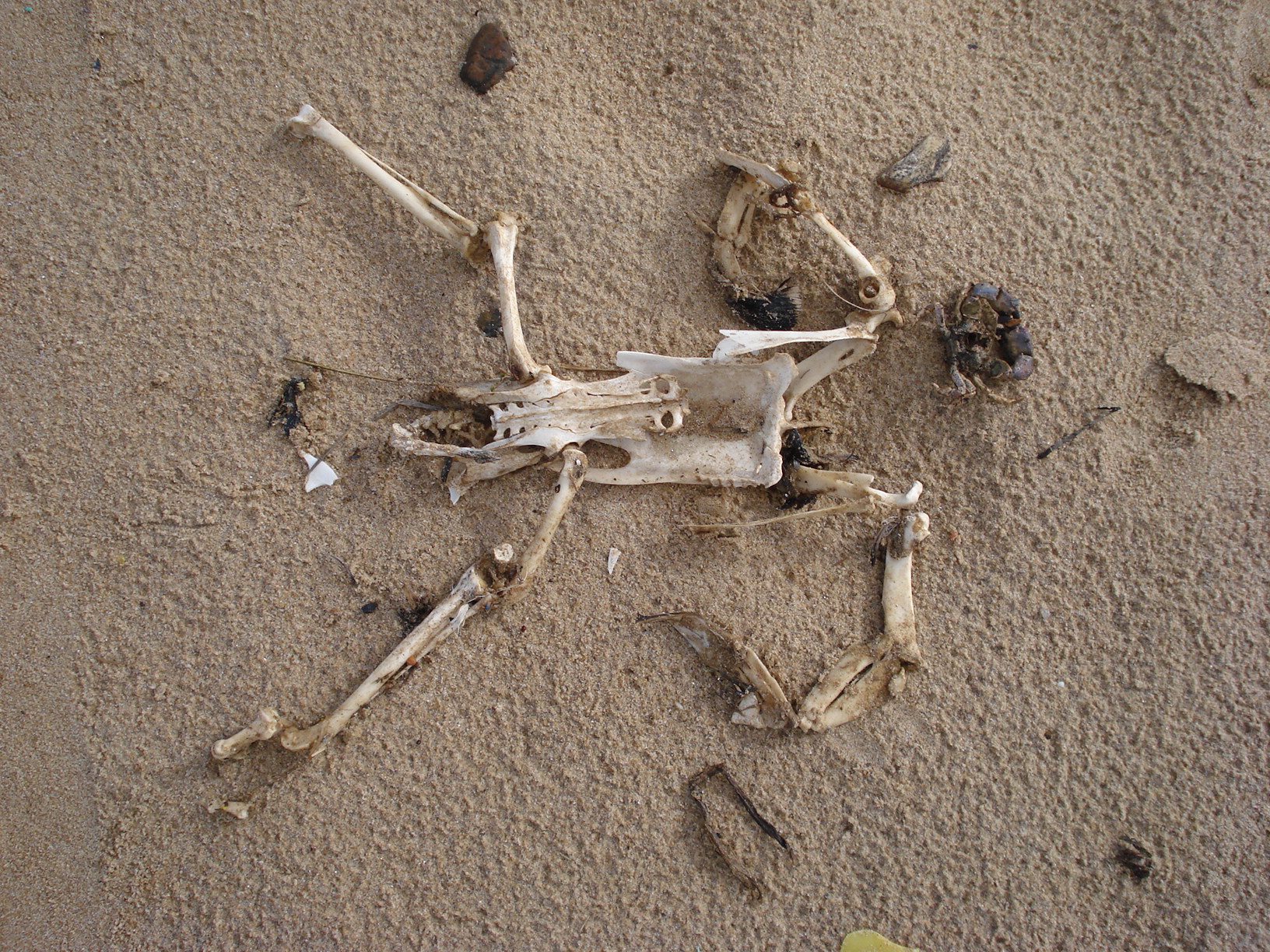
My first encounter with a penguin in the wild is probably this specimen washed up on a beach in Uruguay. I'm going with the tentative ID of a juvenile penguin skeleton; probably Magellanic.

My first encounter with a penguin in the wild (but not a live one) is probably this specimen washed up on a beach in Uruguay. I’m going with the tentative ID of a juvenile penguin skeleton (short foot; flat wing bones); probably Magellanic. The bevy of vertebrate morphologists investigating dead penguins on this beach during our conference in 2010 will not soon be forgotten!

Magellanic penguin skeleton, "flying" through the Punta Tombo visitor centre.

Magellanic penguin skeleton, “flying” through the Punta Tombo visitor centre.

University Museum of Zoology Cambridge skeleton of one of the "great penguin" (do not confuse with the great pumpkin!) species; either King (patagonicus) or Emperor (forsteri).

University Museum of Zoology Cambridge skeleton of a “great penguin” (do not confuse with the great pumpkin!) species of Aptenodytes; either King (patagonicus) or Emperor (forsteri). Characteristic features, in addition to the robust, dense skeleton, include the short neck, flattened but robust wings and scapulae, robust furcula (wishbone), stubby legs (with a big blocky patella) and thin but longish tail (supposedly used to balance with while walking/standing).

I’ll visit some more penguin anatomy in coming images- those photos are just teasers. And they set the stage for me to go back to my one-stop-shopping for awesome ornithological specimens, the Natural History Museum at Tring (images below presented with kind permission from the Natural History Museum, London; but I took the photos), to pick up an assortment of 11 frozen penguins from helpful curator Hein van Grouw! Such as this “gagged” King penguin:
NHMUK penguin

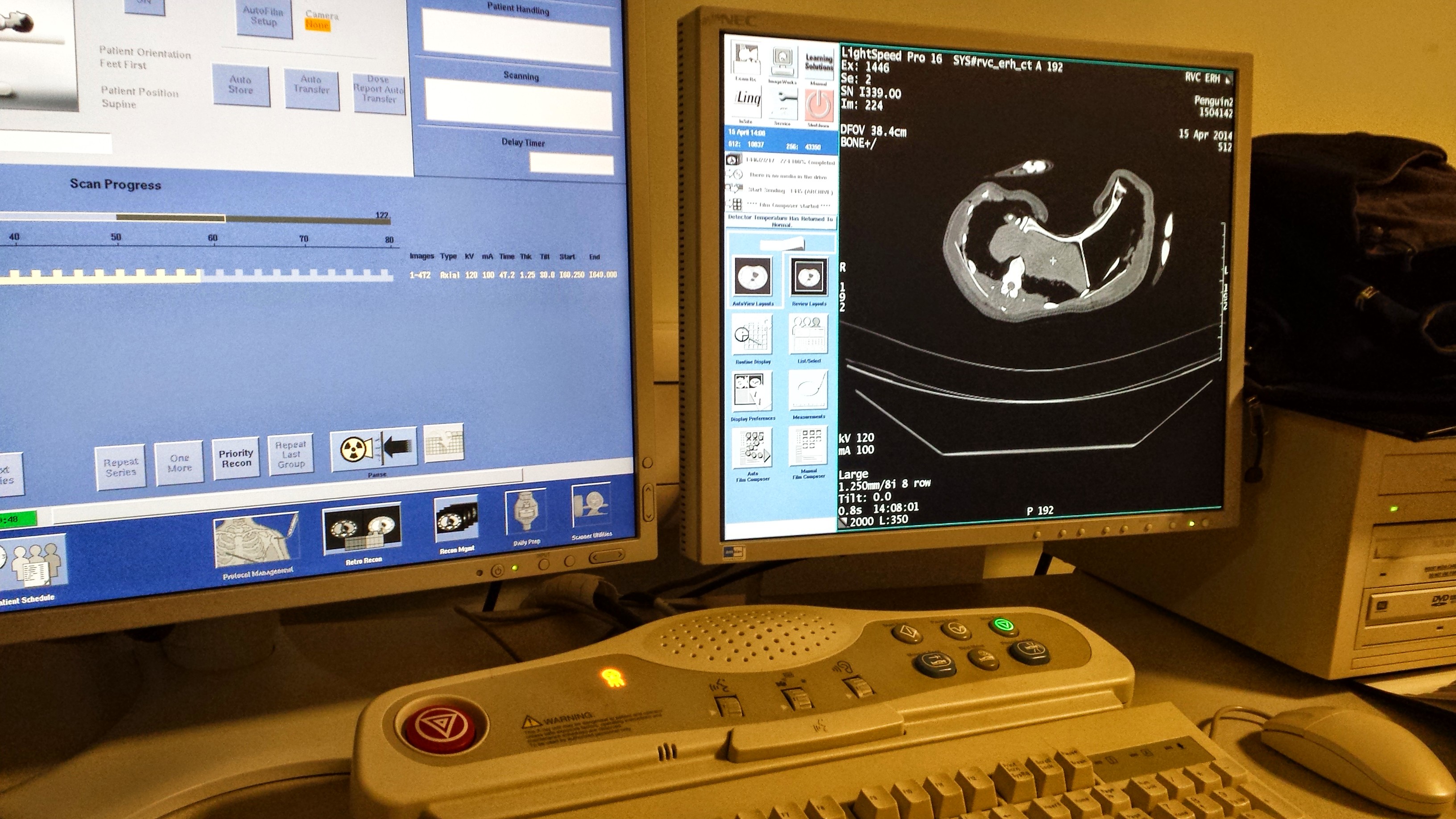
And this handsome Emperor penguin, going through the Equine Imaging Centre’s CT scanner as I do my usual routine of (1) get cool critters, (2) barrage them with radiation to peek inside:penguin CT (3)

CT scanner monitors as I scan a penguin; mid-torso x-ray slice shown on the right.

CT scanner monitors as I scan a penguin; mid-torso x-ray slice shown on the right.

Awwwwww... baby Gentoo penguin (Pygoscelis papua). Unhappy feet, I'm afraid.

Awwwwww… baby Gentoo penguin (Pygoscelis papua— EDIT: Probably Aptenodytes; see comments below). Unhappy feet, I’m afraid… Happy CT scanning, however– specimens like this are NOT easy to come by in these northern nether regions!

Because I love the CT scan images of these penguins so much (their skeletons are awesome and bizarre!), I’ll share the pilot scans of the best ones now:

Calling all penguin experts! What's up with this? Is that really how much gastrolith volume a penguin carries, or did a museum curator stick rocks up its bum? Seems very caudal in position. I'm fascinated.

Calling all penguin experts! What’s up with this? Is that really how much gastrolith (stomach stone; near bottom of image) volume a penguin carries (answer after some literature reading: maybe yes!), or did a museum curator stick rocks up its bum? It seems very caudal in position, and this is consistent with other animals I’ve seen (some below). A paper on this phenomenon and potential role in ballast is here. Another here.
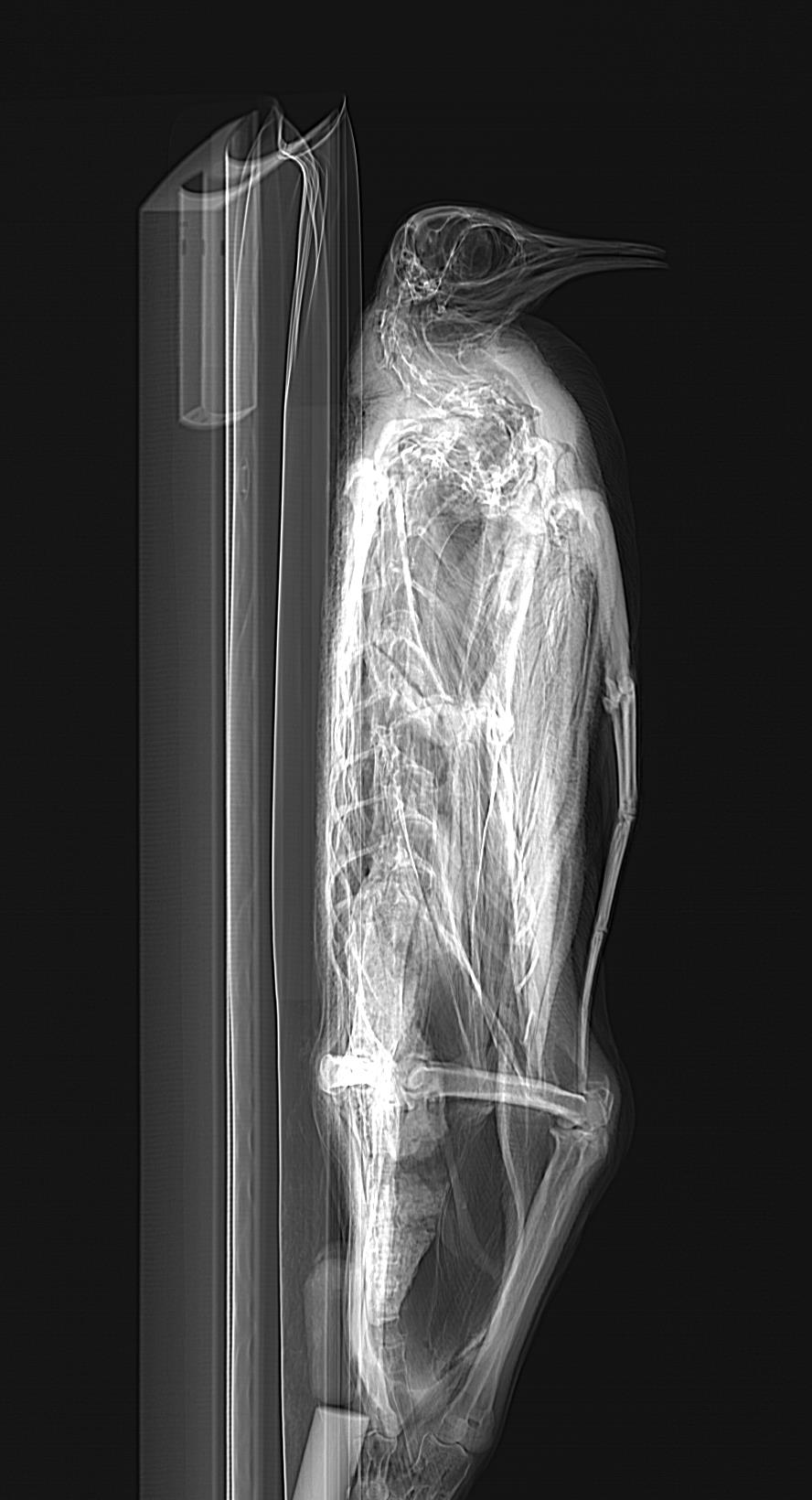
Side view.

Side view. Nice view of the head at least.
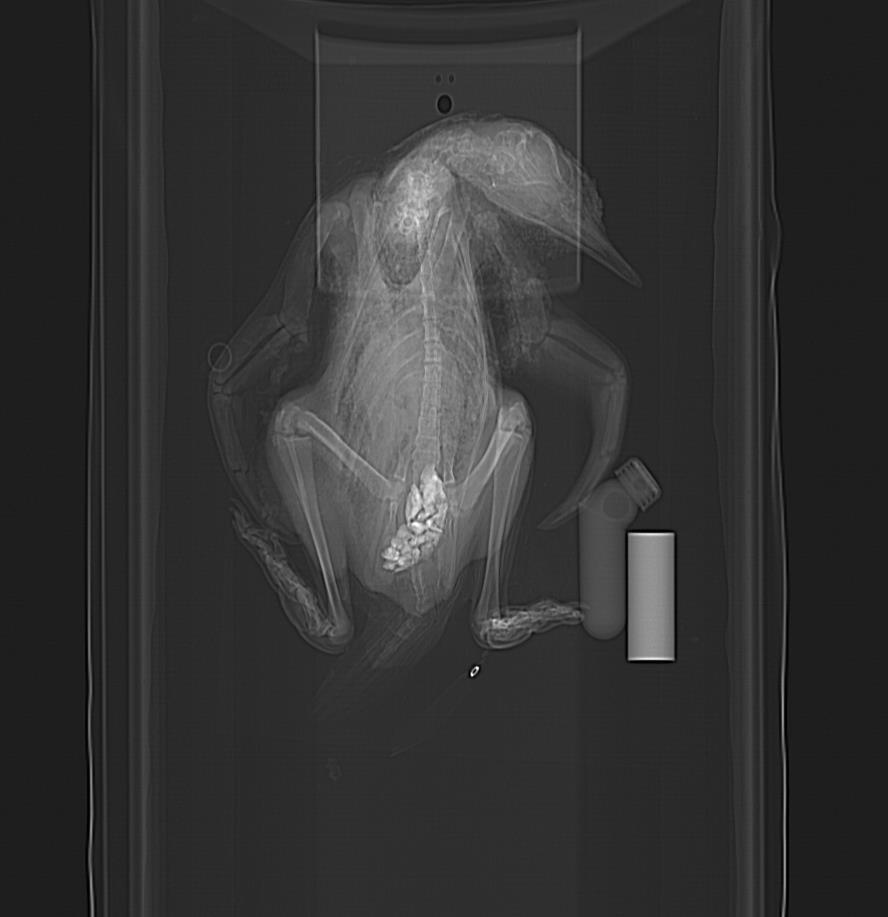
The fluffy baby shown in the photo above. Nice pose, and lots of anatomy shown. And check it out- gastroliths?!? In such a young animal-- is it even feeding yet?

Young juvenile. Nice pose, and lots of anatomy is shown. And check it out- gastroliths?!? In such a young animal– is it even feeding yet? (presumably straight after hatching) And they are relatively big pebbles, too! If I noticed this 5 years ago, it would have been a nice paper to report- first recognition of gastroliths in penguin chicks seems to have been then. Indeed, that study observed some chicks intentionally swallowing stones.

Another youngun.

Another youngun; the fluffy one from the photo above. More rocks up its wazoo.
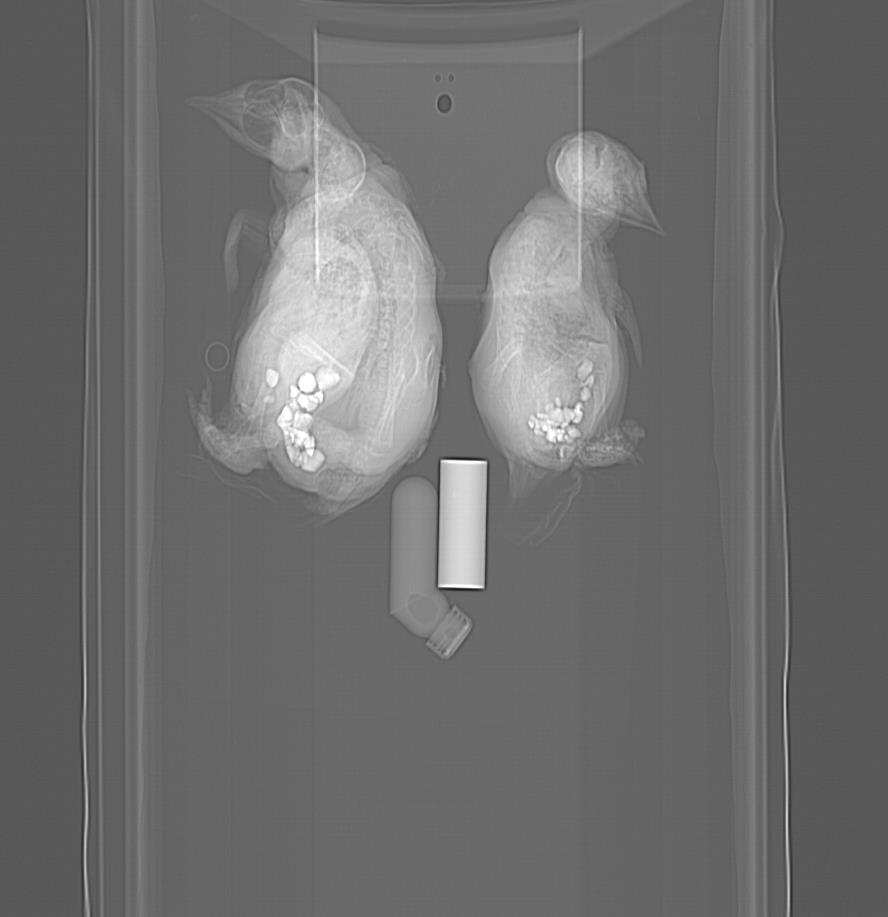
Three wee little chicks.

Three wee little chicks, all with stomach stones.

CT reconstruction of adult skeleton. This specimen was gutted and flattened, so the gastroliths are few and scattered. Check out the long tail:

From recent skeletons to fossil ones, penguins have wacky anatomy; they break most of the “rules” of being a proper bird, putting other oddballs like rheas to shame. I can’t ably review the many penguin species we know of, but the ancient Palaeocene penguin Waimanu features prominently in recent scientific discussions of penguin evolution, such as the superb research and blog of Dan Ksepka  as well as many workers in the southern hemisphere. I haven’t had a chance to inspect that creature’s bones, but while in Trelew, Argentina, I was very pleased to run into some excellent specimens of a later animal:

Part of the rather nice skeleton of Palaeospheniscus patagonicus, an Oligocene/Miocene largish penguin; from the MFN collections in Trelew, Argentina and collected nearby.

Part of the nice skeleton of Palaeospheniscus patagonicus, an Oligocene/Miocene largish penguin; from the MEF collections in Trelew, Argentina and collected nearby. The genus has been known since Ameghino’s description in 1891, and is closely related to living penguins, especially Aptenodytes. It was not a large penguin, but at about 5kg body mass was no slouch as birds go (roughly similar in size to a Magellanic penguin). I also got to see  Madrynornis mirandus, a Miocene form.
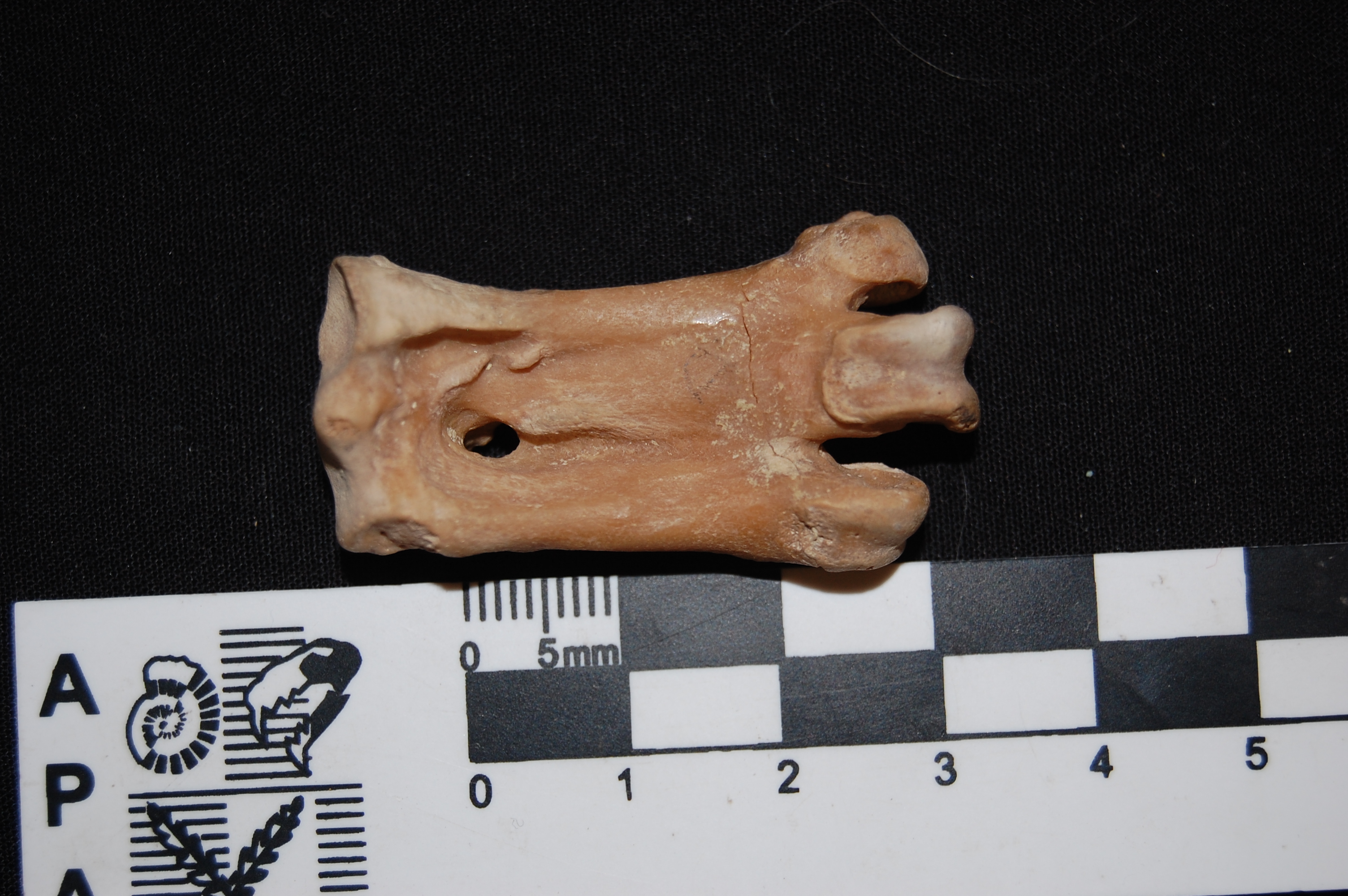
For me, the diagnostic trait of a penguin skeleton: the very short, tobust tarsometatarsus. From Palaeospheniscus, as above.

For me, the diagnostic trait of a penguin skeleton: the very short, tobust tarsometatarsus. From Palaeospheniscus, as above. The great palaeontologist GG Simpson wrote of it: “Despite the innumerable variations in details, the tarsometatarsi, on which all species but P. robustus are based, are quite stereotyped in general structure and leave little doubt that the forms placed here by Ameghino do all belong to a natural group.” A ratio of length to proximal width of >2 is typical of most penguins.  Synapomorphy FTW!

From beach skeletons, to mass suffering of landbound birds, to 3D imaging and fossil skeletons, I’ve had quite the immersion in penguinness lately. And through that experience, I’ve been drawn closer to penguins in more ways than one. I’ve been impressed by their adaptability and durability. In some ways, penguins’ adaptations to harsh freezing winters in wastelands also aid them to survive harsh baking summers in dry badlands.

Yes, those badlands are still coastal, and penguins can still drink the saltwater and excrete salt via their supraorbital glands, but those penguins in Punta Tombo were not having a keg party. They were clearly enduring some serious discomfort, and not all making it through the ordeal. I watched silently along with other penguins as one penguin lay prone in an awkward pose on a bleached-white stretch of hardpan soil, while one flipper meekly raised, then flopped down. It was not long for this world, and there was a host of large scavengers around ready to make the most of that, while penguin-eating giant petrels (a sister group to penguins) wheeled overhead.

penguin-waddle

Waddlers of the wastes

While penguins still spend most of their lives at sea, they retain a sometimes astonishing array of behaviours they use on land: burrowing, hopping/jumping, costly short-legged (but efficiently waddling) walking, and perhaps more that we haven’t yet discovered! Their unique anatomy reflects a compromise between all these factors, and we’re fortunate to have knowledge of their fossil record that shows a lot of detail on how they evolved it all. While penguins are a highly aquatic species, they show how aquatic and terrestrial adaptations can coexist in harmony; it’s not just a black-or-white issue. But with climate change in progress, the ~18 species of penguins have some rapidly altering challenges to adapt to, or go the way of Waimanu. This is a critical Kierkegaardian moment for The Existentialist Penguin.

I raise a glass in toast to that versatile, resilient, gravel-gizzarded Existentialist Penguin! May it persevere all the troubles our ever-changing world throws at it, as it has done since the Palaeocene. And may we draw inspiration from its tenacity, to face our own troubles, together on this crazy spinning globe!

Cheers!

by animalloz, on deviantart

Read Full Post »

This post was just published yesterday in a shorter, edited form in The Conversation UK, with the addition of some of my latest thoughts and the application of the editor’s keen scalpel. Check that out, but check this out too if you really like the topic and want the raw original version! I’ve changed some images, just for fun. The text here is about 2/3 longer.

Recently, the anatomy of animals comes up a lot, at least implicitly, in science news stories or internet blogs. Anatomy, if you look for it, is everywhere in organismal and evolutionary biology. The study of anatomy has undergone a renaissance lately, in a dynamic phase energized by new technologies that enable new discoveries and spark renewed interest. It is the zombie science, risen from what some had assumed was its eternal grave!

Stomach-Churning Rating: 4/10; there’s a dead elephant but no gore.

My own team has re-discovered how elephants have a false “sixth toe” that has been a mystery since it was first mentioned in 1710, and we’ve illuminated how that odd bit of bone evolved in the elephant lineage. This “sixth toe” is a modified sesamoid kind of bone; a small, tendon-anchoring lever. Typical mammals just have a little nubbin of sesamoid bone around their ankles and wrists that is easily overlooked by anatomists, but evolution sometimes co-opts as raw material to turn into false fingers or toes. In several groups of mammals, these sesamoids lost their role as a tendon’s lever and gained a new function, more like that of a finger, by becoming drastically enlarged and elongated during evolution. Giant pandas use similar structures to grasp bamboo, and moles use them to dig. We’ve shown that elephants evolved these giant toe-like structures as they became larger and more terrestrial, starting to stand up on tip-toe, supported by “high-heels” made of fat. Those fatty heels benefit from a stiff, toe-like structure that helps control and support them, while the fatty pads spread out elephants’ ponderous weight.

Crocodile lung anatomy and air flow, by Emma Schachner.

Crocodile lung anatomy and air flow, by Emma Schachner.

I’ve also helped colleagues at the University of Utah (Drs. Emma Schachner and Colleen Farmer) reveal, to much astonishment, that crocodiles have remarkably “bird-like” lungs in which air flows in a one-way loop rather than tidally back and forth as in mammalian lungs. They originally discovered this by questioning what the real anatomy of crocodile lungs was like- was it just a simple sac-like structure, perhaps more like the fractal pattern in mammalian lungs, and how did it work? This question bears directly on how birds evolved their remarkable system of lungs and air sacs that in many ways move air around more effectively than mammalian lungs do. Crocodile lungs indicate that “avian” hallmarks of lung form and function, including one-way air flow, were already present in the distant ancestors of dinosaurs; these traits were thus inherited by birds and crocodiles. Those same colleagues have gone on to show that this feature also exists in monitor lizards, raising the question (almost unthinkable 10-20 years ago) of whether those bird-like lungs are actually a very ancient and common feature for land animals.

Speaking of monitor lizards, anatomy has revealed how they (and some other lizards) all have venom glands that make their bites even nastier, and these organs probably were inherited by snakes. For decades, scientists had thought that some monitor lizards, especially the huge Komodo dragons, drooled bacteria-laden saliva that killed their victims with septic shock. Detailed anatomical and molecular investigations showed instead that modified salivary glands produced highly effective venom, and in many species of lizards, not just the big Komodos. So the victims of numerous toothy lizard species die not only from vicious wounds, but also from worsened bleeding and other circulatory problems promoted by the venomous saliva. And furthermore, this would mean that venom did not evolve separately in the two known venomous lizards (Gila monster and beaded lizard) and snakes, but was inherited from their common ancestor and became more enhanced in those more venomous species—an inference that general lizard anatomy supports, but which came as a big surprise when revealed by Bryan Fry and colleagues in 2005.

There’s so much more. Anatomy has recently uncovered how lunge-feeding whales have a special sense organ in their chin that helps them detect how expansive their gape is, aiding them to engulf vast amounts of food. Scientists have discovered tiny gears in the legs of leafhoppers that help them make astounding and precise leaps. Who knew that crocodilians have tiny sense organs in the outer skin of their jaws (and other parts of their bodies) that help them detect vibrations in the water, probably aiding in communication and feeding? Science knows, thanks to anatomy.

Just two decades or so ago, when I was starting my PhD studies at the University of California in Berkeley, there was talk about the death of anatomy as a research subject; both among scientists and the general public. What happened? Why did anatomy “die” and what has resuscitated it?


TH Huxley, anatomist extraordinaire

TH Huxley, anatomist extraordinaire, caricatured in a lecture about “bones and stones, and such-like things” (source)

Anatomy’s Legacy

In the 16th through 19th centuries, the field of gross anatomy as applied to humans or other organisms was one of the premier sciences. Doctor-anatomist Jean Francois Fernel, who invented the word “physiology”, wrote in 1542 that (translation) “Anatomy is to physiology as geography is to history; it describes the theatre of events.” This theatric analogy justified the study of anatomy for many early scientists, some of whom also sought to understand it to bring them closer to understanding the nature of God. Anatomy gained impetus, even catapulting scientists like Thomas Henry Huxley (“Darwin’s bulldog”) into celebrity status, from the realisation that organisms had a common evolutionary history and thus their anatomy did too. Thus comparative anatomy became a central focus of evolutionary biology.

But then something happened to anatomical research that can be hard to put a finger on. Gradually, anatomy became a field that was scoffed at as outmoded, irrelevant, or just “solved”; nothing important being left to discover. As a graduate student in the 1990s, I remember encountering this attitude. This apparent eclipse of anatomy accelerated with the ascent of genetics, with anatomy reaching its nadir in the 1950s-1970s as techniques to study molecular and cellular biology (especially DNA) flourished.

One could argue that molecular and cellular biology are anatomy to some degree, especially for single-celled organisms and viruses. Yet today anatomy at the whole organ, organism or lineage level revels in a renaissance that deserves inspection and reflection on its own terms.


Anatomy’s Rise

Surely, we now know the anatomy of humans and some other species quite well, but even with these species scientists continue to learn new things and rediscover old aspects of anatomy that laid forgotten in classic studies. For example, last year Belgian scientists re-discovered the anterolateral ligament of the human knee, overlooked since 1879. They described it, and its importance for how our knees function, in novel detail, and a lot of media attention was drawn to this realisation that there are some things we still don’t understand about our own bodies.

A huge part of this resurgence of anatomical science is technology, especially imaging techniques- we are no longer simply limited to the dissecting knife and light microscope as tools, but armed with digital technology such as 3-D computer graphics, computed tomography (series of x-rays) and other imaging modalities. Do you have a spare particle accelerator? Well then you can do amazing synchrotron imaging studies of micro-anatomy, even in fairly large specimens. Last year, my co-worker Stephanie Pierce and colleagues (including myself) used this synchrotron approach to substantially rewrite our understanding of how the backbone evolved in early land animals (tetrapods). We found that the four individual bones that made up the vertebrae of Devonian tetrapods (such as the iconic Ichthyostega) had been misunderstood by the previous 100+ years of anatomical research. Parts that were thought to lie at the front of the vertebra actually lay at the rear, and vice versa. We also discovered that, hidden inside the ribcage of one gorgeous specimen of Ichthyostega, there was the first evidence of a sternum, or breastbone; a structure that would have been important for supporting the chest of the first land vertebrates when they ventured out of water.

Recently, anatomists have become very excited by the realization that a standard tissue staining solution, “Lugol’s” or potassium iodide iodine, can be used to reveal soft tissue details in CT scans. Prior to this recognition, CT scans were mainly used in anatomical research to study bone morphology, because the density contrast within calcified tissues and between them and soft tissues gives clearer images. To study soft tissue anatomy, you typically needed an MRI scanner, which is less commonly accessible, often slower and more expensive, and sometimes lower resolution than a CT scanner. But now we can turn our CT scanners into soft tissue scanners by soaking our specimens in this contrast solution, allowing highly detailed studies of muscles and bones, completely intact and in 3D. Colleagues at Bristol just published a gorgeous study of the head of a common buzzard, sharing 3D pdf files of the gross anatomy of this raptorial bird and promoting a new way to study and illustrate anatomy via digital dissections- you can view their beautiful results here. Or below (by Stephan Lautenschlager et al.)!

Buzzard-head

These examples show how anatomy has been transformed as a field because we now can peer inside the bodies of organisms in unprecedented detail, sharing and preserve those data in high-resolution digital formats. We can do this without the concern that a unique new species from Brazilian rainforests or exciting fossil discovery from the Cambrian period would be destroyed if we probed certain questions about its anatomy that are not visible from the outside– a perspective in which science had often remained trapped for centuries. These tools became rapidly more diverse and accessible from the 1990s onward, so as a young scientist I got to see some of the “before” and “after” influences on anatomical research—these have been very exciting times!

When I started my PhD in 1995, it was an amazing luxury to first get a digital camera to use to take photographs for research, and then a small laser scanner for making 3D digital models of fossils, with intermittent access to a CT scanner in 2001 and now full-time access to one since 2003. These stepwise improvements in technology have totally transformed the way I study anatomy. In the 1990s, you dissected a specimen and it was reduced to little scraps; at best you might have some decent two-dimensional photographs of the dissection and some beetle-cleaned bones as a museum specimen. Now, we CT or MRI scan specimens as routine practice, preserving many mega- or gigabytes of data on its internal and external, three-dimensional anatomy in lush detail, before scalpel ever touches skin. Computational power, too, has grown to the point where incredibly detailed 3D digital models produced from imaging real specimens can be manipulated with ease, so science can better address what anatomy means for animal physiology, behaviour, biomechanics and evolution. We’re at the point now where anatomical research seems no longer impeded by technology– the kinds of questions we can ask are more limited by access to good anatomical data (such as rare specimens) than by the ways we acquire and use those data.

My experience mirrors my colleagues’. Larry Witmer at Ohio University in the USA, past president of the International Society for Vertebrate Morphologists, has gone from dissecting bird heads in the 1990s to becoming a master of digital head anatomy, having collected 3D digital scans of hundreds of specimens, fossil and otherwise. His team has used these data to great success, for example revealing how dinosaurs’ fleshy nostrils were located in the front of their snouts (not high up on the skull, as some anatomists had speculated based on external bony anatomy alone). They have also contributed new, gorgeous data on the 3D anatomy of living animals such as opossums, ostriches, iguanas and us, freely available on their “Visible Interactive Animal” anatomy website. Witmer comments on the changes of anatomical techniques and practice: “For extinct animals like dinosaurs, these approaches are finally putting the exploration of the evolution of function and behavior on a sound scientific footing.

I write an anatomy-based blog called “What’s in John’s Freezer?” (haha, so meta!), in which I recount the studies of animal form and function that my research team and others conduct, often using valuable specimens stored in our lab’s many freezers. I started this blog almost two years ago because I noticed a keen interest, or even hunger for, stories about anatomy amongst the general public; and yet few blogs explicitly were about anatomy for its own sake. This interest became very clear to me when I was a consultant for the BAFTA award-winning documentary series “Inside Nature’s Giants” in 2009, and I was noticing more documentaries and other programmes presenting anatomy in explicit detail that would have been considered too risky 10 years earlier. So not only is anatomy a vigorous, rigorous science today, but people want to hear about it. Just in recent weeks, the UK has had “Dissected” as two 1-hour documentaries and “Secrets of Bones” as back-to-back six 30-minute episodes, all very explicitly about anatomy, and on PRIME TIME television! And PBS in the USA has had “Your Inner Fish,” chock full of anatomy. I. Love. This.

Before the scalpel: the elephant from Inside Nature's Giants

Before the scalpel: the elephant from Inside Nature’s Giants

There are many ways to hear about anatomy on the internet these days, reinforcing the notion that it enjoys strong public engagement. Anatomical illustrators play a vital role now much as they did in the dawn of anatomical sciences– conveying anatomy clearly requires good artistic sensibilities, so it is foolish to undervalue these skills. The internet age has made disseminating such imagery routine and high-resolution, but we can all be better about giving due credit (and payment) to artists who create the images that make our work so much more accessible. Social media groups on the internet have sprung up to celebrate new discoveries- watch the Facebook or Twitter feeds of “I F@*%$ing Love Science” or “The Featured Creature,” to name but two popular venues, and you’ll see a lot of fascinating comparative animal anatomy there, even if the word “anatomy” isn’t necessarily used. I’d be remiss not to cite Emily Graslie’s popular, unflinchingly fun social media-based explorations of gooey animal anatomy in “The Brain Scoop”. I’d like to celebrate that these three highly successful disseminators of (at least partly) anatomical outreach are all run by women—anatomical science can (and should!) defy the hackneyed stereotype that only boys like messy stuff like dissections. There are many more such examples. Anatomy is for everyone! It is easy to relate to, because we all live in fleshy anatomical bodies that rouse our curiosity from an early age, and everywhere in nature there are surprising parallels with — as well as bizarre differences from — our anatomical body-plans.


Anatomy’s Relevance

What good is anatomical knowledge? A great example comes from gecko toes, but I could pick many others. Millions of fine filaments, modified toe scales called setae, use micro-molecular forces called van der Waals interactions to help geckos cling to seemingly un-clingable surfaces like smooth glass. Gecko setae have been studied in such detail that we can now create their anatomy in sufficient detail to make revolutionary super-adhesives, such as the product “Geckskin”, 16 square inches of which can currently suspend 700 pounds aloft. This is perhaps the most famous example from recent applications of anatomy, but Robert Full’s Poly-Pedal laboratory at Berkeley, among many other research groups excelling at bio-inspired innovation in robotics and other fields of engineering and design, regularly spins off new ideas from the principle that “diversity enables discovery”, as applied to the sundry forms and functions found in organisms. By studying the humble cockroach, they have created new ways of building legged robots that can scour earthquake wreckage for survivors or explore faraway planets. By asking “how does a lizard use its big tail during leaping?” they have discovered principles that they then use to construct robots that can jump over or between obstacles. Much of this research relates to how anatomical traits determine the behaviours that a whole, living, dynamic organism is capable of performing.

Whereas when I was a graduate student, anatomists and molecular biologists butted heads more often than was healthy for either of them, competing for importance (and funding!), today the scene is changing. With the rise of “evo devo”, evolutionary developmental biology, and the ubiquity of genomic data as well as epigenetic perspectives, scientists want to explain “the phenotype”—what the genome helps to produce via seemingly endless developmental and genetic mechanisms. Phenotypes often are simply anatomy, and so anatomists now have new relevance, often collaborating with those skilled in molecular techniques or other methods such as computational biology. One example of a hot topic in this field is, “how do turtles build their shells and how did that shell evolve?” To resolve this still controversial issue, we need to know what a shell is made of, what features in fossils could have been precursors to a modern shell, how turtles are related to other living and extinct animals, how a living turtle makes its shell, and how the molecular signals involved are composed and used in animals that have or lack shells. The first three questions require a lot of anatomical data, and the others involve their fair share, too.

Questions like these draw scientists from disparate disciplines closer together, and thanks to that proximity we’re inching closer to an answer to this longstanding question in evolutionary biology and anatomy, illustrated above in the video.  As a consequence, the lines between anatomists and molecular/cellular biologists increasingly are becoming blurred, and that synthesis of people, techniques and perspectives seems to be a healthy (and inevitable?) trend for science. But there’s still a long way to go in finding a happy marriage between anatomists and the molecular/cellular biologists whose work eclipsed theirs in past decades. Old controversies like “should we use molecules or morphology to figure out how animals are related to each other?” are slowly dying out, as the answer becomes evident to be “Yes. Both.” (especially when fossils can be included!) Such dwindling controversies contribute to the healing of disciplinary rifts and the unruffling of parochial feathers.

Yet many anatomists would point to lingering obstacles that give them concern for their future; funding is but one of them (few would argue that gross anatomical research is as well off in provision of funding as genetics is, for example). There are clear mismatches between the hefty importance, vitality, popularity and rigour of anatomical science and its perception or its role in academia.

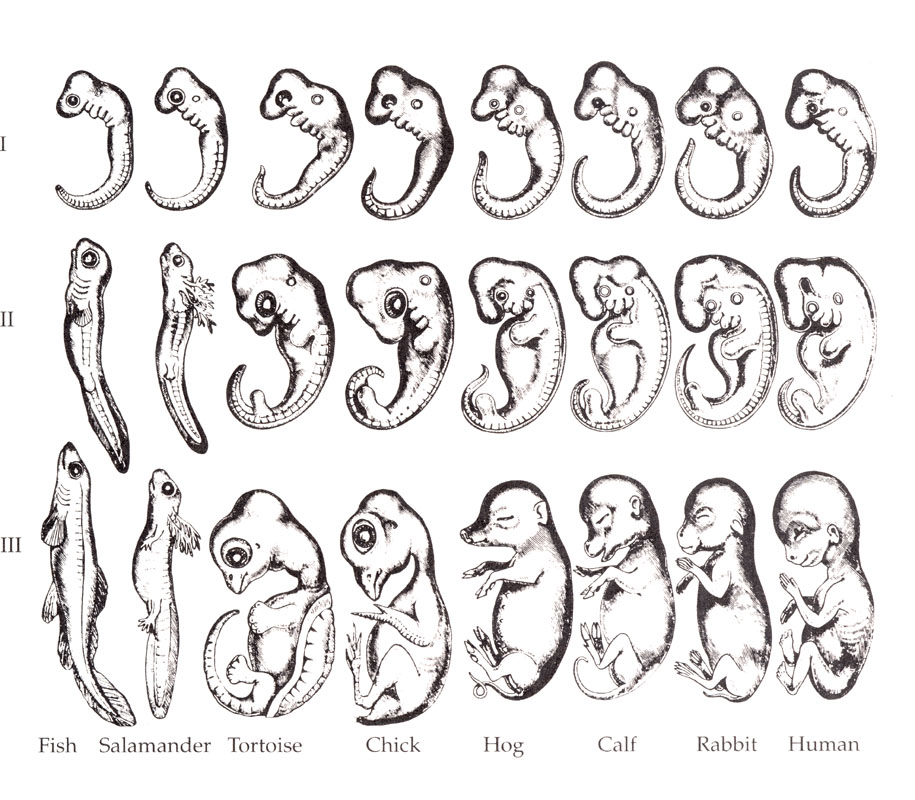
Romane 1892, covering Haeckel's classic, early evo-devo work (probably partly faked, but still hugely influential)

Romane 1892, covering Haeckel’s classic, early evo-devo work (probably partly faked, but still hugely influential) (source)


Anatomy’s Future

One worry the trend that anatomy as a scientific discipline is clearly flourishing in research while it dwindles in teaching. Fewer and fewer universities seem to be teaching the basics of comparative anatomy that were a mainstay of biology programmes a century ago. Yet anatomy is everywhere now in biology, and in the public eye. It inspires us with its beauty and wonder—when you marvel at the glory of beholding a newly discovered species, you are captivated by its phenotypic pulchritude. Anatomy is still the theatre in which function and physiology are enacted, and the physical encapsulation of the phenotype that evolution moulds through interactions with the environment. But there is cause for concern that biology students are not learning much about that theatre, or that medical schools increasingly seem to eschew hands-on anatomical dissection in favour of digital learning. Would you want a doctor to treat you if they mainly knew human anatomy from a CGI version on an LCD screen in medical school, and hence were less aware of all the complexity and variation that a real body can house?

Anatomy has an identity problem, too, stemming from decades of (Western?) cultural attitudes (e.g. the “dead science” meme) and from its own success—by being so integral to so many aspects of biology, anatomy seems to have integrated itself toward academic oblivion, feeding the perception of its own obsolescence.  I myself struggled with what label to apply to myself as an early career researcher- I was afraid that calling myself an “anatomist” would render me quaint or unambitious in the eyes of faculty job interview panels, and I know that many of my peers felt the same. I resolved that inner crisis years ago and came to love identifying myself at least partly as an anatomist. I settled on the label “evolutionary biomechanist” as the best term for my speciality. In order to reconstruct evolution or how animals work (biomechanics), we first often need to describe key aspects of anatomy, and we still discover new, awesome things about anatomy in the process. I still openly cheer on anatomy as a discipline because its importance is so fundamental to what I do, and I am far from alone in that attitude. Other colleagues that do anatomical research use other labels for themselves like “biomechanist”, “physiologist,” or “palaeontologist”, because those words better capture the wide range of research and teaching that they do, but I bet also because some of them likely still fear the perceived stigma of the word “anatomy” among judgemental scientists, or even the public. At the same time, many of us get hired at medical, veterinary or biology schools/departments because we can teach anatomy-based courses, so there is still hope.

Few would now agree with Honoré de Balzac’s 19th century opinion that “No man should marry until he has studied anatomy and dissected at least one woman”, but we should hearken back to what classical scientists knew well: it is to the benefit of science, humanity and the world to treasure the anatomy that is all around us. We inherit that treasure through teaching; to abscond this duty is to abandon this trove. With millions of species around today and countless more in the past, there should always be a wealth of anatomy for everyone to learn from, teach about, and rejoice.

X-ray technology has revolutionized anatomical studies; what's next? Ponder that as this ostrich wing x-ray waves goodbye.

X-ray technology has revolutionized anatomical studies; what’s next? Ponder that as this ostrich wing x-ray waves goodbye.

Like this post? You might also find my Slideshare talk on the popularity of anatomy interesting- see my old post here for info!

Read Full Post »

I’ve described our “Walking the Cat Back” Leverhulme Trust-funded project with Dr. Anjali Goswami and colleagues before, but today we really got stuck into it. We’re dissecting a 46kg male Snow Leopard (Panthera uncia) as the first “data point” (actually several hundred data points, but anyway, first individual) in our study of how limb and back muscles change with size in felids. No April Fools’ pranks here; real science-as-it-happens.

Stomach-Churning Rating: 7/10 for skinned leopard and globs of fat. Much worse in person, hence the downgrading from what could be a higher score. Don’t click the photos to emkitten them if you don’t want to see the details.

This leopard is the same one that Veterinary Forensics blogged about. It died in a UK cat conservation/recovery centre. Today is simply a short post, but it is the first in what will surely be a continued series of posts on felid postcranial anatomy and musculoskeletal biomechanics by our felid research team, with bits of natural history and evolution thrown in when we can manage. As befits one of my curt “Anatomy Vignette” posts, pictures will tell the story.

Skinned and mostly de-fatted snow leopard, with fat piled up on the lower left hand corner near the hind feet. Here we are identifying and then removing and measuring the individual muscles. Project postdoc Andrew Cuff is hard at work on the forelimb while I'm mucking around with the hindlimb.

Skinned and mostly de-fatted snow leopard, with fat piled up on the lower left hand corner near the hind feet. Here we are identifying and then removing and measuring the individual muscles. Project postdoc Andrew Cuff is hard at work on the forelimb while I’m mucking around with the hindlimb. The fat here is about 3kg subcutaneous fat, so around 6.5% of body mass. And as the cat has been around for a while, that fat has gone a bit rancid and that is not nice. Not nice at all, no… Usually smells do not bother me, but this took some adjustment. Fortunately, the muscles are still OK, and work is coming along well.

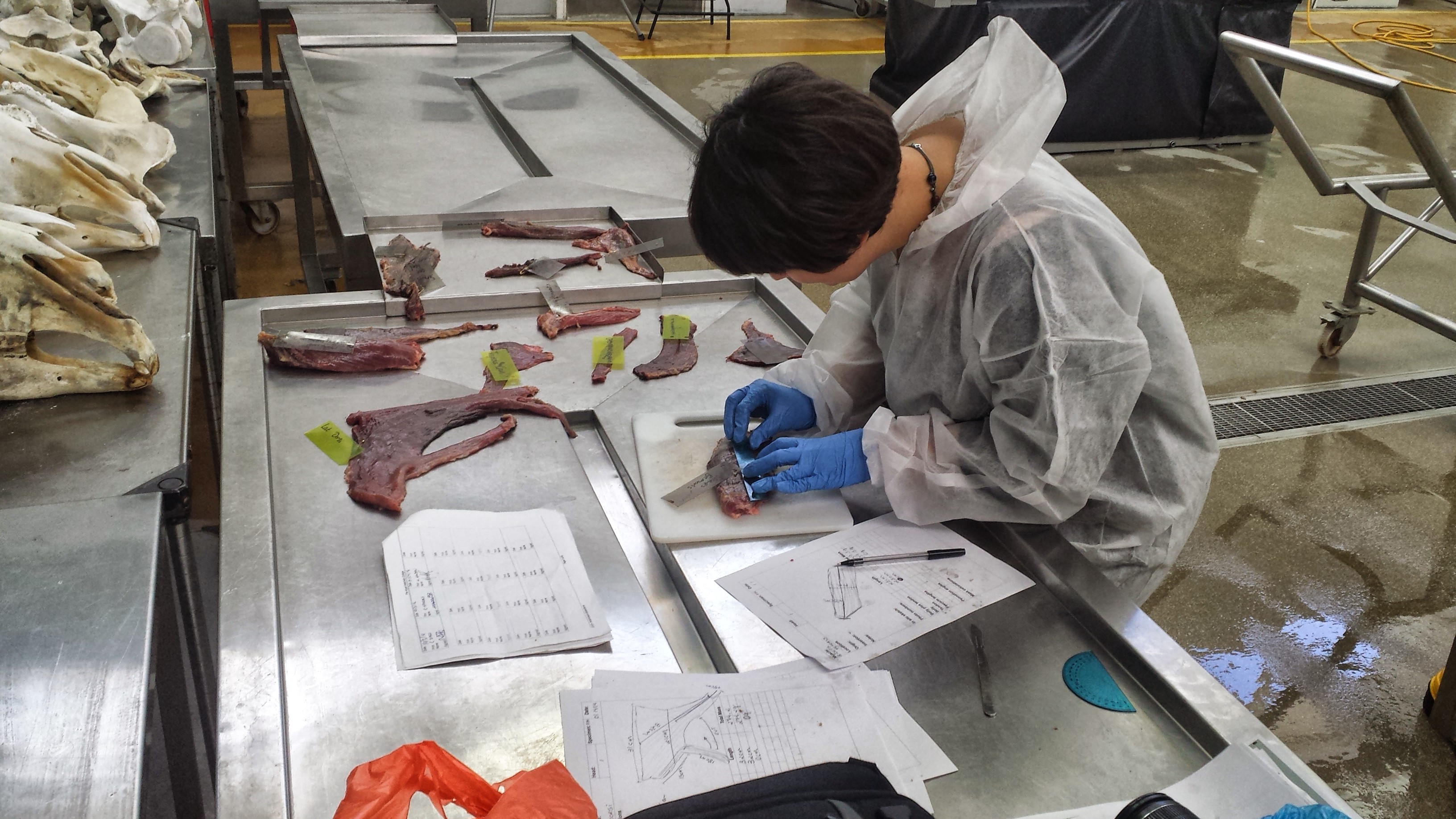
UCL PhD student Marcela Randau,, carving up our cat's limb muscles. As usual in comparative biomechanics, we measure the "architecture"- parameters of the muscle that relate in a somewhat straightforward fashion to function.

UCL PhD student Marcela Randau, carving up our cat’s limb muscles. As usual in comparative biomechanics, we measure the “architecture”- parameters of the muscle that relate in a somewhat straightforward fashion to function. This muscular architecture includes things like muscle mass, the lengths of the fibers (fascicles) that make up the muscles, and the angle of the fascicles to the muscle’s line of action. These parameters correlate reasonably well with the force and power that the muscle can develop, and its working range of length change. Other posts here have discussed this more, but by measuring the architecture of many muscles in many felids of different sizes, we can determine how felids large and small adapt their anatomy to support their bodies and move their limbs. This will help to solve some lingering mysteries about the odd ways that cats move and how their movement changes with body size.

This research is being driven forward mainly by Andrew and Marcela, shown above, so I wanted to introduce them and our odoriferous fat cat. Upcoming dissections: 1-2 more snow leopards, tiger, various lions, ocelot, black-footed cat, leopard, and a bunch of moggies, and whatever else comes our way. All were EU zoo/park mortalities (there are a LOT of big cats out there!).

EDIT: Had to add a photo of the CLAWS! Whoa dude.

CLAWS

Read Full Post »