Feeds:
Posts
Comments

Archive for May, 2013

Less words, more pictures in this post, and I’ll get the one lame cake joke out of the way early. I’ve nearly finished my research blitz through the postcranial material of the NHM-Tring’s osteological collection and have made some pit-stops for cake skulls now and then when I see one that pleases me. Now I shall present a survey of some of the species I’ve examined. I’ll proceed up from the base of the crown clade of living birds (Neornithes/Aves; the most recent common ancestor of living birds and all its descendants) and first take a tour of Palaeognathae; the ratites and kin; then move another step up into the Neognathae, first featuring the lineage featuring the ground fowl (Galliformes) and then the waterfowl (Anseriformes). If all this taxonomy and phylogeny is a bit much, check out this page for a brush-up on the bushy branches of bird biodiversity.

First, lots of bones of our cast of currasows, chachalacas, cassowaries and other kooky characters. And then, perhaps, a stop to the excessive alliteration. Finally, I will finish with some examples of species oddity (hat tip to Chris Hadfield).

Stomach-Churning Rating: 2/10- some bony pathologies but still just dry bones. Minimal cake jokes, and no filthy swearing this time.


BRING ON THE BONES:

My photographs are shown with kind permission from the Natural History Museum, London.
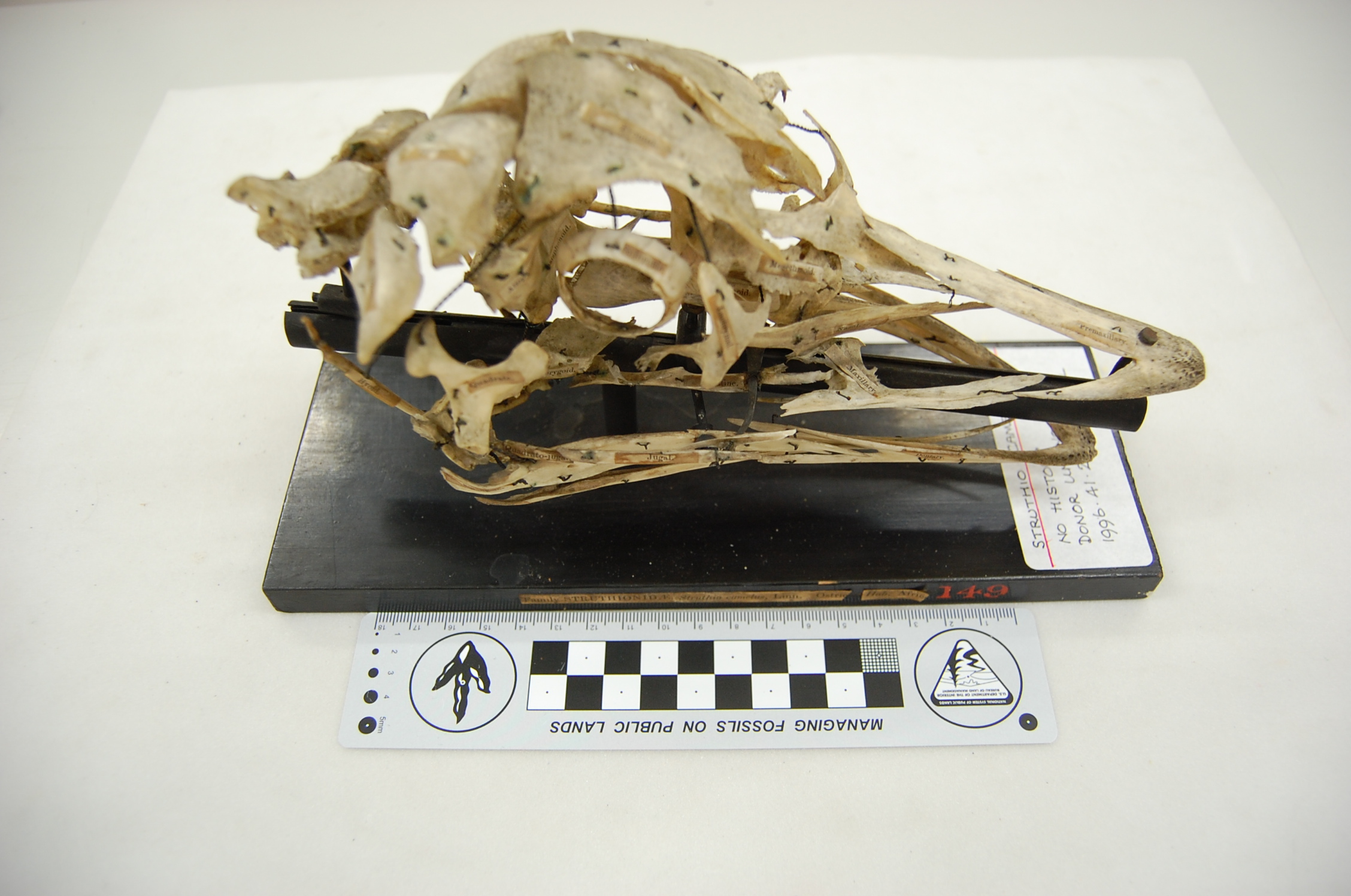
Exploded skull of an ostrich/ This takes skill.

Exploded skull of an ostrich, Struthio camelus. This kind of careful preparation takes crazy skill, and creates a thing of rare beauty.
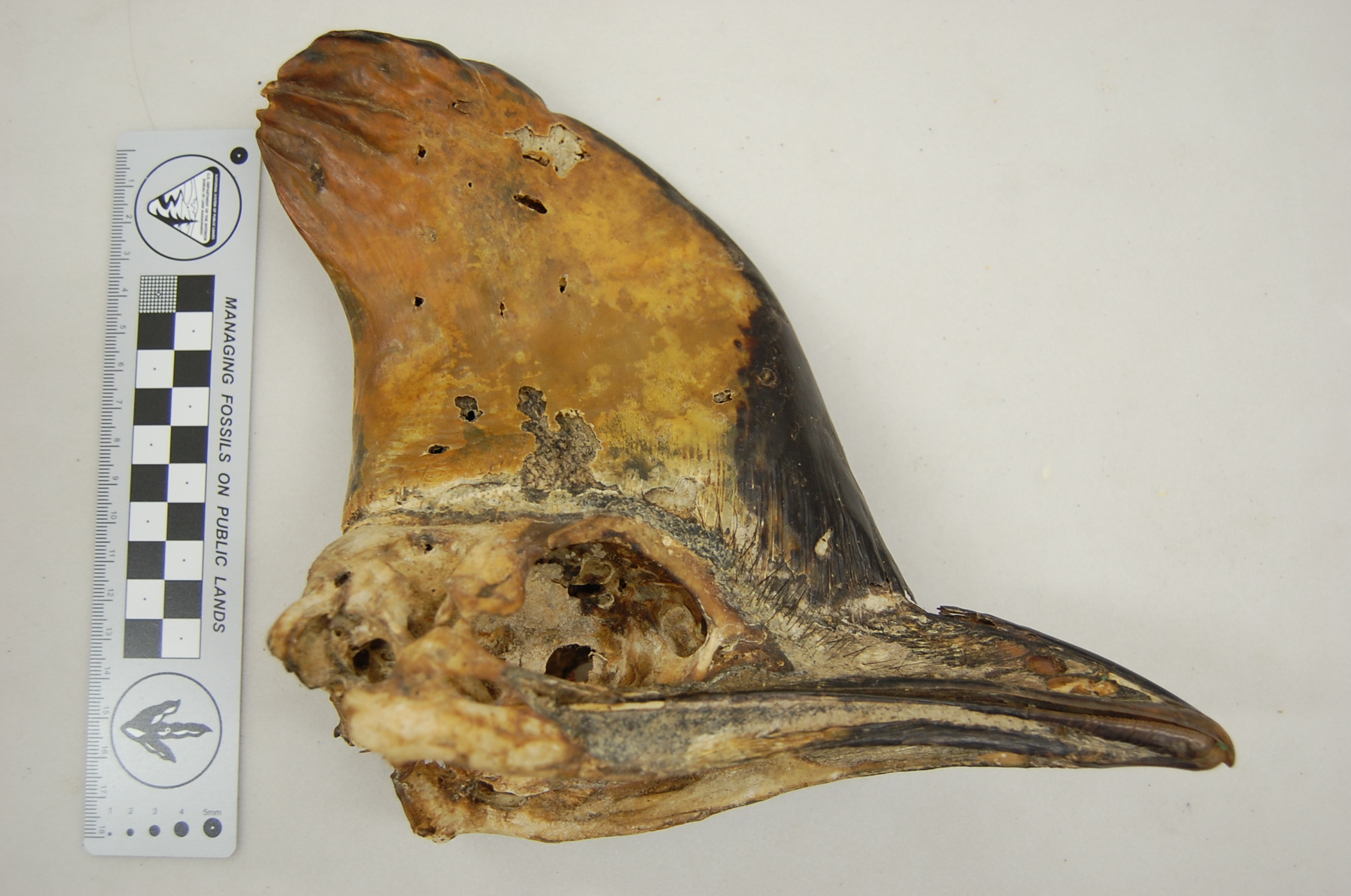
Neat skull of a cassowary, Casuarius casuarius.

Imposing skull of a cassowary, Casuarius casuarius, with a rather worn head casque.

Mummified Owen's Little Spotted kiwi, Apteryx owenii.

Mummified Owen’s Little Spotted Kiwi, Apteryx owenii. The feathers were still soft and fluffy, but I would not call this specimen cuddly.

Dorsal view of the back/hips of the Great Spotted kiwi, Apteryx haasti.

Dorsal view of the back/hips of the Great Spotted Kiwi, Apteryx haasti. I like this photo and am not sure why. The symmetry and shading pleases me, I guess.
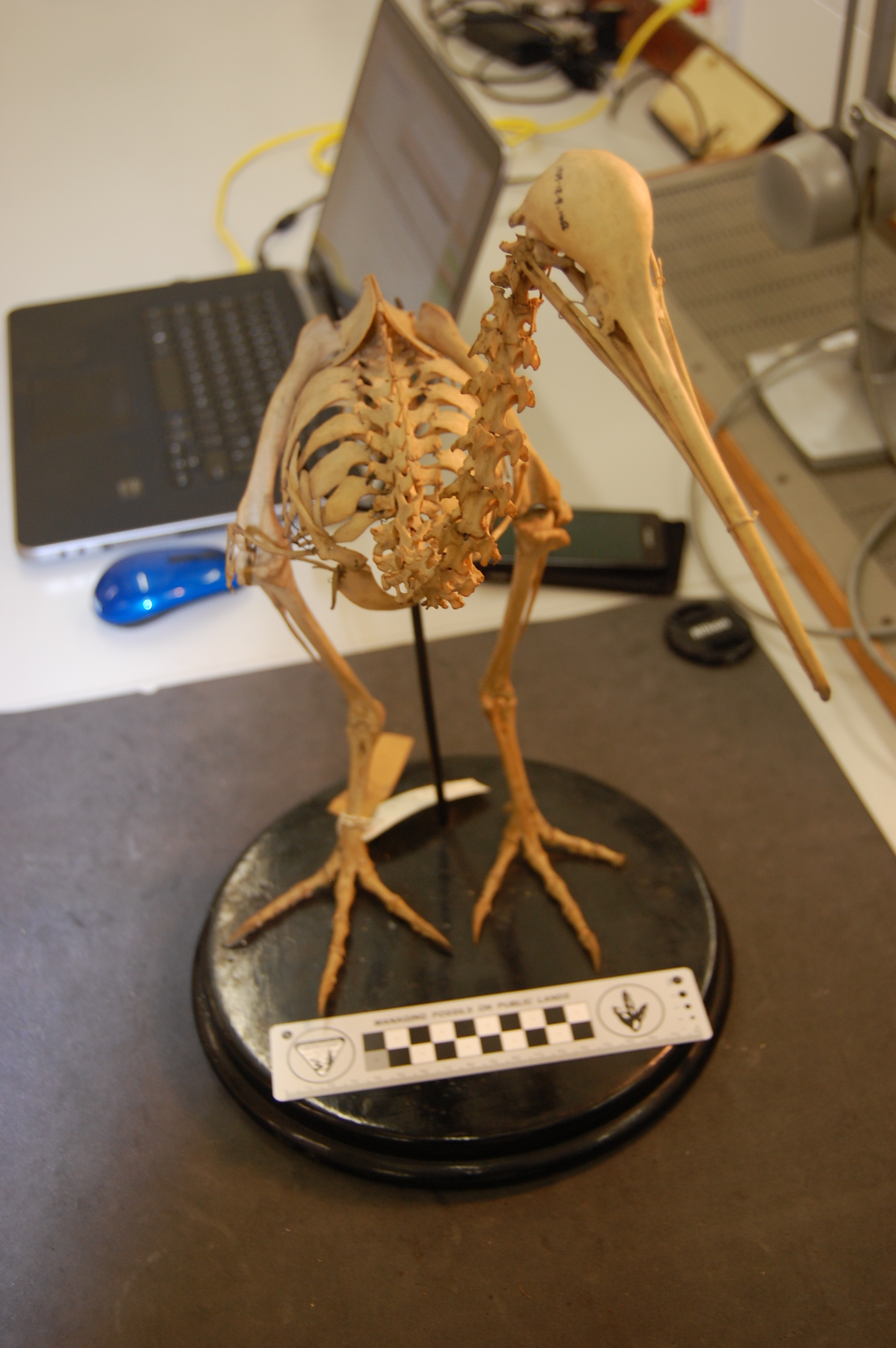
Front view of the back/hips of the Great Spotted kiwi, Apteryx haasti.

Front view of the back/hips of the Great Spotted Kiwi, Apteryx haasti, watching over my laptop and watching me while I write this blog on my laptop… so meta(ornithine)!

Wing of a kiwi, showing the fragile bones and feather attachments.

Wing of a kiwi, showing the fragile bones and feather attachments. “Apteryx” = “no wings”… well not quite. Click to emkiwi(?) so you can identify the individual bones, from the humerus right down to the fingers! I love this specimen.
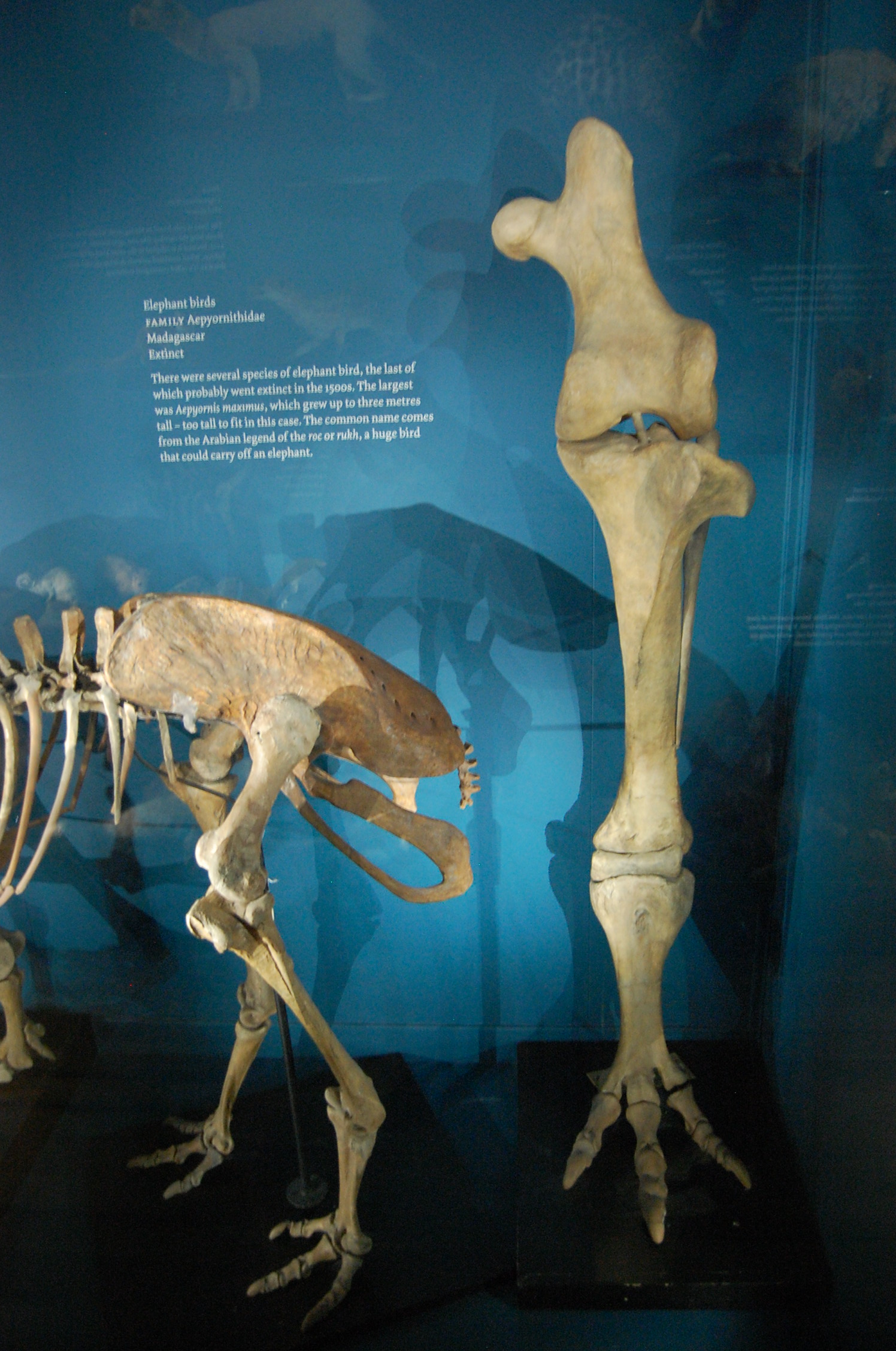
The left leg (in front view) of the elephant-bird, Aepyornis maximus, from Madagascar, with a small moa nearby in left side view.

The titanic left leg (in front view) of the Elephant Bird, Aepyornis maximus, from Madagascar, with a small moa nearby in left side view. There’s so much awesomeness about elephant birds I don’t know where to start, but this is one good place to do so.

Mummified Unulated tinamou, Crypturellus undulatus.

The smaller end of the palaeognath scale: a mummified Undulated Tinamou, Crypturellus undulatus. Somehow the head got stuck into the abdominal cavity underneath the sternum, so this tinamou almost had its head up its arse. A tinamou with head in its proper position looks and sounds like this (video).

And now we take a left turn into the Galloanseres, most basal branch of the neognath birds, to see some of the neglected, strange early branches off from the “main line” that led to the modern diversity of ducks, geeses and swans (Anatinae, Anserinae).

Screamers (Anhimidae) are to Anseriformes as megapodes (see below; brush turkeys) are to Galliformes. By that I mean that both screamers and megapodes are very early branches off the main line of their respective lineages’ evolution, and both are quite strange when seen in that context… an unfair one, frankly; over-focused on the most familiar, “modern” or most speciose group. More about this issue further below.

This was my first hands-on experience with screamer anatomy; I was familiar from reading Tetrapod Zoology and other material about them. Check out the sound that gives them their name here! I’m now a big fan- they have so many strange features: oddly chunky but often very light bones, big feet with long toes, and then these switchblade-wrists, which would make Batman jealous:

Crested screamer, Chauna torquata, showing the wicked spur on the carpometacarpus.

Crested Screamer, Chauna torquata, showing the wicked spur (and smaller one) on the carpometacarpus.

Horned screamer, Anhima cornuta; similar carpometacarpal spur as in Chauna.

Horned Screamer, Anhima cornuta; similar carpometacarpal spurs as in Chauna.

Torso of a screamer seen in top view. Nice narrow body.

Torso of a screamer seen in top view. Nice narrow body, and no uncinate processes (spur-like bony struts that cross the ribs and act as levers for the muscles that move the ribcage during breathing)

The long, gracile, clawed toes of a screamer.

The long, gracile, clawed toes of a screamer. Those toes, especially as they belong to an animal called a screamer, are spooky for me. Note also: very little toe-webbing for a “waterfowl.”

Not to be outdone, on the Galliformes side of Galloanserae, we have some funky headgear in the Maleo (a megapode bird/Megapodiidae; a very basal branch of “brush turkeys” and kin) and curassows (part of the Cracidae; odd South American birds whose males make booming sounds, presumably using their head-casques as resonating chambers?):

Skull of a male maleo, Macrocephalon maleo.

Skull of a male Maleo, Macrocephalon maleo. AR Wallace famously pursued it, and here is its funky call.
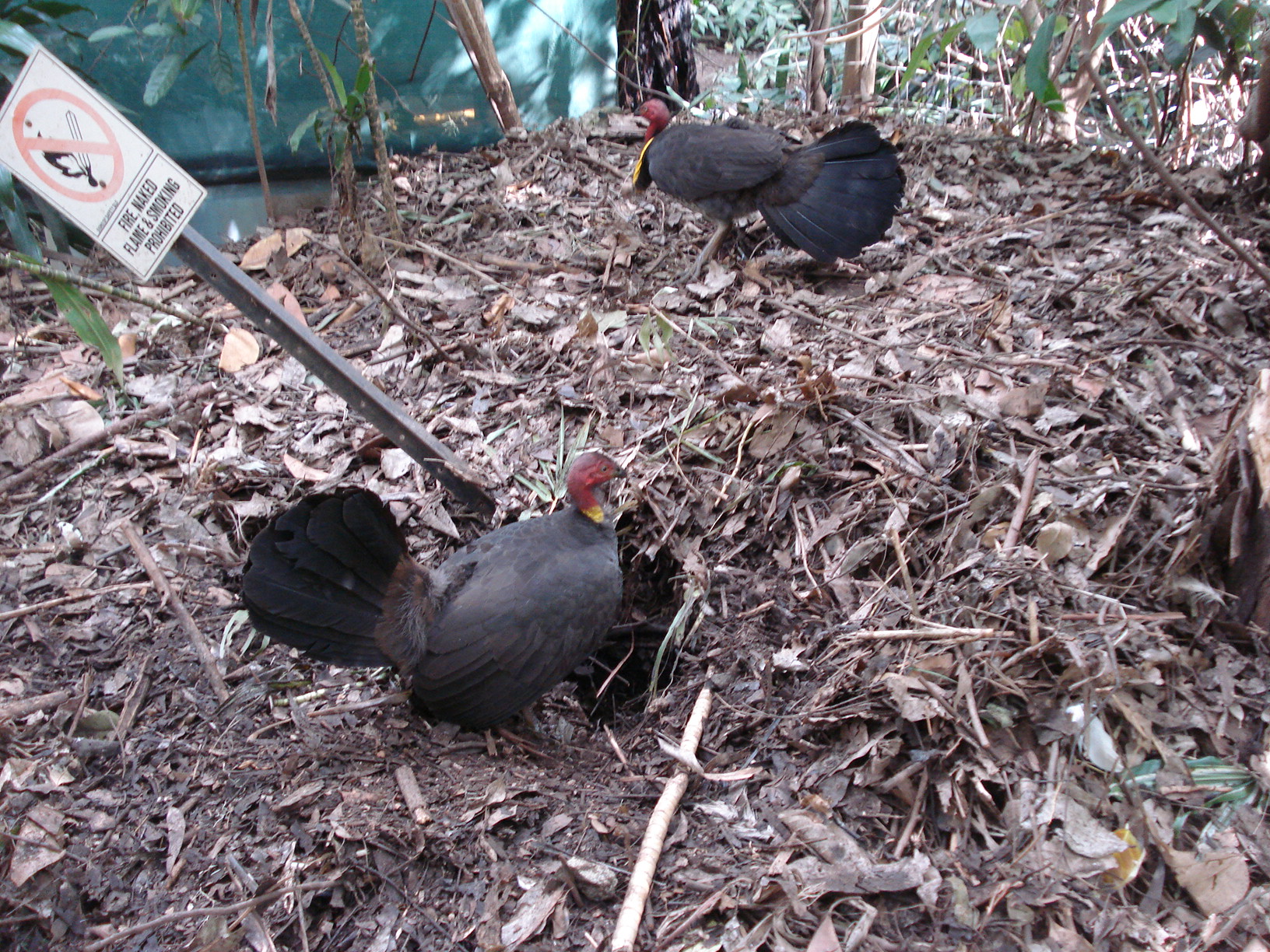
Australian brush-turkeys, Alectura lathami i, at the Alma Park Zoo near Brisbane, Australia; they run wild there. Here they are doing what they are best known for: making a mound-like nest.

Australian brush-turkeys, Alectura lathami, at the Alma Park Zoo near Brisbane, Australia; they run wild there. Here they are doing what they are best known for: making a mound-like nest. We were doing kangaroo biomechanics experiments and they were everywhere. I was in awe to see such exotic (to me) birds; locals seemed not so enthused (the birds are loud and make a lot of mess).
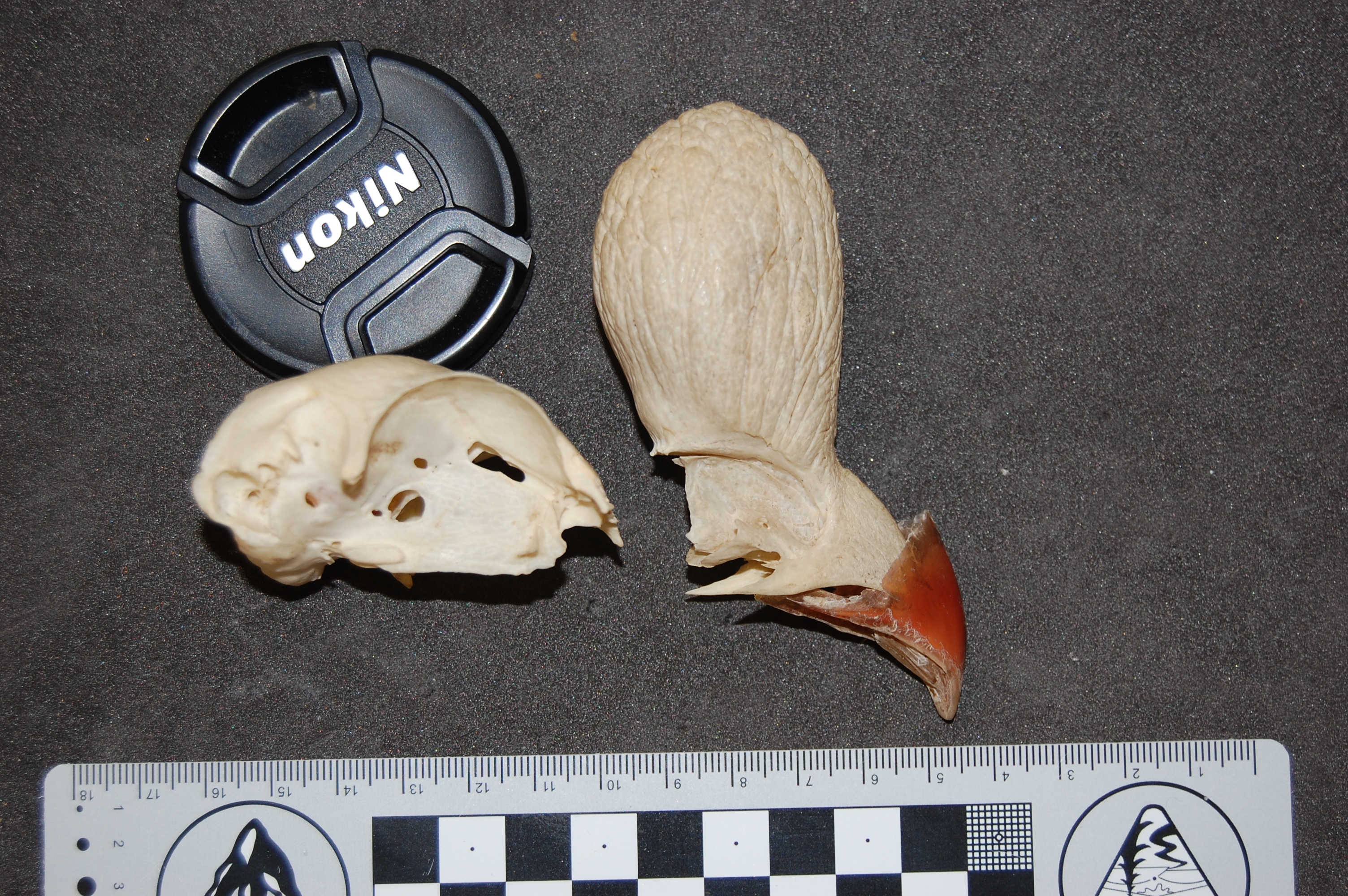
Skull of Helmeted curassow, Crax/Pauxi pauxi.

Skull of Helmeted Curassow, Crax/Pauxi pauxi,  showing that resonating chamber. Along with this boom-boom-room, the male uses a piece of food that he holds to draw in the female; if she takes it, then it’s sexy time.

Foot of a Russian Black Grouse, Tetrao tetrix (nothing to do with a certain videogame), with and without flesh.

Foot of a Siberian Black Grouse, Tetrao tetrix (nothing to do with a certain videogame), with and without flesh. Regard the broad, feathered feet, well insulated and with plenty of surface area for prancing around in the snow or moorlands. Tetrao engage in a cool display pattern called lekking, in which the males group together and show off to watching females.

A theme in the section above that is not to be missed is that there is some amazing disparity of anatomical forms in these basal lineages of poultry-relatives. Don’t dismiss the Galloanserae as just boring food-birds! Heaps of not-so-well-studied species exist here, surely with a treasure trove of cool neontological and evolutionary questions waiting for the right person to ask! Darwin’s chickens may get their share of neglect, but that pales in comparison to how little we understand about many basal Galloanserae.

What a lot of people think of as a “ground fowl” or galliform way of life is more of a way of life somewhat typical of the Phasanidae- chickens, pheasants and their familiar kin. Megapodes, curassows, guans, grouse and other Galliformes do not necessarily do things in the “typical” ground fowl way, much as the earlier branches of the Anseriformes don’t always look/act like “proper water fowl” (i.e. Anatidae). The phenomenon at play here is one of the great bugaboos in biology: essentialism— the often implicit misconception that variation away from some abstract ideal is negligible, uninteresting or just not conceivable due to mental blinders. When we say something like “the chicken is a fascinating species” we are sliding down the essentialistic slope. There is no “the chicken.” Not really. Oh dear, speaking of slippery slopes, I’d best stop here before I start talking about species concepts. And no one wants that to happen! Anyway, essentialism still pervades a lot of modern scientific thinking, and has its place as a conceptual crutch sometimes. But in biology, essentialism can be very insidious and misleading. It burrows in deep into the scientific mind and can be hard to root out. Unfortunately, it is entrenched in a lot of science education, as it makes things easier to teach if you sweep aside the exceptions to the essentialist “rules” in biology. I catch myself thinking in static, essentialist ways sometimes. The punishment is no cake for a week; so awful. 🙂

And speaking of “normal” or “typical,” morphology is of course often not that way even within a species, age class or gender. Pathology is a great example; by definition it is abnormal. It is a shattering of the “essence” of animals, brought on by some malady.

Next I’ve highlighted some of the amazing pathologies I’ve seen in the Tring skeletons. There have been so many I’ve been unable to keep track of them– some of these birds had the stuffing beaten out of them, and I’m not talking about Thanksgiving turkeys. Some were captive animals, in which the pathology might be blamed on living an inappropriate environment, but some were wild-caught — given the extreme pathologies, it’s a wonder those even survived to be found, but perhaps less a surprise that they were caught.


BONES GONE BONKERS:

View of left knee of a specimen of the Highland guan, Penelopina nigra, showing some nasty osteoarthritis around the whole joint.

View of left knee of a specimen of the Highland Guan, Penelopina nigra, showing some nasty osteoarthritis around the whole joint. Eew.  A happier Guan sounds like this.

Femora and tibiae of the Blue-throated Piping Guan, Aburria cumanensis. Amazing pathology involving the left femur (broken, rehealed) and tibiotarsus (secondary infection?).

Femora and tibiotarsi of the Blue-throated Piping Guan, Aburria cumanensis. Amazing pathology involving the left femur (broken, rehealed) and tibiotarsus (secondary infection?). Interestingly, the non-fractured limb also showed some pathology, perhaps indicating general infection and/or arthritis in reaction to the severe damage to the other leg, or just increased load-bearing on that leg.
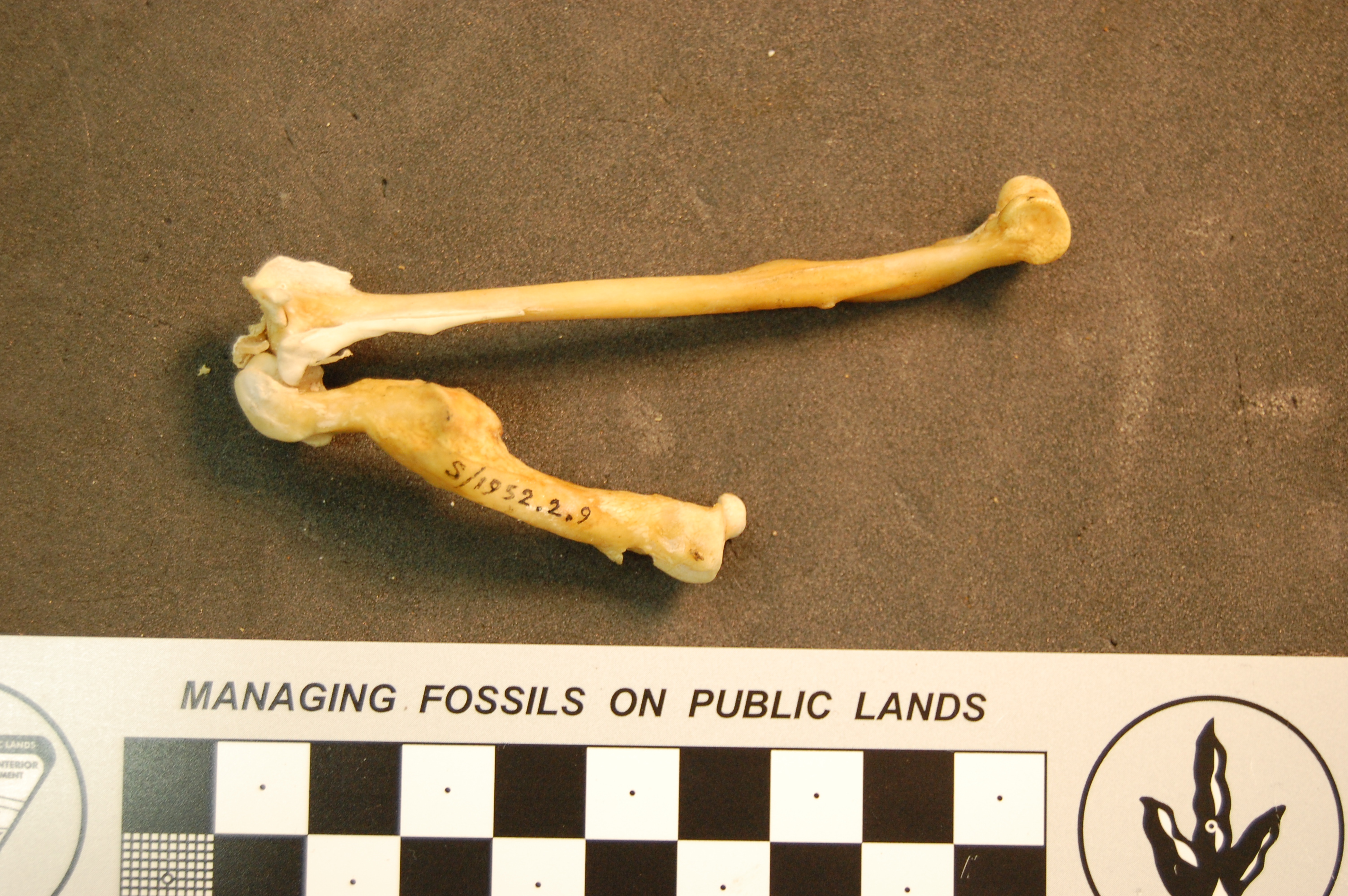
Little Chachalaca, Ortalis motmot, showing a broken and rehealed right femur and the tibiotarsus.

Little Chachalaca, Ortalis motmot, showing a broken and rehealed right femur and the tibiotarsus. As in the guan above, this animal was not walking for many weeks; its femur had snapped in two, but somehow melted back together. The tibiotarsus didn’t look too great, either; lumpy and bendy. In better times, the Chachalaca does the cha-cha like this.

These two specimens blew my mind. On the right is a normal Tetrao tetrix (Black grouse); on the left is one hybridized with another (unknown) species.

These two specimens blew my mind. On the left is a normal Tetrao tetrix (Black Grouse); on the right is one hybridized with another (unknown) species.

In the picture above, what amazed me first was the very unusual flattened pelvis/synsacrum of Tetrao, which characteristically is light and wide. But in the hybrid this morphology was completely gone; the pelvis had a more standard “galliform” (read: Phasianid)-like shape, deeper and narrower and more solid in build. I am guessing that the hybrid was a cross with a pheasant like Phasianus itself, whose anatomy would be more like this. Somewhere in here there is a fantastic evo-devo/morphometrics project waiting to happen.

That’s my quick specimen-based tour of “basal birds”. Beyond these two clades of Palaeognathae and Galloanseres, there lies the forebidding territory of Neoaves: much of living avian diversity, and extremely contentious in its phylogenetic relationships. I’m tackling them next for my research on the evolution of the patella/kneecap. But first, I’ll be at the NHM-Tring today for a whirlwind tour through the respectably speciose “normal” Galloanseres clades of Phasianidae and Anserinae+Anatidae, so off I go! (It’s my wife’s birthday celebration, so cake may have to wait for later this time)

So what do you think? What’s your favourite neglected “primitive” bird group (more apropos: early branching avian lineage that may still be very specialized, rare and poorly understood), or cool factoid about palaeognaths and basal neognaths?

No quaggas were harmed during the writing of this post.

No quaggas were harmed during the writing of this post. Polly wanna quagga?

Read Full Post »

Bovids to the right of me, pinnipeds above, what's a guy to do but squee?

Bovids to the right of me, pinnipeds above, what’s a guy to do but squee?

I’ve been doing some osteological studies of the patella (bone in the major tendon in front of the knee; termed a sesamoid) that have included frequent visits to the Natural History Museum’s avian skeleton collection at Tring. It’s a cute little town, northeast of London, in the green county of Hertfordshire where I live and work. The museum at NHM-Tring is a great old school multi-storey display packed with skeletons and stuffed animals in dark wood cabinets, with many critters hanging from wrought iron railings or other suspensions above (see above). I blogged about the Unfeathered Bird exhibit (and book) that just finished up its tour there yesterday. And I’ll be blogging later, as I keep promising, about the cool things I’ve learned during the past year of my studies of the form, function, development and evolution of the patella.

As an aside, I heartily recommend doing research at the NHM-Tring. It’s away from the bustle (and arduous Tube trip) of the South Kensington NHM, and the curatorial staff are immensely helpful… and there is something else that makes the trip even more enjoyable, but you must read more below to find out about it.

Stomach-Churning Rating: 2/10; 150-year-old dry bones. But an advance warning to (1) diabetics and (2) pun-haters, for reasons that will become evident.

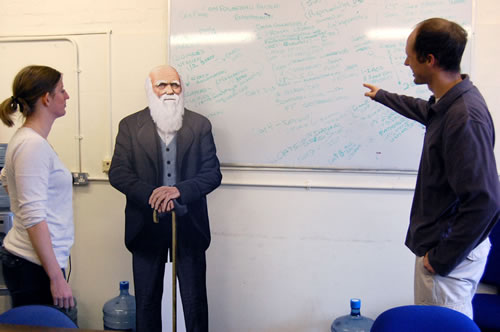
Dr Heather Paxton and Dr Jeffrey Rankin, postdoc researchers working on our collaborative BBSRC chicken biomechanics grant (see thechickenofthefuture.com), explain their science to an attentive Darwin.

Dr Heather Paxton and Dr Jeffery Rankin, postdoc researchers working on our collaborative BBSRC chicken biomechanics grant (see thechickenofthefuture.com), use the Structure & Motion Lab whiteboard to explain their science to an attentive Darwin.

Today I have a short pictorial exhibit of something wonderful I ran into while patellavating in the NHM collections. As often happens while doing museum research, I had a serendipitous encounter with a bit of history that blew my mind a little, and had me geeking out. These things happen because museum collections are stuffed with specimens that, to the right eyes or the right mindset, pack a profound historical whallop. As a scientist who is pretty keen on chickens (Gallus gallus), there are probably no museum specimens of chickens that would get me more excited about than the chickens Darwin studied in his investigations of artificial selection. In fact, most museum specimens of domestic chickens would not be that interesting to me, especially after seeing these ones.

Darwin wielded the analogy between artificial selection and his conceptual mechanism of natural selection in the first ~4 chapters of On the Origin of Species to clobber the reader with facts and try to leave them with no doubt that, over millennia, nature could craft organisms in vastly more complex and profound ways than human breeders could mould them over centuries. While people most often speak of Darwin’s pigeons when referring to Darwin and avians or artificial selection and variation, his chickens appear in The Origin and other writings quite often, too (most prominently, The Variation of Animals and Plants Under Domestication in 1868– more about that here). For example, from my 1st edition facsimile of The Origin from Harvard University Press, pp. 215-216:

Natural instincts are lost under domestication… It is not that chickens have lost all fear, but fear only of dogs and cats, for if the hen gives the danger-chuckle, they will run… and conceal themselves in the surrounding grass or thickets; and this is evidently done for the instinctive purpose of allowing, as we see in wild ground-birds, their mother to fly away. But this instinct retained by our chickens has become almost useless under domestication, for the mother-hen has almost lost by disuse the power of flight.”

Well told, Mr D!

I am also reminded of how chickens and Darwin have had darker relationships, such as this sad story. Or how evolution via Darwinian mechanisms crosses paths with pop culture in fowl ways, such as how tastes-like-chicken evolved, or how some say that chickens, over great periods of time, have been naturally selected in such a way that they are now heritably predisposed to cross roads, or that the amniote egg preceded the evolution of the genus Gallus by some 325+ million years. I see I am drifting and drifting further away from the topic at hand, so let me segue back to Darwin’s chickens. We’ll take this corridor there:

Inside the avian osteology collection at Tring. Sterlie at it might seem, places like this are  fertile breeding grounds for scientific discovery.

Inside the avian osteology collection at Tring. Sterile at it might outwardly seem, places like this are fertile breeding grounds for scientific discovery. And a sterile-looking collection means well cared-for specimens that will persevere for future discoveries.

So anyway, when museum curator Jo Cooper said to me something like “I have some of Darwin’s chickens out over on the other counter, do you want to have a look or shall I put them away?” my answer was quick and emphatic. YES! But only after lunch. I was hungry, and nothing stops me from sating that hunger especially when the sun is out and there are some fine pubs within walking distance! I settled on the King’s Arms freehouse, and had a delicious cheeseburger followed by a spectacularly good apple-treacle-cake with ice cream, expediently ingested while out on their sunny patio. Yum! I cannot wait to have that cake again. What a cake! Darwin’s bushy eyebrows would have been mightily elevated by the highly evolved flavour, which would have soothed his savage stomach ailments. He would have been like:

Damn, Emma! Holy s___ this is great apple-cake; here, try some! There is grandeur in this tasty cake, with its several flavours, having been originally cooked into a few baking trays or into one; and that, whilst this pub has gone on serving fine food according to the fixed hygiene laws of Tring, from so simple a beginning endless foods most beautiful and most wonderful have been, and are being, devoured.” And Emma, cake then firmly in hand, would have said something like, “My dear Charles, I shall try this enticing dessert, and I am glad to see you so enthused about something other than barnacles. Write a letter to Huxley or Lyell about that cake later. You need to focus on concocting an ending to that big species book of yours, not cakes. It’s been 20 bloody years, dude; cake can wait. End the book on a high note.” And so it must have happened.

Working at a museum collection is like having an extra home/office for a day or more. You get familiar with the environment while working there, and start to settle in and enjoy the local environs while taking work breaks. Or I do, anyway. So this post is also partly about how cake and other provisions are an important part, or even a perk, of life as a visiting museum researcher. Put in some good solid work, then it’s cake time, but where are the cakes? You explore, and you discover them– opening the door of an unfamiliar shop or pub near a museum can be like opening a museum cabinet to discover the goodness inside. Just don’t get them mixed up. Museum specimens: for research; subjects for science. Cakes: for eating; fuel for scientists. Got it?

But I digest digress. This post is not about my lunch. Not so much, anyway, although I did enjoy the cake quite a bit. Back to the chickens. Here, try some!

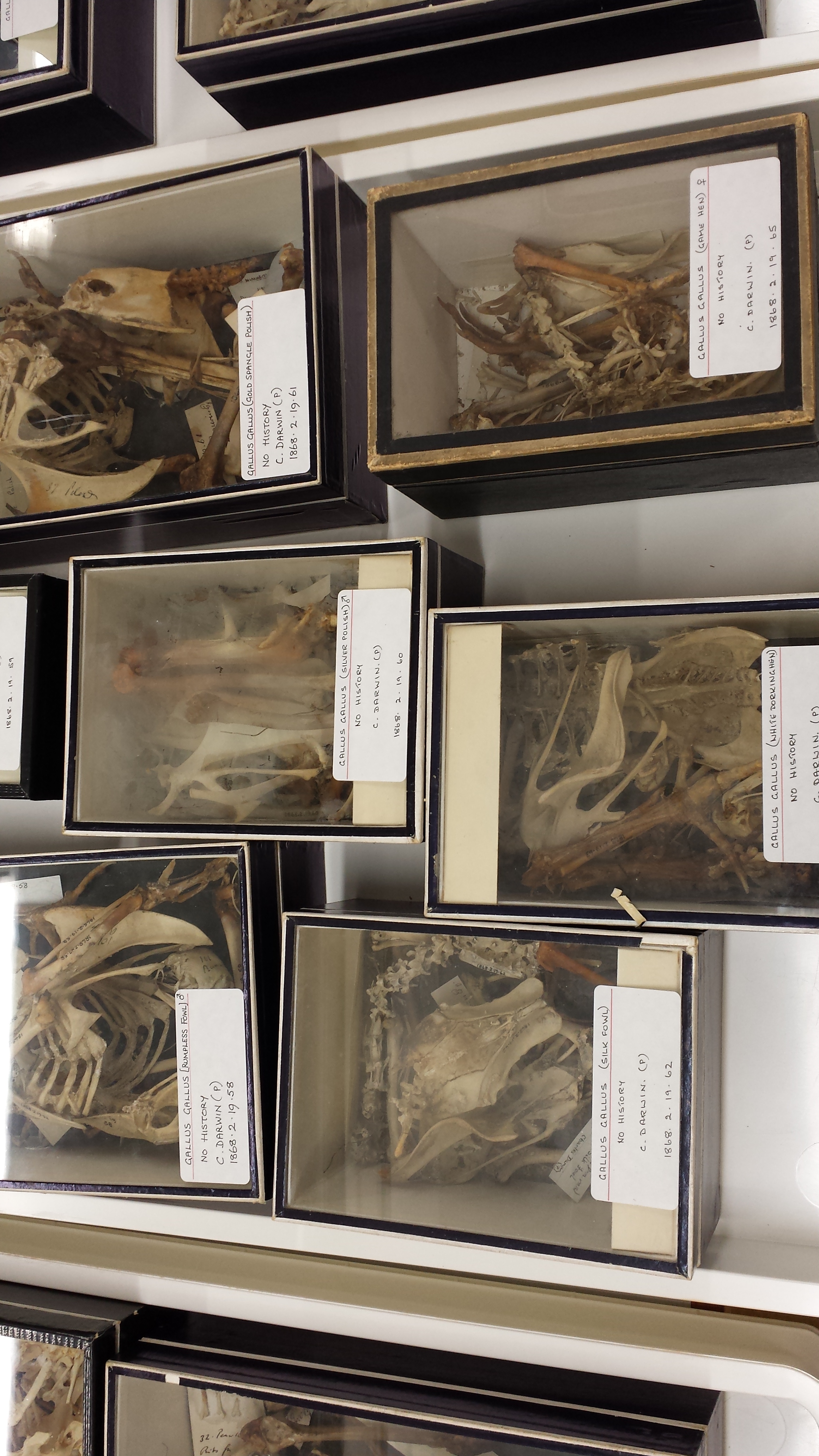
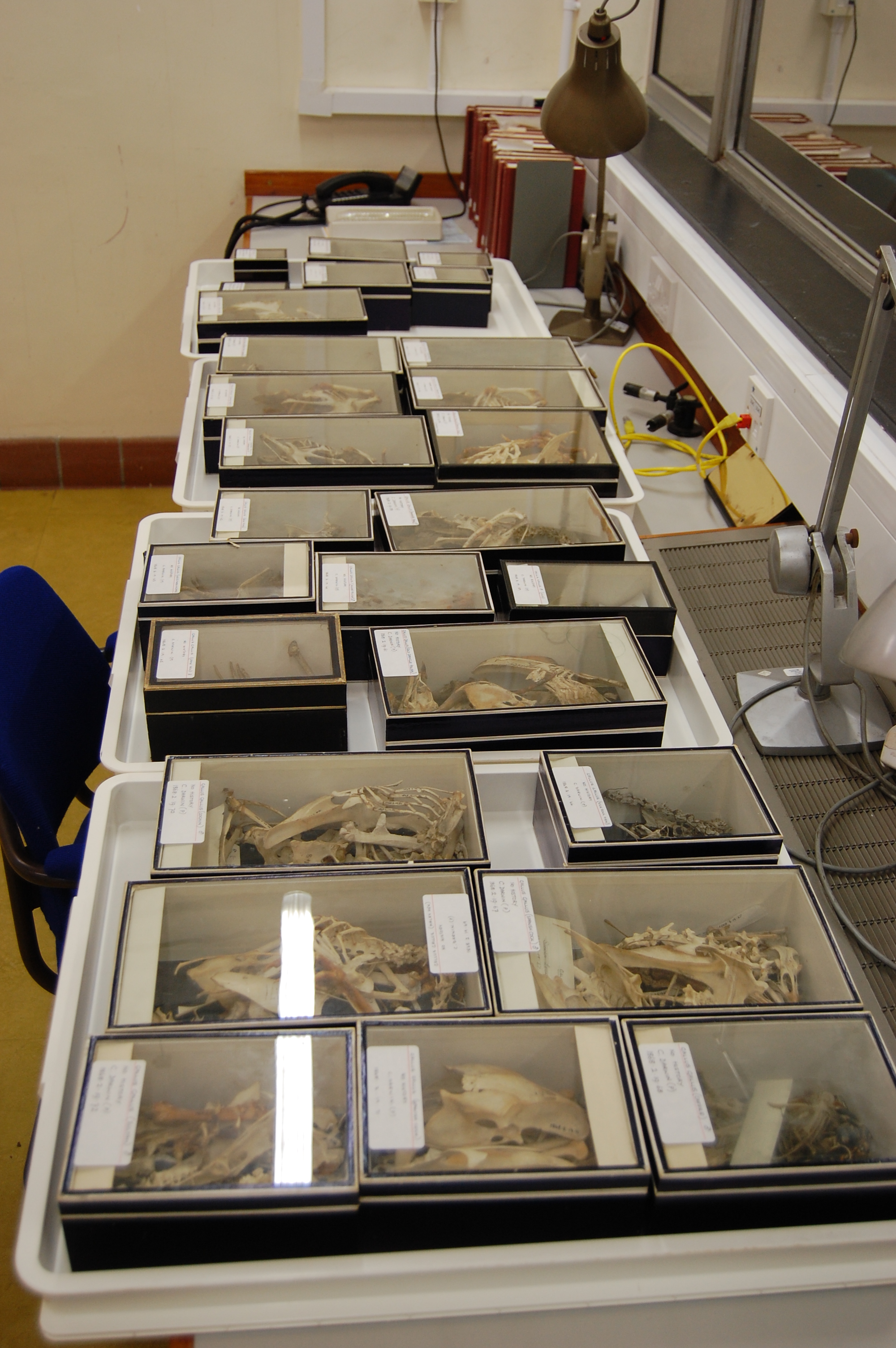
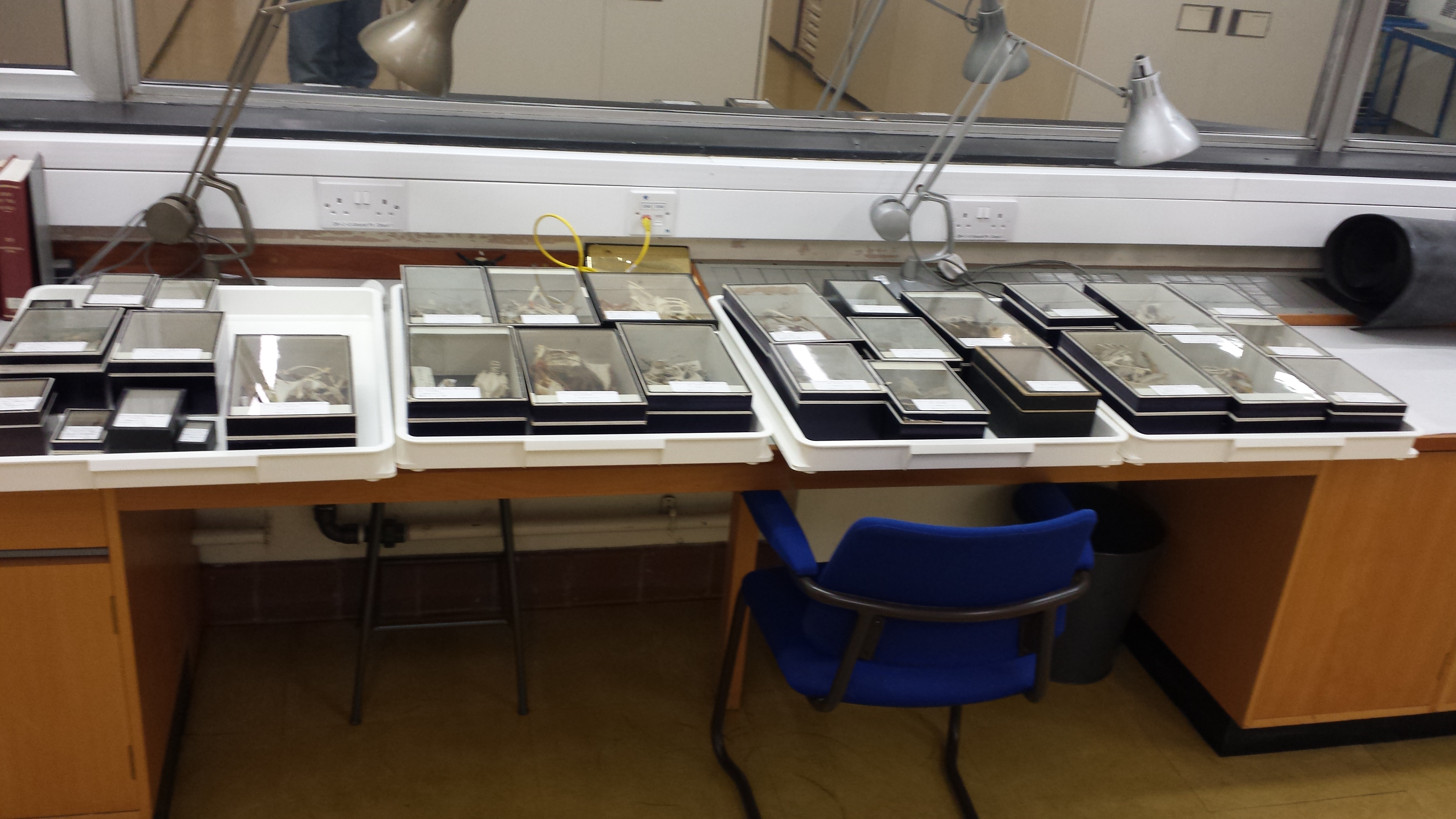
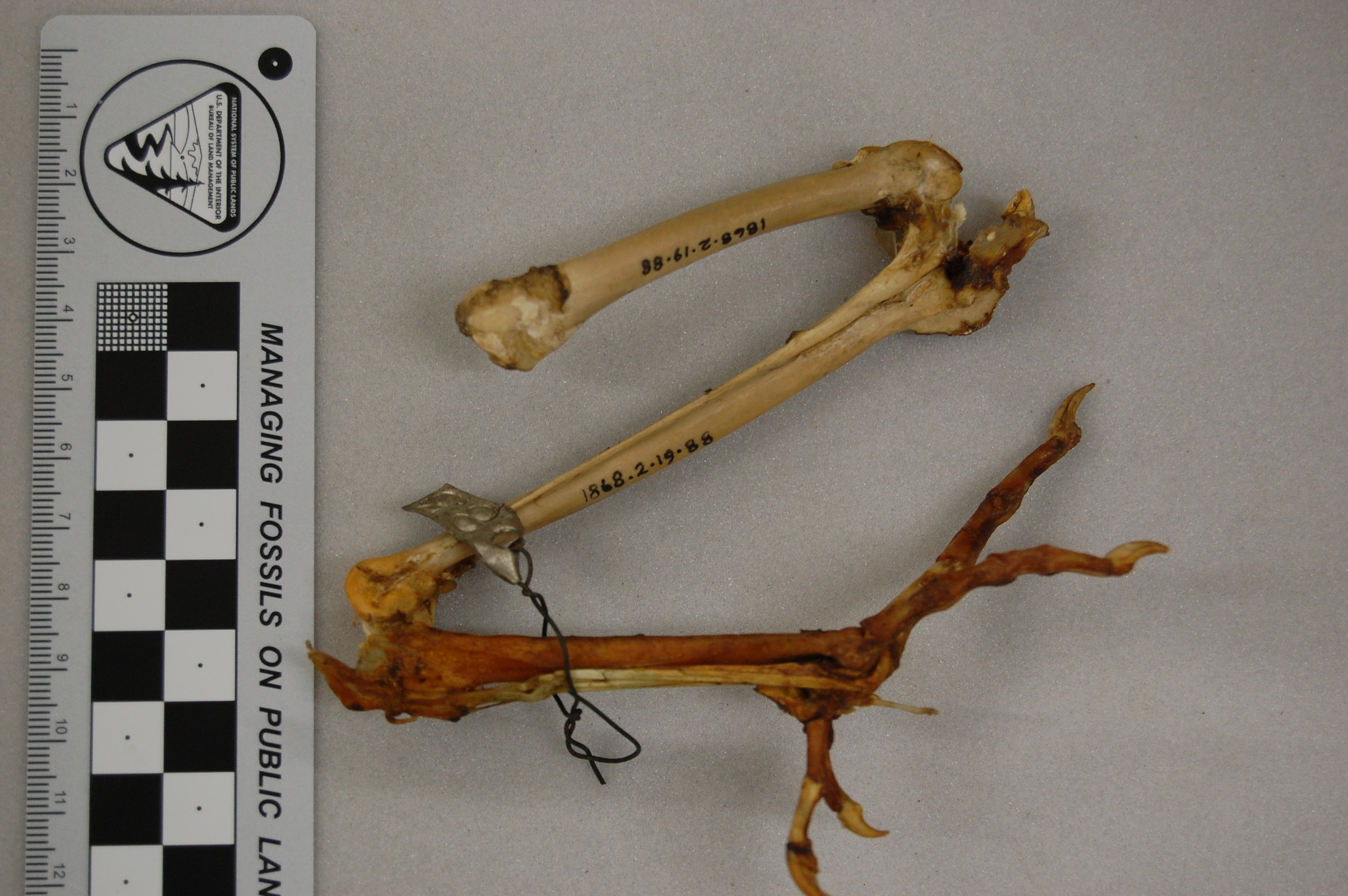
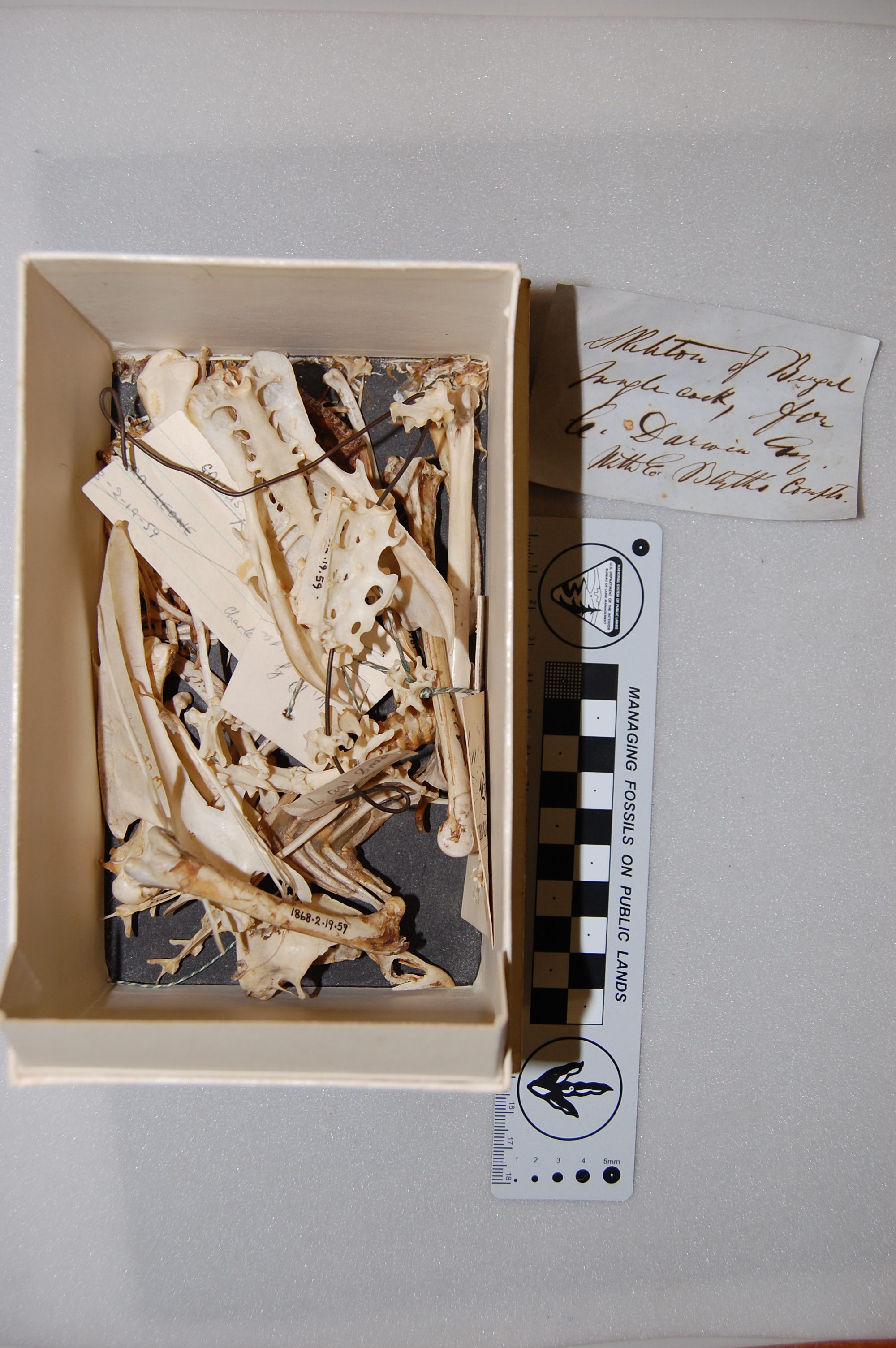
Darwins-chickens (1)Darwins-chickens (6)

Darwins-chickens (5) Darwins-chickens (4)

Above: Views of Darwin’s chickens laid out at the NHM-Tring.  (all photos in this post can be clucked to emchicken them)

The chickens, much like the pub lunch, did not disappoint in the least. Here I had before me Darwin’s own personal specimens, which I envisioned him dissecting and defleshing himself, studying them in deep introspection, then handing them over to the museum for curation once his lengthy researches were complete (all the ones I studied dated back to around 1863-1868, so they were curated shortly after The Origin was published (1859)). Perhaps the museum gave him some fine sponge-cake in return. There was at least one male and female adult of each of numerous breeds, many of them still bearing the dried flesh of centuries past. This was great for me, as the patella often gets removed and clucked chucked in the bin with its tendon when museum specimens of birds are prepared (much as elephant “sixth toe” sesamoids are). All of the specimens had their honking huge patellae on display, so that’s what a lot of my photos feature. I do so lament that I did not take a photo of the cake. Did I tell you about that cake? Oh… Check out these examples of Darwin’s chickens:

XXXX breed in right side view, with the patella indicated by a red arrow. It is still attached to the tibiotarsus by the patellar tendon (often misnamed the patellar "ligament", but it is just a continuation of the proximal tendon).

African rooster (wild variety? Darwin’s label was not clear) in right side view, with the patella indicated by a red arrow. That patella is still attached to the tibiotarsus by the patellar tendon (often misnamed the patellar “ligament”, but it is just a continuation of the proximal tendon).

Darwin's handwritten label and the well-endowed patella of the Spanish Cock. What? Oh, you. Stop it.

Darwin’s handwritten label and the well-endowed patella of the Spanish Cock. What? Oh, you. Stop it. That has nothing to do with cake, and only cake-related humour is allowed in this post.

Some other fascinating features exhibited by Darwin’s chickens, which he doubtless mulled over while nibbling on fine cakes, included the following:

The hindlimb of a Polish Silver Laced breed, nicely showing the ossified tendons (red arrow) along the tarsometatarsus. Why these tendons turn into bone is one of the great unsolved mysteries of bone biology/mechanics and avian evolution. Check out the famed feather crest here.

The hindlimb of a Polish Silver Laced breed, nicely showing the ossified tendons (red arrow) along the tarsometatarsus. Why these tendons turn into bone is one of the great unsolved mysteries of bone biology/mechanics and avian evolution.

Check out the famed feather crest of the Silver (Laced) Polish here; it gets so extreme in males that they have a hard time seeing, and can get beaten up by other cockerels when kept in mixed breed flocks.

Here on this blog, and of course on the companion blog “Towards the Chicken of the Future,” domestic chickens and wild junglefowl have often come up, most recently with the Dorking Chicken (another of Darwin’s own specimens that I studied) in the “Mystery Museum Specimen” poetry round of late. Dorkings are HUGE chickens; easily twice the weight of even a broiler chicken, up to 4-5kg. The Dorking-characteristic polydactyly featured in that post is also observed at a relatively high incidence in Silkie and Sultan breeds, I’ve learned. Like this one! (I was so patella-focused, or cake-somnolescent, that I missed it while studying at the museum and only noticed it now while browsing through my photos, bereft of cake)

Nice leg of a Sultan hen. There is an extra toe here as in the Dorking chicken; a duplicate hallux (first toe). This is not, as it might at first seem, a pathological condition as in modern "twisted toe"-suffering domestic chickens.

Nice leg of a Sultan hen. There is an extra toe here as in the Dorking chicken; a duplicate hallux (first toe). This is not, as it might at first seem, a pathological condition as in modern “twisted toe”-suffering domestic chickens.

Malays are another giant breed like the Dorking, but with longer and more muscular legs and longer necks, looking much more like a classic, badass wild junglefowl than a fancy, pampered chicken. But here, undressed to the bare bones, it just looks like a skinny chicken leg, albeit perhaps a bit svelte compared to the Dorking or Sultan.

Hindlimb of a Malay breed of chicken, which Wikipedia nicely tells the story of its misnomer (it may originate from Pakistan, not Malaysia!). Can you find the nice patella? Check out Darwin's lovely label, too.

Hindlimb of a Malay breed of chicken, which Wikipedia nicely tells the story of its misnomer (it may originate from Pakistan, not Malaysia!). Can you find the nice patella? Check out Darwin’s lovely label, too.

You may have come across wild-eyed news stories 5 years ago about “OMG Darwin was sooooooo wrong about chickens!”, referring to his writings on the origin of domestic chickens from Red junglefowl. As Greg Laden adeptly wrote, Darwin (say it with me) didn’t really get it very wrong after all. He did quite well, in fact. Some media outlets did get it more wrong, probably inspired by this press release. Oh well; the science they were reporting about definitely was interesting- modern chickens seem to have some of their yellow skin pigmentation-related genes from Grey junglefowl, although they are still largely descendants of Red junglefowl.

Here, have a JUMBLE-fowl, or rather a junglefowl cockerel, with another Darwin label:

Darwin's example of a wild-type chicken; a Red Junglefowl. As he suspected, these Asian birds were the ancestors of domestic chickens, but today evidence suggests that domestication occurred multiple times in Asia and with different wild varieties of junglefowl bred/mixed in different regions.

Darwin’s example of a wild-type chicken; a Red junglefowl. As he suspected, these Asian birds were the ancestors of domestic chickens, but today evidence indicates that domestication may have occurred multiple times in Asia and with different wild varieties of junglefowl bred/mixed in different regions.

Some breeds aren’t so funky inside, of course, but just have cool feather patterns on the outside, like the “pencilling” (dark streaks on white feathers) evident in pencil breeds; also called triple-laced. Like this fine chap below once would have had, before Darwin tore off his feathers and reduced him to a research-friendly naked skeleton:

A Golden Pencil Hamburgh breed of chicken (cockerel), whose skeleton features the leg and a fine articulated patella.

A Golden Pencil(led) Hamburg breed of chicken (cockerel), whose skeleton features the leg and a fine articulated patella.

Also known as the Holland Fowl, several European countries including the UK claim the Hamsburg as an original breed from their respective realm, and no surprise they do- it’s a lovely spangled chicken. Then, later in the 1800’s the Americans got involved in breeding them, too, and it’s all a big mess. They should get together, have some delectable cakes, and just sort it out.

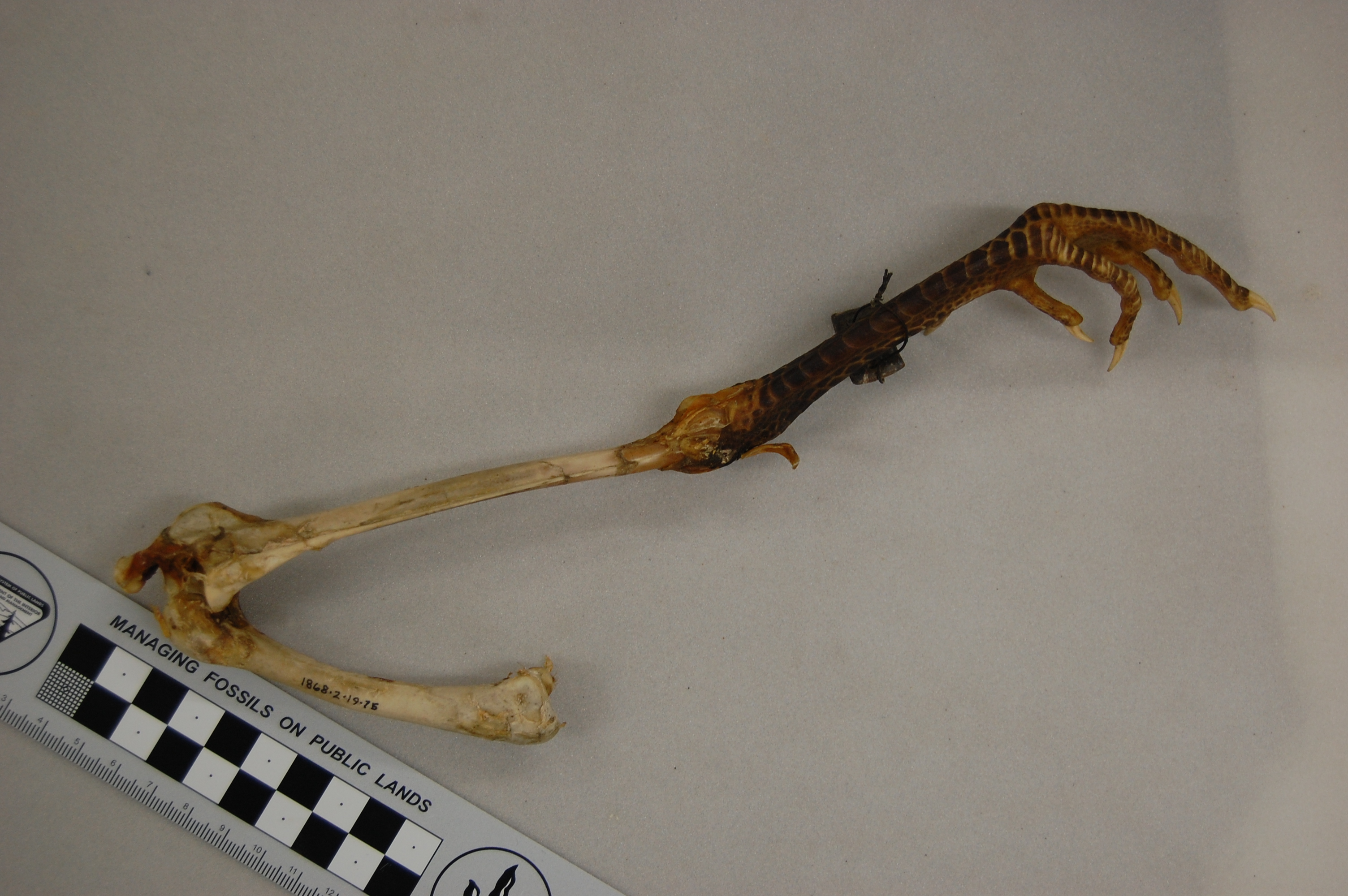
Scaly, still-greasy foot and hindlimb of what Darwin labelled as the male of a "Game" breed.

Scaly, still-greasy foot and hindlimb of what Darwin labelled as the male of a “Game” breed.

We thus close with another leg of another chicken. Darwin was a bit naughty here, or else terminology of breeds has changed a lot since the 1850’s (very possible), as he just labelled this as a “Game” cockerel. Now, Gamefowl is a big category of breeds. I’m guessing this one was either (1) a Cornish/Indian Game variety or (2) an Old or Modern English Game Fowl. Maybe a person who knows their chicken breeding far better than me (that’s not hard!) will opine differently. The latter varieties were popular in Darwin’s time — the (Muffed) Old English version was mated with other breeds (Malay?) to produce the Modern English form as cockfighting “sports” became banned in 1849 and breeder attentions shifted to the polar opposite of producing showy, fancy birds instead. And thus the bufante, feathered-hair-adorned 1980s pop-rock group was created, to sing about mating or moulting or melting with people or something terribly disgusting and probably having nothing at all to do with chickens,  cake, or cockfighting, or other more seemly pursuits.

So, we have come to the end of my photos of Darwin’s chicken leg bones and such. If you’ve learned something here about chicken breeds, patellae, cake, or Darwin, that’s simply frabjous. Enough of those poncey pigeons, already! I’m crying fo… no, I won’t use that pun. Nevermind. Not even remotely cake-related. Let’s give Darwin’s chickens their just desserts, is the point– and a much better pun, too. Darwin’s chickens are an important part of Darwiniana, and an interesting evolutionary study in and of themselves. I’ve certainly become impressed during my researching for this blog post by the diverse, fascinating biology of chicken breeds. My copy of the “Complete Encyclopedia of Chickens” will be getting some more thorough reading shortly.

Today, however, I am off to return to the NHM-Tring and peruse their other, non-chickeny Galliformes and Anseriformes, with a detour to the mythical hoatzin. But… but… there may be a cake detour involved, too. I shall report back in due course. Off I go!

No, hopefully not that cake.

Read Full Post »

I have a rant to do, and an anatomy vignette or two, but before I do, here is a puzzleroo: It’s a reconstructed CT scan. I’ve digitally cut off the head to be tricksy. Come on man, I ain’t just whistlin’ Dixie! What is this beastie? Not hard in the leasty.

(your answer needs neither rhyme nor Shakespearean meter, but do take the time and provide the Latin binomen for reala– don’t just call it Peter or Sheila!)

Stomach-Churning Rating: 1/10. It won’t bite.

Difficulty: decapitation.

Read Full Post »

This is pinned to the top of the “Mystery Anatomy” page, where it shall stay for easy reference.

MYSTERY ANATOMY RULES: 5 pts for correct, spot-on and FIRST right answer, 4 pts for very close or second, 3 pts for partly right or third in line with right answer, 2 pts for a good try, 1 pt consolation prize for just trying, or for a good joke!

Poetry rounds have special rules as described there, but the general rule is that cleverness gets more points.

If you post as “anonymous” name then it all goes into the same tomb of the unknown anatomist.

If you change your answer, you may lose ~1 pt if I feel frigidly cruel.

Answers posted via Twitter, Facebook, email or whatever do not count! No appeals. I am a frigid dictator. :-)


CURRENT SCORES- In order from top, ice-cool score to lukewarm ones:

(to be reset with start of 2014 game)

END OF 2013 FINAL SCORES FROM HOLIDAY SONG ROUND!!!

The Ice-Cool Eight:

Mark Robinson [38]– 2013 WINNER!

Michael Doube/mdoube [25]

Heinrich Mallison [24]

Jaime A Headden [23]

Stu Pond [20]

Filippo [20]

RH [17]

PaoloV [15]

The Rimey Runners-Up:

hypnotosov [13]

Anath Sheridan [9]

Darren Naish/Eotyrannus [9]

Casey Holliday [8]

Henry Astley [8]

Robin Birrrdegg [8]

Lisa Buckley (@ShamanSciences) [8]

Carolyn Eadie DeBoer [7]

Chris Thomas [7]

Jason Anderson [7]

Mieke Roth [6]

Check out the 5-point Gang of Awesomeness: Chris K, Olle Håstad, 220mya, Jason, Coherentsheaf, nick gardner.

Ever-persistent 4-pointers: William Perez (vetanat), Diane Kelly, Amy Beer, Colleen, Martin Brazeau, Richard Dearden.

Zoinks, 3 points! brooke, Thomas R Holtz, Jr, Christopher Taylor, Andy Farke, dobermunk, .gabi.sobral. (@darkgabi), Dave Hone, Ryan Marek.

And in the still-in-the-running, chilled out 2 pt sector: Nicola newton, Alejandro Otero, Joy Reidenberg, unknown anatomist (oh noes! don’t let them win!), Aldo Matteucci, Dan, Bruce J. Mohn, gingerest, John Collins, Carol, cromercroxHenry, AnJaCo, Ben, pakasuchus, Lorna Steel, Sandra N, Eric Morsschauser.

Finally, the 1pt hoary horde– keep trying! protohedgehog,  mcarnall, rebecca fisher, edward ayton, Welmoed, heather, Jenn, palaeosam, Carol Robbins, Old Geezer, A Person, rjm, Robyn, Morgan, Fiver, Colleen, Amber Alink, himmapaan, AnJaCo, J Gentry, Federico “Dino” Degrange, henstridgesj, smg, Jason Poole, Roger Close, Stephanie Pierce, VIvian (Allen).

Thanks for a good game of Mystery Anatomy!  A new game will begin afresh (afrozen?) in 2014!

Read Full Post »

It’s back! Mystery Anatomy is in full swing again after a lovely summer holiday in Antarctica- check out its fabulous tan freezerburn! We now have a new scoreboard page, too, for your convenience.

Today is another poetry round, which means you not only get 1 pt for trying but also can amaze and delight us all– and win extra points for rhapsodizing in sublime eloquence at the marvel of nature you are about to behold!

The poetry form for today is the SONNET. 14 lines as usual, but we’ll relax the form and allow you to be maximally creative– just include some rhyming, but you do not need to stick to iambic pentameter or other rigid, galling forms. You must (1) identify the specimen, (2) explain what’s important/unusual about it, and (3) have fun.

Look upon this foul form, feel its greasy exterior and inhale deeply of the same rancid perfume that might have graced Pliny’s or Caesar’s aquiline nose, while your mind reels at its historical significance, which spurred on one individual of some note to exclaim “I was so ignorant I do not even know there were three varieties… how do they differ?”

Mystery12

Difficulty: The poetry will be the hardest part for some.

Stomach-Churning Rating: 2/10. Again, the main threat here is the poetry.

Proceed, morpho-poets; let this museum specimen be no paltry muse!

Some labels to help those unfamiliar with the wonders of chicken foot anatomy!

Some labels to help those unfamiliar with the wonders of chicken foot anatomy! The position I’ve labelled the “extra toe” in is arbitrary; it might be “toe 1” that is the new toe. That might make more developmental sense, that the identity of “toes” has migrated up the limb to add a new toe– and is the spur in male chickens also spurred on by similar signals? No one knows, I think.

Read Full Post »