Feeds:
Posts
Comments

Archive for March, 2012

Birds and crocodiles are part of the spectacularly diverse group of animals called the Archosauria, or archosaurs if you’re on casual terms with them. Other (extinct) archosaurs include the dinosaurs (non-avian), pterosaurs, and sundry wondrous other beasts like aetosaurs and phytosaurs. Archosaurs have, and presumably their common ancestor had, many specialized features of their anatomy that are related to metabolism and locomotion. That’s a big reason why, as a scientist, I love them.

Yet the bird lineage evolved its own extreme specializations, whereas in some (but not all!) ways crocodilians stayed closer to the ancestral state. Here is a great example of one of the major categories of differences between living crocs and birds: the proportions of the respiratory system, from freezer specimens I’ve CT scanned with my former PhD student Vivian Allen, which were part of a paper we published in Anatomical Record back in 2009. We scanned the thawed specimens with and without the lungs inflated (croc results not shown for inflated state). This was easy; we just stuck a syringe into the windpipe and then tied it off once we had pressurized the lungs. [I’m now working with Colleen Farmer and Emma Schachner on using these specimens to learn more about the surprisingly “bird-like” features of croc lungs despite the smaller total volume of the airways; more about that another day… we can do MUCH better than these images!]

Here, the airways are coloured blue/purple and the flesh has been made transparent yellow, while the skeleton is orange. The relatively massive size of the airways is evident in birds, especially the air sacs (side pockets of the lungs/other air passages), whether they are relaxed or inflated. The lungs (purple) aren’t that differently sized in the two animals.

Australian Freshwater crocodile from CT scan:

Junglefowl (“ancestral wild chicken”) from CT scan; relaxed airways:

Junglefowl from CT scan; inflated airways:

(note that the light blue region is the expanded air sacs; the lung in purple hardly changes because it is fairly rigid in birds)

Read Full Post »

Croc-cicle

Breaking up the giraffe monotony with my next subject (too long postponed in my research): how awesome crocodile anatomy (and locomotion) is! Just a teaser, using a CT scan of one of my favourite freezer specimens: the enigmatic Crocodylus moreletii. The frozen specimen itself was quite rotten so I won’t put a pic of that up right now (you’re welcome!) but the skeletal anatomy shows up great when all that decay is made transparent– and when the bones are turned a pleasing purple.

The specimen came from La Ferme Aux Crocodiles in France, which very kindly let us drive down there and come back with a vanload of >20 awesome crocs, which now occupy the left side of The Freezer.

Edit: check out the great blog post by Darren Naish on Tetrapod Zoology, about a crocodile dissection and crocodylomorph phylogeny- hopefully the start of a long series on these wonderful critters!

Read Full Post »

William Pérez from the Veterinary Anatomy Facebook page sent me a link to this stunning image of a giraffe hindlimb dissection– wowza!

Read Full Post »

Scanner's eye view of giraffe leg

This is why we get scan artifacts from giant specimens. It fits, but only just. The x-ray beams are getting scattered from being too close to the x-ray detectors (ring around the specimen), creating noise in the images. The red lines on the specimen are from a laser, used to align it properly within the gantry of the scanner. The femoral head (hip joint) is visible as the pale white thingy, down on the bottom right.

Read Full Post »

We use Mimics software, which is pricey but sooooo easy to do stuff like this. Here I’ve just had a very quick pass at reconstructing the distal hindlimb (limb except the thigh, which had bad scan artifacts). With more effort, I could remove the pesky artifacts around the knee and ankle (2 uppermost joints), although some of those are unavoidable because the leg was too damn big for the CT scanner gantry (70cm diameter; leg was around 60cm across at largest).

So how long did this process take? The hardest part was moving the leg around and positioning it on the CT table. Then the scan (608 cross-sectional slices) took about 15 minutes to do, then 15 more minutes to transfer over to my PC. Loading the DICOM slices of data and making a movie (previous post) took 5 minutes, and then making this 3D reconstruction movie took just another 5 minutes, although I waited a few days because I was busy.

So, when operating at peak efficiency, we can obtain decent 3D models from frozen specimens in less than an hour. This is but one example of how modern technology, especially X-ray computed tomography and computer hardware/graphics software, have massively transformed any research that deals with anatomy. When I was doing my PhD back in the 90’s, this would have been a much more time-intensive procedure (probably weeks of work, and difficulties getting CT access); in the 80’s it would basically have been impossible.

In the future, now, we’ll be using these models (once cleaned up a bit) with data from dissection to model how the limbs work in a real giraffe. More about that later. The Giraffe-A-Thon is over for now. I hope you enjoyed it! More of the same to come on this blog!

Read Full Post »

A man had a parrot that could talk. Unfortunately, it swore a lot, as if a sailor and a pirate had created a drunken love-child. In an effort to get the parrot to be quiet, he put it in a cupboard. The parrot continued swearing and after a while the man decided to put the bird in the freezer. After that, the parrot started swearing even more. After a few minutes, it suddenly became quiet.

The man opened up the freezer and the wide-eyed parrot then said, “I’m sorry, sir, that kind of outburst will never happen again.” As the man took the bird out of the freezer he wondered what the difference was between the cupboard and the freezer. Just then, the parrot said, “So, uh, what did the chicken do?”

[thawed out from here]

Read Full Post »

Giraffe limb from previous post, now shown via movie of DICOM (CT image data) files. Axial slices every 2.5mm, from toes to knee/stifle. Darker areas are lower density (black is air); white is very dense– bone, artefact, metal, Santorum, etc.

Read Full Post »

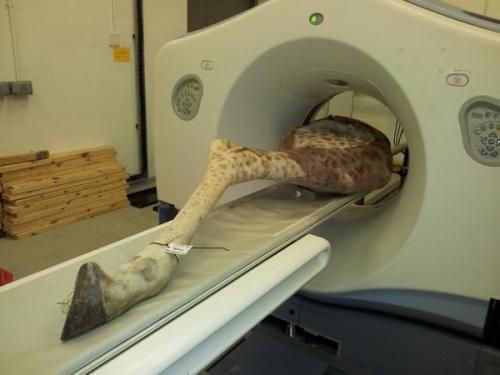
Right hindlimb of giraffe ready for CT scan!

I’m preparing to do anatomically-realistic computer modelling of giraffe locomotor mechanics with some colleagues. To do that, we of course need the 3D anatomy of bones, muscles and tendons, for which CT can be pretty useful. Here, we put our first frozen leg through the motions. It was a 3 person job to lift the sucker, but the CT bed managed to move it through the scanner with minimal hiccups. Inside the ring that the upper end of the leg is lined up with are 8 x-ray detectors, so 8 CT slices can be imaged at once, speeding the procedure.

This specimen died in a UK zoo recently, apparently from trauma (falling?), which we’re trying to help them figure out in the course of our scans and future dissections. We often provide a pretty detailed postmortem service in return for being given cadavers, since we are a vet school with a lot of expertise in pathology and anatomy. Also, we have been describing the kinds of pathologies we observe along the way, because terribly little is known about some diseases/injuries in non-domestic animals, so there is plenty we can contribute to the scientific literature as a result. We’re also interested in documenting how pathologies in wild vs. captive animals differ (if at all).

Read Full Post »

Hell Freezes Over

I confess to hipsterism or some other fatal disorder; I’m no Luddite but I am hesitant to jump onto popular techy trends. (Although I was writing webpages for www.ucmp.berkeley.edu as early as 1995!) Back circa 2006, I maintained I’d never board the bandwagon and sign up for Facebook, then I relented. Even into the spring of 2011, I was a staunch non-Twitterer, then I caved.

But all along, I’ve maintained I have no great idea for a blog and don’t have time to blog. So here I am. Maybe both those things are still true! But we shall see what crystalizes here…

Aside: the “frigorific” in the Links section is a real word, and refers to extreme coolness. Bear with me. I’m gonna milk the limited set of puns that this blog’s theme relates to, even if only tangentially so. Some freezer-burned puns may result.

In celebration of my first blog post, cue the thematic music! (I am aware of its photographic, not frigorific, context, and there are plenty of alternatives, but I like the celebratory tone here– please sing along while sporting hideously outdated fashion choices!)

Awright, let the Blogging Begin! Hopefully not at a glacial pace… First up: Giraffe-a-Thon! And be sure to check out the “Welcome to My Freezer” tab at the top, for important WIJF information.

Read Full Post »

« Newer Posts