Feeds:
Posts
Comments

Archive for the ‘Exalting Archosauria’ Category

…a daily picture of anatomy! And today it is three pictures, scoob-a-dee!

Welcome back again to Freezermas! 

For the previous days of Freezermas we first had 1 picture, then 2, now guess how many we have today? Right, we’ve settled into a groove and have three (plus one silly one). Today is fresh beefy anatomy day! No focus on bones, but on soft tissues– however, once again, I’m representin’ bird legs! And this time, no mystery things to identify; sorry. But if you want to muscle in on some myology, today is the day for you. I will unwrap the thigh of an ostrich and consider the major muscles that power rapid running in this biped, and how they illuminate the evolution of bipedal motion along the line of descent to birds. For more ostrich escapades, see this old post. And we’re off!

Stomach-Churning Rating: 7/10; plenty of fresh, red, meaty meat from ostrich leg muscles.

Ostrich thigh muscles 1

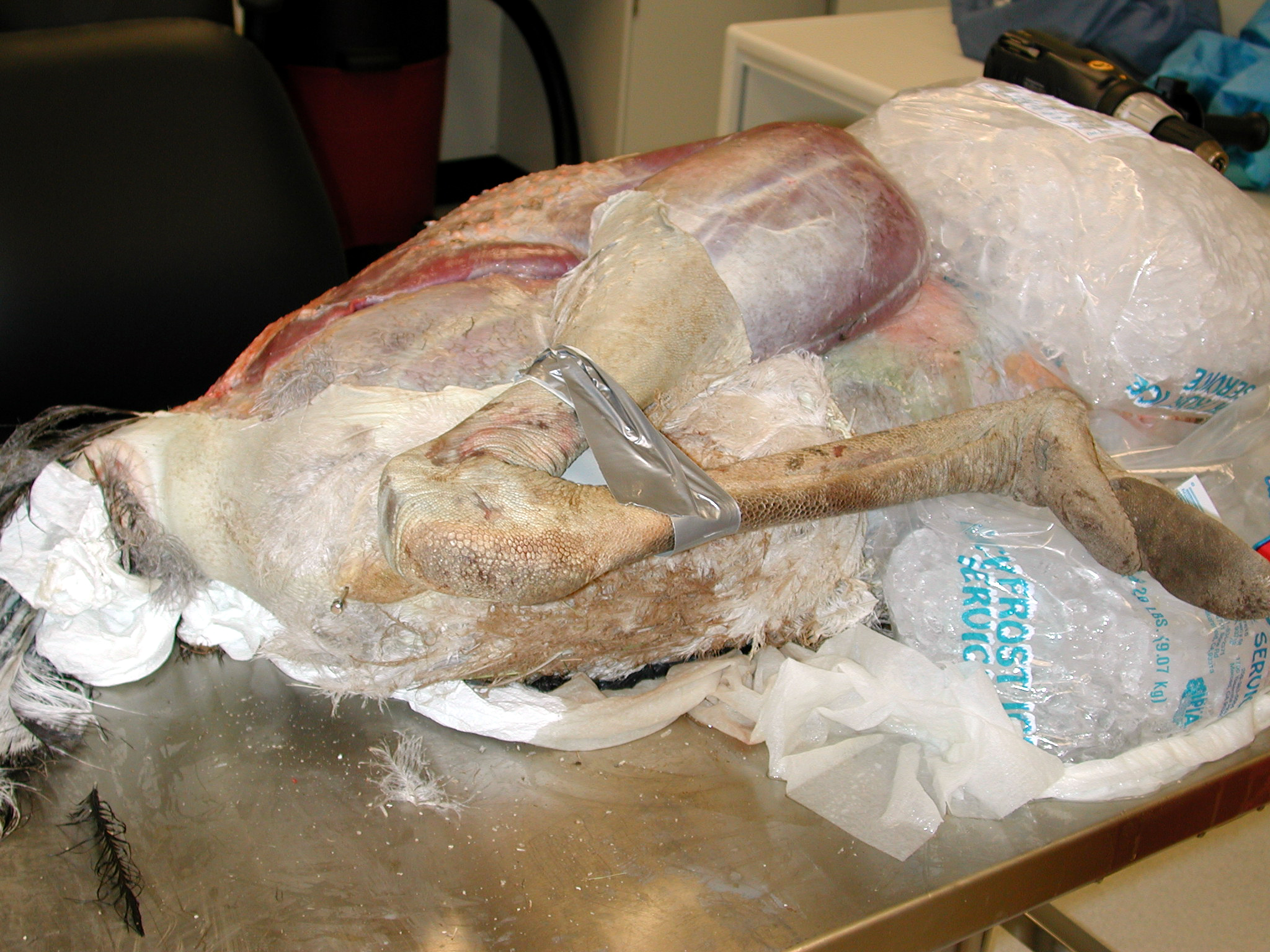
Here you are looking at a right hindlimb of an ostrich, in side/lateral view. To help orient yourself, the hip lies deep in the middle of the image and the knee is the rounded bump near the bottom right corner, with the shank angling sharply back toward the bottom left.

I’ve labelled six muscles in yellow. As usual for sauropsid (bird/reptile) pelvic limb muscles, they have sensible names that reflect their attachments. They don’t have so many silly old mammalian names like pectineus or latissimus, which tell you rather little about the muscles themselves. We can thank 19th century anatomists like two of my anatomist heroes, Hans Gadow and Alfred Romer (who refined Gadow’s earlier work and made it more popular among English-speakers and palaeontologists), for that enlightened nomenclature.

The six muscles seen above are the IC (iliotibialis cranialis), IL (iliotibialis lateralis), “AMB2?” (one of the ambiens muscles– correctly identified; ignore the ?), ITC (iliotrochantericus caudalis), CFP (caudofemoralis pars pelvica) and FCLP (a mouthful to say: flexor cruris lateralis pars pelvica). The ambiens is the one oddly, non-anatomically named muscle, and has nothing to do with helping you sleep (pssst– wake up! Muscles are exciting!), but everything to do with the state of total awesomeness, which is what “ambiens” means. Maybe. Or I am making shit up.

Amazed ostrich

The IC, IL and AMB2 are parts of the triceps femoris group (discussed in my 1st Freeezermas post), or for mammal fans the quadriceps. The IC and AMB are in front of the hip so they flex it (move the thigh forward; protract it); the IL is right around the hip so it can flex or extend the hip (protract/retract the femur); all three of these can extend (straighten) the knee joint to varying degrees. The IC is fairly typical for a bird except for its size, and helps to quickly swing the leg through the air between steps. Some birds have multiple parts of the IL, but ostriches and many others have simplified it to one major mass; regardless, it is a major muscle used to support the weight of the body.

The AMB2 is a remarkable muscle unique to ostriches; it can also be called the dorsal ambiens muscle. Typical birds just have a single head of the AMB sitting on the preacetabular (pubic) tubercle, so in front of and below the hip. It has a crazy tendon that snakes past the knee (in some birds, perforating/grooving the patella) into the lower leg muscles and may be able to even pull on the toes. But ostriches, for some reason, added a second head of this muscle that was shifted way up onto the front of the pelvis (the ilium; dorsal bladelike bone). Crocodilians also have a 2nd ambiens muscle but in a different position, and almost certainly as an example of convergent evolution. The function of the ambiens is mysterious, but this muscle has featured prominently in avian systematics/taxonomy, evolution (invoked as a key muscle used in perching) and more.

These muscles of the triceps femoris group are easily identifiable in crocodiles and other reptiles because they are remarkably similar in their attachments. The main changes these muscles experienced during the evolution of bipedalism, dinosaurs and later birds are simply proportional– they got bigger, with stronger, larger attachments on the pelvis and the front of the knee (the CC/LC, if you remember from Freezermas day 1).

The ITC is a muscle that is very dear to me. I’ve written a lot about it, and I love saying the name “Iliotrochantericus caudalis”- it is musical to me. For mammal fans, think gluteal muscles (medial gluteal in particular). It is a huge, pennate muscle (short and strongly angled muscle fibres in a “sandwich” with a tendinous sheet between the two layers of fibres). It has a short, broad tendon that wraps around the trochanteric crest (a structure on the upper front end of the femur with a history that goes wayyyy back into dinosaurs; long story!) to insert in a scarred depression. The ITC seems to mainly rotate the femur around its long axis to help support the body. I could go on and on about this muscle, which is part of the enigmatic “deep dorsal” thigh muscle group — the homologies of this group among land vertebrates are still controversial and confusing. But I will spare you the on-and-on. Incidentally, the ITC  is the “oyster” in birds that is the best cut of meat. And in ostriches it makes a massive steak.

The CFP also has a cool evolutionary history. It runs from the back of the pelvis to the middle of the femur, closely adjoined to the caudal head of the muscle (CFC), which is more vestigial. In birds the CFP is usually not a large muscle, but in other sauropsids/reptiles it can be fairly hefty, although almost never as hefty as its more famous counterpart the caudofemoralis longus (= CFC in birds). Probably any dinosaur specialist is familiar with its origin and its insertion: respectively, the “brevis fossa” on the back of the ilium; a big shelf of bone; and the fourth trochanter of the femur; a crest of bone that is reduced to a scar/tubercle in birds. Much like its tail-based counterpart, the CFP became progressively reduced closer and closer to birds. This is related to a reduction in the amount of movement of the femur/thigh during locomotion, as birds shortened their tails and shifted their balance forward, as Steve Gatesy showed in a classic 1990 paper. Hopefully there will be more about this subject in a future paper from my team…

The FCLP is another muscle that didn’t change much, except by getting larger as we trace its evolution from early reptiles to birds. It is a “hamstring” muscle that is an important power source during locomotion in birds like the ostrich, because it retracts the lower limb (flexes the knee; hence flexor cruris in its name) as well as the femur/thigh (extends the hip). Your semitendinosus muscle is a good comparison to it. Indeed, these two differently named muscles are homologous– our very distant tetrapod ancestor had the same single muscle, and its descendants didn’t change it that much on our lineage or on the avian/reptile one.

Ostrich thigh muscles 3

I’ve reflected the IL muscle out of the way so we can see the second layer of muscles underneath it. Now we see two more muscles of the thigh, and large ones at that– the FMTL (femorotibialis lateralis) and ILFB (iliofibularis).

The FMTL simply is a part of the triceps femoris group that only comes from the femur and hence only, but due to its large size powerfully, straightens the knee. Unlike the other muscles in this group, it has no action about the hip joint. It is very similar to your vastus lateralis muscle: its fleshy origin dominates the surface of the femur (thigh bone). There are two other parts of that muscle, hidden in this figure, much like our vastus group has multiple parts. Again, this is a muscle that enlarged on the lineage leading to modern birds.

And that evolutionary enlargement applies, too, to the ILFB, whose prominent insertion I discussed on day 1 of Freezermas. This huge “biceps” muscle (it is single-headed unlike in humans, so the name “biceps” does not apply well) is the most powerful of the “hamstring”-type muscles that extend the hip and flex the knee. Therefore it is important for the “knee-driven” locomotion of birds. And hence the ILFB enlarged during avian evolution– which is very evident from changes of both its bony origin on the back of the pelvis/ilium and its insertion on the fibula.

Ostrich thigh muscles 2

Here, for the terminus of today’s trio of struthious tributes and tribulations, I’ve moved the ILFB  out of the way so you can see the various inner/medial layer of thigh muscles. Some of the former muscles are more exposed now, and we can see three new ones: the FCM (flexor cruris medialis), PIFM+(PIF)L (the tongue-twisting puboischiofemoralis medialis et lateralis), and tiny ISF (ischiofemoralis).

The FCM (~mammalian semitendinosus) is merely another, smaller part of the FCLP’s “hamstring” group, and its thin tendon blends with that of the FCLP, so it very much works with that muscle in locomotion, and has a similar evolutionary history.

The PIFM+L are “adductors”, but in birds they don’t really do any adduction (drawing the legs inwards) because they are right behind, rather than below or inside, the hip. They act as hip extensors/retractors of the femur, and probably aid more in holding the femur steady (“postural muscles”) than playing a major role in producing power for locomotion like the ILFB/hamstring group does. In earlier reptiles, they were much more important, for preventing the legs from splaying too far away from the body.

The ISF is usually quite a large muscle in birds, but ostriches and some other ratites have reduced it to a thin slip of muscle– often mistaken for other muscles (indeed, like a few other muscles I’ve described here, modern anatomists still get confused by this muscle– an otherwise superb recent description by Gangl et al., among others, mis-identifies this and some other muscles— an error an upcoming paper from my group will rectify). Normally the ISF sits atop a bone-free window on the outer surface of the pelvis, the ilio-ischiadic fenestra (literally a window in Latin) in birds; in ostriches it has moved more onto the ischium. In contrast, in other sauropsids it lies inside the pelvis, so during its evolution it became more lateral, but the insertion on the upper femur was maintained. It is a weak rotator and extensor of the hip, especially in ostriches in which its role is probably proportionately puny.

And there you have read a healthy chunk of my 2001 PhD thesis, condensed into less jargonious language. You might now know almost half of the key muscles of the avian hind limb. If you made it this far, you are one awesome anatomical enthusiast. If you eat meat, apply this lesson to the next chicken thigh you consume, to consumate this enthusiasm.

A broader point I’d like to make here is that anatomy is best conveyed not only along with the functional narrative (How does anatomy work?) but also the evolutionary tale (Where did anatomy come from and What were the consequences of its changes? Why did it change?). This takes it away from dry memorization of terms and locations, and carries it into the realm of explaining why nature is the way it is, and how every organism’s biology has a richly detailed and complex background. This style portrays nature as much more like that tangled bank that Darwin so enchantingly envisioned. I’ve tried to do that justice here, using this one ostrich whom we affectionately called Twinkletoes, or Twinkie, when we dissected it back in 2002.

Happy Freezermas! Sing it: “On the third day of Freezermas, this blo-og gave to me: one tibiotarsus, two silly pictures, a-and three muscle layers from Twinkie!”
Read Full Post »

…a daily picture of anatomy!

Welcome to Freezermas! In the dead of winter, the WIJF blog jumps down your internet to deliver mind-warming science, and images, and evolution! To celebrate Charles Darwin’s birthday (204th = tomorrow Feb 12, 2013), I’m bringing you one Anatomy Vignette each day this week (we’ll see if I can manage the weekend or not)! Let’s do this!

Stomach-Churning Rating: 2/10; just bones; one picture of them, and then a lot of discussion of muscle anatomy but no pictures of it.

Hutch02-Fig4

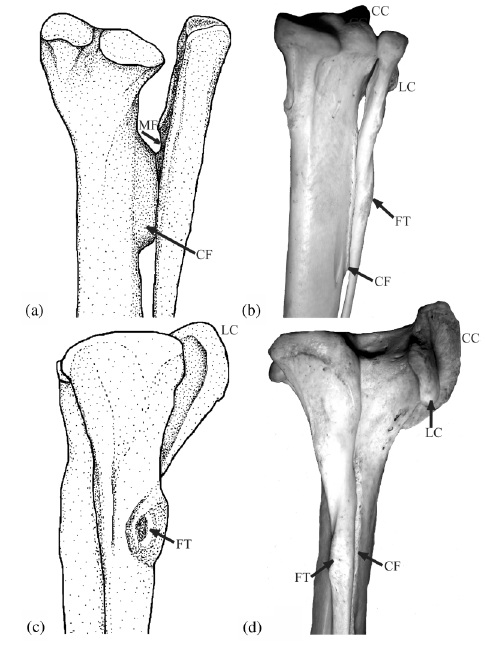
The above image comes from one of my old, somewhat obscure anatomy papers (link to pdf here), from 2003. It’s possibly the first figure I made, entirely by myself, that I’m sort of proud of. It doesn’t totally suck compared with some of my other attempts. I did the stippled line drawing on the left, and on the right is one of my first usages of a digital photo in a paper (digital cameras were finally up to the task around that time; I used my new Nikon Coolpix 900, if memory serves). It was a greatly improved figure over what I’d submitted for this paper originally, which was a rushed, half-baked manuscript for a SICB conference symposium on tendons. I’ll never forget one of the peer reviews of the manuscript, which said something like “the text of this paper is a joy to behold, but the figures are a horror.” They were right, and luckily the images in the paper I submitted changed a lot in revision. (I’m still embarrassed by the incident, though!)

Anyway, the picture is of  the lower hind limb of two theropod dinosaurs: (a,c) an adult Tyrannosaurus rex, and (b,d) a wild turkey (Meleagris) from my personal collections of dissected-then-skeletonized animals (this turkey became a biomechanical model in a 2004 paper of mine, too!).  In both cases we’re looking at a right hind limb; in (a) and (b) from a caudal/posterior/rear view, and in (c) and (d) from a lateral/side-on/profile view.

If you’re having trouble visualizing these bones in the real animal, check this T. rex skeleton in rear and side views and try to find these bones. You can do it! You might also want to look back at my paroxysmic outburst of love for knee joint anatomy.

The thicker long bone is the tibia (your main shank bone; or in a lamb shank, chicken drumstick, etc); the thinner outer bone is the fibula. Together with some smaller bones, for brevity we can call them the tibiotarsus — but only in theropod dinosaurs, or you will anger the freezer gods.

The labels show some cool anatomical features, as follows:

CC” the cranial cnemial crest of the tibia (a projection of bone unique to the knees of birds);

CF” the crista fibularis; or fibular crest; of the tibia (more about this below);

FT” the fibular tubercle (insertion of the big hamstring/biceps muscle M. iliofibularis);

LC” the lateral cnemial crest of the tibia (a big arching swath of bone that both birds and non-avian theropods like Tyrannosaurus have; the CC is just pasted on top of this in birds); and

MF” which denotes a muscle fossa (depression) on the inner surface of the upper end of the fibula, which presumably housed a muscle (M. popliteus) binding the fibula to the tibia in earlier dinosaurs, but is vestigial in birds.

The CF, or fibular crest, is a feature that only theropod dinosaurs, among reptiles, develop like this. It evolved early in their history and thus was passed on to birds with other ancient features like hollow bones and bipedalism. It binds the fibula closely appressed to the tibia, making those bones act more like a single functional unit –and sometimes they even fuse together. The CF also transmits forces from the whopping big M. iliofibularis muscle’s insertion (the FT label) across the puny fibula onto the robust tibia. The MF once held a muscle that also helped keep those two bones together, but additionally it could have contracted to move them relative to each other a little bit, as in other living animals (many mammals and reptiles have a big M. popliteus and/or M. interosse[o]us). So these features all have a common functional, anatomical and evolutionary (and developmental; different story for evo-devo fans) relationship. By binding the fibula and tibia together, these structures helped early bipeds (the first theropods and kin) support themselves on one leg at a time during standing and moving, and also helped begin to reduce the limbs to lighten them for easier, faster swinging. So we can think of these features as specializations that helped theropod dinosaurs, and ultimately birds, get established as bipedal animals.

The CC and LC have a similar story to tell; for one, they are muscle attachments, again mainly for thigh muscles. And again, the LC dates back to early theropods (and some other dinosaurs had a version of it; usually smaller). These crests serve mainly as insertions for the “quadriceps” (in human/mammal terms) or triceps (in reptile/bird terms) muscle group’s major tendon, spanning from the pelvis/femur across the thigh and knee to this region. In birds, we call this structure of insertion the patellar tendon or (less appropriately) ligament. But dinosaurs had no patella, ever, so the triceps femoris tendon would be the proper technical term. Regardless, that crest (LC, and later LC too) helped the attached muscles to straighten the knee joint or support body weight during standing/moving, by giving them better leverage. So it would have been important for early bipeds, too, like the CF, MF and other features above. Your cnemial crest (tibial tuberosity) is pathetic by comparison. Don’t even look at it. Droop your knees in primate shame!

Bumps and squiggles on bones might seem puny details just for anatomists to study and describe in long, tedious monographs, but each is part of the great story of evolution, and each has a story to tell that fits into that story. Back in Darwin’s day, some of the world’s greatest scientists of the age (Richard Owen and Thomas Huxley being but two spectacular examples) pored over these seemingly innocuous features, and so they became part of nascent evolutionary theory even then. This week, I’ll be celebrating a lot of those details, which I still feel are important today, and the stories they help to tell.

Happy Freezermas! Sing it: “On the first day of Freezermas, this blo-og gave to me: a tibiotarsus with a CF and FT!”

Read Full Post »

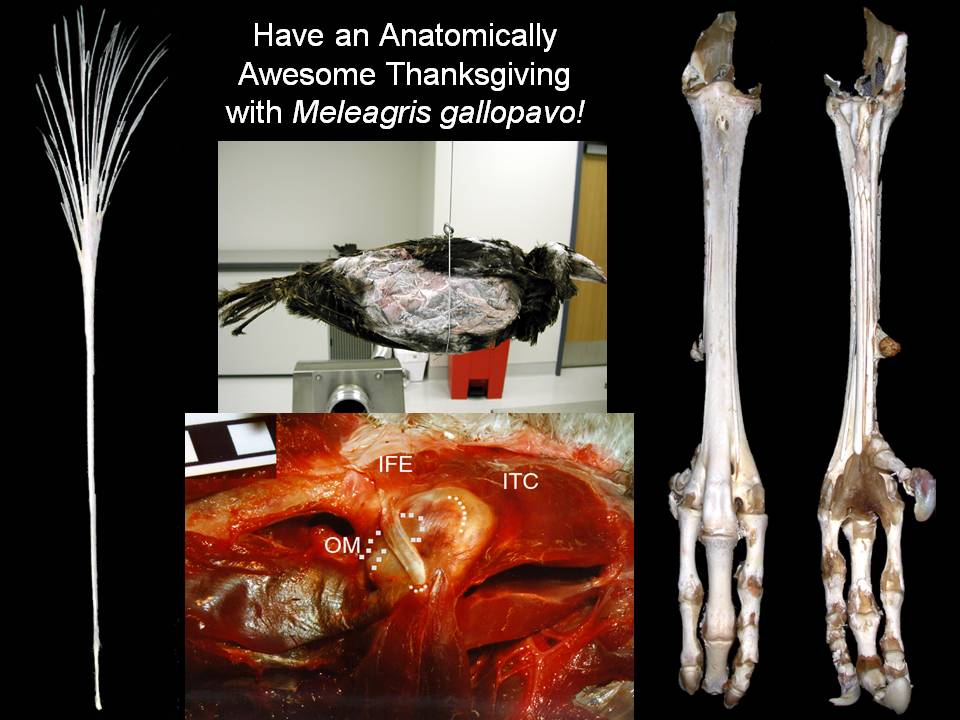
Hey, Americans and others happening to be gobbling down Meleagris gallopavo today– don’t forget to practice your anatomy! Such a great opportunity. Dig in to that carcass and horrify/amaze your family and friends! This pic might help you get started (info below if you want it), and is my WIJF blog wish of happiness to you all, today.

Stomach-Churning Rating: 6 out of 10; a small picture of some fresh turkey leg muscles, but not that bad really.

Click to embiggen.

Wondering what’s shown here?

On the left: an ossified (turned into bone!) tendon, probably part of the M. flexor perforans et perforatus group (a wickedly complex set of muscles that go from the knee region to the toes, and act mainly to flex the knee, extend the ankle and (plantar)flex the toes; i.e curl the toes up). What’s particularly cool is that, towards the top, you can see the divisions where the pennate (angled) fibers of the short, meaty muscle belly sat. If you are eating a turkey drumstick, you will be picking some of these out of the meat, although many turkeys seem to have fewer bony tendons due to human breeding and young age at slaughter.

In the middle, top: a crude experiment where we hung a frozen turkey’s body in a few different orientations to determine its centre of mass, important for biomechanical calculations. Mad science, but simple science.

In the middle, bottom: the right hip joint of a turkey in lateral (side) view, showing a few of the key muscles of the thigh. The ITC is M. (abbreviated Latin for Musculus) iliotrochantericus caudalis. Practice saying that (ill-ee-oh-tro-kan-tare-ick-us caw-dahl-iss) to impress your friends. It sits in a depression in the ilium (top pelvic bone), in front of the hip joint. The ITC is also important for helping birds to support their weight, as Steve Gatesy and I discussed in our 2000 Paleobiology paper. The ITC leaves a lovely crescent-shaped scar on the top of the femur (thigh bone). Show off your culinary skills by noting to your dinner party that this muscle is the best bit of the bird, AKA the “oyster”. (A little tip is here for how to find it; in a chicken but the anatomy is almost the same in a turkey)

The OM is the obturatorius medialis (obb-turr-ahh-tor-ee-us mee-dee-ahl-iss), an antagonist to the ITC, used to swing the leg. It is mostly hidden inside the pelvis so you just see its tendon (dotted line), and especially in turkeys (seriously, they have very nicely visible muscle attachments on their leg bones, for any bird!), a little knobby bit of bone that helps guide the tendon to keep it in its little groove on the femur. Unless you’re very industrious and break open the body cavity to excavate into the pelvis, you won’t be eating this muscle.

The IFE; M. iliofemoralis externus (ill-ee-oh-fem-oh-rahl-iss ex-ter-nuss); arching over the ITC and OM tendons, is a vestigial muscle, often lost in birds, and having little major function but helping a bit to draw the leg away from the body (abduction). Even though it is a puny muscle, it still has a nice little pit for its insertion on the femur. Turkeys are just cool that way. But it’s not much in the way of eating.

And now you know three of the ~40 main muscles of the avian leg, well done! 

I love these muscles not only because I did a lot of my PhD (and later) research on them, but also because they leave great scars on bird and other dinosaurian bones that allow us to reconstruct how muscles evolved. I better stop here or I’ll be writing for days… don’t wind me up further! 🙂

On the right: the foot of a turkey in front and back views. Lots of ossified tendons are visible if you squint. Why do birds only have ossified tendons below their knee joints, and why only some muscles in some birds, and not so commonly in most other species of land animals? This is one of those cool mysteries that remain for people doing evolutionary or biomechanics research to sort out.

Hope you enjoyed a quick anatomy tour with our pal Meleagris!

Read Full Post »

Like other birds, ostriches are fluffy. Too fluffy for some anatomists– so fluffy, it’s hard imagining or estimating what they look like beneath all the feathers. A few years ago, we received an ostrich from a UK farmer. The male bird had been killed by a kick to the neck from another rival, and at the time was supposedly “Britain’s largest ostrich.” As the feathers were valuable to him, the farmer delivered the animal to us whole but plucked. I wanted to dissect it mainly to refresh my memory on ostrich anatomy while developing a biomechanical model of their limbs (see below). Taphonomy expert Jason Moore then buried it for his studies of how bodies decompose.

[Side note: ostriches and other ratites (flightless birds, members of the palaeognath group, whose evolution remains fascinatingly complex) are often brought up as uniquely dinosaur-like. That’s rather misleading; all birds are living dinosaurs, so all birds are descended from an ancestor that was equally ‘dinosaur-like’. What we see of them today is a snapshot that is biased by their recent evolutionary history. During their apparently multiple losses of flight, ratite birds increased in body size and “re-evolved” (or simply enhanced) some traits that were more marked in extinct dinosaurs than in the most recent common ancestor of living birds. Some of those more ‘primitive’ traits may be due to flightlessness, some due to large size, some due to their extreme running specializations; science hasn’t sorted all that out just yet. But the point is, ostriches and other ratites are far from the ancestral form that all birds sprung from, which was probably more like a small, flying tinamou-like animal. Their similarities are due to convergent evolution. And they’re still quite different from something like an “ostrich-mimic” dinosaur- which is a sad misnomer because it’s more that ostriches mimicked (in a naughty teleological sense) ostrich-mimic dinosaurs like Struthiomimus than the other way around; the ornithomimosaurs did it first (Huzzah!). Ratites have just gone back, in some ways but not others (e.g. no long tail or large arms) to a superficially more primitive body form. There have been some wacky ideas to the contrary before, such as the idea that ratites evolved entirely separately from other living birds from different dinosaur stock, but they’re so discredited now by multiple lines of evidence that I won’t glorify them by spending time discussing each. This tangent has gone on too long and must die.]

Anyway, back to the plucked ostrich in question. My first look at it really stunned me. It was a powerful example of just how ‘dinosaurian’ most of the anatomy of living birds is, for reasons noted above. I’d never seen a naked ostrich and now I’ll never look at them the same again. Maybe you won’t, either…

First, some images of the animal once it was brought into our dissection room (which you might recognize from the great Inside Nature’s Giants documentary).

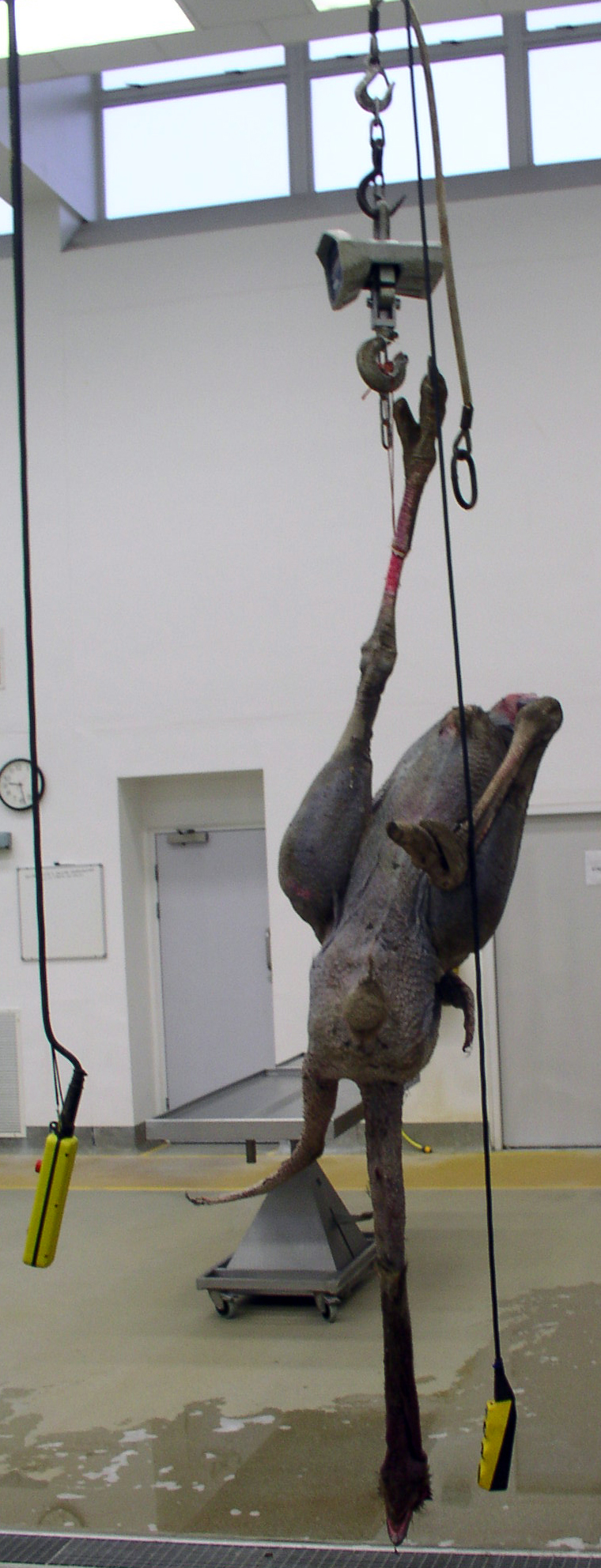
The device near the top of the screen is a digital scale; we were weighing the bird before we cut in…

Close-up view of the hugely muscular legs (each leg is around 25% of the animal’s body weight, and mostly muscle; about 50% more bulky than our legs), and the arms (shown more below).

129 kg weight sans feathers; not bad! That’s about 284 pounds for those folks still mired in the medieval Imperial system of units. 🙂

The swollen, bloody region just below the head (on the left above) is where the mortal blow struck. Ouch!

I love the hands of ratite birds. Yes, those are little claws attached to the three vestigial fingers (thumb/first finger at top, long middle finger, and tiny third finger bound to it). Darren Naish covered some of this in a previous post, and let’s not forget SV-POW’s excellent series of “things to make and do” involving various critters including ostriches.

Ostriches and I go way back. Here I am from my less bald immature postdoctoral days at Stanford University in 2002, dissecting a smaller (female, 65kg) ostrich for some biomechanical modelling (still mostly unpublished; aaargh!).

And yes, I had a third hand back then; later lost during a tragic dissection incident involving a battleaxe and a bottle of tequila. I don’t want to talk about that.

Ostrich packed for transport. Just barely fit in the trunk of my little 1993 Toyota Tercel (R.I.P.)!

Once we complete dissections. we put everything together in some fancy biomechanical computer models (a subject of a future post), resulting in a nice, 3D,  poseable, anatomically-realistic model of the entire limb musculature, shown above. This is a right hindlimb in side view, with the individual muscle paths abstracted as red lines. More about this when it is finally published…

This is just a teaser showing off some of the cool external anatomy of ostriches-in-the-buff, and what we’ve done with the anatomical data we’ve gathered. I’ll do a post later showing what’s inside, which is also pretty amazing. Hope you enjoyed it!

Read Full Post »

I’m off soon for a sunny break on the beaches of Morocco, but as an Easter gift to you, my (admirable, sagely, few, beautiful) readers, here is an image of two specimens, formerly from my freezers, to consider:

Image

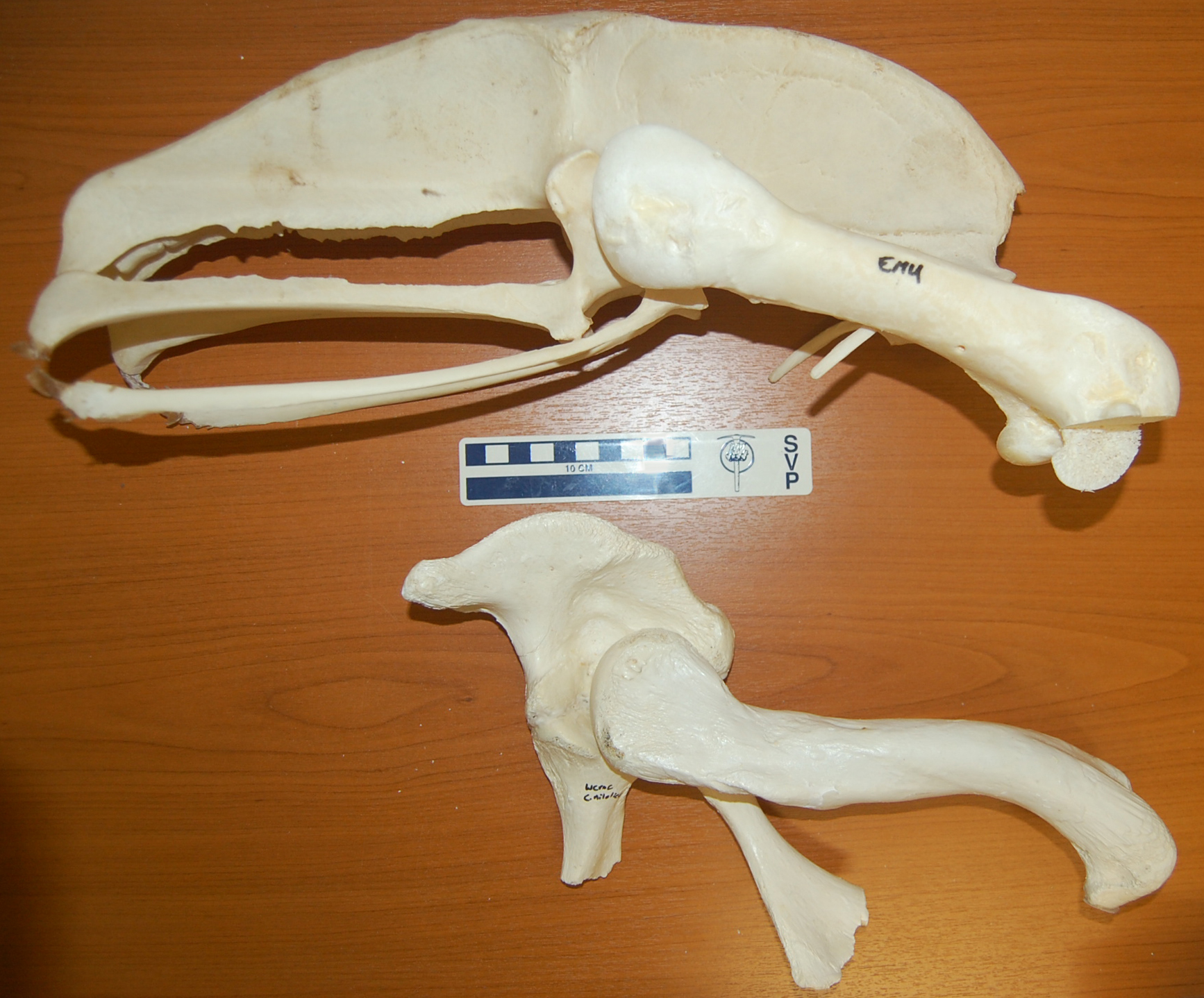
Both are the right pelvis (hip bones; crocodile pelvis is a bit broken toward the bottom) and femur (thigh bones) of living archosaurs– a 27kg emu above, and a 278kg nile crocodile below. The head would be toward the right side of the picture. A tenfold difference in mass between the bird and the crocodile, and yet some of the dimensions are so similar in both of them (femur length etc.), or so vastly different in the bipedal runner vs. the quadrupedal not-so-fast-runner (much bigger pelvis for leg muscle attachments in the former).

This image says it all. It is why I study the evolution of locomotion in land animals. It is why I am so fascinated by the transition from vaguely crocodile-like early archosaurs to modern birds by way of earlier dinosaurs. Anatomy, size, mechanics, behaviour, phylogeny… the photo captures all the facets of why I am so enraptured by research in this field.

It also might evoke thoughts of what features are expected in a terrestrial vs. aquatic animal, and thoughts of how some numbskulls still think big dinosaurs lived in the water (no I will not link to the execrable story from BBC today that I am thinking of!)…

I hope you appreciate it, too. Have a freezer-burn-free holiday period, folks!

Read Full Post »

Birds and crocodiles are part of the spectacularly diverse group of animals called the Archosauria, or archosaurs if you’re on casual terms with them. Other (extinct) archosaurs include the dinosaurs (non-avian), pterosaurs, and sundry wondrous other beasts like aetosaurs and phytosaurs. Archosaurs have, and presumably their common ancestor had, many specialized features of their anatomy that are related to metabolism and locomotion. That’s a big reason why, as a scientist, I love them.

Yet the bird lineage evolved its own extreme specializations, whereas in some (but not all!) ways crocodilians stayed closer to the ancestral state. Here is a great example of one of the major categories of differences between living crocs and birds: the proportions of the respiratory system, from freezer specimens I’ve CT scanned with my former PhD student Vivian Allen, which were part of a paper we published in Anatomical Record back in 2009. We scanned the thawed specimens with and without the lungs inflated (croc results not shown for inflated state). This was easy; we just stuck a syringe into the windpipe and then tied it off once we had pressurized the lungs. [I’m now working with Colleen Farmer and Emma Schachner on using these specimens to learn more about the surprisingly “bird-like” features of croc lungs despite the smaller total volume of the airways; more about that another day… we can do MUCH better than these images!]

Here, the airways are coloured blue/purple and the flesh has been made transparent yellow, while the skeleton is orange. The relatively massive size of the airways is evident in birds, especially the air sacs (side pockets of the lungs/other air passages), whether they are relaxed or inflated. The lungs (purple) aren’t that differently sized in the two animals.

Australian Freshwater crocodile from CT scan:

Junglefowl (“ancestral wild chicken”) from CT scan; relaxed airways:

Junglefowl from CT scan; inflated airways:

(note that the light blue region is the expanded air sacs; the lung in purple hardly changes because it is fairly rigid in birds)

Read Full Post »

« Newer Posts