Feeds:
Posts
Comments

Posts Tagged ‘dem bones’

Last time I gave a quick overview of the museum and anatomy’s long history at the RVC. I’ll cover some of the cool skulls we have on display first, then in future posts the dissected specimens, then some of the neat birds and other exotic animals, and I’ll return to bones with a general overview of rockin’ skeletons at the end. Or something like that order. I am a fickle beast and might do otherwise. On with the show then!

So, skulls… I dread talking about skulls. As people on my research team know, I have at least one Cardinal Rule: I don’t work on skulls or heads. Except maybe skulls of Cardinals? Skull anatomy is too complex for my feeble old mind to grasp, and there are too many people working on them that are really great scientists, so I feel I have little to contribute to that area. But I do appreciate them, even if with a glazed look of apprehension and lack of comprehension. 🙂

It may not surprise you to learn that we have dog skulls in our vet anatomy museum, but you might be impressed by the selection! We have a case full of a diverse set of domestic breeds and non-domestic species (fox, wolf, etc.) of canids, shown above. There is bound to be a good research project in there somewhere- the plasticity of dog skeletons under humans’ artificial selection has done some amazing, and disturbing, stuff, especially to skulls and heads!

But I’m a cat lover and, lest the felids get jealous and enact their final vengeance upon us all, let me move quickly to our felid skull collection:
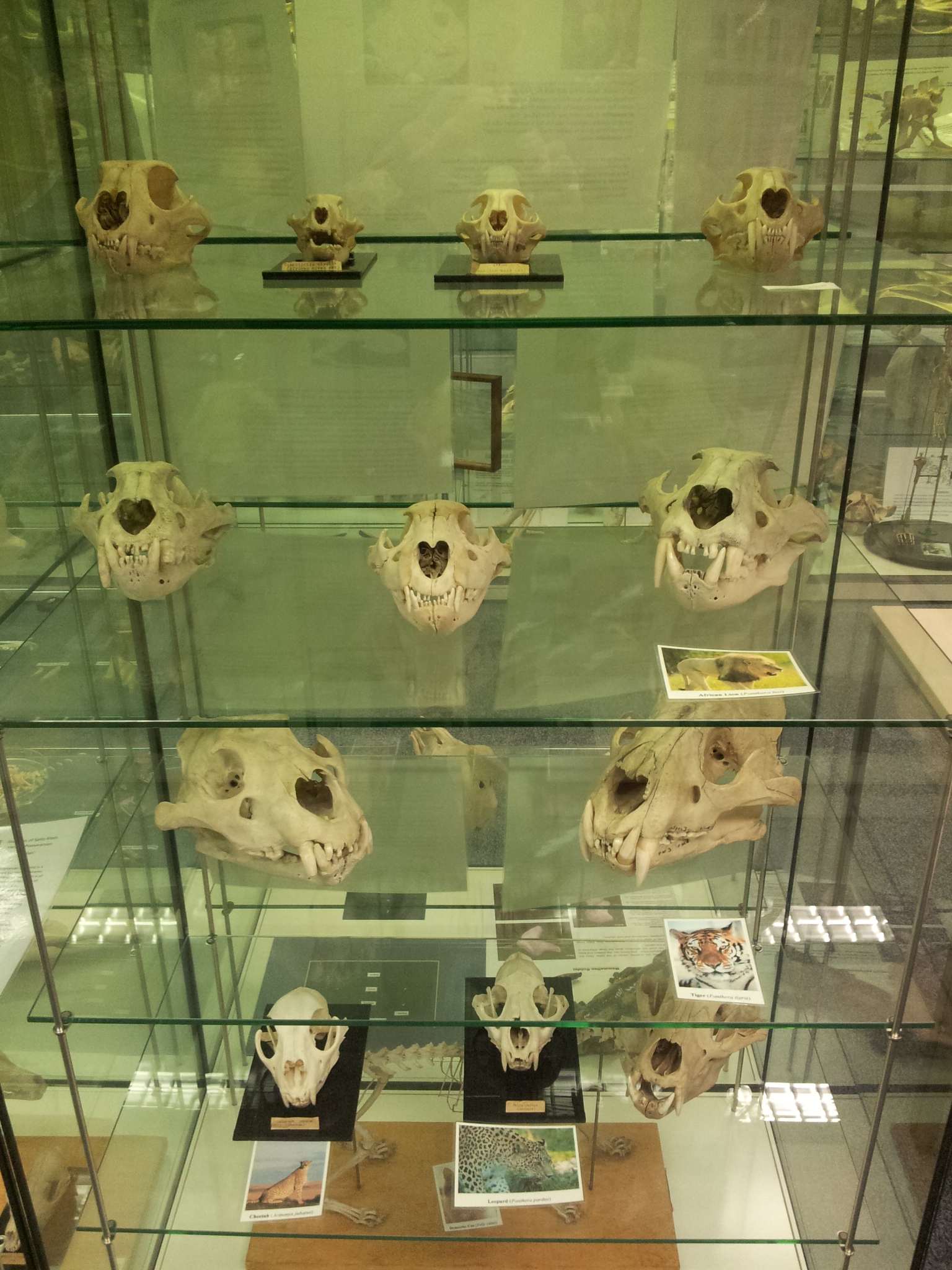
Yep, not just domestic cats but a nice assortment of lions, tigers and other hypercarnivorous predators! Many from local zoos, especially London Zoo over the past centuries/decades.

Not to be outdone, the ungulates are braying for predationattention, so let’s give them some love:
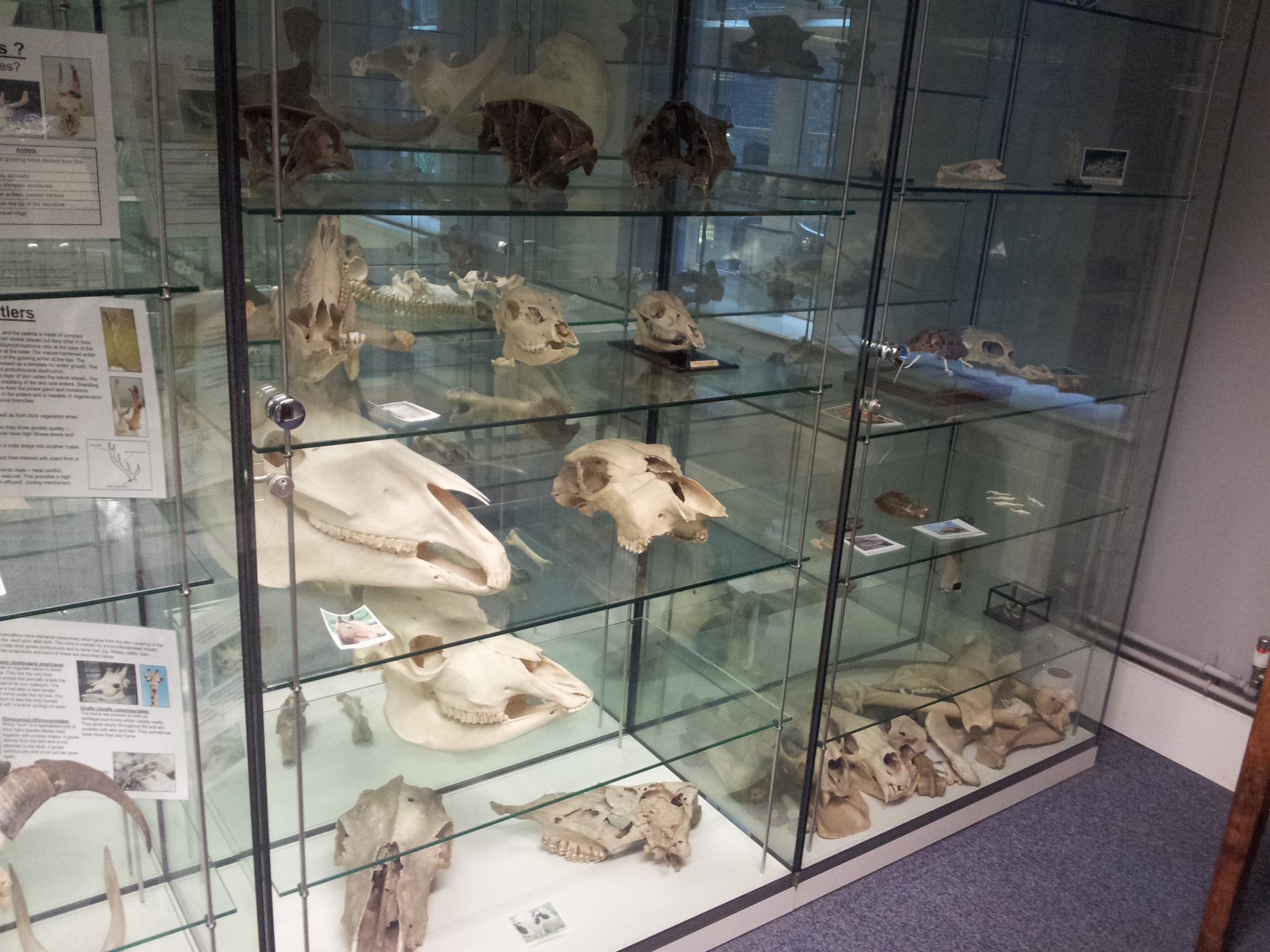
With some requisite horses thrown in but also quite a few exotic species! And right next to them is another case full of coneheads:
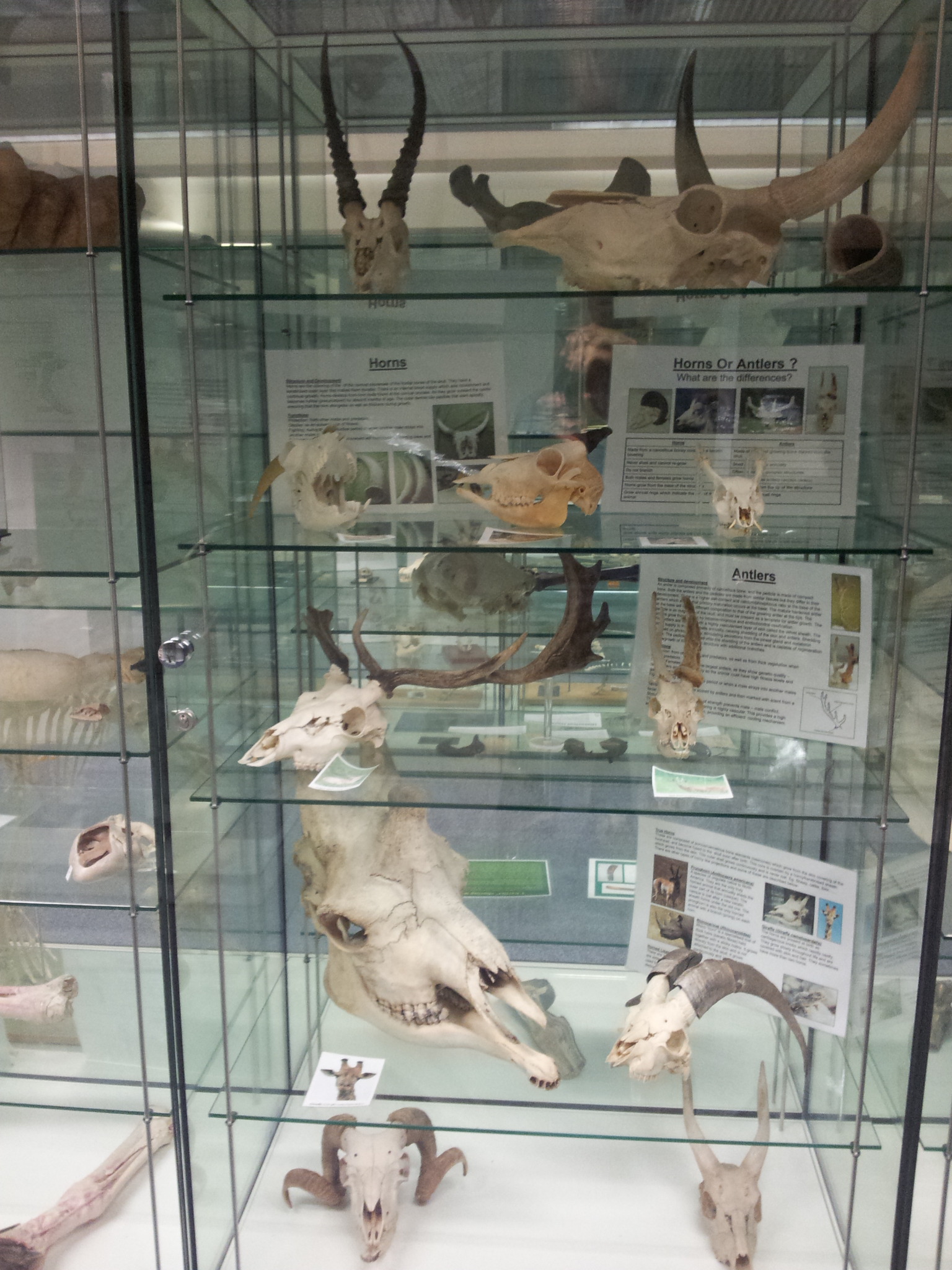
With one prominent member that definitely deserves a closeup, since giraffes are what got this blog started, and this is a lovely old ?male? specimen with honking big ossicones:

Don’t worry old bean, your artiodactyl chum the hippo is keeping you company, pip pip!
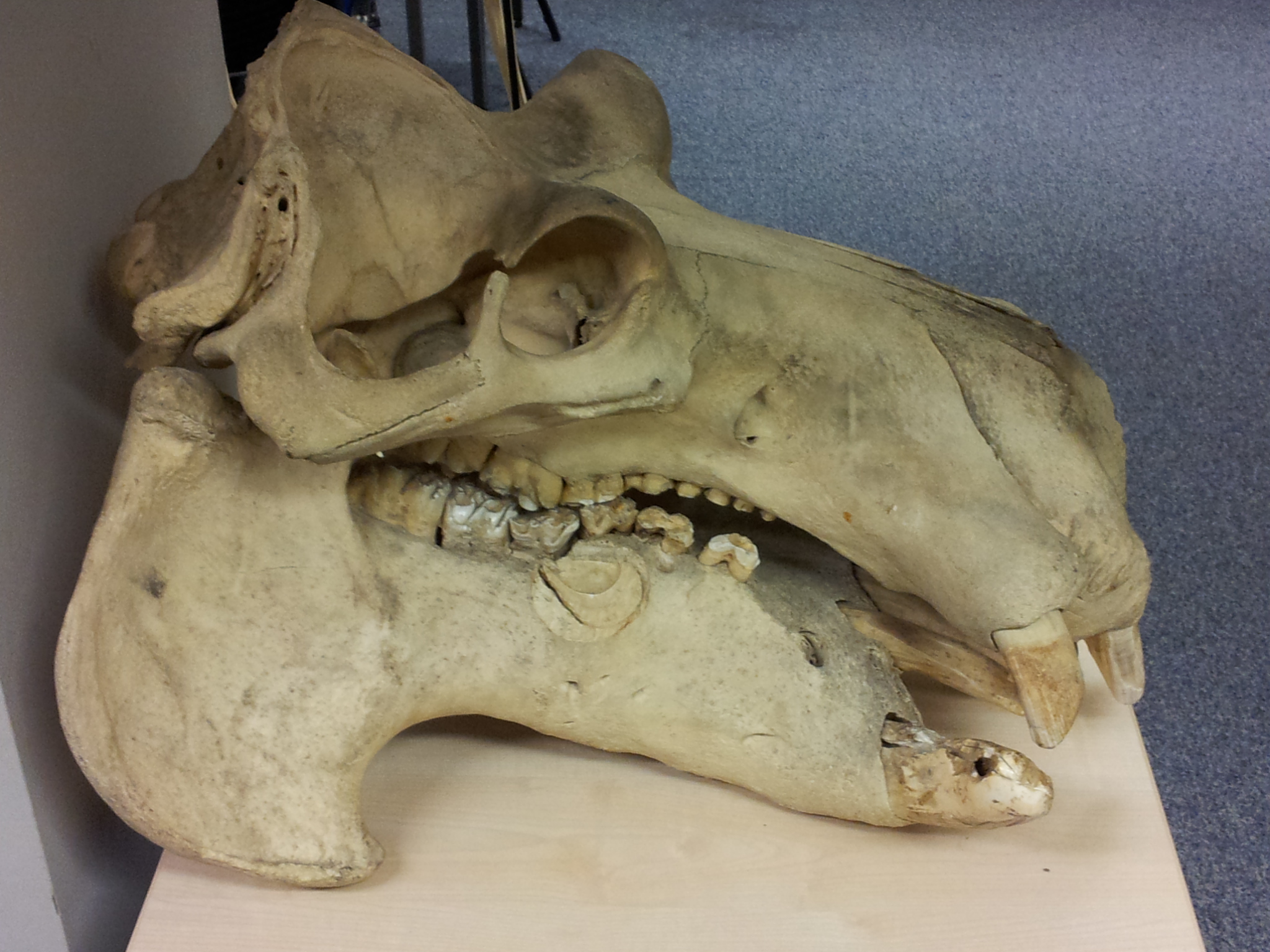
Look closely at the right side of the mandible (lower jaw) of that hippo and observe the lumpy bit in the middle of the jaw, which would be inside the cheek in life. That is apparently (I am no skull pathologist by any stretch) an impacted or otherwise severely wonky tooth, and it shows some signs of having been operated on, presumably to keep it from puncturing the cheek or getting infected. Ouch! (For comparison see this more normal, more toothsome skull) It is unilateral (just right side) so I presume this is a sound, if rough, diagnosis. Anyway, stunning skull nonetheless!

Stunning as that may be, archosaurs aren’t going to take this skull-off lying down! Here is one of our crocodylian species; an American Alligator (I think, but I know if I am wrong one of my readers will steer me to an alternative ID, presumably a common caiman, which I know we also have, along with a Tomistoma), with a turtle and python cowering behind it:

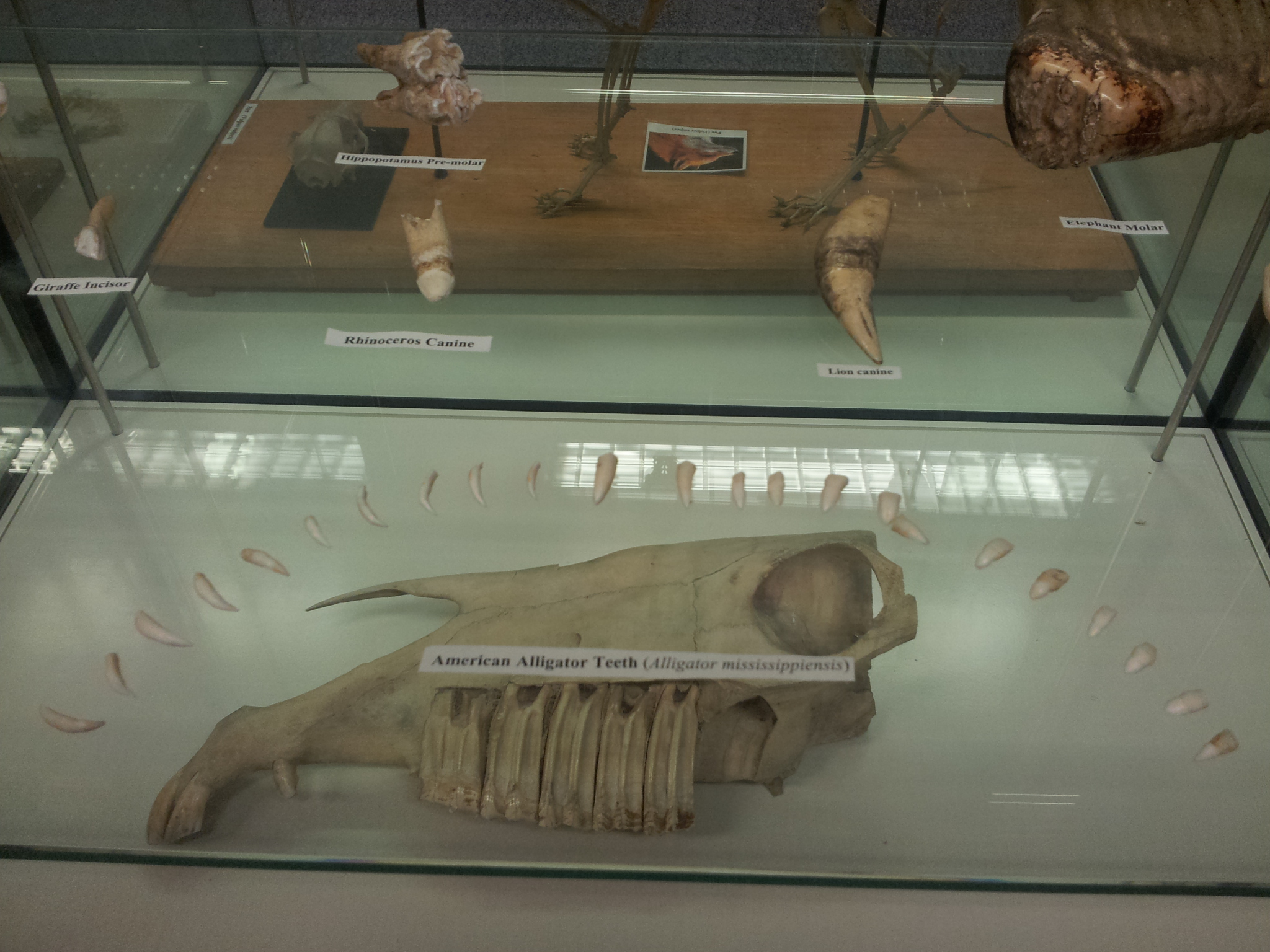
Indeed, some Alligator teeth,  with a horse jaw on display, make a lovely halo-like effect when viewed from a certain angle, in a set of shelves devoted to the diversity of tooth forms and functions:
But let’s get real, folks. Fish (OK systematists, non-tetrapod vertebrate) skulls could be said to blow away the diversity of tetrapod skulls. Or at least that’s what the wolffish is trying to tell us, from his vantage point in a display about jaws and ears (more evolutionary context, yay!):

And because I am not one to argue with a wolffish, I will let him have the last word. Hope you enjoyed another quick tour! I’ve only scratched the surface of our selection of skulls; there are plenty more good ones, so come visit sometime!

Read Full Post »

Welcome to the first of a series of image galleries with highlights from the RVC‘s Anatomy Museum! Our veterinary school dates back to the 1789 epic dissection of the unbeaten racehorse Eclipse by surgeon Mr Charles Vial de Saint Bels, which led to the college’s founding in 1791 (incidentally, the RVC retains Eclipse’s skeleton to this day, and 80% of living racehorses come from Eclipse’s lineage!).

What, you didn’t know we have an anatomy museum? Well this is another of London’s many hidden museum treasures. It is based at our Camden campus, just a 10min jaunt from King’s Cross or St Pancras stations (or Mornington Crescent tube), in the colourful Camden Town neighborhood. It doesn’t have its own website, yet, and my posts are not intended to play that role, but I want to informally and unofficially celebrate its glory because I think we have a great museum full of wonderful features and people deserve to see them.

For example, when I first interviewed for (what became) my job at the RVC in 2003, one of the first sights at the Camden campus was the original, classic ~Victorian style (dark and gloomy, stained wooden cabinets, room chock full of skeletons) anatomy museum which presented the entrant with a lovely view of this:

Which sadly is my only photo of the skeleton of an Asian elephant that shows it in its original position, crowded next to the skeletons of a white rhino, common hippo, horse and other animals. If you know me and my penchant for giant critters, that was like being shown the Promised Land! Since then, modernity has required us to clear out the dusty Victorian room and rehouse the specimens in more airy, spacious surroundings. Which has worked out pretty well in our case, I think. Here is the elephant now, in the midst of our cafe next to our Anatomy Museum (sadly, the rhino and hippo are mostly now tucked away in storage, and no, there is no rhino horn here for people to steal. Sheesh!):

Much easier to walk around, drink coffee with, etc., and it has gained a second skull (with the skull of a baby also on display nearby). So you might immediately be able to see why I like our museum– any museum with a mounted elephant skeleton rocks, in my opinion. But also, I’m gradually cleaning up my freezer specimens, building a little museum of “my” own that will eventually become an official part of the RVC museum’s collection, so there is a connection to this blog too.

Anyway, here is what a visitor gets as a first impression upon entering our museum:

Namely, a horse who is less famous than Eclipse but still no slouch in his day, Foxhunter the show jumping horse, who won Britain its only gold medal at the Olympics 70 years ago (nice timing)! Then, looking around the museum, you will see:

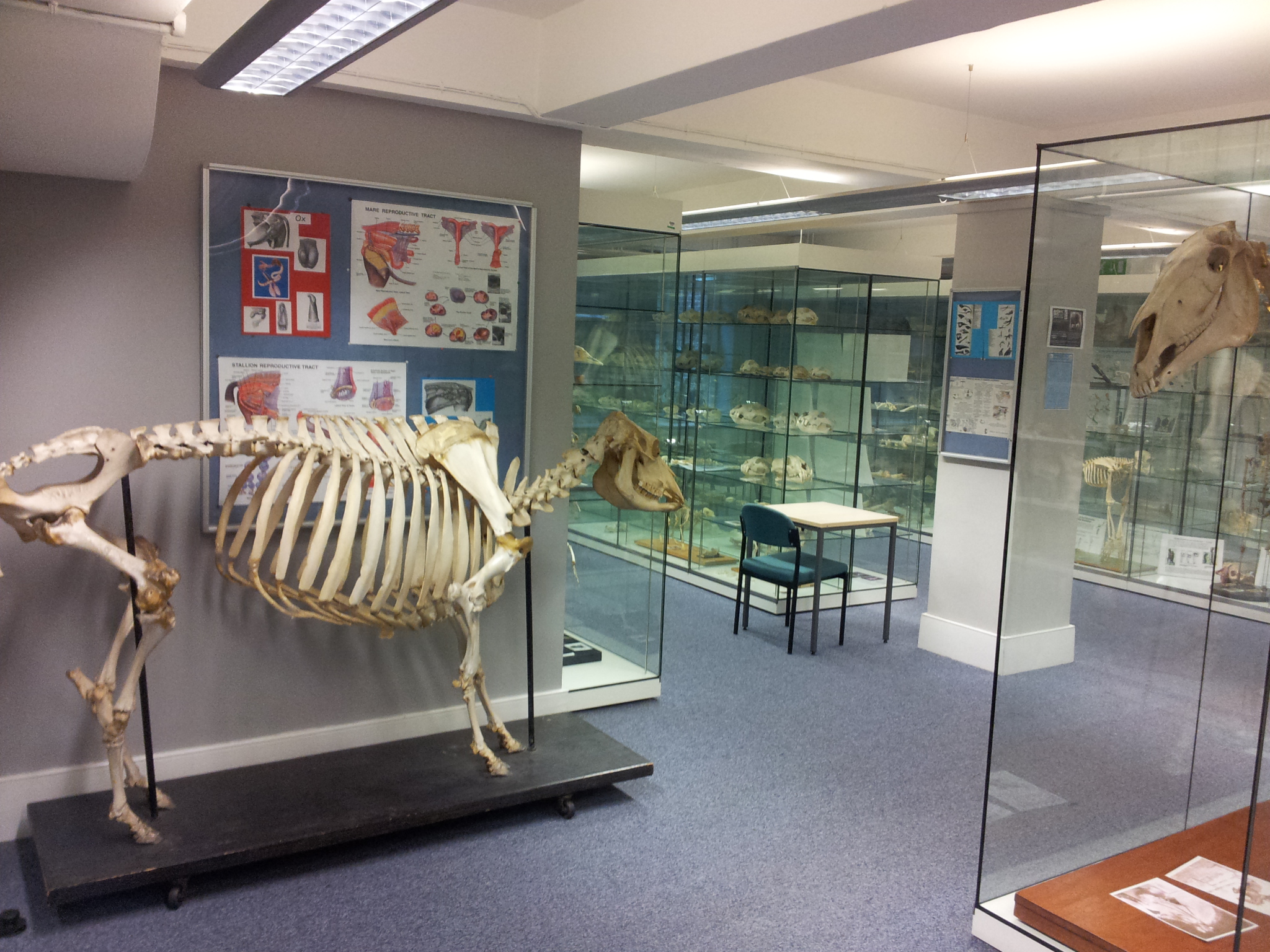
A cow skeleton to your left, which is no shock at a vet school, but then look more closely, to the right:

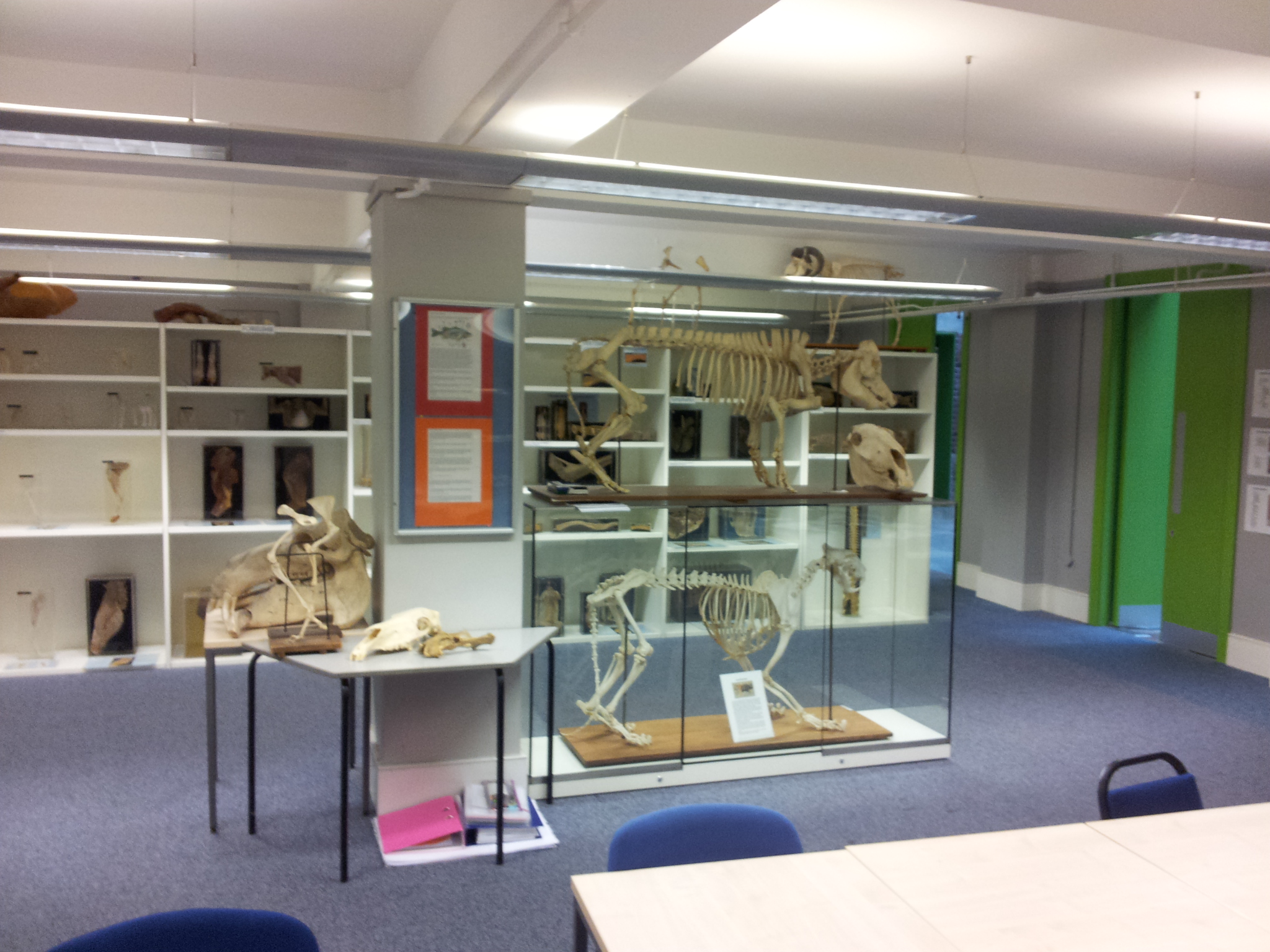
A nice tiger skeleton is mounted there, with a pig skeleton atop it, and a hippo skull hanging out nearby (closer view of that in a later post). Through the green doors to the right is our lovely cafe, with the elephant and a few more specimens including a splendid mount of a sitting polar bear (to be shown later). And then, meandering around back to the left through the museum hall you will find:

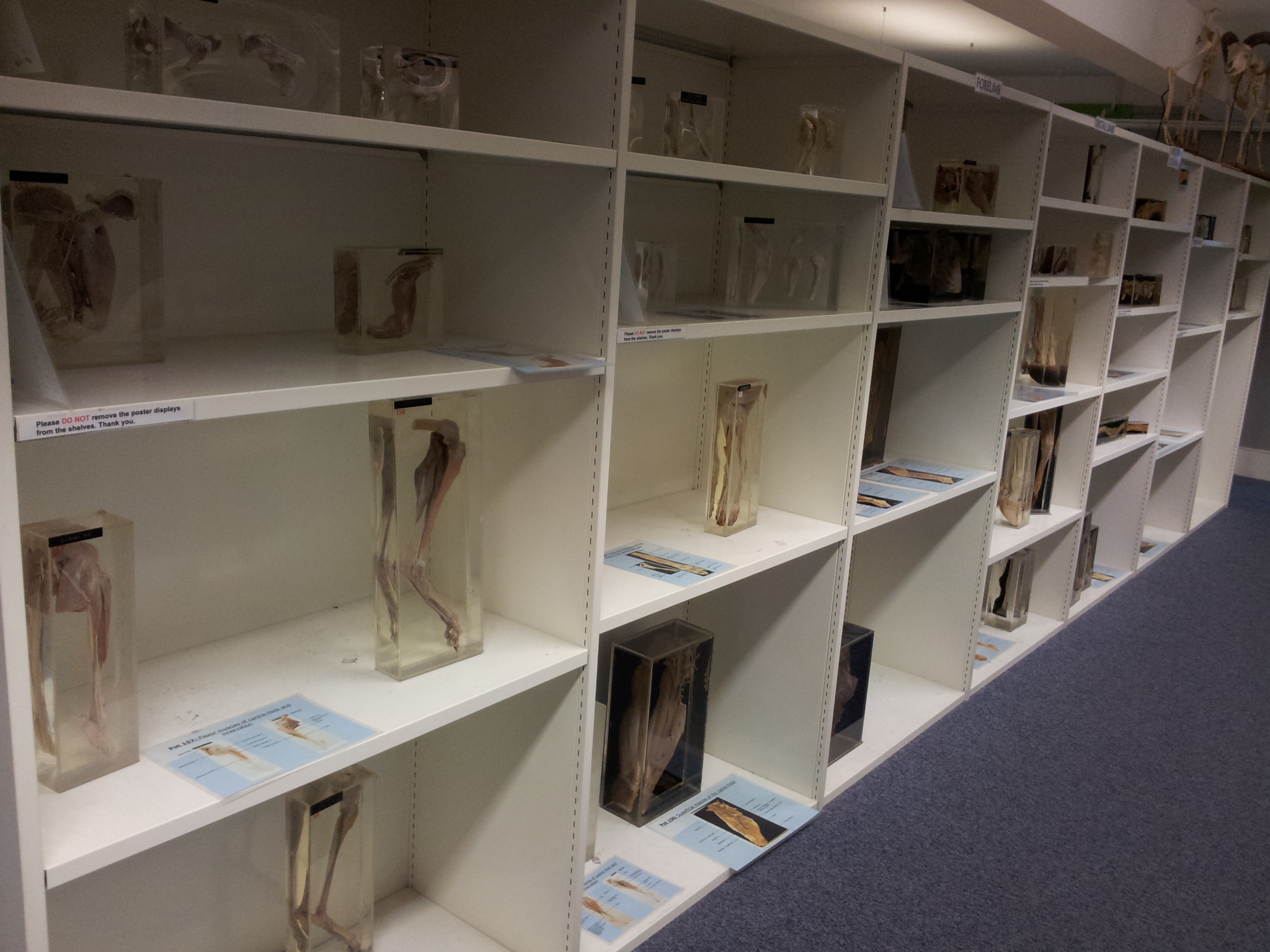
A nice replica chimp skeleton next to a cast of “Lucy”, the famed Australopithecus early hominin! So there’s some decent evolutionary context in the exhibit, too; not just your standard domestic critters with little broader conceptual unification. But I think some of the museum’s greatest treasures  are the preserved specimens of lovingly dissected animal anatomy demonstrations, such as toward the back of the room:

These were done over past decades, many winning awards for the skill displayed in making them, and it is sad that this skill is becoming more and more rare, with shifts toward less hands-on, more computerized education and training. At least BodyWorlds and Animal Inside Out bucks this trend! It’s fortunate we have museums to show off the skill of preparators and dissectors so the beauty of such specimens can continue to be appreciated. I’ll show some closeups later.

There are plenty of surprises in the RVC’s Anatomy Museum, so if you get a chance and expect to be near our Camden Campus, come take a look sometime. Casual, unheralded visitors are not normally welcome, as the museum is more of an in-house educational resource than a public one. But I am told that scientists could easily get entry to study specimens on prior request, and with plenty of advance notice other members of the general public probably could, too. Mr Andrew Crook (recently awarded an MBE for his efforts using our museum and other facilities to educate local students) is the main contact person but please don’t swamp him with requests. It would be best to contact me first for advice and contact details.

So there’s a little introduction to our Anatomy Museum, and coming posts will show you more of the cool specimens within– stay tuned!

I’ll have our friend the ostrich skull show you the way out–

Read Full Post »

« Newer Posts