This is a rant, but stick with me and this rant might have a silver lining toward the end, or at least a voice of reason within the roiling cloud of bitter blog-scowling. And there are pictures of cats.

My little tiger, Karmella.
Like probably almost anyone in the 21st century that does research in a field of biology, I grew up watching nature documentaries on TV, and that influenced me to become a scientist. Doubtless it remains a powerful influence on other people, despite the massive de-science-ification of certain cable channels ostensibly, or at least potentially, dedicated to communicating science and nature (Animal Planet and History Channel, we’re looking at you).
But now I’ve seen behind the curtain. There’s still magic to behold there (e.g. working with early episodes of Inside Nature’s Giants), to be sure. However, some of my experiences have led me to become increasingly discontented with the relationship between TV documentaries and scientists.

Black leopard with glowing motion capture markers and eyes; eerie image from our past studies.
Here’s a common flow of events, and how they sometimes veer into frustration or worse:
Once a month or so, especially concentrated around this time (May-June-ish), I get a call or email from a documentary producer or researcher who is fishing for expert advice as they build a proposal for a documentary. I’m always very happy to talk with them and direct them to the best researchers to speak to, or papers to read, or to aspects of my own work that fit in with their idea for a documentary. Sometimes their idea is a bad one and I’m not afraid to tell them that and try to steer them toward a better idea; on occasion that seems to work, but more often they have their plan already and are reluctant to deviate from it.
About 3/4 of the time, I either never again hear from these nascent documentaries or else hear back maybe one more time (even to meet for coffee or give them a tour of our campus)– presumably, the proposal fails at that stage as it doesn’t excite executives. I’ve easily grown to accept this status quo after some initial disappointments. Much like in science, some ideas just don’t pass the muster of “peer review”, and documentary makers are operating under more of a market economy than science tends to be. Sifting is inevitable, and the time I spend helping people at this stage is quite minimal, plus it’s fun to see the sausage being made in its earliest stages. All fair so far…?
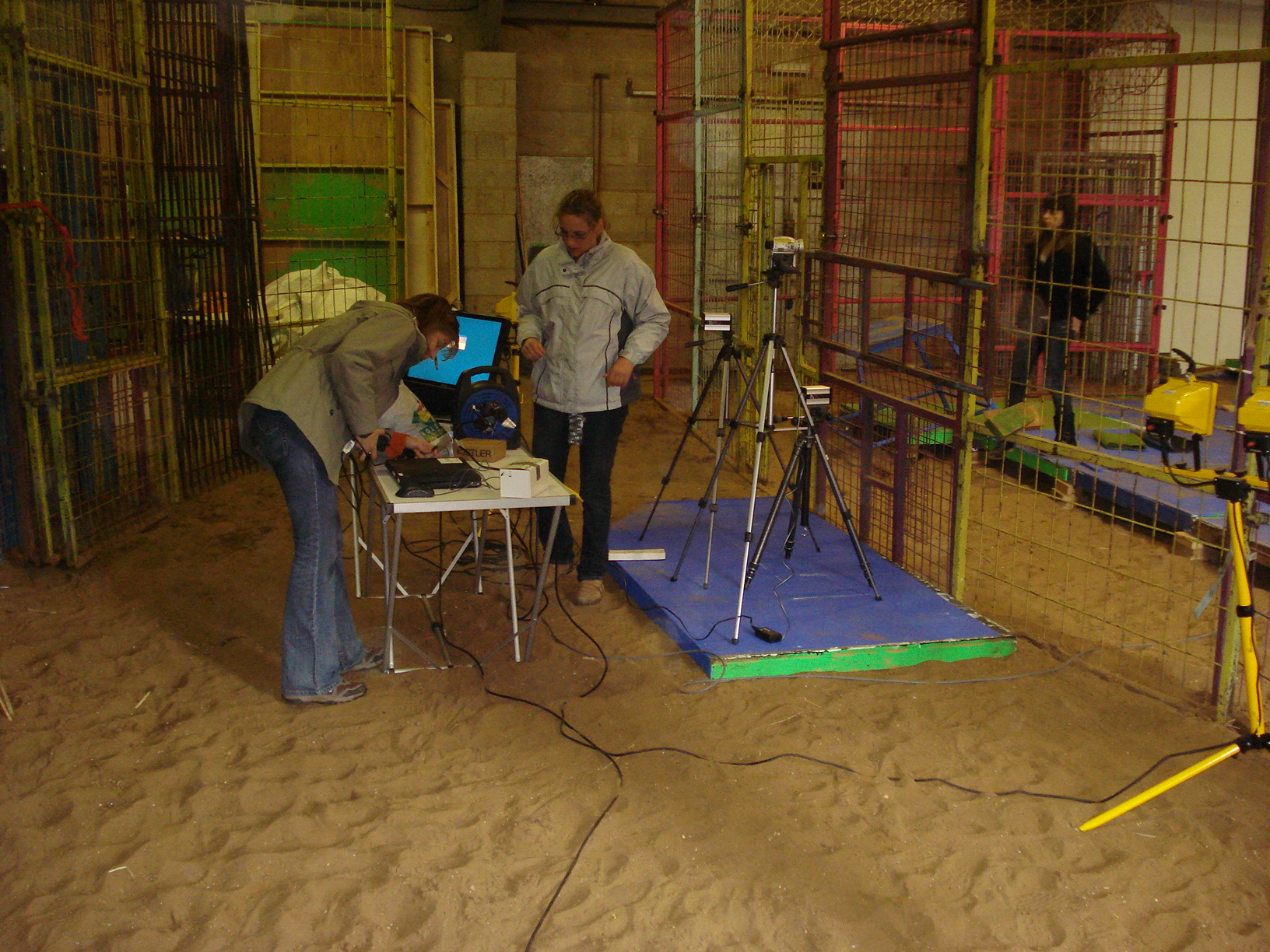
Alexis and technician setting up gear for one of our past studies of how cats move.
The frustration naturally ramps up the more one invests in helping documentaries through their gestation period. I’m sure it’s very frustrating and stressful for TV makers, too, to spend days or months on a project and then have the rug pulled out from under them by those on high. Hopefully they are getting paid for their time; all I can speak to is my experience. My experience is that all this early input I regularly provide is pro bono.
I used to mention that my time is not cheap, and I had a policy (after a few disappointments and lost time) that I should get paid around £100/hour for my time, even at the early consulting stage. That fee went straight into my research funds to help send grad students to conferences or buy small consumables; it was definitely worth my effort and felt very fair. Since the 2008 economic downturn, I’ve rapidly abandoned that policy, because it seems clear to me that documentary makers of late tend to be working on more austere budgets. I’m sympathetic to that, and the payoff for a documentary that gets made with my input is often quite substantial in terms of personal satisfaction, PR/science communication, happy university/grant funders, etc. On rare occasions, I still do get paid for my time (albeit essentially never by the BBC); Inside Nature’s Giants was generous in that regard, for example.

How the leopard got glowy spots: motion capture markers from our past studies.
But at some point a line needs to be drawn, where the helpful relationship between scientists and documentary makers veers from mutualism into parasitism, or just careless disregard. I’ve been featured in roughly eight different TV documentaries since 2004, but there were almost as many (six or so) other documentary spots that went beyond the proposal stage into actual filming (easily 8+ hours of time) and never aired; either being cancelled entirely or having my scenes cut. All too frequently, I don’t hear about this cutting/cancellation until very late and after my inquiries like “Any news about the air date for your programme?”
Several times I’ve heard nothing at all from a documentary after filming, only to watch the programme and reach the end credits to find no sign of me or my team’s research (in one embarrassing case that really soured my attitude, the RVC had broadcast to the college to watch the show to see me in action, and upon watching we found out I was cut. Ouch!). At that point I really do wonder, is it all worth it? Hours or days invested in calls, emails, paperwork, travel, arranging and replicating an experiment, repeating filmed scenes and lines, working to TV producers’ scripts and demanding timetables. All that is totally worth it if the show gets made. But if the odds are ~60/40 or so that I get cut, I think I have cause to do more than shrug. The people I’ve worked with on documentaries can be wonderfully kind and full of thanks and other approbations, and they often impress me with their enthusiasm for the programme and their very hard, tenacious work making it all happen. It is jarring, then, to find out “Oh, you’ve been cut from the show, I’m so very sorry, the executives made that decision and it was a bitter pill for us to swallow, believe me– take care and I hope we can work together again.”
Above: Performance art illustrating what it’s like to have your science filmed for a documentary, then cut; graciously acted out by a cat (R.I.P.).
My aggravation has resurfaced after filming with BBC Horizon’s new documentary on “The Secret Life of the Cat,” airing right now. Alan Wilson’s team, from our lab, is featured prominently there, so that is fantastic for the Structure & Motion Lab (also check out his purrfectly timed Nature paper on cheetah agility vs speed, also from this week!). It’s hopefully going to be a nifty show; I’ve seen some of the behind-the-scenes stuff develop. (EDIT: I’ve seen it now and it was pretty good in terms of imagery and showing off Alan’s team’s technology, but the science was pretty weakly portrayed– even laypeople I’ve spoken to said “Cats avoid each other… duh!” and the evolutionary storytelling didn’t convince me as much as I’d like; it came across as arm-waving, which is a shame if the two featured cat researchers actually have built a scientifically reasonable case for it. One could not tell if the “changes” in 1 village’s cats evidenced by 1 week’s observation were happening within a cat’s lifetime or were truly evolutionary and recent. I don’t think I’ll watch the 2nd segment.)
I was filmed for a segment which probably would have been in the 2nd part of the show airing on Friday night, but I found out last week that it got cut with a week left before airing. I will be watching the show anyway, of course. I’m not that bitter. The segment featuring my team’s research was about how cats of different sizes do not do what other land mammals do, which is to straighten their legs as size increases across evolutionary spans. This helps support their body weight more effectively, but I explained in the filming segment that in cats, the lack of a change of posture in size may have other benefits despite the cost in weight support: it can make them more stealthy, more agile/maneuverable (segue to the cheetah paper cited above!), or even better able to negotiate rough terrain. Hence a domestic cat is in a biomechanical sense in many ways much more like a tiger than it should be for a “typical mammal”– an athlete, specialized for the hunt. And smaller cats are relatively much more athletic than bigger ones because they don’t suffer from the reduced ability to support body weight that bigger cats do. This may be, for example, why cheetahs are not very large compared with tigers or lions; they are at a “happy medium” size for agility and speed. But this all got cut, I am told.

Random cat that sidled up to us during some research into cat movements; so meta!
For my would-be-part in the show, we recreated experiments that I did with then-postdoc Alexis Wiktorowicz Conroy and others (a paper yet to be published, but hopefully coming very soon) that showed how cats large and small use such similar mechanisms in terms of postures as well as forces and moments (rotational forces). In these recreations, I got an RVC clinician to bring her cat Rocket (?IIRC) Ricochet over to be filmed walking over forceplates with high-speed video recording it. The cat didn’t do much for us; it probably found our huge lab a bit overwhelming; but it did give us at least one good video and force trace for the programme. Next we did the same thing with two tigers at Colchester Zoo, and got some excellent footage, including a tiger launching itself out of its indoor enclosure to come outside, while rapidly making a turn past the camera. The latter tiger “ate” (well, ripped to shreds, literally) the rubber mat that covered my pressure pad, too, which was mostly funny — and the film crew has reimbursed me for that as well as for the drive to/from the zoo. The filming experience was good; the people were nice; but the end result was a bummer.

Advantage of visiting Colchester Zoo for research: going behind the scenes and meeting a baby aardvark (that’s not a cat).
My segment, as far as I could tell, had cool footage and added a nice extra (if intellectual) context to the “secret life of cats” theme, so it’s a shame that it got cut. I heard that famed Toxoplasma-and-cat-behaviour researcher Prof. Joanne Webster‘s segment also got cut, so at least I’m in good company. I don’t have those cool videos of slo-mo cats and tigers with me now but will put them up early next week on my Youtube channel; stay tuned. They won’t ever show up on a documentary anyway; typically when footage gets cut it just vanishes into TV-land’s bowels.
So I’m not happy. Not at all. Bitter? Yeah, a bit. Spoiled brat scientist? I’d say that would be an overly cynical perspective on it. I do recognize that I am lucky that the research I do has a strong public appeal sometimes; many scientists will never be in a documentary or get much PR of any kind. But I think anyone has a right to examine their situation in life and ask, applying basic logic, whether it is fair treatment under the circumstances. Hence I have become disillusioned and angry about the relationship of documentary makers and scientists. Not just me, but us scientists in general. We’re unpaid actors playing sizeable roles and with major expertise. We give documentaries some sci-cred, too, simply by appearing onscreen with “Professor Snugglebunny from Smoochbridge University” in the caption. Supposedly, and often truly, we get good PR for it, when our segments don’t get cut or are not edited to obliterate the context or due credit. But it’s those latter instances that raise the question of fairness. If the segment gets cut, we simply have wasted our time. And to a busy scientist, that is like jabbing me with a hot poker.
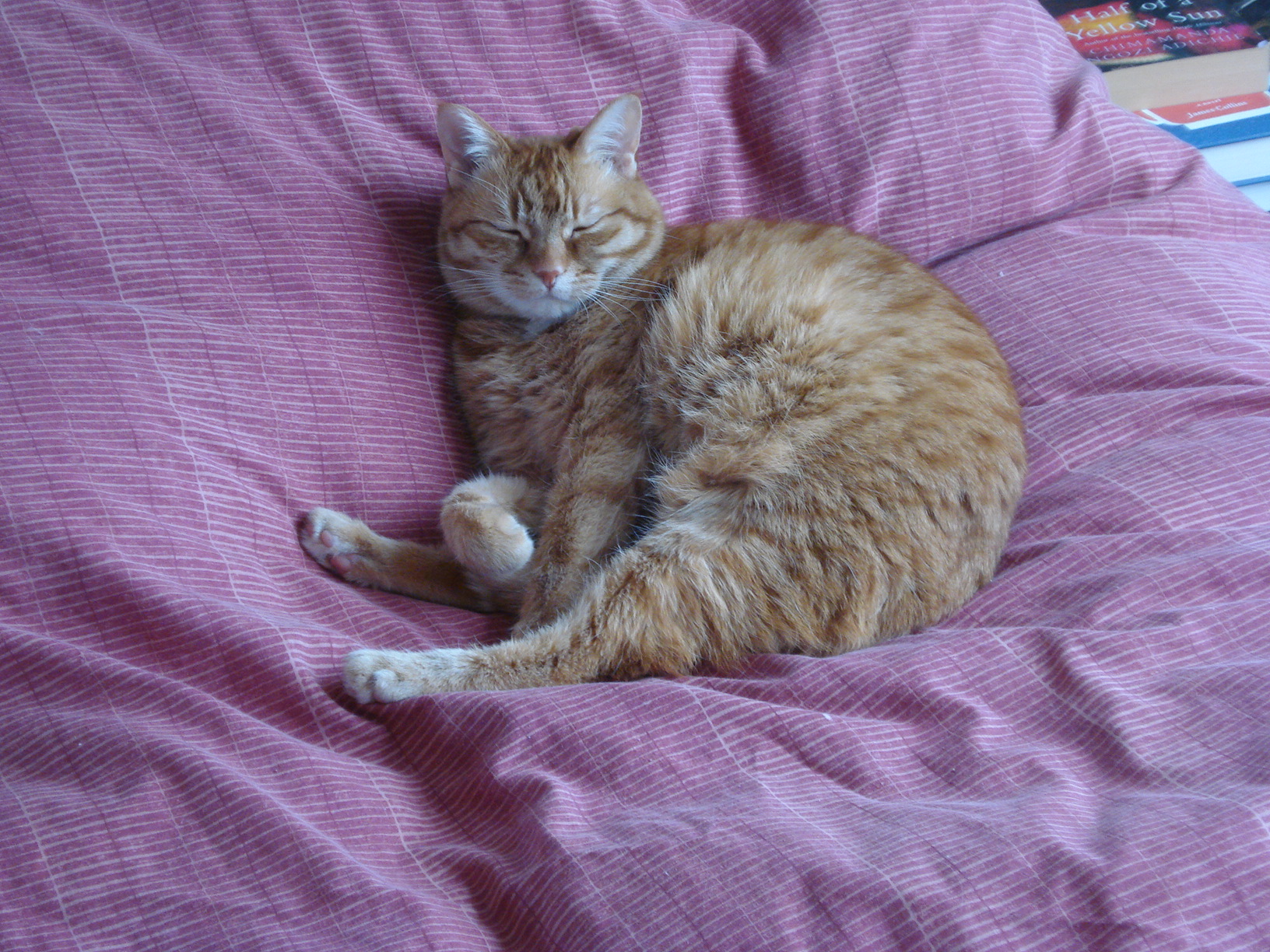
Serenity now!
[Aside: I’m waiting to hear what has happened to another documentary I was filmed for, and again spent ~2 days on, Channel 5’s “Nature Shock: Giraffe Feast” which should be airing soon… no word yet if I’ve made the final cut but the show’s airing has been delayed; hopefully not a bad sign. I am crossing my fingers… it seemed like a great show with a cool idea, and my segment raised some fun anatomical and biomechanical issues about giraffes.]
I know I’m not alone. I’m going to end my rant and see what feedback it draws.
But don’t get me wrong— it’s not all sour grapes, not by any means. I’ve still had eight-ish pretty good TV documentary experiences (cough, Dino Gangs, cough!). I’ve had great experiences working with documentaries; indeed, Inside Nature’s Giants was one of the best experiences of my career to date. And I’m sure many other scientists have had positive experiences. In answer to my provocative “Why bother?” in the headline, there are plenty of good reasons to bother working with documentaries if you are a scientist whose research they want to feature… but only if you have some assurance that it will be worth your while, perhaps? How much of a gamble should we be bothering with? That brings me to my main point, a general query–
But what about the bad? And is it all worth it, in your views, given the risks of wasting time? Do we deserve some scientists’ bill-of-media-rights or something; a documentary-actor-scientists’ guild (90% joking here)? What should our rights be and should we push harder for them? Or do we just sit back and take the good with the bad, biting our lips? (I’m obviously not the type…)
I’d like to hear from not only the seasoned veterans who’ve experienced various ups and downs, but also from anyone that has views, anecdotes; whatever. I’m not aware of anyone collecting horror stories of documentary mishaps and mistreatments experienced by scientists, but that could start here. Please do share; even if you just got a call wondering if you’d want to help a documentary and then never heard back. Who knows where it would lead, but I think it’s helpful to bring these issues to the fore and discuss them openly.


 What's In John's Freezer?