This week was a great week for me and giant dinosaurs in many ways, so I’m sharing that experience via photos and a bit of backstory. I hope you like it.
Stomach-Churning Rating: 1/10. Big birds and bones but no barfing.
First, I attended the filming of a new documentary, “T. rex Autopsy” (due for release on 7 June on NatGeo TV, just in time to steal the thunder of get you excited for Jurassic World), on the edge of London. I’m allowed to post these two photos of it. Expect much, much more information later– and I think you will like that information when it comes! Not quite a 50′ tall bird, but… So. Damn. Cool.
Second, my team and I dissected a big animal I’ve mentioned here before. For various reasons, I won’t/can’t post images or details of it right now, but I hope to soon. It’s not a dinosaur, but it was giant as its kind goes, so I’m wedging it in here.
Third, and this is the main impetus for my post, I finally got to see the giant chicken! No, not this one that I recall from my childhood…
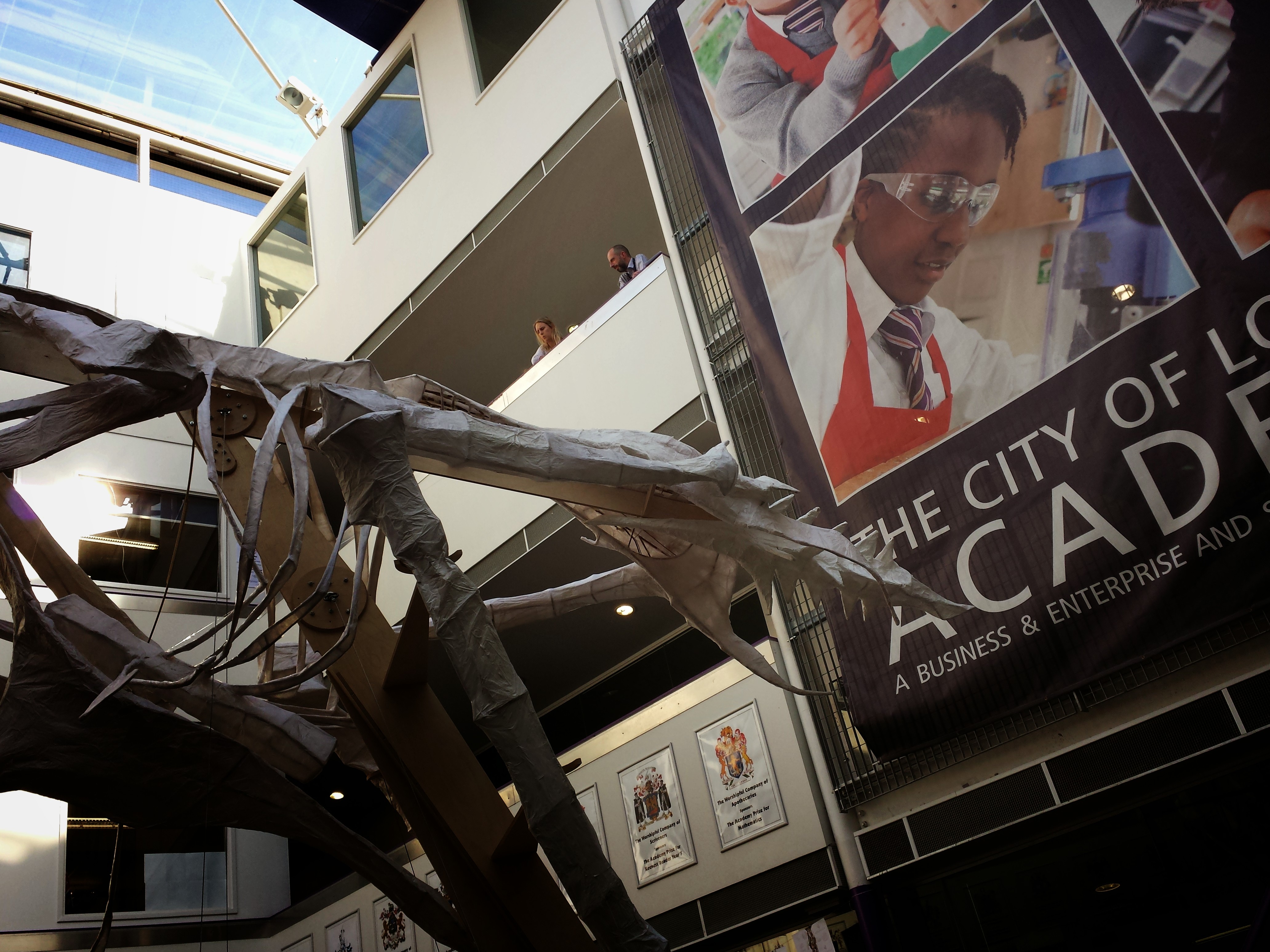
But this one! A 50’/13m tall chicken made by teacher Ben Frimet’s team of students and teachers at the City of London Academy!
Shortly after my first encounter. I’m still in a state of awed shock. And shadow.
The megachicken was unveiled at a “Chickenfest” event celebrating the sculpture’s completion. Chickenfest also prominently involved members of the “Chicken Coop” team who have drawn together scientists, humanities scholars, artists and more to investigate “Cultural & Scientific Perceptions of Human-Chicken Interactions” — more details here. Their theme helped unite the event’s various displays and lectures as well as some of the City of London Academy’s teaching topics, which inspired students to look at chickens from many angles. The event was so fun and truly integrative that it had me clucking with joy, but the anatomically accurate giant chicken art piece stole the show (as intended). Enjoy the photo tour below.
Pelvic/thigh region! (no patella, but hey)
Great views from up to 3 storeys around it.
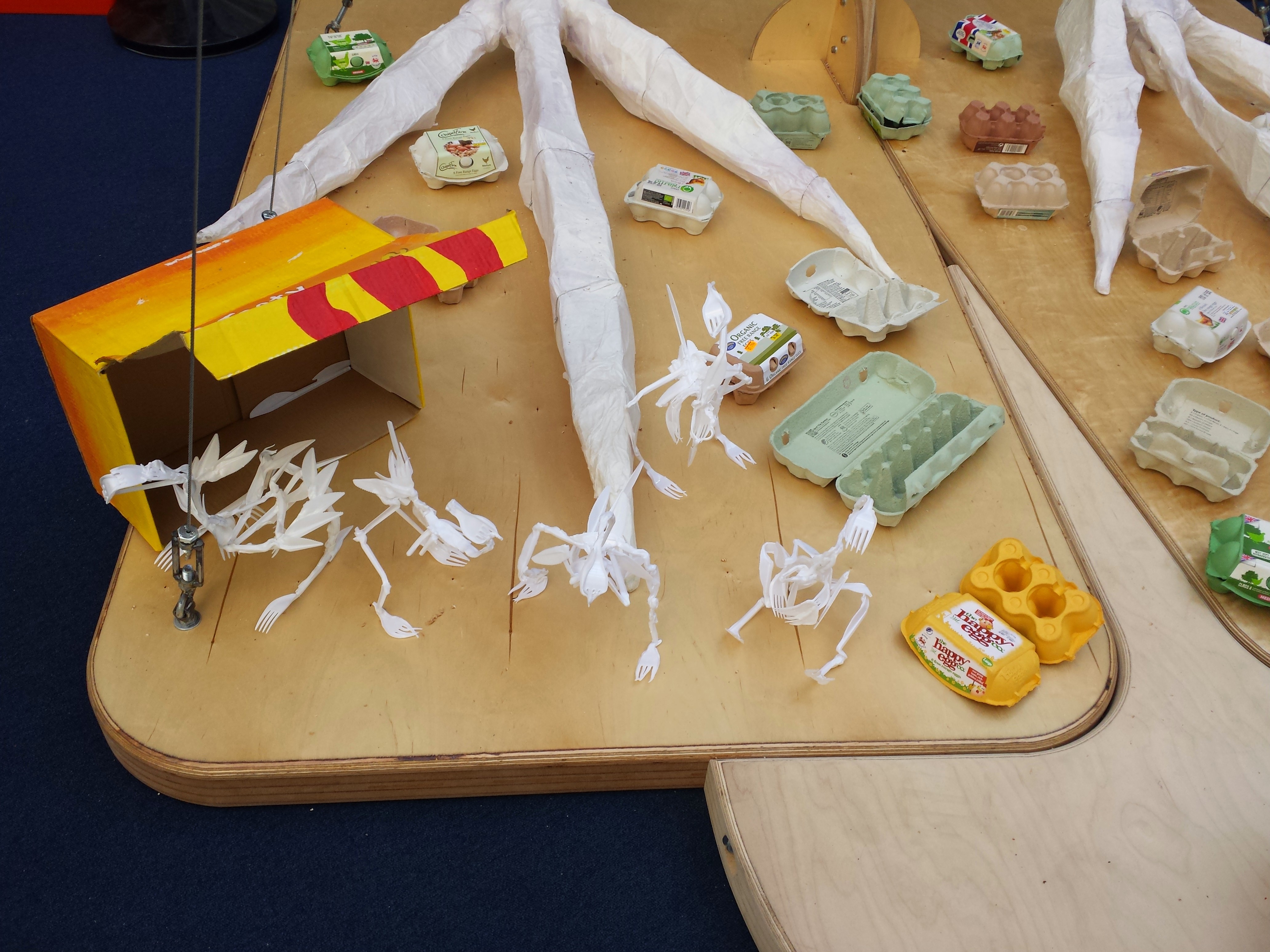
Little chickens made of fast-food forks and stuff. Very clever.
One of our research chickens, a 30-day-old broiler, skeletonized by the Chicken Coop team and brought to the event. Chunky and funky!
Our RVC chicken research team (postdocs/fellows Drs. Heather Paxton, Jeffery Rankin, Diego Pereira Neves) presented a stall with motion capture demos and chicken bones, like this fun identification display.
What will happen to that giant chicken art piece? This is yet to be determined, and was the question asked of the lecture panel (including me, who gave a lame answer involving King’s Cross’s birdcage). It was unanimous that it must not be destroyed– as long as it does not go on a destructive rampage through London…
One of my favourite films of my teenage years, Beastmaster, lends me a phrase I’ll throw out here like a razor-edged boomerang-thing: “Life is a circle. We will meet again.” And so, at the Chickenfest event, past and present worlds collided. I happened to be there presenting a talk just before Luis Rey. Almost exactly 13 years ago, Luis had done this classic T. rex vs. giant chicken race for my “T. rex was not a fast runner” paper in Nature. He likewise has blogged about the Chickenfest event, so check that out!
Coincidentally, there was ANOTHER 50′ tall bird placed not far from that giant chicken in southeast London this week, for a very different reason- a huge Norwegian Blue parrot in celebration of the Monty Python reunion! And I’ve been a Monty Python fan since age ~11, so that rocks my world two times over.
IMAGE: FLICKR USER TAYLOR HERRING
Two giant birds in London in one week. It doesn’t get any better than that– unless there were three such birds– if I missed one, chime in in the Comments!
When does a science story “end”? Never, probably. Science keeps voyaging on eternally in search of truth, and few if any stories in science truly “end”. But as science communicators of any stripe, we routinely have to make decisions about when a certain story has run its course; when the PR ship has sailed and the news cycle has ended. As scientists, we’re lucky if we have to consider this and should be grateful if and when our science even attracts media/science communication attention. But the point of today’s post; perhaps an obvious one but to my mind worthy of reflection on; is that scientists are not slaves to the PR machine– as a flip side to the previous self/science-promotion post, at some point we may have to say “This story about our research is done (for now).”
I routinely reflect on this when the media covers my research; I always have. My recent experience with New Yorker and BBC coverage of our penguin gait research (with James Proffitt and Emily Sparkes as well as Dr. Julia Clarke) got me thinking about this issue a lot, and talking about it quite a bit with James. This morning, over coffee, this blog post was born from my thoughts on that experience.
Stomach-Churning Rating: 7/10 for some mushy penguin specimens; PR officers might also get queasy.
I was waiting for a call from BBC radio one night almost three weeks ago, to do a recorded interview about our penguin research-in-progress, when I woke up surrounded by paramedics and was whisked off to the hospital. I never did that interview or any further ones. I won’t go into what went wrong but it relates to this old story. I’m OK now anyway. But for me, the penguin story had mostly ended before it began. However, I’d already agreed with James that we’d try to avoid doing further media stories beyond the New Yorker one and the BBC one, which was due out the next day and for which James (fortuitously instead of me!) was doing a live appearance on BBC Breakfast (TV). I got a few emails and calls about this story while recuperating in my hospital bed, including the one below, and turned down interview invitations for obvious reasons, with no arguments from anyone– at first.
For Jerry, the story never should have started, apparently. We all have our opinions on what stories are worth covering. A “kind” email to receive in one’s hospital bed…
Then, after I recovered and got back to work, we kept getting a trickle of other interview/story invitations, and we declined them. Our PR office had suggested that we do a press release but we had already decided in advance not to, because we saw the story as just work-in-progress and I don’t like to do press releases about that kind of thing– except under extraordinary circumstances.
Finally, over a week after the BBC story aired, a major news agency wanted to film an interview with me about the story, which would get us (more) global coverage. They prefaced the invitation with the admission that they were latecomers to the story. Again I firmly said no; they could use existing footage but I could not do new interviews (these would inevitably take a half day or so of my time and energy). They wrote back saying they were going to go forward with the story anyway, and the journalist scolded me for not participating, saying that the story would have been so much better with a new film sequence of me in it. Maybe, but (1) I felt the story had run its course, (2) I’d had my hospitalization and a tragic death in the family, and (3) I was just returning, very jetlagged, from a short trip to the USA for other work. Enough already! I had other things to do. I didn’t follow up on what happened with that story. Maybe it didn’t even get published. I wasn’t left feeling very sympathetic.
Above: The BBC story
I kept thinking about being pressured and scolded by journalists, once in a while, for not joining in their news stories when they contradicted my own threshold for how much media coverage is enough. This reaching of a personal threshold had first happened to me 13 years ago when I published my first big paper, in Nature, on “Tyrannosaurus was not a fast runner.” After ~3 weeks of insane amounts of media coverage, I was exhausted and pulled the plug, refusing more interviews. It felt good to exert control over the process, and I learned a lot from learning to wield that control. I still use it routinely.
But… I am of course passionate about science communication, I feel it is a great thing for science to be in the public eye, and I actually love doing science communication stories about research-in-progress– too much science is shown as an endpoint, not a process. Indeed, that’s why I do this blog and other social media, most of which is science-in-progress and my thoughts about it. So I was and still am thrilled that we got such positive, broad, good quality media attention for our penguin work, but it was plenty.
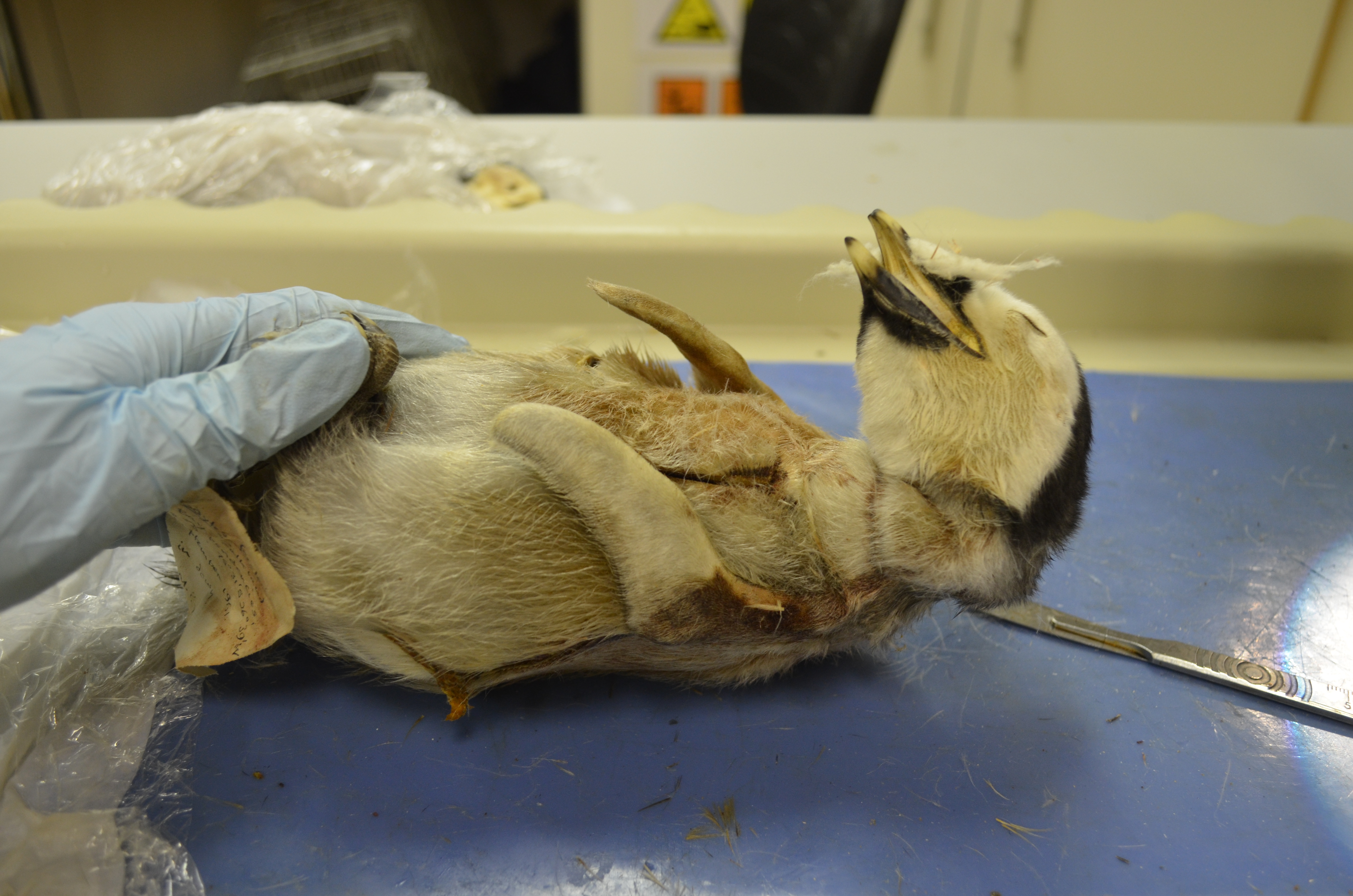
More sphenisciform science in progress: Penguin bodies awaiting dissection for our latest work. Unfortunately, years of formalin, freezers and thawing cycles had rendered most of the soft tissues useless for our work. Photos here and below are of Natural History Museum (Tring) specimens from the ornithology collection; most collected in Antarctica ~50 yrs ago.
Probably to many seasoned science communicators and scientists, my post’s message is blindingly obvious. Of course, scientists have rights — and responsbilities– in deciding how and when their research is covered. This is a negotiation process between their research team, their university, PR officers, journalists/media, funders and others involved– including the public. But less experienced scientists, and perhaps the public, might not realize how much control scientists do have over the amount of media attention they get. It’s easy to get caught up in a media frenzy surrounding one’s science (if you’re lucky enough to generate it at all) and feel the wind in one’s sails, thereby forgetting that you’re at the helm– you can decide when the journey is over (just be sure you communicate it diplomatically with others involved!).
This penguin did not survive the preservation process well; for whatever reason it had turned to mush, fit only for skeletonization. Gag. Its journey was definitely over.
As scientists, we have to balance enormous pressures and priorities: not just science communication and PR, but also our current main research, teaching, admin, personal lives, health, and so on. So we have to make hard decisions about how to balance these things. We should all reflect on what our dynamically shifting thresholds are for how much attention is enough, what priority level a given story has in our lives, and when the timing is right for any media attention. And as collaborative teams; more and more the norm in science; we should be discussing this issue and agreeing on it before it’s too late for us to exert much control.
One of our penguin chicks from the Natural History Museum, in a better state of preservation than the adults. Photo by James Proffitt.
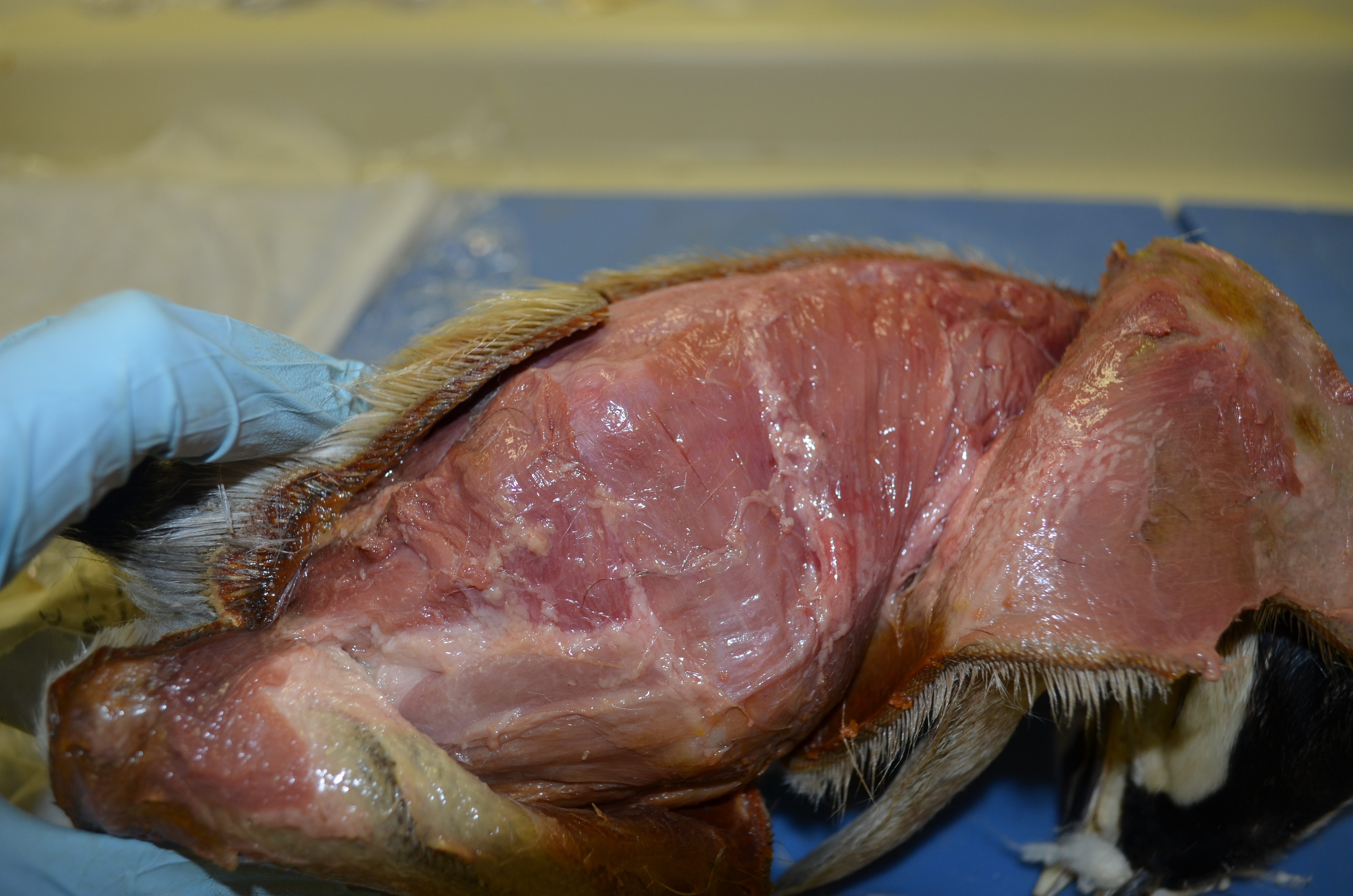
Penguin chick’s right leg musculature in side view, exposing some decent muscles that gave us some useful data. Photo by James Proffitt.
Much like an over-played hit song, it’s not pretty when a science story gets over-milked and becomes too familiar and tedious, perhaps drawing attention away from other science that deserves attention. And we all will have our opinions on where that threshold of “too much attention” is. If we, as scientists, don’t think about those thresholds, we may end up rudderless or even wrecked on lonely islands of hype. I’ve seen scientists ostracized by their peers for over-hyping their work. It’s not fun. “Hey everybody, John is having a celery stick with peanut butter on it!” Celebrity culture doesn’t mean that everything scientists do deserves attention, and any amount of attention is deserved and good.
A great thing about science is that, in principle, it is eternal– a good science story can live forever while other science is built upon it. Each chapter in that story needs an ending, but there’s always the next chapter waiting for us, and that’s what keeps science vital and riveting. As scientists, we’re all authors of that story, with a lot of power over its narrative. We can decide when to save parts of that narrative for later, when the time is right. With our penguin story, we’ve only just begun and I’m incredibly excited about where it goes next.
How about other scientists, journalists and other afficionados of science? What examples of scientists taking charge of how their research gets covered do you find particularly instructive?







 What's In John's Freezer?