In early 2011, I got a fun email from a producer at National Geographic TV about a new project they were planning, which involved dissecting a full-scale model of a Tyrannosaurus rex in a documentary to be called “T. rex Autopsy.” Things fell silent for some months, then I got another email saying they were moving forward, then things fell silent again. Three and a half years later I got another email, this time from a producer at Impossible Factual films (working with NatGeo), saying that the show was finally moving forward for real. (This sort of thing is normal for documentaries; time scales can be long and unpredictable, or very fast-paced) This email invited me to be a primary scientific consultant in the design of the creature and show. Of course, anatomical dissection and T. rex are what I’m about as a scientist; two of my major research areas; so bringing them together was like a dream come true and I leapt into that dream with enthusiasm.
(Meanwhile, circa 2010-11, another TV channel filmed me for a different programme in which a whole, fresh-ish T. rex was found weathering out of an Alaskan cliffside and scientists had ~2 days to study it before it fell into an abyss– it’s probably best that that show never happened… there were fundamental flaws.)
Stomach-Churning Rating: 0/10. Merciful. No gory images here, just text descriptions and 2 glamour shots, for various reasons. The TV show is not for small children, though. I am guessing that the final programme will be about a 7/10 SCR because of gooey, seemingly rancid, but rubbery (so it doesn’t look overly real, but still looks great) dinosaur vital organs. For more pictures, see the links to tweets, trailers and news stories below.
I introduced T. rex Autopsy to you in the previous post, I’ve been tweeting and retweeting extensively since then, and one of my later posts will be a “postmortem” of the show, which airs June 7 worldwide. My feeling is that, if what I’ve seen so far is indicative of the whole show, it will be a landmark moment in palaeontological documentary history. T. rex Autopsy fuses the best aspects of “Inside Nature’s Giants” with “Walking With Dinosaurs”, and without “Alien Autopsy” pseudoscience. Indeed, it seems to be a very science-based documentary (once you get past the requisite conceit that scientists could actually find a very fresh T. rex body– that’s the only sci-fi bit of the show, quickly dispensed with!). T. rex Autopsy is packed with evidence-based palaeobiology, and has consistently been so since I first spoke to producers, which was a great comfort to me.
This post is about my role in the show, my perspective on it, and an attempt at a spoiler-free prelude. I’m willing to go out on a limb a bit and urge people to watch it, because I’m already proud of what was attempted in the show– it was a bold vision by NatGeo and laborious execution by everyone involved. I especially want to give a big shout of respect out to creature designers Crawley Creatures (led by Jez Gibson-Harris [interview here], who helped create Jabba the Hutt and the Dark Crystal beings, among others). Around 14 people on Jez’s team worked full time for ~4 months to make the T. rex. The designers based the proportions on the Field Museum’s scans of “Sue”, which I helped them get access to (I’d used them for our PLOS ONE paper in 2011). That, and numerous comments on their draft dinosaur’s body proportions and limb positions (e.g. avoiding “bunny hands“), was some of my first major involvement in the programme.
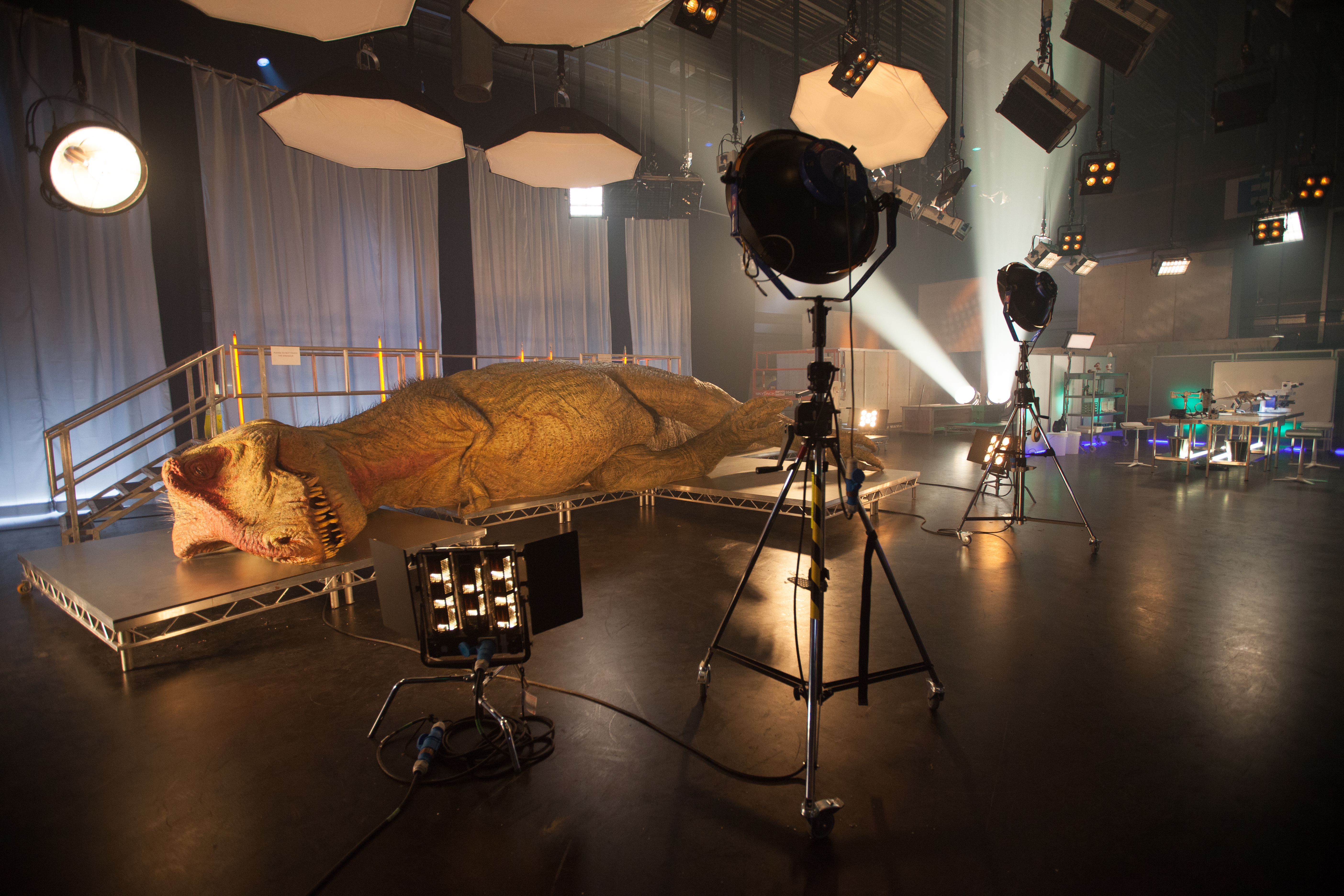
Edwina revealed! (photo credit: National Geographic Channels/Stuart Freedman)
Over 200 emails (I was curious; I counted them!) and a bunch of phone calls and 7 months later, my input on the T. rex Autopsy film shoot and production was finishing. Just last week, I sent what supposedly was my last email of input on the show, about predatory habits (NOT the dumb scavenger debate we’re all tired of; more about ambush vs. pursuit habits). I’d spent many hours going over drafts of T. rex‘s anatomy and function and behaviour from head to tail with the superb Impossible Factual film production team (mainly Assistant Producer Cressida Kinnear). Very often, to their credit, they’d already done a lot of literature searching and speaking with key experts on dinosaur jaws or brains or breathing, so I just had to check the fine details, but in some cases I had to recommend experts to speak to and/or do my own sleuthing and educate myself about aspects of T. rex biology I’d never pondered much.
For example, how big was T. rex‘s heart? I’d been asked the same question about sauropods lately for another show so I had references and an Excel spreadsheet ready to go, and plugged in some values, but the estimates I got seemed too small relative to the thoracic cavity (mediastinum if you must). I had some interesting back-and-forth discussions with the producers and we settled on one size that seemed “right”. No one that I knew of had tried to scientifically estimate the size of a T. rex‘s heart, probably because there hadn’t been a good reason to try. Sauropods get all the dino-love in regards to blood pressure issues and heart size, for good reasons- for them, it should have been a serious biomechanical challenge to pump blood up the long neck to the brain. For an elephant-sized T. rex, it doesn’t boggle the scientific mind so much that blood pressure wasn’t such a major evolutionary design constraint. See the show and find out more about what the intrepid team of dissectors found…
Did T. rex have feathers? This was important to get right, I felt, and not just show T. rex as a leathery or scaly beast, which is outdated. As I put it, it’s more speculative to show T. rex without any feathery thingies than to show it with some. We passed around draft images and thoughts and agreed on a slightly fuzzy, bristly body, especially in some regions of the head/neck, arms and tail tip. I encouraged the design team to go for more colour (I wrote to the designers “Skin colouring: go nuts! Feathery things should be colourful. Big animals tend to be more drab in colour but that doesn’t mean a boring grey/green, and certainly there should be some regional patterning. I like the idea of there being brightly coloured areas on the face”). We can be confident that dinosaurs could see colour like most land animals (except many mammals!) can. All of this is pretty familiar to palaeo-artists and fans of modern dinosaur reconstructions, so I won’t belabour it more. I’m glad that much of this made it into the final design. It’s not your overly familiar Jurassic Park T. rex.
Cheeks, eye pupils, brain/senses, how big a mouthful of meat it could swallow, furcula (wishbone), gastralia (belly ribs- I gave a lot of detailed criticism here), reproductive anatomy and biology, eggs, body fat, growth, air sacs, stomach, and excretory system, among other things: we covered them all in discussing the dino’s design, and I learned a lot along the way.
A memorable part of my discussions with the designers, in early March, was about the intestines and cloaca (rear-end opening): they initially put the cloaca too far forward on the body, I got them to move it backward, then I later realized in a panic that, making a neophyte error, I’d missed a key anatomical feature in the hips that clearly would put the “vent” even further backward, so I send them a hasty email apologizing that I’d missed this and urging that they fix their graphics and animations. I felt bad about this as it was late in the design phase and I’m sure I stressed out the team to make this change, but I thought it would be embarrassing to get the position of that hole wrong. Yet it was also funny to me to be scrutinizing where the “poop hole” of a dinosaur should go, and worrying so much about getting it right… my scatological sense of humour was in overdrive. By the middle of March they had this detail right. Phew!
There is another dinosaur that makes an appearance in the documentary but I don’t want to spoil it. Suffice it to say that one dinosaur from another time period and continent was initially chosen, and I (echoed by Dave Hone, I know) urged them not to do that, choosing a more appropriate Hell Creek Formation dinosaur. Phew! Perhaps more about that later.
Finally, of course we talked about legs and muscles and locomotion. I was filmed at the RVC discussing this, and it looks like it will be a cool segment, including an explanation of how the bones reveal the anatomy of the soft tissues of limbs and other parts of the body (i.e. bread-and-butter from my PhD thesis work). I hope that makes the final cut! (Edit: I’m told it has; yay!) There may even be footage of me dissecting a chicken and talking about enlarged and reduced leg muscles in birds, in any “making of” side-programme.
But I was not one of the four people doing the T. rex dissections in the show. That arduous job (2 looooooong days of filming!) fell to vet Luke Gamble and palaeontologists Tori Herridge, Steve Brusatte and Matthew Mossbrucker, with a crew of assistants including some from Crawley Creatures. The clever idea the producers had, as they explained it to me, was to keep my and others’ scientific input on the show’s design separate from the dissectors’ knowledge, so that when the dissection team arrived and cut into the dinosaur, they’d be discovering things without much advance inside knowledge of what to expect to find. We’ll see how that worked when the programme airs– I’ve only seen the trailer and behind-the-scenes footage, as well as the first day of filming. Scientists like me aren’t Shakespearean actors so it’s hard to act surprised when you sort of know what’s coming and have to redo takes of that same surprise. But if you come to T. rex Autopsy expecting Oscar-worthy theatrics, you’ve missed the point. 🙂
A taxi drove me to Pinewood Studios (west of London; site of filming many blockbusters) on a Sunday morning in late April. I walked into the giant studio where a 12+ meter long T. rex carcass lay in dramatic lighting. Cue the freezing of my giant grin in place and my eyes wide open. I was stunned! It was gorgeous, and the scale of the carcass left me gobsmacked. I’d only seen various incarnations of it during the design phase, from wire mesh scale models to clay sculptures to full-on foam casts and CGI representations; and all of these just as digital files emailed to me. But to see “Edwina,” as she was called, in the pseudo-flesh, was a moment I may never forget. Emailed JPGs definitely didn’t prepare me for that visual splendour. Crawley’s team were still inserting some of the last ~20,000 goose feathers as bristles into the hide, one by one…
I was at Pinewood to spend a day hobnobbing with VIPs and international press visitors as a “tour guide” to the Edwina autopsy event, and then for a day to watch the initial half of filming with the press in a room overlooking the studio. I got excellent hospitality, was called the “on-screen talent” in documents, which felt really weird to me (I’d never been called that in >10 shows before), and I spent a lot of time explaining the show and dinosaur science to that receptive, inquisitive audience. And gawking at the unfolding spectacle before and during filming. And cracking jokes with journalists during long breaks between actual filming of the documentary. It was a surreal, awesome experience and I loved it. (And, as I’ve insisted scientists in documentaries are, I got paid for it.)
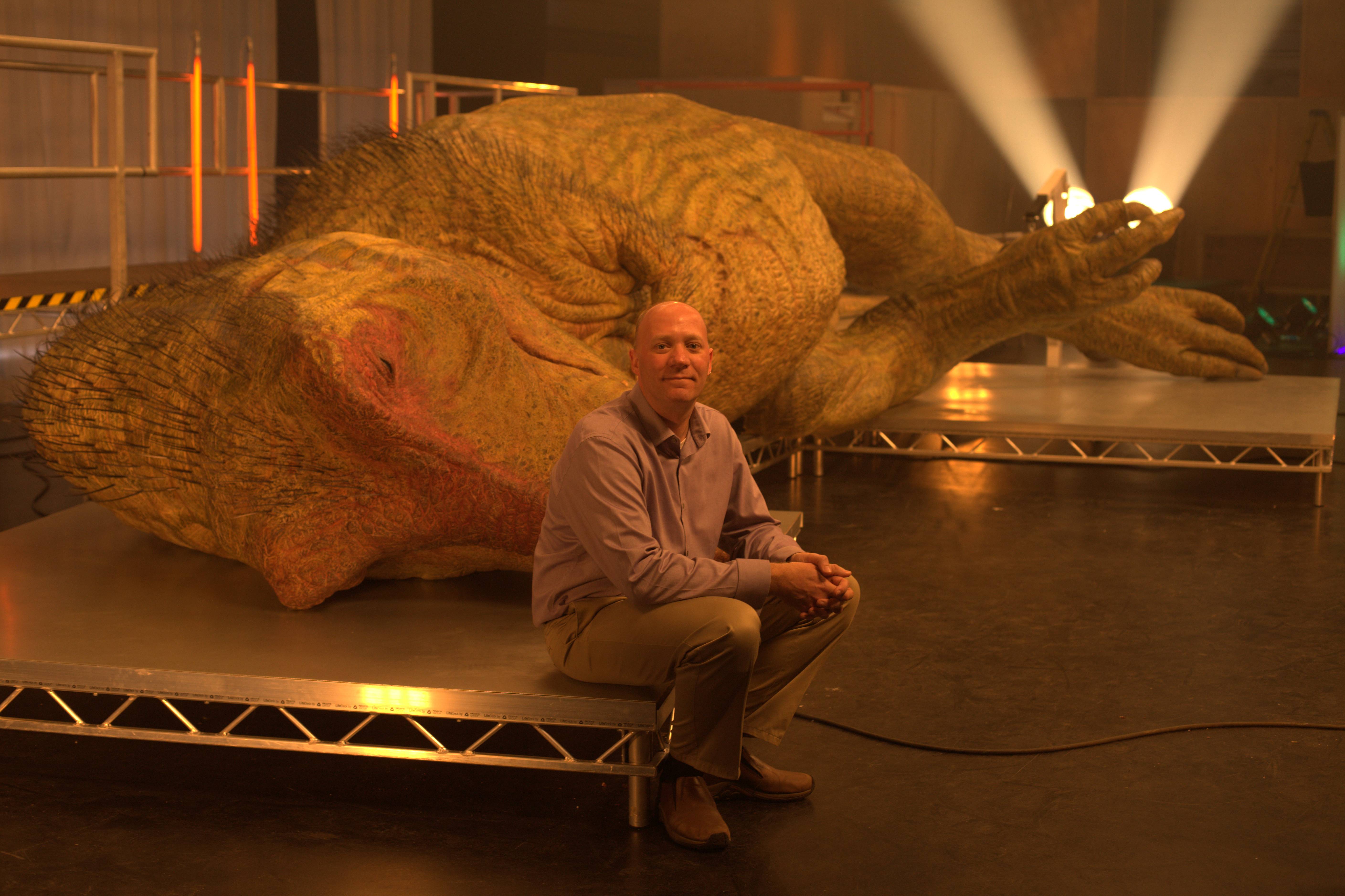
A few minutes after I met Edwina. Still in awe.
This documentary was a blast to be involved in and challenged all my skills as a dinosaur expert and biologist as well as a fan of documentaries, monster movies and anatomical artistry! I give a big hat-tip to NatGeo for taking the plunge on this adventure in the first place, to the amazing creature creators, to the film and production crew, to the many jovial journalists I met, and to the four faux-bloodied, surely exhausted dissectors starring in the show– and to Edwina. This was an impressive collaboration drawing together the best that the media, monster-makers and an international team of scientists (aside from the ones I’ve mentioned already, many others too!) can do together. I feel lucky to have been involved, and I think I’ll be looking back on this event as a highlight of my career, especially as a science communicator; much like consulting on Inside Nature’s Giants is a highlight.
I’m as excited as anyone to see how it turns out. Just 2.5 weeks to go — are you excited too? What would you want to see in a T. rex dissection? Where would your first cut be if you did the dissection? “Jurassic World”, what’s that?
EDIT: The first 5 minutes of the show are here! https://www.yahoo.com/tv/t-rex-autopsy-watch-the-first-5-minutes-who-119918868060.html

 What's In John's Freezer?